
Yes, you can get a business loan as a 1099 independent contractor. No lender requires a W-2. What they require is proof that your business earns steady money and can repay what it borrows. Banks and SBA lenders want that proof in tax returns and a track record, usually two years of it. Online and alternative lenders lean more on bank deposits and recent revenue, which is why contractors who are turned down at a bank often qualify elsewhere.
This guide covers what lenders look at, which documents carry the most weight, how to strengthen a file before you apply, and what to do if you don’t fit a conventional box.
Not as a formal product. “1099” describes how you are paid, not a loan category. The IRS describes Form 1099-NEC as an information return for freelance and independent contractor work, which means it is a record of income that clients report. To a lender, it is one piece of evidence among several.
That matters because the search results for this phrase are crowded with mortgage pages. Mortgage underwriting for 1099 earners is a different process with its own rules. This guide is about business financing: working capital, lines of credit, equipment, and SBA loans for your contracting business.
Lenders differ on thresholds, but nearly all of them test the same five things.
Banks and SBA-backed lenders generally prefer a multi-year history, often two years of filed returns. Online lenders are usually more flexible and may look at a shorter track record if deposits are strong. Exact minimums vary by lender and product, so treat any number you see online as a typical range, not a rule.
For SBA lending, the rules are written down. The SBA says eligible 7(a) businesses must operate for profit in the U.S., be small, and be unable to obtain the credit on reasonable terms elsewhere. A sole proprietor filing Schedule C can be a for-profit business. You don’t have to be incorporated, though an LLC or EIN helps keep business and personal finances apart.
The same SBA page says lenders may consider credit scores or credit history of applicants, associates and guarantors, plus cash flow, equity or collateral. The federal regulation behind the program says applicants must demonstrate a need for credit, and lenders assess creditworthiness and repayment. Personal credit usually matters a lot for a sole proprietor, because you and the business are the same borrower in practice. Our guide to business loan credit score requirements shows how scores affect the options in front of you.
This is where 1099 contractors win or lose. Lenders want to see that money comes in regularly and in amounts that cover a new payment. We go deeper in what lenders look for in cash flow loans.
Lenders want to know what the money does. Funding a new truck that lets you take more jobs is easier to underwrite than a vague request. FDIC guidance lists documents explaining the loan purpose as a normal part of a loan package. See what lenders typically fund for common uses.
The FDIC teaches the Five Cs of credit: character, capacity, capital, collateral and conditions. Here is how each plays out for a contractor.
| Five C | What the lender asks | What a 1099 contractor can show |
|---|---|---|
| Character | Do you pay what you owe? | Credit reports, history with vendors, years in your trade |
| Capacity | Can the business repay? | Bank deposits, tax returns, 1099s, contracts |
| Capital | What have you put in? | Business savings, equipment owned, retained earnings |
| Collateral | What backs the loan? | Equipment, vehicles, receivables, if offered |
| Conditions | What is the loan for, and what is the climate? | A clear purpose, steady client demand |
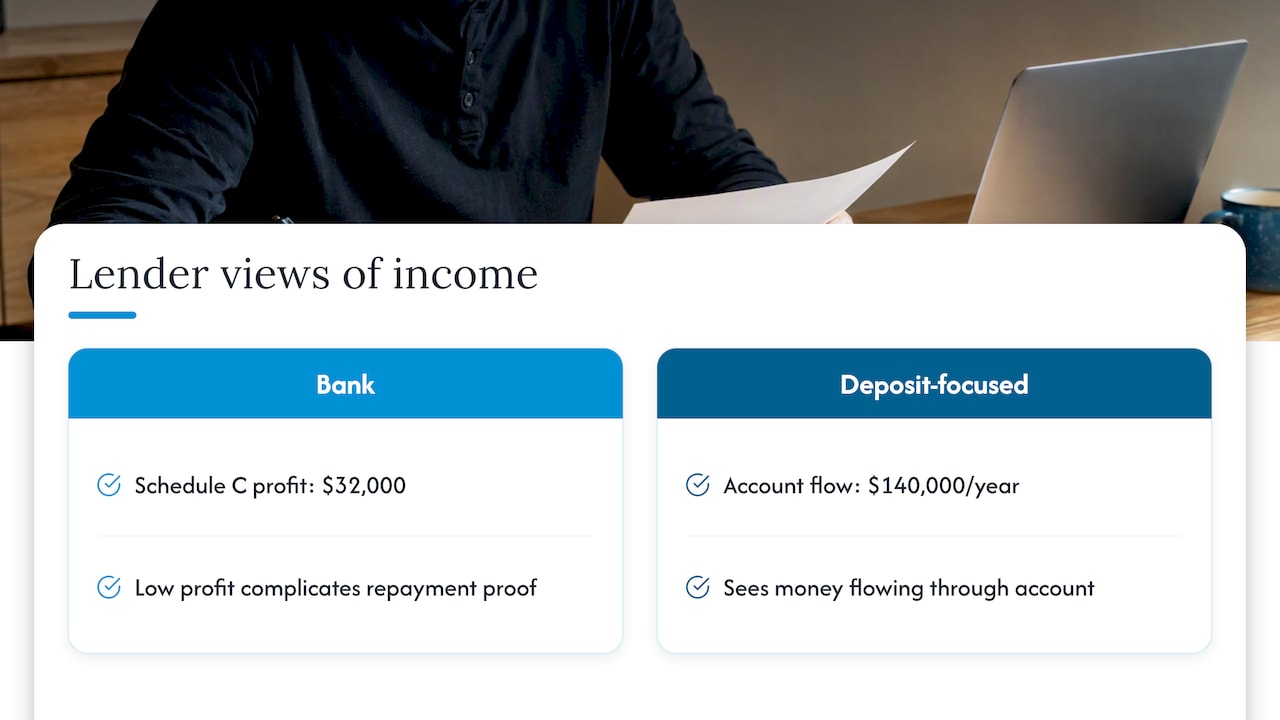
Contractors write off legitimate expenses, which lowers taxable income. That is good at tax time and awkward at underwriting time. The FDIC cautions that little or no reported net profit can make repayment capacity harder to demonstrate, although lenders may add back some noncash expenses such as depreciation.
A simple example: you invoice $140,000 in a year, but after vehicle costs, tools and a home office your Schedule C shows $32,000 of profit. A bank sees $32,000. A lender focused on deposits sees $140,000 flowing through your account. Neither view is wrong, which is why the type of lender matters as much as your numbers.
If one client is 90% of your 1099 income, a lender may worry about what happens if that client leaves. That is a judgment call by each lender, not a published rule, but it is worth addressing with a contract or engagement letter that shows the work continues.
The IRS recommends keeping business books such as journals and ledgers, plus supporting documents like invoices, receipts, deposit slips, canceled checks, Forms 1099-MISC and credit-card statements. Those same records are what a lender wants. According to the FDIC, a typical loan package often includes a loan application, business plan, financial statements, business and possibly personal tax returns, and credit reports.
For a 1099 contractor, build a folder with:
The FDIC notes that separating business and personal transactions improves recordkeeping and tax reporting, and orderly records help lenders assess repayment. If your business income lands in a personal checking account alongside groceries and rent, a lender has to guess which deposits count. A dedicated business account fixes that within a month or two.
If you manage subcontractors or installers, tools such as contractor compliance software can also make job records, payments and paperwork easier for a lender to follow.
We are a marketplace, not a direct lender. We connect small and medium-sized businesses with a network of banks and alternative lenders, and we have funded over $120M for clients. The pattern we see most with contractors is a mismatch, not a bad business. A contractor with healthy deposits applies to a lender that only reads tax returns, gets declined, and concludes that no one will lend to a 1099 earner.

That conclusion is usually wrong. The fix is matching the file to the lender. If your deductions are heavy, lead with bank activity and ask for lenders that underwrite on cash flow. If you have two clean years of returns and a good score, an SBA loan may give you the lowest cost. Our advice is to know which story your numbers tell before you submit anything.
Also keep your own credit in mind. Every hard inquiry is a cost, and applying to five lenders one after another is how good files get worse. That is a big reason we built a one-page application that doesn’t affect your credit score at the first step.
— Rob
The FDIC’s advice for small business borrowers is practical: prepare a business plan, show proposed earnings, keep good business and personal credit, check your credit reports for errors, and comparison-shop for government-guaranteed loans. Here is how that translates for a contractor.
For a deeper look at the lender’s side, read how lenders evaluate business health and the business loan approval factors we have written up.
Missing a bank’s requirements doesn’t end the search. The FDIC points to SBA 7(a) loans for working capital, refinancing business debt, buying real estate, and furniture, fixtures and supplies, and SBA Microloans of up to $50,000 through designated nonprofit intermediaries.
| Option | Best for | Typical lender focus |
|---|---|---|
| SBA 7(a) or Express | Contractors with 2+ years of returns and decent credit | Returns, credit, repayment ability |
| SBA Microloan | Small amounts, newer businesses | Business plan, character, nonprofit intermediary review |
| Business line of credit | Uneven income, late-paying clients | Deposits and credit |
| Working capital financing | Fast needs: materials, payroll, a big job | Recent revenue and cash flow |
| Unsecured business loan | No collateral to pledge | Cash flow and credit |
To compare the SBA routes, see our pages on SBA loan requirements and SBA Express versus 7(a). If you have no collateral, how unsecured approval works and the role of cash flow in unsecured loans explain what replaces it. Newer contractors can read how lenders assess startup repayment ability.
SBA lenders must also show that the credit is unavailable on reasonable terms from non-federal, non-state and non-local government sources. In plain terms, SBA backing is meant for borrowers who wouldn’t get comparable terms elsewhere. Many contractors with thin returns fit that, but your lender makes the call.
We don’t lend directly. You complete one short application, and we match your business with banks and alternative lenders in our network. Our approach is built for owners who get overlooked by conventional banks: the first step doesn’t affect your credit score, no collateral is required for the products we feature, and approvals can come within 24 hours. We hold an A+ rating with the BBB, and an advisor walks you through the offers instead of leaving you to decode them alone.
The products we offer include:
These are the rates published on our site, and the rate you are offered depends on the lender and your qualifications.
If you’d like to see what your 1099 income can qualify for, start your application at Fordham Capital. It takes one page.
Yes. Lenders look at your business income, credit and cash flow, not whether you receive a W-2. Expect to provide bank statements, 1099s and tax returns. Alternative lenders are often more flexible than banks about how that income is documented.
It depends on the lender you choose. Banks and SBA lenders can be hard to satisfy if deductions leave low taxable income or your history is short. Cash-flow-based lenders look at deposits instead, which often makes approval more realistic for contractors with strong revenue.
The core set is business bank statements, Forms 1099-NEC, tax returns with Schedule C, a profit and loss statement, and ID. Contracts with clients and details about the loan purpose strengthen the file. Lenders may ask for more depending on the product.
Not always. Some SBA and bank loans ask for collateral when it is available, while many unsecured and working capital products lean on cash flow and credit instead. Ask each lender what it requires before you accept an offer.
It can, if the lender runs a hard inquiry. That is why it helps to use an application that reaches several lenders at once and doesn’t affect your score at the first step, rather than applying one at a time.
At Fordham Capital, we've made the application process straightforward and reassuring. Dive in and explore your financial options with confidence, knowing there's no impact on your credit score and no obligations. We review your details and offer customized solutions based on what you're looking for.