
You meet SBA loan requirements if your business is for-profit, operates primarily in the United States, qualifies as “small” under SBA size standards, shows real repayment ability, and can prove you couldn’t get comparable credit elsewhere. That last part, the credit-elsewhere rule, trips up more applicants than any credit score ever will.
Three programs cover almost every scenario. The 7(a) loan handles general-purpose financing up to $5 million: working capital, equipment, acquisitions, refinancing. The 504 (CDC) loan is built for long-term, fixed-rate financing on real estate and major equipment. The Microloan program delivers up to $50,000 through nonprofit intermediaries, ideal for very small or early-stage operations.
One more thing changes the game for 2026 applicants: the SBA discontinued its SBSS credit score effective March 1, 2026. Lenders now run their own underwriting models instead of leaning on that single number, which means your financial documentation matters more than it did a year ago.
TL;DR:
- Lenders now rely on their own underwriting models after the SBSS score ended in March 2026, increasing the importance of accurate financial documentation.
- Establishing your business as meeting SBA size standards and proving you cannot obtain credit elsewhere are critical to approval success.
- A well-prepared application packet with tax returns, bank statements, and Form 1919 can significantly accelerate the loan process and reduce delays.
- The Microloan program offers up to $50,000 via nonprofit lenders, ideal for startups with limited credit history, while 7(a) covers general-purpose funding.
- Using a marketplace like Fordham Capital can streamline lender matching, avoiding multiple credit pulls and fitting borrowers with unique or thin credit profiles.
Picking the right program before you apply saves weeks. Each one serves a different financial need, and matching your ask to the wrong program is one of the fastest ways to get rejected before underwriting even starts.
The 7(a) loan is the workhorse. It tops out at $5 million and covers working capital, inventory, debt refinancing, business acquisitions, and equipment. If you’re not sure which program fits, 7(a) is usually the right starting question to ask a lender.
The 504/CDC loan exists for one purpose: long-term, fixed-rate financing on real estate or heavy equipment tied to job creation or public policy goals. It’s structured through a Certified Development Company alongside a bank, and it’s the better fit if you’re buying a building rather than covering payroll gaps.
The Microloan program caps out at $50,000 and runs through nonprofit intermediary lenders rather than banks. It fits startups, very small businesses, and borrowers who need a smaller amount with more flexible underwriting than a bank typically offers.
Before you touch a document checklist, confirm you clear these baseline thresholds. Lenders and the SBA apply these regardless of which program you choose.
Even a spotty personal credit history doesn’t automatically disqualify you. SBA and lenders weigh business purpose, industry stability, and repayment capacity together rather than screening on one number alone.
Assembling a complete packet up front is the single biggest lever you have over your own timeline. Lenders don’t reject strong businesses. They stall weak paperwork.
Pro Tip: Build your packet in the order a lender reads it: financials first, then legal documents, then supporting narrative. A well-sequenced file signals you understand your own business, which underwriters notice.
Lenders confirm two months of commercial bank activity as a baseline check on your stated cash flow, and skipping this step is one of the most common reasons a file bounces back for revisions.

Any owner with 20% or greater equity in the business must sign an unconditional personal guaranty. This isn’t negotiable, and it applies regardless of loan size or program.
Collateral works differently depending on how much you’re borrowing. Loans of $50,000 or less generally don’t require the same collateral documentation as larger amounts, since the SBA treats these as lower-risk transactions where cash flow analysis carries more weight than asset backing. For larger loans, lenders follow their own collateral policy within SBA guidelines, and a shortfall in hard collateral doesn’t automatically kill your application.
Pro Tip: If your collateral looks thin, lead with your cash flow story instead of trying to hide the gap. Lenders would rather see you address it directly than discover it during underwriting.
The SBA officially discontinued its Small Business Scoring Service (SBSS) effective March 1, 2026, a policy shift that hands more underwriting discretion back to individual lenders. For years, that single SBSS number acted as a quick pass/fail filter. Now lenders must apply the same “prudent, generally accepted” credit analysis process they use on their conventional, non-SBA loans.
Lenders may use their own proprietary scoring models when their federal regulator permits it, but they must document those results directly in the credit memorandum, which pushes underwriting toward a more model-driven, paper-heavy process than before.
What lenders now scrutinize more closely:
If you’re applying after March 2026, treat your financial statements like the main event, not supporting material. Clean numbers do more work now than they did under the old scoring system.
Knowing the numeric ceilings before you apply keeps your expectations grounded and helps you plan around fees rather than get surprised by them.
These figures come directly from SBA’s 7(a) loan program page, and lenders cannot exceed them regardless of your risk profile. Repayment terms typically run up to 10 years for working capital and equipment, and up to 25 years for real estate. Borrowers generally pay an upfront guaranty fee plus an ongoing servicing fee, both built into your loan structure rather than billed separately.
Fordham Capital holds an A+ BBB rating and has funded more than $120 million, helping clients generate over $500 million in revenue. That track record comes from doing one thing well: connecting small business owners to a wide network of banks and alternative lenders through a single, simple application.
Fordham Capital’s one-page application replaces the redundant paperwork you’d otherwise submit to multiple lenders separately, and matching typically moves faster than shopping banks one at a time. It’s a practical option if you’re working against a deadline or carry credit that’s less than pristine but your business fundamentals are sound.
Pro Tip: Fordham Capital operates as a marketplace, not a direct lender. You’ll work with a third-party bank or lender for final funding, so keep your documentation ready the moment a match comes through.
Most SBA guides treat the credit-elsewhere rule as a formality. It isn’t. It’s the single most misunderstood requirement on this list, and lenders document it in their own credit memo whether or not you ever think about it directly. The applicants who get approved fastest aren’t the ones with flawless credit. They’re the ones whose bank statements and projections tell a consistent story.
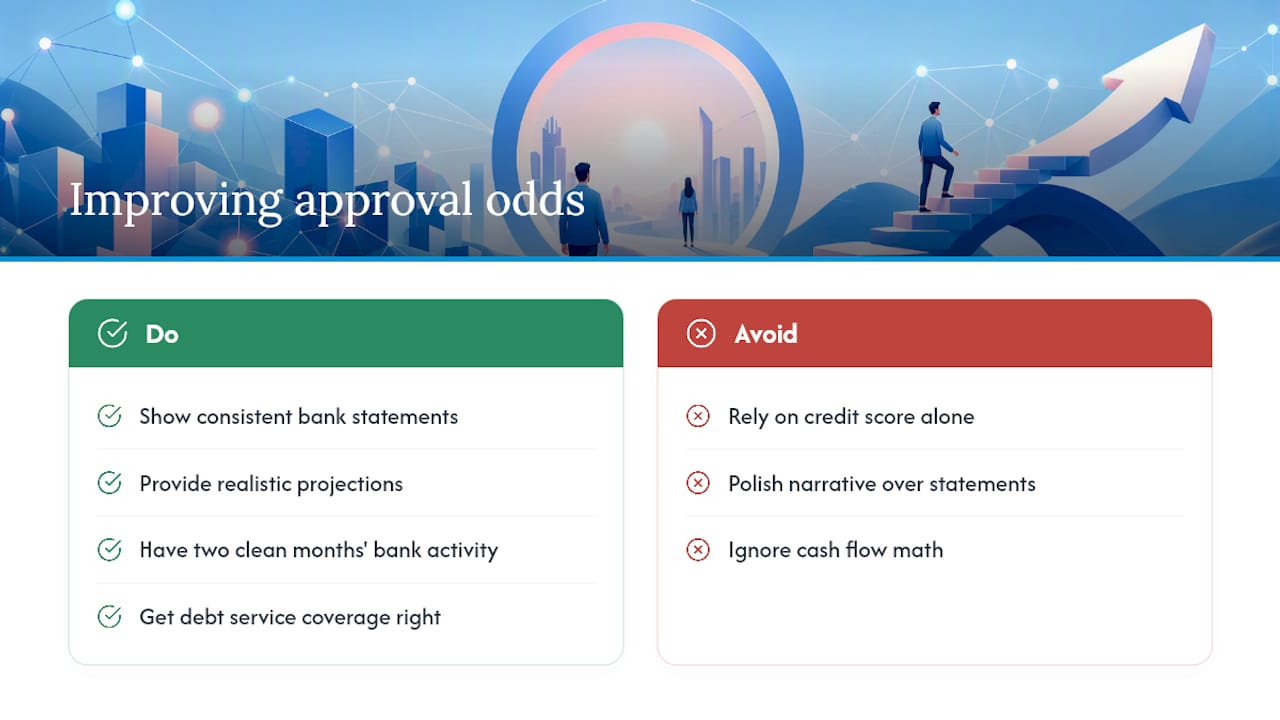
The SBSS discontinuation changes the math here. Under the old system, a borderline credit score could sink an otherwise solid application before a human ever read your business plan. Now that lenders run their own analysis, a thin credit file paired with strong cash flow and two clean months of bank activity has a real shot it didn’t have a year ago.
Prioritize your financial statements over polishing your business plan narrative. Lenders skim the story. They study the numbers. Get the debt service coverage math right before you worry about anything else, and the rest of the application tends to fall into place.
— Rob
Shopping SBA lenders one by one means filling out separate applications, each with its own credit pull and paperwork demands, and waiting weeks to hear back from each. Fordham Capital replaces that entire process with one application that reaches a wide network of banks and alternative lenders at once, without dinging your credit just to see what’s available.
That matters most if your file doesn’t fit neatly into a single bank’s box, whether that’s a thinner credit history, a newer business, or financials that need a lender willing to look past the surface number. Fordham Capital’s network includes lenders positioned to work with exactly those situations, and its A+ BBB rating reflects a track record of following through on that matching promise across more than $120 million funded.
If you’ve read this far and you’re ready to see what you qualify for, start your one-page application and get matched with a lender built for your situation, not a generic checklist.
Meeting SBA loan requirements comes down to proving repayment ability and credit-elsewhere status through clean, lender-ready documentation, especially now that lenders handle underwriting without the SBSS score.
| Point | Details |
|---|---|
| Match program to need | Use 7(a) for general funding, 504 for real estate or equipment, Microloan for amounts under $50,000. |
| Clear size standards first | Check your NAICS code against SBA size standards before assuming you qualify or don’t. |
| Documents drive speed | Tax returns, two months of bank statements, and Form 1919 form the core packet lenders expect. |
| SBSS ended March 2026 | Lenders now apply their own credit analysis, making accurate financials more important than ever. |
| Consider a marketplace match | Fordham Capital’s one-page application connects you to multiple lenders without a hard credit pull. |
At Fordham Capital, we've made the application process straightforward and reassuring. Dive in and explore your financial options with confidence, knowing there's no impact on your credit score and no obligations. We review your details and offer customized solutions based on what you're looking for.