
A business line of credit works best as a revolving cash cushion, not a long-term investment tool. Use it to smooth cash flow gaps, buy inventory before busy seasons, cover payroll during slow stretches, and handle repairs or emergencies that can’t wait. You pay interest only on what you draw, and the balance replenishes as you repay. If you need a reusable buffer for variable, short-term operating costs, this is usually the right instrument. If you need capital for a multi-year expansion, look elsewhere.
TL;DR:
- A business line of credit is best used for short-term cash flow gaps, seasonal inventory purchases, emergency repairs, or staffing pushes, not for long-term investments.
- It should be tied to specific, predictable inflows, with repayment targets generally set between one and three months to avoid misuse as permanent capital.
- Interest rates are variable and costs can increase due to fees, so tracking fees and settlement times is essential for effective management.
- Secured lines offer larger limits and lower rates but risk asset loss, while unsecured lines are faster to access and suitable for smaller, short-term needs.
- Lenders require proof of steady cash flow, proper documentation, and a clean banking history, and lines should be avoided for ongoing losses or structural cash flow issues.
A business line of credit is revolving credit: you get approved for a limit, draw against it as needed, repay, and the available credit resets. That structure makes it suited to a specific category of need, one where timing is uncertain but the shortfall is temporary.
The most common and highest-value scenarios include:
Pro Tip: Match every draw to a specific, dated cash inflow. If you can’t name the invoice or sales event that repays it, you’re probably using the line as a crutch, not a tool.
Consider a simple mini case: a flooring contractor draws $10,000 in March to buy materials for a job that starts in two weeks. The client pays a 50% deposit at signing and the balance on completion. The contractor repays the draw within 45 days, right when the final payment clears. That’s the ideal use pattern: a short, self-liquidating loop between draw and repayment. Businesses commonly rely on lines of credit for exactly this kind of timing mismatch rather than for permanent capital needs.
Flexibility is the main selling point. You draw only what you need, pay interest only on the drawn balance, and can reuse the same limit repeatedly without reapplying. Compared with term loans, factoring, and merchant cash advances, a line of credit is often cheaper for recurring, short-duration needs because you’re not paying interest on a lump sum sitting idle in your account.
The downsides are real, though:
So when should you look elsewhere? A term loan fits better for a defined, one-time purchase like a vehicle or major equipment, where you want a fixed payment schedule. A business credit card works for smaller, everyday purchases with grace-period float. Factoring fits when the real problem is a specific set of slow-paying invoices, not general cash flow. Basecamp Funding’s guide on factoring versus a line of credit points out that many businesses combine both: a line for everyday buffer needs, factoring for a large 60 to 90 day invoice gap. An MCA usually costs more than either and should be a last resort, not a planning tool.
Discipline is what separates a line of credit that strengthens a business from one that slowly drains it. Follow a repeatable process for every draw.
For a deeper look at operational uses, Fordham Capital’s guide to smart ways to use a business line of credit breaks down specific draw scenarios by industry.
Interest accrues only on the amount you’ve drawn, not your full approved limit. That’s the core mechanical advantage over a lump-sum loan. Rates are typically variable, tied to a benchmark plus a margin set by the lender, though some lenders offer fixed-rate lines for qualified borrowers. Lending conditions and credit quality shift with the broader economic cycle, which is part of why your effective rate can move even after approval.
Fees are where costs often hide:
Access methods matter more than most owners expect. Some lenders issue a debit card tied to the line for instant access. Others route funds through a bank transfer that settles in one to two business days, or issue paper checks that take even longer to clear. If your main use case is emergency repairs, a line that takes two days to fund won’t actually solve a Friday afternoon breakdown. Ask about settlement timing before you need the money, not after.
The collateral question comes down to how much you need and how much risk you can absorb. Secured lines, backed by inventory, equipment, or receivables, typically offer lower rates and higher limits because the lender has an asset to fall back on. The trade-off is real: if you default, you can lose that asset.
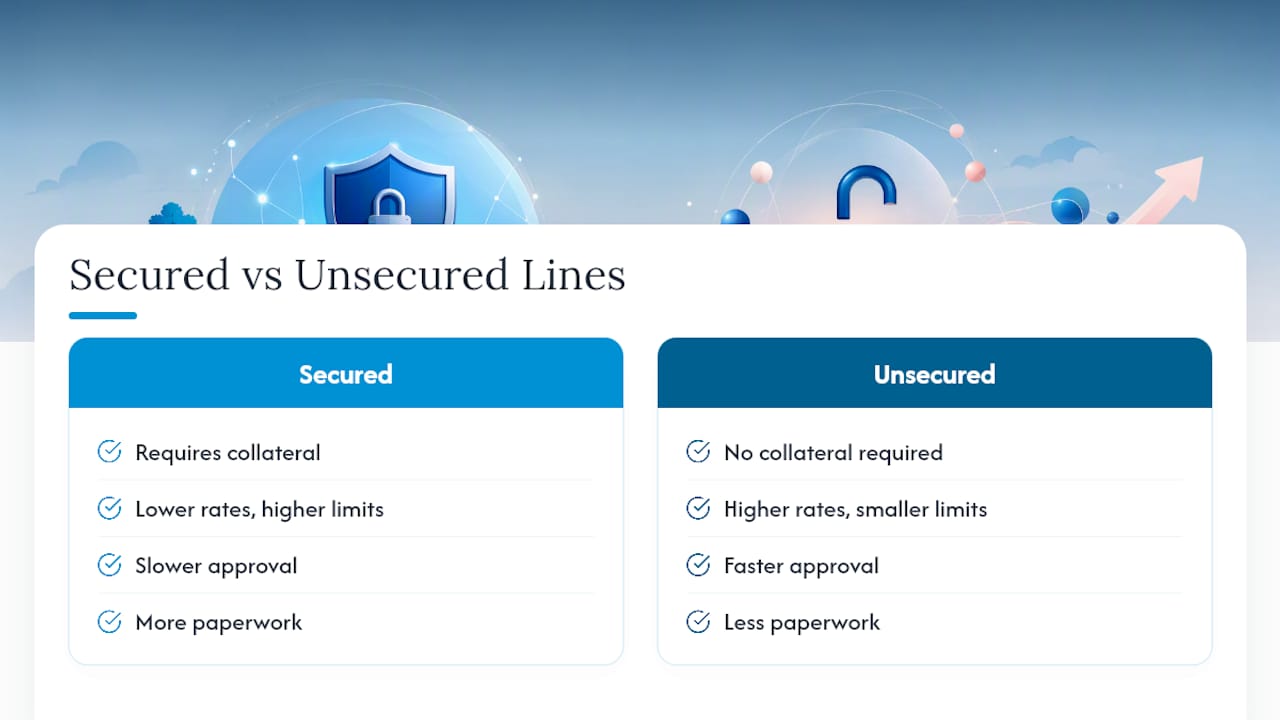
Unsecured lines skip the collateral requirement, which means faster approval and less paperwork, but usually come with smaller limits and higher rates since the lender is taking on more risk without a backstop.
A simple decision rule: if you’re pursuing a larger expansion and have business assets sitting idle that could secure a bigger limit at a better rate, a secured line makes sense. If your need is smaller, short-term, and your revenue is solid and consistent, an unsecured line gets you funded faster with less exposure. Businesses with strong receivables sometimes prefer structuring payment terms upfront to reduce how often they need to draw on either type of line in the first place.
Lenders typically want to see time in business (often at least six months to two years), a minimum monthly or annual revenue threshold, and a clean recent banking history. Expect to provide documentation, not just fill out a form.
Lenders read your bank statements as a cash-flow story, not just a balance check. Frequent overdrafts, erratic deposit patterns, or heavy reliance on short-term debt already outstanding all raise flags. Cleaning up overdraft activity for a few months before applying, and reducing existing high-interest debt where possible, meaningfully improves approval odds. Understanding what lenders look for in cash-flow based underwriting helps you prepare a stronger application before you submit it.
A line of credit is the wrong tool for funding recurring operating losses or big capital projects like a new location build-out or a major equipment purchase. Those need a structured term loan, an equity raise, or a hard look at cost restructuring, not a revolving balance that quietly grows every month.
Watch for these red flags:
If any of that sounds familiar, the line isn’t bridging cash flow anymore. It’s covering a structural gap that needs a different fix, possibly a working capital loan or a broader look at your financing options.
This guidance is based on experience connecting small and medium businesses with a network of lenders through a one-page application. When comparing any funding offer, ask what the total APR includes, how fast funds actually settle, and whether the lender reports to business credit bureaus. Request written fee schedules before signing anything, and verify any bank partner through FDIC or NCUA resources.
Plan every draw before you make it, tie it to real revenue, and start small. Test a modest limit before leaning on a larger one. Practically, that means auditing your cash-flow calendar this week, pulling your bank statements together, and applying for a limit sized to your actual gap, not your biggest hope.
— Rob
Some online platforms reduce paperwork compared to traditional banks, allowing faster applications and access to networks of banks and alternative lenders, often with quick approvals.
That speed matters most exactly when you need it: covering payroll before a delayed invoice clears, or restocking inventory before a seasonal rush passes you by. The provider has funded over $120M for small and medium businesses, helping clients generate more than $500M in revenue, and carries a strong reputation with an A+ BBB rating. If you’re ready to see what limit and rate you qualify for, apply now and compare your offer against whatever your bank quoted you last.
For further reading on how business lines of credit work and how lending conditions shift, these sources are worth bookmarking:
This article is general information, not a substitute for advice from a qualified financial advisor. Consult a qualified financial professional about your own circumstances before acting on anything here.
For most small businesses with variable cash flow, yes. It gives you a reusable buffer for payroll, inventory, and emergencies without paying interest on money you’re not using.
Yes. You draw funds through a debit card, bank transfer, or check, depending on the lender, and you only owe interest on the amount actually withdrawn.
There’s no single fixed rule since terms vary by lender, but a common best practice is repaying each draw within 30 to 90 days to keep the line functioning as a short-term buffer rather than long-term debt.
At Fordham Capital, we've made the application process straightforward and reassuring. Dive in and explore your financial options with confidence, knowing there's no impact on your credit score and no obligations. We review your details and offer customized solutions based on what you're looking for.