Business loans most commonly fund working capital like payroll and inventory, equipment purchases, commercial real estate, expansion costs, debt refinancing, and startup expenses. Lenders match these needs to specific products: term loans, lines of credit, equipment loans, SBA 7(a) and 504 loans, invoice factoring, and business credit cards. Exactly what you can spend the money on, and how fast you get it, depends on the lender’s rules and the paperwork you bring.
TL;DR:
- A line of credit suits recurring payroll gaps and seasonal inventory, while term loans fit buildings and major equipment with longer repayment periods.
- Equipment loans are often secured by the asset, and repayment should track its useful life; financing it for much longer or less time can add costs.
- Eligible borrowers can combine SBA 7(a) and 504 loans for up to $10 million, but longer approval may not suit urgent payroll needs.
- Invoice factoring and merchant cash advances can deliver cash quickly, but they often cost more than traditional loans and repay from incoming revenue.
- Complete applications move faster; gather bank statements, tax returns, projections, and invoices, and keep personal spending separate to protect tax deductibility.
Most financing requests fall into a handful of categories, and seeing how each one plays out makes it easier to figure out where your own need fits.
Working capital covers the everyday cash gaps between paying your bills and collecting from customers. A retailer stocking shelves for the holiday season before sales revenue arrives is a textbook example. Inventory and purchase order financing serve a related but narrower purpose: buying raw materials or finished goods to fulfill a specific contract, often with repayment tied to when that order gets paid.
Equipment and machinery purchases, from production lines to computers to newer AI-related hardware, are among the most frequently approved uses because the asset itself can secure the loan. Commercial real estate and leasehold improvements cover buying a building outright or renovating a leased space to open a new location, both of which usually call for longer repayment terms given the size of the investment.
Expansion costs include hiring, marketing pushes, franchise openings, or launching a new product line, essentially any growth move that needs capital before it generates revenue. Debt refinancing lets you consolidate higher-cost obligations into a single loan with a lower payment or longer maturity. Startup costs are permitted under many loan programs, though they often require more documentation, like a detailed business plan and financial projections, since there’s no operating history to review.
Once you know what you’re funding, the next question is which product actually fits. Lenders build their underwriting around specific uses, and the match affects both your approval odds and your total cost.
Pro Tip: Match the loan term to the life of what you’re buying: financing equipment over a term that is much longer or shorter than its useful life may cost you more in the long run.
The real trade-off is speed versus cost versus term length. When cash is tight and you need funds quickly, speed may matter more, even at a higher rate. When you’re financing a building or a major expansion, a longer approval process in exchange for a lower rate and longer term is usually worth it.
Lenders want to see that your proceeds will go where you say they will, and the documentation you bring determines how quickly that happens.
Dedicated project codes and vendor invoices tied directly to specific purchases make capital expense tracking far easier at tax time. Applications with complete paperwork move faster; missing documents are the most common cause of delayed approvals.
SBA-backed loans tend to offer longer repayment terms and more favorable rates than many alternative products, and they can fund both fixed assets and working capital under one umbrella. That makes them a strong fit for buying or improving property, financing major equipment, acquiring an existing business, or funding a large-scale expansion where the total cost over time matters more than speed.
As of July 2026, eligible borrowers can combine 7(a) and 504 loans for up to $10 million in total SBA-backed financing, up from a previous combined cap of $5 million. Each program can now provide up to $5 million on its own, and the SBA has confirmed this change gives capital-intensive industries more room to pair long-term fixed-asset financing with working capital in a single structure. That shift matters for manufacturers, healthcare practices, or multi-location operators whose needs outgrow a single loan type.
Alternative or nonbank financing may make more sense when you need cash urgently or when the speed of approval outweighs the extra cost. Federal Reserve survey data shows loan demand is frequently driven by operational needs like inventory financing and equipment investment, needs that may call for timely funding.
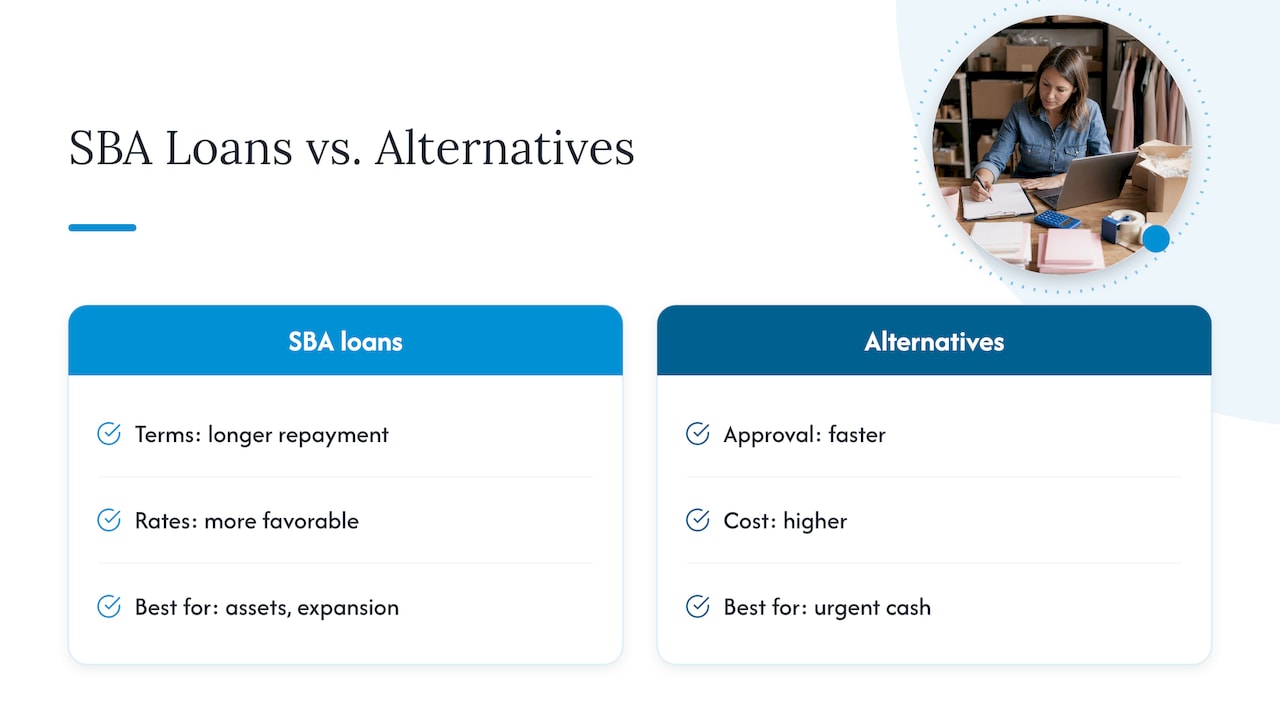
Before you apply, define the exact use and dollar amount, choose a loan type that matches your term and collateral situation, gather your documentation, weigh speed against cost, and confirm permitted uses directly with the lender.
Most advice on business loans treats “what can I use this for” as the hard question, when the harder one is usually “what’s this going to cost me relative to how fast I need it.” A term loan and a merchant cash advance may both fund an inventory purchase, but their costs over time can differ substantially. The conventional framing skips that comparison entirely and just walks through a menu of eligible uses.
The SBA’s July 2026 change to combine 7(a) and 504 financing up to $10 million is a good test of this. It’s a real opportunity for capital-intensive businesses, but only for those patient enough to handle a longer approval process. If you need funds for payroll urgently, that policy change may be irrelevant to you, and chasing the “better” program on paper can cost you the deal you actually needed.
Prioritize matching your timeline to the product first. The use case matters, but it’s rarely what separates a smart financing decision from an expensive one.
— Rob
We connect small and medium-sized businesses with a network of banks and alternative lenders for SBA loans, lines of credit, and working capital through an application that lets you check without affecting your credit.
If you’ve mapped your expense to a loan type and you’re ready to move, you can check your eligibility with Fordham Capital and get matched with lenders promptly.
Business loans typically cover working capital, inventory, equipment, real estate, expansion costs, and debt refinancing, though permitted uses vary by lender and loan type. SBA 7(a) loans, for example, explicitly allow real estate, equipment, working capital, and refinancing, while some products restrict funds to a narrower purpose like inventory or receivables.
A business loan gives you capital for growth or stability without giving up equity in your company, and interest may be deductible when used for legitimate business expenses. The trade-off is a repayment obligation regardless of how your business performs, plus documentation requirements that can slow down approval for less-prepared applicants.
Using business loan proceeds for personal expenses typically violates the loan agreement and can jeopardize the tax deductibility of the interest, since only ordinary and necessary business expenses qualify. Keeping business and personal accounts separate is the simplest way to avoid this problem and preserve clean records for tax purposes.
Before committing to a loan, confirm the lender’s permitted uses match your actual need, compare the total cost against how quickly you need funds, and have your documentation (financial statements, projections, and invoices) ready. Programs like SBA 7(a) and 504 suit longer-term, larger-scale needs, while a line of credit or short-term product fits faster, smaller cash gaps.
At Fordham Capital, we've made the application process straightforward and reassuring. Dive in and explore your financial options with confidence, knowing there's no impact on your credit score and no obligations. We review your details and offer customized solutions based on what you're looking for.