
Second-chance lending gives entrepreneurs who were denied by traditional lenders, often justice-impacted or credit-impaired founders, a real path to startup capital, credit repair, and business coaching. Banks reject applicants over a low FICO score or a past conviction even when the business itself is sound. Second-chance programs look past that history and fund the person building the business instead.
Two moves to make today: search for an SBA microloan intermediary near you, or start Fordham Capital’s one-page application to see what a lender network can offer without a hard credit pull.
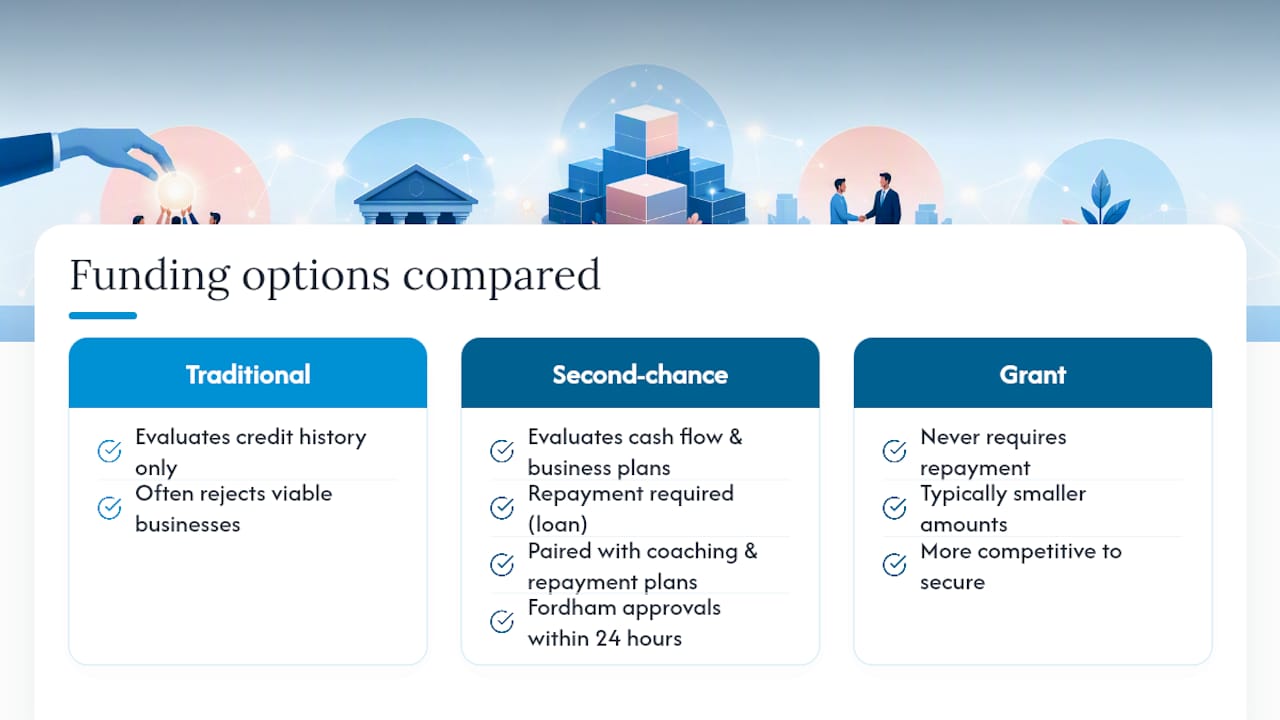
Second-chance lending works because it evaluates a business’s cash flow and potential instead of relying solely on a damaged credit score.
| Point | Details |
|---|---|
| Definition matters | Second-chance lending pairs financing with coaching, unlike traditional loans that judge credit score alone. |
| Programs vary by speed | SBA microloans and CDFIs take weeks; marketplaces move in days. |
| Eligibility has exclusions | Some programs have historically restricted justice-impacted owners; confirm rules before applying. |
| Treat it as a bridge | Use higher-cost second-chance loans short-term, then refinance within 12 to 24 months. |
| Fordham Capital speeds access | A one-page application connects credit-impaired founders to a lender network with approvals often within 24 hours. |
Second-chance lending is financing built for borrowers with damaged credit, thin files, or justice involvement, usually paired with coaching, incentives for on-time payments, or reduced documentation requirements. It’s a different animal from a traditional bank loan, which leans almost entirely on credit score and collateral. Second-chance products range from true grants (no repayment) to microloans to short-term bridge loans priced higher because the lender is taking on more risk.
A few program types show up again and again:
The SBA Microloan program caps loans at $50,000, but the average microloan lands closer to $13,000, with repayment terms that can stretch up to seven years.
Second-chance financing fills a structural gap in traditional lending: credit scoring systems weren’t built to evaluate someone rebuilding after incarceration, bankruptcy, or a business failure, even when that person now runs a profitable operation. Without it, thousands of viable businesses never get off the ground, not because the idea is bad, but because the founder’s paper trail looks risky on a spreadsheet.
The evidence backs this up:
Andrew Glazier of Defy Ventures puts the core problem plainly:
Traditional lenders often lean on outdated assumptions about risk for justice-impacted entrepreneurs, rather than looking at real, data-driven signals of business potential.
That gap between assumption and data is exactly what second-chance underwriting tries to close.
Most programs target a similar profile: justice-impacted founders, people working through a recent bankruptcy, entrepreneurs with thin or nonexistent credit files, and anyone with steady revenue but a low FICO score that traditional banks won’t touch.
You’ll typically need to show:
Watch for exclusions. Federal guidance during the pandemic era, for example, tightened PPP eligibility for owners on probation or parole, even though the underlying law didn’t require it. Program rules shift, so confirm eligibility directly with the lender before you invest hours in an application.
Start your search with these sources, roughly in order of how founder-friendly they tend to be:
A practical five-step roadmap looks like this:
Timelines vary widely. SBA microloans and CDFI loans often take two to six weeks because intermediaries review both the credit picture and the business plan. Online marketplaces move faster, sometimes within 24 to 48 hours, which matters if payroll or inventory can’t wait. If speed is the priority, a platform connecting you to multiple lenders at once tends to outpace waiting on a single intermediary’s queue.
Lenders in this space respond to evidence of a credible repayment plan more than to a clean credit report they’ll never see. What you bring to the table matters:
Treat a high-cost second-chance loan as bridge financing, not a permanent fixture. Make every payment on time to rebuild your score, then move toward cheaper capital once you qualify.
Pro Tip: Ask upfront whether the lender offers an APR reduction or cash rebate for a defined streak of on-time payments. Some credit union and CDFI programs build this in, and it can meaningfully cut your effective cost.
Pro Tip: Set a calendar reminder at month 10 to start shopping refinance options. Waiting until your loan matures gives you no leverage to negotiate.
Second-chance loans can genuinely rebuild your credit, but they usually cost more than conventional financing, and that tradeoff needs to be understood before you sign anything.
Watch for these warning signs:
Before signing, ask every lender directly: What’s the APR? Are there prepayment penalties? Is mentoring included? Will you help me refinance once my credit improves?
Most successful paths look the same: a founder takes capital paired with mentoring, makes every payment on time for a year, and refinances into something cheaper. It’s not glamorous, but it works.

If SBA microloans and CDFIs feel slow, or your local SBDC waitlist stretches out for weeks, Fordham Capital offers a faster route into the same lending ecosystem. Instead of applying to one intermediary at a time, one one-page application puts your request in front of a network of banks and alternative lenders simultaneously, with no impact to your credit score just to see offers.
Three things this matters for if you’re rebuilding after a credit setback:
If your business has revenue and a plan but your credit history has been the obstacle, start the application and see what the network can offer before committing to a slower, single-lender process.
Why do entrepreneurs need second-chance lending in the first place? Because traditional underwriting rejects viable businesses based on credit history alone. Second-chance lending evaluates cash flow, business plans, and repayment capacity instead, giving denied entrepreneurs a real shot at capital.
What’s the difference between a second-chance loan and a grant? A loan must be repaid, usually at a higher rate than conventional financing. A grant never requires repayment but is typically smaller and more competitive to secure.
How much can I borrow through an SBA Microloan? Up to $50,000, though the average microloan is closer to $13,000, with repayment terms running as long as seven years.
Will a second-chance loan hurt my credit further if I struggle to repay? Missed payments on any loan can damage your credit. That’s why reputable programs pair lending with coaching and realistic repayment plans before funding.
How fast can I get approved through Fordham Capital compared to an SBA microloan? Fordham Capital’s network often returns approvals within 24 hours, while SBA microloans and CDFI loans typically take two to six weeks due to added technical assistance review.
This article is general information, not a substitute for advice from a qualified financial advisor. Consult a qualified financial professional about your own circumstances before acting on anything here.
At Fordham Capital, we've made the application process straightforward and reassuring. Dive in and explore your financial options with confidence, knowing there's no impact on your credit score and no obligations. We review your details and offer customized solutions based on what you're looking for.