
If you need funding fast, the highest-probability routes for most New York small businesses are city-backed funds through NYC SBS, state programs via Empire State Development’s SSBCI suite, SBA loans for larger or longer-term capital, and Fordhamcapital as a marketplace alternative when speed or program eligibility is the issue.
Three immediate next steps:
The primary entry points for New York business funding are: Empire State Development (ESD) / SSBCI, New York Forward Loan Fund, NYC Future Fund, NYC Funds Finder, the SBA loan portal, and Community Development Financial Institutions (CDFIs). Each serves a different business profile, and the sections below tell you exactly which one fits yours.
Empire State Development administers New York’s SSBCI-funded loan suite, which channels federal capital into state-level programs targeting small businesses that conventional banks routinely pass over. The programs cover term loans, loan guarantees, and equity support, with a particular focus on SEDI-designated businesses (socially and economically disadvantaged individuals) and very small businesses (VSBs).
Here is what each program is designed for:
Most state programs are delivered through partner lenders, CDFIs, or participating banks rather than directly through ESD. That means your first step is identifying which partner operates in your county or borough, not applying to ESD itself. Revenue caps and FTE limits vary by program, but VSB targeting generally applies to businesses with fewer than ten employees, and SEDI targeting prioritizes owners from historically underserved communities.
Pro Tip: Before contacting a partner lender, download ESD’s program one-pagers from the SSBCI page and mark which programs your business qualifies for. Lenders move faster when you walk in knowing your fit.
The New York Forward Loan Fund was designed for small businesses affected by pandemic-era closures, and its loan sizes are directly tied to your historical revenue, not a flat cap. That structure rewards businesses with documented sales history and penalizes those with thin or inconsistent records.
Loan terms at a glance:
Eligibility checklist:
For documentation, expect to provide two years of business tax returns, a current profit-and-loss statement, a balance sheet, a rent or lease agreement confirming your NY address, and government-issued ID for all owners holding more than 20% of the business.
Applications are reviewed on a rolling basis, and program availability is subject to funding limits. Check the program page directly before investing time in a full application packet, since phases open and close as capital is deployed. If the program is not currently accepting applications, register your interest so you are notified when the next round opens.
New York City runs its own parallel funding infrastructure that operates independently of state programs. For businesses inside the five boroughs, city channels are often faster to access and come with free advisory support that state programs do not match.
The NYC Future Fund offers revenue-based loans from $25,000 to $500,000 at a 7.5% annual interest rate. The defining feature: principal payments adjust with your monthly revenue against a defined threshold. If your sales drop in a slow month, your payment drops with them. For restaurants, retail shops, or any business with seasonal swings, that flexibility is worth more than a lower headline rate on a fixed-payment loan.

This fund targets businesses that have already won a city contract but need capital to fulfill it. If you are waiting on a government payment while covering payroll and materials, this is the program to check. Loan sizes are tied to contract value.
NYC Funds Finder is the city’s free online capital marketplace. Enter your business profile and it matches you to loans, grants, and vetted advisors across city, state, and CDFI sources. You can schedule a free one-on-one session directly through the platform.
NYC SBS (Small Business Services) goes a step further: advisors help you calculate repayment capacity, prepare your document package, and connect you with the right CDFI or SBA lender. Call 888-SBS-4NYC to book a session.
When to choose a city fund over state or federal options:
Federal and CDFI channels fill the gaps that state and city programs leave open, particularly for larger loan amounts, longer terms, or businesses that do not meet SEDI or VSB criteria.
| Channel | Loan Size | Best For | Timeline | Documentation Intensity |
|---|---|---|---|---|
| SBA 7(a) | Up to $5M | Established businesses needing working capital or expansion | 30–90 days | High |
| SBA CDC/504 | Up to $5.5M | Real estate or major equipment purchases | 60–90 days | High |
| SBA Disaster Loans | Available for businesses in federally declared disaster areas up to amounts specified by the SBA | Varies | Moderate–High | |
| CDFI Microloans | $500–$250,000 | Startups, under-banked owners, thin credit files | 2–6 weeks | Moderate |
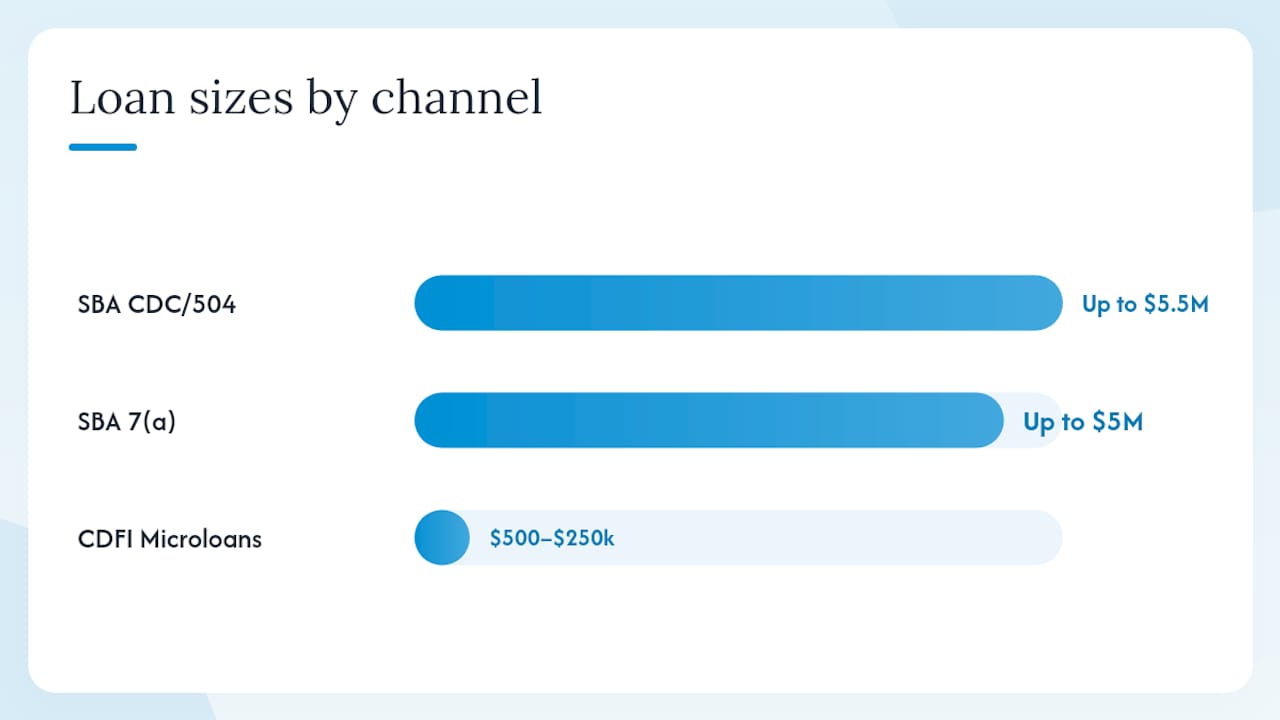
SBA loan programs carry federal guarantees that reduce lender risk, which is why they can approve borrowers that conventional banks decline. The trade-off is documentation volume and processing time. SBA 7(a) loans are the most flexible, covering working capital, equipment, and refinancing. CDC/504 loans are structured specifically for fixed assets. Disaster loans are only available after a federal disaster declaration and are not a general-purpose option.
CDFIs are the fastest route for microloans and for businesses that fall outside conventional credit profiles. The Small Business Revolving Loan Fund Round 2 channels capital through local CDFI partners, so you get mission-driven underwriting alongside state backing. For businesses exploring non-bank financing options, CDFIs are often the most accessible entry point.
When CDFIs beat SBA for your situation:
Most New York business loan programs share a common eligibility framework, even when the specific thresholds differ. Knowing the standard requirements lets you build one document packet that works across multiple applications.
Common eligibility rules:
Typical loan costs across programs:
| Program | Interest Rate | Origination Fee | Prepayment Penalty |
|---|---|---|---|
| Main Street Capital | 9.90% APR (fixed) | Varies | Check program terms |
| NY Forward Loan Fund | ~3% annual (fixed) | Not publicly listed | Check program terms |
| NYC Future Fund | 7.5% annual | Not publicly listed | Check program terms |
| SBA 7(a) | Prime + lender spread | Up to 3.5% of guaranteed portion | Yes, for loans over 15 years |
| CDFI microloans | Varies by CDFI | Varies | Typically none |
Document checklist for most applications:
For approval factors lenders weigh most heavily, consistent revenue trends and clean bank statements matter more than a perfect credit score in most CDFI and state program reviews.
The application path for most NY programs follows the same five-stage structure, whether you are going through ESD, a CDFI, or the SBA.
For free help at any stage, call NYC SBS at 888-SBS-4NYC. Advisors can review your document package, calculate your debt-service coverage ratio, and identify the two or three programs most likely to approve your profile. This is not generic advice; it is program-specific guidance from people who know which CDFIs are actively lending right now.
Pro Tip: Schedule your SBS session before you start filling out applications. Advisors often know which programs have open capacity and which are temporarily paused, saving you from submitting to a closed fund.
For businesses that want to secure outside funding efficiently, having a clean, pre-assembled document packet and a clear cash-flow narrative cuts underwriting time significantly across every channel.
Choosing among programs is not just about the interest rate. The factors that matter most to a small or micro business are often repayment flexibility, speed, and whether a personal guarantee is required.
Decision factors to weigh:
Understanding the difference between a term loan and a line of credit also matters here. A term loan vs. line of credit comparison can clarify which structure fits your cash-flow pattern before you commit to a program.
Ten questions to ask any lender or program officer:
Red flags during underwriting and contract review:
New York small businesses have the strongest funding odds when they match their profile to the right program tier before applying, rather than submitting to every available option at once.
| Point | Details |
|---|---|
| Start with NYC Funds Finder | Use the free city tool to match your profile to open programs before assembling documents. |
| State programs need a partner lender | ESD/SSBCI programs are accessed through CDFIs and participating banks, not directly through ESD. |
| Revenue-based repayment fits seasonal businesses | NYC Future Fund offers $25,000–$500,000 with principal payments that flex with monthly revenue. |
| Document preparation is the biggest timeline variable | Two years of tax returns, YTD financials, and a cash-flow narrative cover most NY program requirements. |
| Fordhamcapital offers a fast parallel route | A one-page application reaches a broad lender network with decisions in as little as 24 hours, no credit impact. |
The conventional advice for small business funding is to start with the SBA. That is not wrong, but for most New York micro businesses, it is the slowest and most document-intensive route available. The city and state programs covered here were specifically built to serve businesses that the SBA pipeline was not designed for: under-banked owners, very small businesses, startups under four years old, and businesses in historically underserved communities.
What gets overlooked is that these programs are not just cheaper capital. The free technical assistance attached to them, through NYC SBS and CDFI partners, is genuinely valuable. An advisor who knows which CDFIs are actively lending this quarter, which programs have open capacity, and how to package your financials for a specific underwriter is worth more than any interest rate difference. Most business owners skip that step and pay for it in rejections and delays.
The other thing worth saying plainly: public programs and marketplace lenders are not competing options. They serve different timelines and different risk profiles. If you need capital in the next two weeks, a marketplace route is your realistic option. If you can wait six to eight weeks and want the lowest possible rate, a state or city program is worth the paperwork. The smartest move is often to pursue both simultaneously, using the marketplace as a bridge while the public program processes.
Public programs are the right answer for many New York small businesses, but they come with timelines that do not always match the pace of a real business problem. Fordhamcapital is built for the gap between “I need capital” and “the program opens next quarter.”
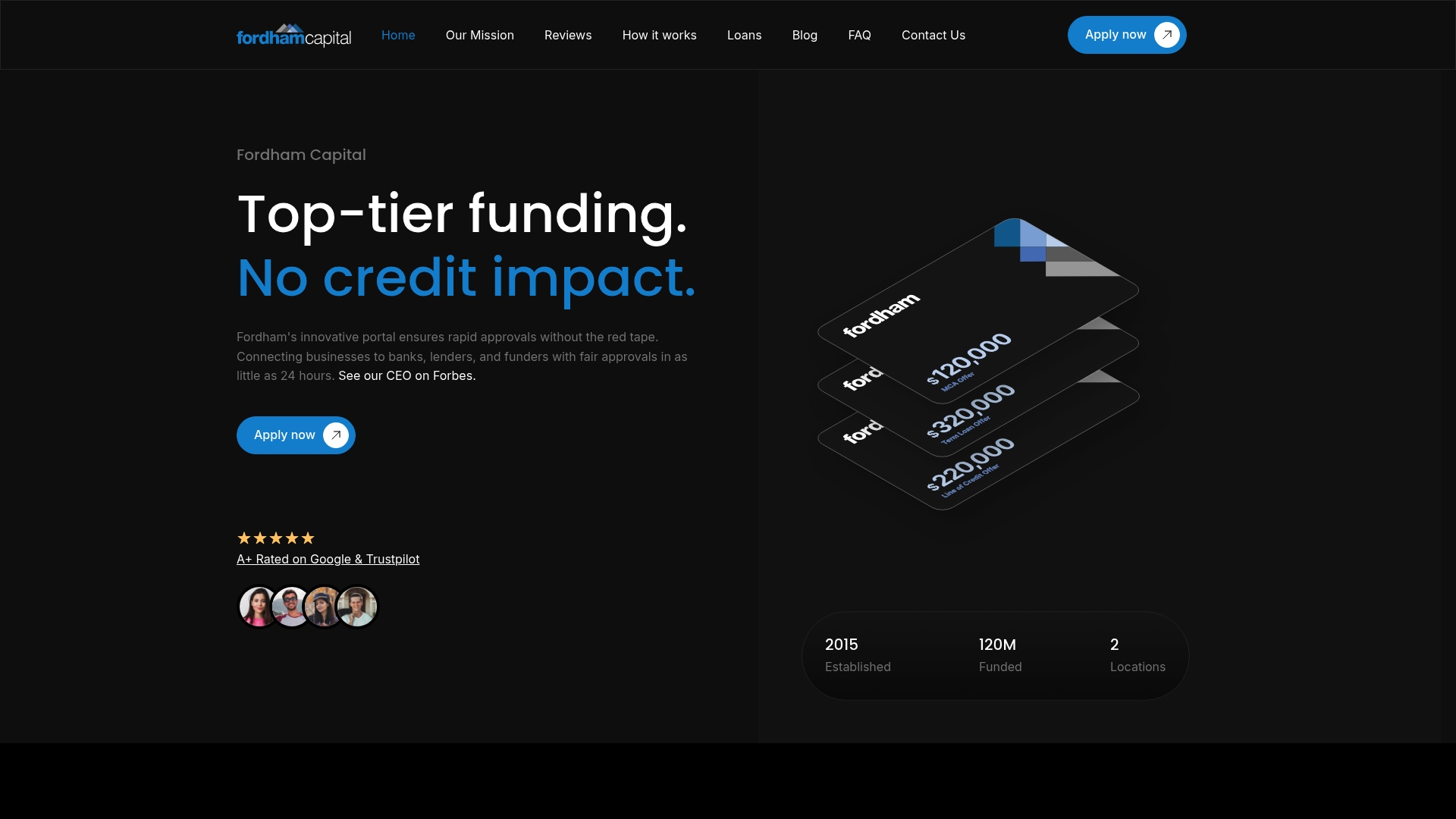
With a one-page application, no credit score impact, and access to a network of banks and alternative lenders, Fordhamcapital delivers decisions in as little as 24 hours. That is not a replacement for a 3% state loan, but it is a real option when you cannot wait six weeks for underwriting, when your business does not fit a program’s eligibility criteria, or when you want SBA loan origination support without navigating the process alone. Fordhamcapital holds an A+ BBB rating and has funded over $120M, helping clients generate more than $500M in revenue.
For businesses that want to explore local funding programs alongside a marketplace application, both paths are worth running in parallel. Apply now at Fordhamcapital to see your options without affecting your credit score.
This article provides general information about business loan programs and is not financial or legal advice. Verify current program eligibility, rates, and availability directly with each program’s official page or a qualified financial advisor before applying.
Official program pages update eligibility rules and application status regularly. Bookmark these and check them before submitting any application.
Most programs post application status updates directly on their pages. Subscribe to ESD and NYC SBS email alerts to be notified when new funding rounds open, particularly for programs that cycle through phases as capital is deployed.
At Fordham Capital, we've made the application process straightforward and reassuring. Dive in and explore your financial options with confidence, knowing there's no impact on your credit score and no obligations. We review your details and offer customized solutions based on what you're looking for.