
There is no single minimum credit score for a business loan. What you actually face depends on the lender type, the loan product, and how your business metrics back up your credit profile. That said, the ranges are predictable enough to plan around.
For personal credit, most lenders draw their lines somewhere between 500 and 700. Traditional banks typically want relatively high personal credit scores, SBA lenders prefer moderately high scores, and online or alternative lenders often work with lower scores. For business credit, the scales differ by bureau: Dun & Bradstreet PAYDEX runs 1–100 (80+ is low risk), Experian Intelliscore runs 1–100 (76+ is low risk), and FICO Small Business Scoring Service (FICO SBSS) runs 0–300 (155+ is a common SBA threshold).
Here is how lender types typically line up by minimum personal credit score:
If your personal score is high, you have access to nearly every loan type. Lower scores narrow your options quickly, and the cost of capital rises sharply. Knowing where you stand before you apply is the single most useful thing you can do.
Pro Tip: Pull your personal credit report from AnnualCreditReport.com and your business reports from Dun & Bradstreet, Experian Business, and Equifax Business before you approach any lender. Errors are common, and fixing one can move your score faster than months of on-time payments.
Your business loan credit score determines not just whether you get approved, but the rate, term, collateral requirement, and maximum loan size you receive.
| Point | Details |
|---|---|
| No single minimum exists | Requirements range from ~500 to 700+ depending on lender type and loan product. |
| Score bands define your options | 700+ opens banks and SBA; 640–700 needs strong business credentials; below 600 limits you to alternative lenders. |
| Personal and business credit both matter | SBA and bank lenders review personal credit for all owners with 20%+ ownership alongside business bureau scores. |
| Fastest improvement levers | Paying down utilization and disputing errors can show score movement in 1–3 billing cycles. |
| Fordhamcapital for imperfect scores | One-page application, no credit impact, 24-hour approvals, and access to a lender network for businesses traditional banks overlook. |
Business credit scores are not the same as personal FICO scores, and the scales are not interchangeable. Lenders may check one, two, or all three of the major business bureaus depending on the loan type and their internal underwriting process.
Dun & Bradstreet PAYDEX runs on a 1–100 scale and measures how promptly a business pays its bills relative to terms. A score of 80 means you pay exactly on time; above 80 means you pay early. Most lenders treat 75+ as acceptable and 80+ as low risk. PAYDEX only reflects trade payment history, so a business with no vendor accounts will have no score at all.
Experian Intelliscore Plus also runs 1–100 and pulls from a broader data set: payment history, credit utilization, company age, and public records like liens or judgments. Scores of 76–100 are considered low risk. Banks and SBA lenders frequently check Intelliscore alongside PAYDEX.
Equifax Small Business Credit Risk Score runs 101–992. It incorporates payment behavior, credit inquiries, and the age of the business’s credit relationships. Scores above 580 are generally considered acceptable; higher is better.
FICO Small Business Scoring Service (FICO SBSS) runs 0–300 and blends personal and business credit data into a single composite score. The SBA uses FICO SBSS to pre-screen 7(a) loan applications, and a score of 155 is the commonly cited floor for passing that screen, though individual lenders may set higher thresholds.
Which score gets checked depends on the lender:
Because these scales are completely different, a “good” score on one system does not translate directly to another. A PAYDEX of 80 and an Intelliscore of 80 both signal low risk, but a FICO SBSS of 80 is well below the SBA threshold. Always know which score a lender is pulling before you apply.
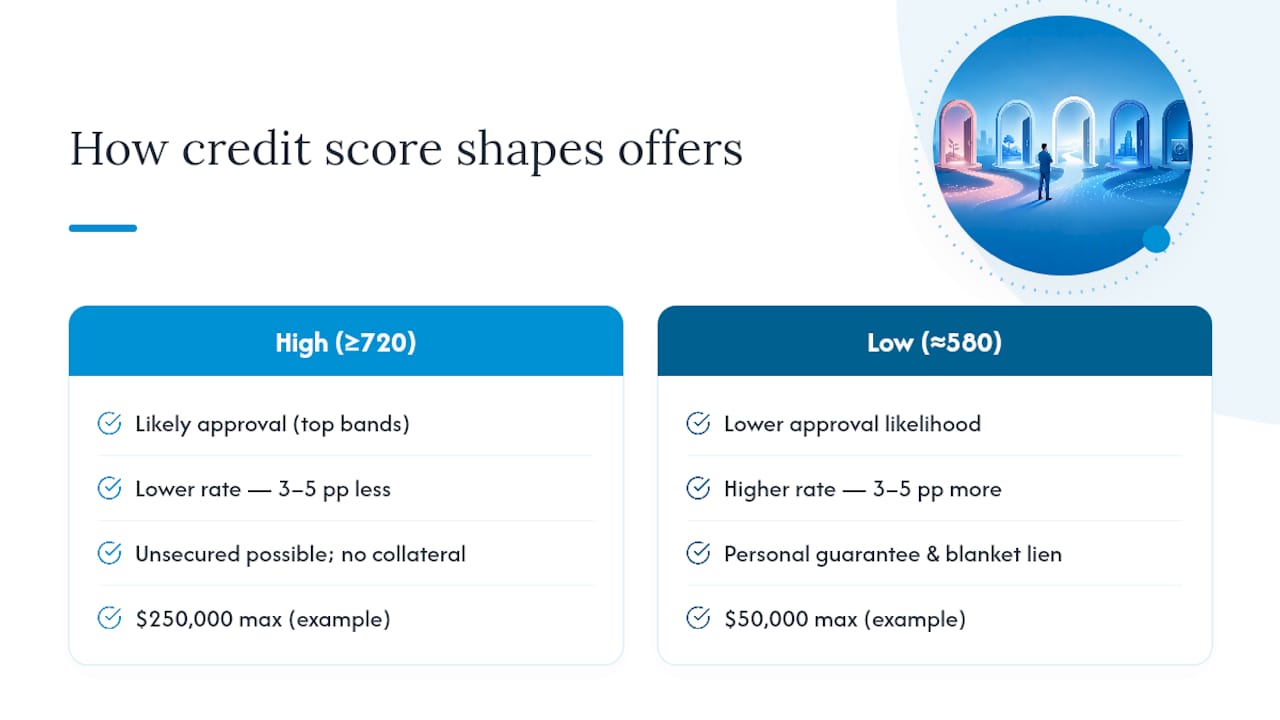
Credit scores do not just determine whether you get approved. They shape the entire structure of the offer you receive. Underwriters use your score as a proxy for repayment risk, and that risk assessment flows directly into five underwriting outcomes.
Approval likelihood is the most obvious. A business with a personal score above 720 and a PAYDEX of 80+ is treated as low risk, and approval rates in 2025 reflected that gap clearly. Borrowers in the top score bands were approved at substantially higher rates than those in medium or high-risk bands.
Interest rate tiers move in direct proportion to perceived risk. A borrower at 720+ might receive a rate 3–5 percentage points lower than a borrower at 620 for the same loan amount. On a $200,000 term loan over five years, that difference compounds into tens of thousands of dollars.
Collateral and personal guarantee requirements tighten as scores drop. A strong-score business may secure an unsecured line of credit. A weaker-score business applying for the same product will often face a personal guarantee requirement, a blanket lien on business assets, or both.
Maximum loan size shrinks when scores are lower. Lenders cap exposure based on risk, so a business at 580 personal credit may qualify for $50,000 where a 720-score business qualifies for $250,000 under the same revenue profile.
Loan term length also shifts. Higher-risk borrowers tend to get shorter repayment windows, which drives up monthly payments even when the rate looks manageable on paper. A lender offering 60-month terms to a strong borrower might offer only 24 months to a weaker one.
Here is a quick scenario comparison. A business owner with a 740 personal score, $500,000 in annual revenue, and a PAYDEX of 82 applies for a $150,000 term loan. They likely receive approval, a competitive rate, and a 5-year term with no collateral requirement. A business owner with a 590 personal score and the same revenue applies for the same product. They may get a counteroffer for $75,000, a higher rate, a shorter term, and a personal guarantee. Same business size, very different deal.
Pro Tip: Lenders can and do trade off strong business metrics against weaker credit. If your debt service coverage ratio (DSCR) is above 1.25 and your revenue is consistent, mention it upfront. Some underwriters will move you to a better tier if the cash flow story is compelling, even when the score alone would not get you there. See what lenders evaluate beyond credit scores for the full picture.
Requirements vary enough by loan type that matching your score to the right product is worth doing before you apply. Applying for a bank term loan with a 610 score wastes time and generates a hard inquiry. Applying for an equipment loan with the same score is often viable.
Banks are the most demanding. Most want a personal score of 680–700+, at least two years in business, and annual revenue above $250,000. Business credit bureau scores matter here too. Rates are typically the lowest available, but approval timelines run weeks to months. If your score is below 660, a bank term loan is rarely worth pursuing until you’ve improved it.
The SBA does not publish a single numeric minimum, but lenders who originate SBA loans apply their own floors. In practice, most SBA lenders want a personal score of 650–680+. FICO SBSS is used for pre-screening 7(a) loans under $500,000, with 155 as the common threshold. SBA loans offer favorable rates and longer terms, but the application process is document-heavy and funding typically takes weeks to months.
This is where the range widens. Online lenders often accept personal scores as low as 550–600, with revenue and time in business carrying more weight than bureau scores alone. Rates are higher than bank products, but funding can happen in days. These lenders are a realistic path for businesses with 1–2 years of operating history and consistent revenue but imperfect credit.
Equipment loans are secured by the equipment itself, which reduces lender risk and lowers the credit bar. Personal scores of 600–650 are often workable. Lenders want to see that the equipment has resale value and that the business can service the debt. Rates depend on score tier but are generally moderate. Funding typically takes days to a couple of weeks.
A credit score for a business line of credit typically needs to be in the mid-600s or higher, paired with a debt-to-income ratio below roughly 36% and steady verifiable income. Utilization under 30% on existing revolving accounts helps materially. Bank-issued lines require stronger profiles; online-issued lines are more accessible at lower scores.
MCAs are the most accessible and the most expensive. Providers often work with personal scores as low as 500–550 because repayment is tied to daily card receipts rather than a fixed schedule. The cost of capital is high, expressed as a factor rate rather than an APR. Use an MCA only when speed is critical and no other option is available.
SBA microloans and nonprofit lenders like Accion Opportunity Fund use mission-driven underwriting. Personal scores of 575–640 are often acceptable, and some programs specifically serve businesses that cannot qualify elsewhere. Loan amounts are smaller (typically up to $50,000 for SBA microloans), but terms are reasonable and the application process is more flexible.
| Loan Type | Typical Min. Personal Score | Other Key Requirements | Time to Funding |
|---|---|---|---|
| Bank term loan | 680–700+ | 2+ yrs in business, $250K+ revenue | Weeks–months |
| SBA 7(a) / 504 | 650–680+ | FICO SBSS 155+, full documentation | Weeks–months |
| Online term loan | 550–640+ | 1+ yr in business, consistent revenue | Days–weeks |
| Equipment financing | 600–650+ | Equipment as collateral, serviceable debt | Days–2 weeks |
| Business line of credit | 620–660+ | DTI below ~36%, utilization under 30% | Days–weeks |
| Merchant cash advance | 500–550+ | Daily card revenue, 6+ months in business | 1–3 days |
| Microloan | 575–640+ | Mission-fit, business plan, limited collateral | Weeks |
Most lenders check both. Personal credit is not just a fallback for new businesses; it is a standard part of underwriting for banks and SBA lenders regardless of how established the business is.
The reason is straightforward: banks use personal FICO as a primary indicator because business owners typically provide personal guarantees on loans. If the business defaults, the lender can pursue the owner personally. That guarantee is only as strong as the owner’s personal financial position, which personal credit reflects.
For new businesses with no established business credit, personal credit is essentially the whole story. There are no PAYDEX scores, no Intelliscore history, and no FICO SBSS composite to pull. The lender is underwriting the owner, not the business. This is why personal credit matters so much in the first two years of operation, and why startup underwriting criteria differ from those for established businesses.
For established businesses with strong business credit, the dynamic shifts. A business with a PAYDEX of 85, three years of clean payment history on vendor accounts, and consistent revenue can sometimes offset a personal score in the 640–660 range. The business credit profile carries enough weight to compensate, particularly with alternative lenders and some SBA-preferred lenders.
One nuance that catches business owners off guard: if you have partners or co-owners, their personal credit matters too. Underwriters frequently review the personal credit of all owners with 20% or more ownership. A strong personal score on your end does not fully protect an application if a co-owner has significant derogatory marks.
Pro Tip: Separate your personal and business finances as early as possible. Open a dedicated business checking account, get a business credit card, and pay all business expenses through business accounts. This creates a paper trail that bureaus like D&B and Experian can use to build your business credit profile, and it prevents personal spending patterns from muddying your business financial picture. For owners dealing with weak personal credit, building business credit independently is a viable path.
The most common mistake is applying too early. A few targeted actions taken over 60–180 days can move you from a “maybe” to a clear “yes” with better terms. Here is the sequence that produces the fastest results.
1. Pull all your reports first. Get your personal reports from AnnualCreditReport.com (Equifax, Experian, TransUnion) and your business reports from D&B, Experian Business, and Equifax Business. You cannot fix what you have not found.
2. Dispute errors immediately. The FTC’s guidance on credit disputes outlines your rights: you can dispute inaccurate items with both the bureau and the original creditor. For business reports, contact D&B’s dispute center, Experian Business, and Equifax Business directly. Bureaus typically have 30 days to investigate. A single removed derogatory item can shift your score meaningfully.
3. Pay down revolving balances. This is the fastest lever for personal credit. For business credit, the same logic applies to any revolving business accounts.
4. Add vendor tradelines. Net-30 vendors (suppliers who report payment history to D&B and Experian) are one of the fastest ways to build a business credit profile. Accounts with Uline, Quill, or similar net-30 suppliers that report to the bureaus can start generating positive payment history within 30–90 days. This tactic is especially useful for businesses with limited revolving-account history.
5. Update your D&B profile. Verify that your business’s legal name, EIN, address, and NAICS code are accurate in the D&B database. Incomplete or incorrect records can suppress your PAYDEX score or prevent it from generating at all. The same applies to Experian Business and Equifax Business.
6. Avoid new hard inquiries before applying. Each hard pull from a lender can shave a few points off your personal score. Clustering multiple applications within a short window (rate shopping) is less damaging than spreading them out over months, but the safest approach is to limit applications to lenders you have pre-qualified with.
7. Diversify your credit mix. A mix of installment accounts (a term loan or equipment lease) and revolving accounts (a credit card or line of credit) signals lower risk than a single account type. This matters more for personal credit than business credit, but it applies to both.
| Action | Typical Time to Impact |
|---|---|
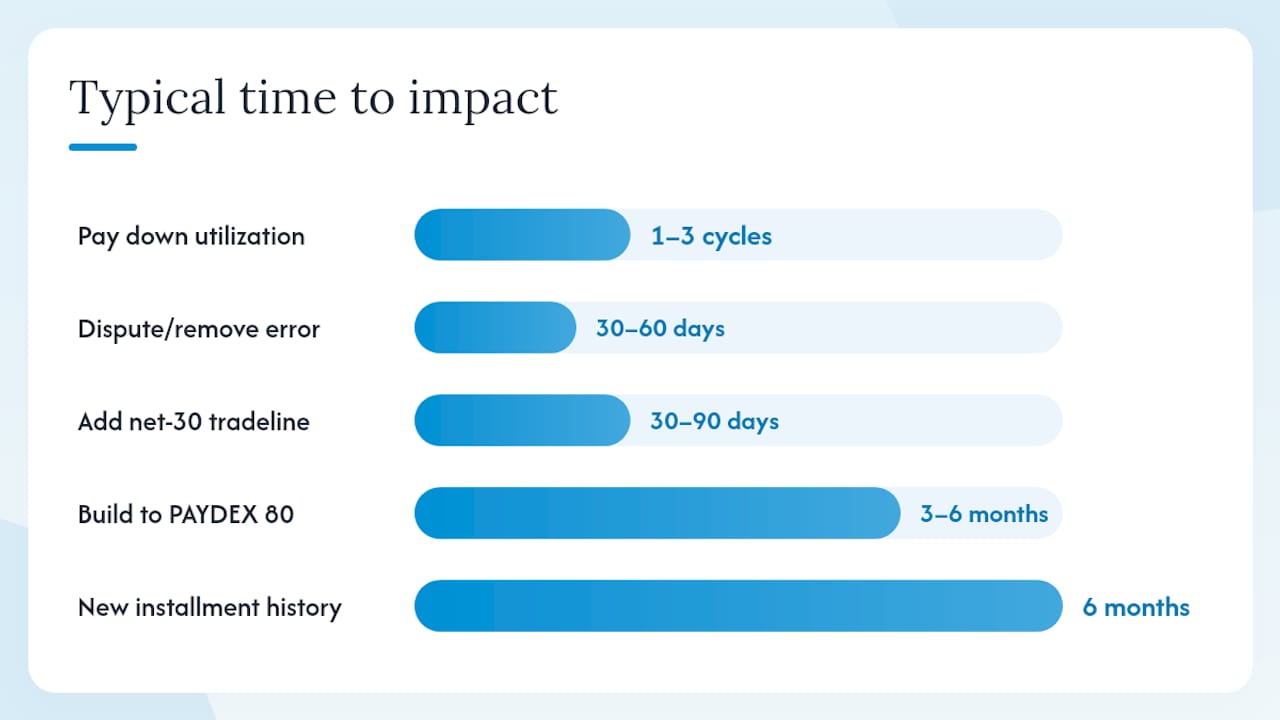
| Dispute and remove a credit error | 30–60 days |
| Pay down revolving utilization to under 30% | 1–3 billing cycles |
| Add a net-30 vendor tradeline | 30–90 days to first report |
| Build business tradelines to PAYDEX 80 | 3–6 months |
| Correct D&B / bureau profile records | 30–60 days |
| Establish new installment account history | 6 months |
Once you have made changes, wait at least one full billing cycle before pulling your scores again. For significant improvements (removing a major derogatory item, building multiple tradelines), allow 90–120 days before applying. Applying too soon after changes means the bureaus have not yet reflected the improvement.
Borrowers who reach the low-risk score bands (personal 720+ or business PAYDEX 80–100) see materially better approval outcomes. Approval data from 2025 shows that low-risk borrowers were approved at substantially higher rates than medium or high-risk applicants, which makes the pre-application improvement window worth taking seriously if you are close to a threshold.
The approval picture in 2025 was not evenly distributed. Lenders concentrated approvals among borrowers who cleared specific score thresholds, and the gap between score bands was meaningful.
Borrowers with personal credit scores of 720 or above, or business scores in the 80–100 range on the PAYDEX and Intelliscore scales, were treated as low risk and approved at higher rates than those in medium or high-risk bands. This was consistent across bank, SBA, and online lender categories, though the absolute approval rates differed by lender type.
Score bands map to realistic options in a fairly predictable way:
The practical implication for timing: if your score is at 635 and you need capital in 90 days, an online lender or equipment loan is your realistic target. If you can wait 6 months and push to 680, SBA and bank products open up with substantially better terms. The decision between “apply now” and “improve first” is really a question of how much the rate difference costs you over the life of the loan versus how much the delay costs your business.
One trend worth noting from 2025 data: lenders increasingly weighted cash flow and bank statement analysis alongside bureau scores. A business with a 650 personal score but 18 months of consistent $50,000+ monthly deposits was often treated more favorably than the score alone would suggest. Approval odds in 2026 continue to reflect this shift toward holistic underwriting, particularly among online and SBA-preferred lenders.
The pattern that shows up most consistently is owners who apply before they are ready, not because they are unqualified in any fundamental way, but because one fixable item is dragging their score below a lender’s threshold. A single collection account from three years ago, a D&B profile with an outdated address suppressing the PAYDEX score, or a business credit card sitting at 85% utilization. Any one of these can be the difference between approval and a counteroffer for half the amount at twice the rate.
Three fixes I see make the most immediate difference for applicants:
Correct the D&B profile. A surprising number of businesses have inaccurate or incomplete records in the D&B database. An address mismatch or missing EIN can prevent a PAYDEX score from generating at all. Fixing it takes a few days and costs nothing.
Secure one net-30 vendor tradeline. Even a single supplier account reporting on-time payments to D&B or Experian can establish or improve a business credit profile faster than waiting for a loan tradeline to season. It is a low-effort, high-impact move that experienced finance managers use routinely.
Reduce utilization before the statement closes. Paying down a revolving balance before the statement date, not just before the due date, is what actually moves the score. Most owners do not know the difference. The bureau sees the balance at statement close, not at payment.
Pro Tip: Time your application to avoid multiple hard inquiries. If you are shopping lenders, do it within a 14–30 day window. Credit scoring models treat multiple inquiries for the same loan type within that window as a single inquiry. Spreading applications over several months is the worst approach. For more on protecting your score during the application process, see how to protect your credit during borrowing.
If your score is not where you want it but your business needs capital now, waiting is not always the right answer. Fordhamcapital connects small and medium-sized businesses to a network of banks and alternative lenders through a one-page application that does not impact your credit score. That means you can check your options without adding a hard inquiry to your report.
Fordhamcapital has funded over $120M for businesses across the U.S. and holds an A+ BBB rating. The platform is built specifically for businesses that traditional banks overlook: those with imperfect scores, limited collateral, or a need for speed. Approvals come back within 24 hours, and funding can follow shortly after. No collateral is required to apply. Whether you are targeting a term loan, a line of credit, or working capital, the lender network covers the full range of products discussed in this article. Before you accept any offer, verify the lender’s registration through NMLS Consumer Access to confirm they are licensed in your state. Apply now and see what your business qualifies for today.
This article is general information, not a substitute for advice from a qualified financial advisor. Consult a qualified financial professional about your own circumstances before acting on anything here.
At Fordham Capital, we've made the application process straightforward and reassuring. Dive in and explore your financial options with confidence, knowing there's no impact on your credit score and no obligations. We review your details and offer customized solutions based on what you're looking for.