

Business loan prequalification is a quick, nonbinding lender assessment that estimates whether your business is likely to qualify for financing. It’s not an approval and it’s not a promise. It’s a preview, and a fast one: most prequalification forms take about 60 to 90 seconds to complete, and many of them run a soft credit check instead of a hard one.
Here’s why that matters before you fill out a single application:
The Small Business Administration doesn’t run prequalification itself, but SBA-backed lenders use similar early screens to steer applicants toward programs like the SBA 7(a) loan, the agency’s primary long-term financing vehicle. If your business doesn’t fit a bank’s box, prequalification is how you find that out in minutes rather than after three weeks of paperwork.
Business loan prequalification works because it gives you a fast, low-risk read on your eligibility before you commit to a full application or risk your credit score.
| Point | Details |
|---|---|
| Prequalification is nonbinding | It’s a quick estimate, not a guarantee of final approval or locked terms. |
| Lenders check the same core factors | Credit score, revenue, time in business, and collateral drive most decisions. |
| Documents matter before you apply | Tax returns, bank statements, and financials speed up verification later. |
| Ask about credit inquiries upfront | Confirm whether prequalification uses a soft pull, a hard pull, or none at all. |
| Small fixes move the needle fast | Correcting credit errors and organizing documents can improve results within weeks. |
| Fordhamcapital streamlines the process | Its one-page application matches you across a lender network, with approvals often within 24 hours. |
Prequalification usually starts with a short form: your business name, time in operation, estimated annual revenue, how much funding you want, and sometimes your personal credit score range. Some lenders ask for your Social Security number to run a soft pull. Others skip the credit check entirely at this stage and estimate eligibility from your revenue and banking activity alone.
What you get back is an estimate, not a contract. A lender might tell you that you likely qualify for a line of credit up to a certain amount, or that a term loan is a better fit given your cash flow. None of that is locked in. PayPal’s small business financing flow is a good real-world example: it uses a quick application with a soft eligibility check, and it doesn’t run a hard credit inquiry unless you actually accept a funding offer. That’s the model most modern lenders follow now, whether they’re a fintech, a marketplace, or a community bank with a digital front door.
The catch is that prequalification is still an informal read. Final approval requires actual verification, meaning the lender will eventually want real documents, not just self-reported numbers, and the terms you saw in your prequal result can shift once underwriting digs into your files.
One more wrinkle worth knowing upfront: prequalification looks different depending on who’s running it. A bank’s version tends to be conservative and paperwork-heavy even at this early stage. An online lender’s version is often instant and automated. An SBA-affiliated lender’s prequal might route you toward a specific program, like the 7(a), based on your size and use of funds. None of that changes what prequalification fundamentally is. It just changes how fast and how deep the first look goes.
The biggest reason to prequalify before you formally apply is speed. You find out in minutes, not weeks, whether a lender is even in your ballpark. That single fact reshapes how you shop for financing.
Picture a seasonal retailer heading into fall, needing $75,000 to stock inventory before the holiday rush. Instead of applying cold to five lenders, the owner runs prequalification checks across a bank, an online lender, and a lending marketplace. Two hours later, she knows the bank wants two years of tax returns she doesn’t have yet, the online lender can move fast but at a higher rate, and the marketplace has matched her with three lenders offering competitive terms. She applies only where she has a real shot, and saves herself both time and unnecessary credit inquiries.
Every lender weighs the same handful of factors, even if the exact cutoffs shift. Understanding these criteria before you apply is the difference between a confident applicant and one who’s guessing.
Personal credit score. Traditional banks and SBA lenders often want to see a FICO score around 670 or above. Online lenders are frequently more flexible here, sometimes working with scores in the 600s if your revenue is solid.
Business credit profile. Separate from your personal score, this reflects how your business has handled its own credit obligations, vendor accounts, and prior loans.
Annual revenue and cash flow. Many online lenders set a revenue floor, OnDeck’s roughly $100,000 minimum is a commonly cited example, because consistent cash flow is often a stronger predictor of repayment than credit alone.
Time in business. Most traditional lenders want at least a couple of years of operating history. Startups and pre-revenue businesses face a narrower set of options, though some pathways exist even before revenue starts flowing.
Industry risk. Lenders price certain industries, like restaurants or construction, differently based on historical default patterns in that sector.
Ownership and character. Some lenders review your business plan, your management background, and how clearly you’ve articulated what the funds will do for the business, a factor covered in more depth in how a business plan affects loan approval.
Existing debt load. A business already carrying heavy debt service may struggle to prequalify for more, regardless of revenue.
Collateral and personal guarantees. Secured loans often require collateral, and many lenders ask for a personal guarantee regardless, an issue worth understanding before you assume every loan requires it.
| Criterion | Typical Threshold | Most Likely To Require It |
|---|---|---|
| Personal credit score | FICO around 670+ | Banks, SBA lenders |
| Annual revenue | $100,000+ | Online lenders, banks |
| Time in business | 1–2 years (some accept 6+ months) | Banks require longer; online lenders more flexible |
| Collateral | Varies by loan type | Banks, secured term loans |
| Existing debt load | Lower debt service preferred | All lender types, especially SBA |
Pro Tip: Online lenders tend to relax credit and time-in-business requirements in exchange for higher rates or shorter terms. If your credit score isn’t quite where a bank wants it, that tradeoff might still get you funded faster than waiting to build a longer track record.
Prequalification itself rarely demands full documentation, but having it ready speeds up everything that follows once a lender says yes. Build this file before you start shopping, not after.
Most lenders now accept PDFs uploaded directly through a portal, and many use secure bank-read permissions (through services that connect directly to your business bank account) instead of requiring you to manually upload statements. That verification step is often what separates prequalification from final approval, since it confirms the revenue and cash flow figures you reported.
Pro Tip: Create a single folder labeled with your business name and the current year, then name each file clearly, like “2025_TaxReturn,” “Q3_BankStatement,” or “P&L_Current.” Lenders and marketplace platforms move faster on applications where documents are obviously organized, and a clean document pack often moves an application from “maybe” to “likely” during verification.
These two terms get used interchangeably, and that’s a mistake. They represent different stages of commitment from both you and the lender.
| Factor | Prequalification | Preapproval |
|---|---|---|
| Scope | Rough estimate based on self-reported info | Deeper review based on verified documents |
| Credit inquiry | Usually a soft pull or none | Often requires a hard pull |
| Verification level | Minimal to none | Documents reviewed and partially confirmed |
| Binding nature | Not binding, terms can change | Closer to a firm offer, subject to final underwriting |
Use prequalification when you’re early in the process and want to shop multiple lenders without credit consequences. Move to preapproval once you’ve narrowed your options and need a firmer number, especially for a large purchase or a time-sensitive deal where you need real confidence the funding will come through. SBA prequalification tools generally sit closer to the prequalification end of this spectrum since SBA loans require extensive documentation before anything resembling a firm offer emerges, while some private online lenders can move from prequal to a preapproval-level offer within the same day.
Getting a positive prequalification result feels good, but it’s easy to over-read what it actually promises. Keep these limits in mind before you make business decisions based on a prequal alone.
Before you submit any prequalification form, ask the lender directly whether the check is soft or hard, and whether accepting a formal offer later will trigger an additional hard pull. That single question, explained in more detail here, can save you from an unpleasant surprise on your credit report a few weeks later.
A positive prequal result isn’t the finish line. It’s the starting gun for the actual application process, and knowing the timeline ahead of you keeps expectations realistic.

Prequalification itself typically resolves within a few hours to a couple of days(https://kredline.com/prequalify-for-business-funding/), depending on the lender and whether they need to manually review anything. Full underwriting and verification is a different animal: expect anywhere from a few days to several weeks for most private lenders, while SBA-backed loans commonly take longer given the additional government paperwork involved.
Once you’ve got prequal results in hand, here’s what to do next:
Before signing anything or submitting a full application, it’s worth asking each lender directly: What’s your realistic timeline to funding? Is my rate estimate locked or still moving? Do you require collateral or a personal guarantee? What’s the next document you’ll need from me?
If your prequal results come back weaker than you hoped, that’s information, not a dead end. Here’s a rough order of what to fix first, based on speed of impact.
Pro Tip: Don’t rerun prequalification the day after you make a change. Give it at least one full billing cycle, generally 30 days, so your credit report and bank statements actually reflect the improvement before a lender sees them.
Fordhamcapital operates as an online marketplace connecting small and medium-sized businesses to a network of banks and alternative lenders, rather than functioning as a direct lender itself. That distinction matters for prequalification specifically: instead of running separate prequal checks with five different lenders, you fill out one form and get matched against multiple potential fits at once.
Routing your prequalification through a single marketplace form instead of five separate lender applications cuts down the redundant data entry and, for many applicants, avoids stacking multiple credit inquiries in a short window. That’s a meaningful advantage if you’re a startup or early-stage business that doesn’t yet fit neatly into a traditional bank’s box. Fordhamcapital’s guidance for pre-revenue applicants reflects the reality that plenty of small businesses need capital before their financials look “bankable” in the traditional sense.
If this is your first time running a prequalification check, don’t overthink it. Do three things in this order: pull your personal credit report first so you know your starting number, gather your last two years of tax returns and three months of bank statements before you touch a single application, and only fill out full applications with lenders whose prequal results actually look promising.
Ask every lender one direct question before you submit anything: does this prequalification use a soft credit check, a hard one, or none at all? Get that answer in writing or in the lender’s stated terms, not just verbally from a sales rep. Too many borrowers assume “prequalification” always means “no credit impact,” and that assumption isn’t universally true.
The businesses that move fastest through this process aren’t the ones with perfect credit. They’re the ones who know their own numbers cold and don’t waste time applying to lenders who were never going to say yes.
If you’ve read this far, you already know the fastest way to shop multiple lenders without hammering your credit score: one application, matched against a network, instead of five separate forms and five separate risks. That’s exactly what Fordhamcapital’s marketplace was built to solve for small and medium-sized businesses that traditional banks tend to overlook.
The process starts with a one-page application, no lengthy business plan required upfront, and Fordhamcapital matches you against its network of banks and alternative lenders, including pathways toward SBA 7(a) financing where it fits your business. Many applicants see approvals within 24 hours, and the initial matching process is built to avoid unnecessary credit impact. Fordhamcapital carries an A+ rating from the Better Business Bureau and has funded more than $120 million for businesses like yours.
If you’re ready to see what you’d likely qualify for, apply now through Fordhamcapital’s one-page form and get matched with lenders suited to your revenue, credit profile, and financing needs.
What is business loan prequalification, exactly? It’s a quick, informal review a lender runs to estimate whether your business is likely to qualify for financing, based on self-reported information like revenue, time in business, and credit score range.
Does prequalifying for a business loan hurt my credit score? It depends on the lender. Many use a soft credit inquiry or no credit pull at all during prequalification, but some require a hard pull, so always ask before you submit the form.
How long does business loan prequalification take? Most prequalification forms take about 60 to 90 seconds to complete, with results often returned within minutes to 48 hours.
Is prequalification the same as preapproval? No. Prequalification is a rough, nonbinding estimate, while preapproval involves more document verification and sits closer to a firm offer, though terms can still change during final underwriting.
What credit score do I need to prequalify for a business loan? Traditional banks and SBA lenders often look for a personal FICO score around 670 or above, while online lenders and marketplaces may work with lower scores if your revenue is strong.
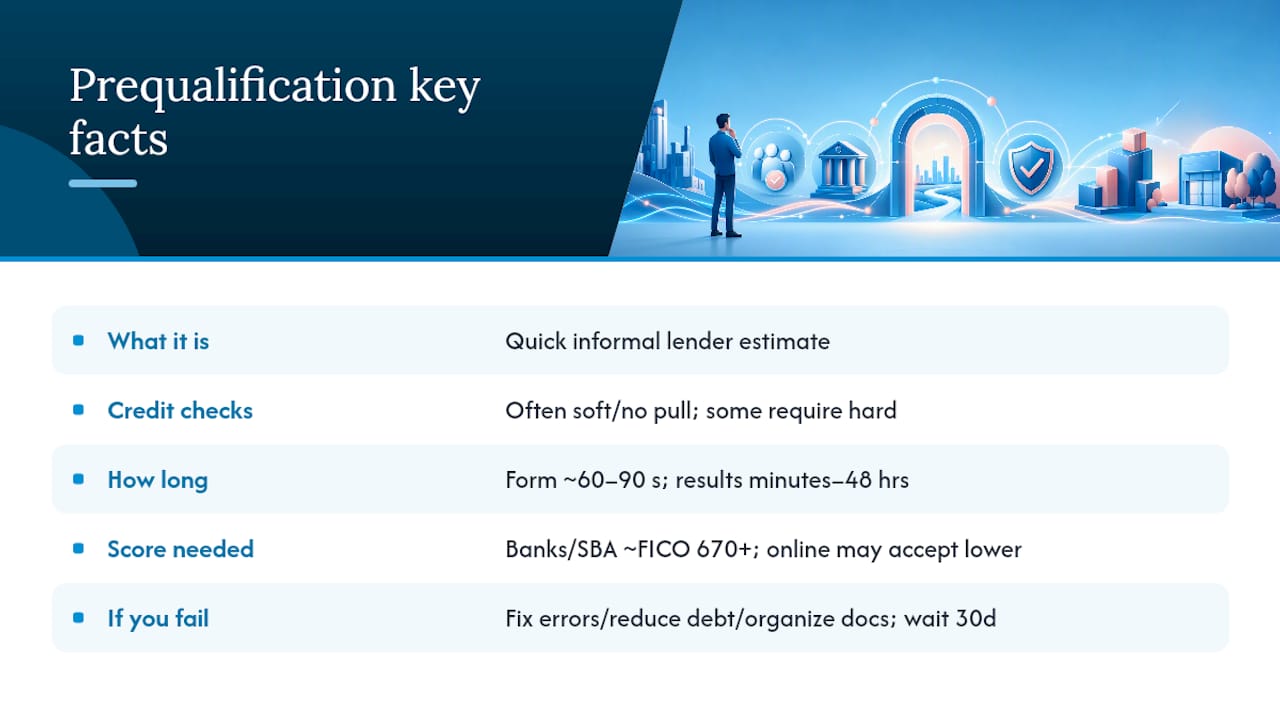
What if I don’t prequalify for a business loan? Focus on the fixes that move fastest: correct credit report errors, pay down existing debt, and organize your financial documents, then wait about 30 days before rerunning prequalification so the improvements show up in your file.
At Fordham Capital, we've made the application process straightforward and reassuring. Dive in and explore your financial options with confidence, knowing there's no impact on your credit score and no obligations. We review your details and offer customized solutions based on what you're looking for.


