
Yes, asset-based lending can put ownership or control of your business assets at risk, and it happens through three specific mechanisms: collateral seizure after default, borrowing base reserves that cut off cash without warning, and account control agreements that let a lender redirect your receipts. None of this is theoretical. It shows up in restructuring case files every year.
If you already have an ABL facility, do three things this week. Pull your current collateral schedule and compare it against your last borrowing base certificate. Reread the covenant and default definitions in your credit agreement, specifically the reporting deadlines. Then call your lender relationship manager or counsel before a small discrepancy becomes a declared default.
Fast fact: the OCC’s Comptroller’s Handbook flags credit, operational, compliance, strategic, and reputation risk as the five categories examiners watch most closely in ABL portfolios, and weak underwriting or loose controls on either side widens all five.
Asset-based lending protects your equity from dilution but transfers real operational control to the lender through borrowing base mechanics, reporting obligations, and enforcement rights that can move faster than owners expect.
| Point | Details |
|---|---|
| Know your exposure points | Collateral seizure, reserve increases, and account sweeps are the three mechanisms that most often threaten ownership control. |
| Watch the reporting cadence | Frequent borrowing base certificates raise the odds of a technical “foot-fault” default from a simple administrative error. |
| Negotiate before you sign | Cap discretionary reserves, secure cure periods, and narrow collateral definitions at the term sheet stage. |
| Protect your credit history | A prior ABL reserve or default event follows you into future underwriting decisions, often for years. |
| Consider faster, lighter alternatives | Fordhamcapital’s one-page application and 24-hour approval process offer a way to access capital while comparing lighter-touch financing structures. |
Further reading: the OCC Comptroller’s Handbook, ABA’s ABL analysis, and the restructuring case study on ABL-induced distress.
Asset-based lending is a loan structure secured by specific business assets, usually accounts receivable, inventory, equipment, or real estate, rather than by cash flow projections or a personal guarantee alone. The lender advances against a percentage of each asset’s value, known as the advance rate, and the sum of those advances forms your borrowing base.
That structure sounds straightforward until you see what it does to your cash access day to day.
Lenders also require frequent reporting, sometimes weekly or even daily borrowing base certificates. That cadence is exactly why foot-fault defaults happen so often: one late report or misclassified invoice can technically trigger a default clause.
Six mechanisms account for most of the ownership and control problems ABL borrowers run into. Each one operates a little differently, but they compound fast when a business is already under stress.
Pro Tip: Ask your lender for the exact definition of “eligible collateral” in writing before you sign anything. Vague language here is where most foot-fault defaults originate, and it’s the easiest thing to fix at the negotiating table.
The Epoch Financial write-up on middle-market ABL makes an important distinction: the facility itself doesn’t dilute your equity the way a venture round would. What it does instead is shift day-to-day operational power toward the lender, because the lender’s core interest is liquidation value, not your five-year growth plan.
Enforcement rarely starts with repossession; effective hedging based on value at risk strategies can help lenders manage collateral risk and avoid sudden enforcement actions. It starts with paperwork, and it escalates in a fairly predictable sequence.
Lenders conduct periodic field audits and third-party appraisals to verify collateral value, and those exams can trigger reserves the moment results come back lower than expected. Common triggers include a shift in accounts receivable aging, rising customer concentration, a covenant breach, or a bad quarter that spooks the credit team.
The timeline compresses faster than most owners expect. A reserve can appear within days of a field exam. Full enforcement, from reserve to liquidation, has played out over a matter of weeks in some documented restructuring cases, not months. Speed is the entire point of ABL from a lender’s perspective: the collateral is the security, and the lender wants the ability to act before that collateral’s value erodes further.
The OCC Comptroller’s Handbook treats ABL as a distinct risk category for examiners, warning that inadequate underwriting or weak monitoring controls increases the chance that a facility produces larger losses than a traditional cash-flow loan would. That guidance exists because regulators have seen the pattern play out repeatedly at the bank level.
Restructuring analysts have documented the pattern from the borrower’s side too. A detailed case write-up on retailer Party City traces how appraisal-driven reserve increases on inventory collateral tightened liquidity at a moment the company could least afford it, contributing to a cascade that ended in bankruptcy proceedings.
A borrowing base reserve isn’t a warning shot. It’s often the first visible sign that a liquidity spiral has already started, because by the time the reserve shows up, the appraisal or aging shift that triggered it has already happened.
Legal commentary from the American Bar Association reinforces the same point from a drafting angle: foot-fault defaults are common enough that experienced counsel routinely negotiate cure periods and narrower default triggers specifically to prevent administrative errors from becoming existential threats.
Most of the risk in an ABL facility gets set at the negotiating table, before you ever draw on the line. A handful of specific asks make a real difference.
On the operational side, tighten your own house before you sign anything. Faster AR collections, cleaner inventory counts, and weekly internal reconciliations against your borrowing base certificate all reduce the odds of a foot-fault. Keep appraisals and insurance current, since a lapsed policy or stale appraisal gives a lender an easy excuse to impose a reserve. Fordhamcapital’s own breakdown of collateral requirements covers how valuation timing affects available credit in more detail.
Pro Tip: Bring a restructuring advisor into the room during term sheet negotiation, not after a default notice arrives. The cost of an hour of advice up front is nothing compared to the cost of renegotiating under duress.
Before signing, ask the lender directly: what triggers a reserve, how is the eligible collateral base recalculated, and what’s the actual cure period for a reporting miss. If the answers are vague, that’s your signal to bring in counsel.
ABL fits certain businesses well despite the control trade-offs. Asset-rich companies with seasonal cash flow, manufacturers with strong receivables, or businesses mid-turnaround that need working capital fast are often better served by ABL than by an unsecured loan they might not qualify for anyway.

The trade-off against other financing is fairly clean: cash-flow lending relies on earnings history and skips collateral liens but usually costs more and caps out lower; equity financing avoids debt and monitoring entirely but costs you a permanent slice of ownership.
Red flags that ABL is the wrong fit:
A defaulted or restructured ABL facility leaves a mark that follows you well past the immediate crisis. Once a lender imposes reserves or moves to enforcement, that activity typically gets reported to commercial credit bureaus, and future lenders will see it during underwriting.
The damage compounds in a specific way. A business that’s already been through a borrowing base reserve event looks riskier to the next lender, which usually means a lower advance rate, a higher interest rate, or a demand for additional collateral the second time around. Some lenders will decline outright if they see a prior ABL default on file, regardless of how the business has since stabilized.
There’s a quieter cost too. Businesses coming out of an ABL-driven liquidity event often find their options narrow toward more asset-based structures rather than away from them, because unsecured and cash-flow lenders lean heavily on trailing financial performance, and a recent crisis depresses those numbers for a year or more. That’s part of why industry surveys showing more than half of small business owners hit a major cash-flow crisis within their first three years matter here. A crisis early in a company’s life can lock it into higher-cost, more restrictive financing for years afterward, simply because the credit history shows stress.
Protecting your standing means treating every borrowing base certificate and covenant compliance report as a credit-history document, not just an internal administrative task.
Every financing option trades one kind of risk for another, and the honest comparison isn’t about which is “safest” in the abstract. It’s about which risk you’re better positioned to absorb.
Unsecured loans and lines of credit skip the lien on specific assets, which means no borrowing base recalculations and no field exams. The trade is that unsecured lenders underwrite almost entirely on cash flow and personal or business credit history, so approval is harder to get and the ceiling on available capital is usually lower. There’s also often a personal guarantee attached, which creates its own ownership risk if the business can’t repay.
Equity financing removes repayment risk and collateral risk entirely. No lender can seize your inventory because there’s no lien to enforce. But you give up a permanent piece of the company, and new equity holders typically want a say in major decisions, sometimes a board seat, sometimes veto rights over specific actions. That’s a different, more permanent kind of control risk than anything ABL creates.
ABL sits in the middle. You keep full equity ownership, which the Epoch Financial analysis rightly credits as a real advantage over dilutive capital. But you accept an ongoing, active monitoring relationship where the lender has contractual leverage over your operating cash and your assets. The risk isn’t losing a percentage of the company. It’s losing operational discretion over specific assets under specific conditions, which is a narrower but sometimes sharper kind of exposure.
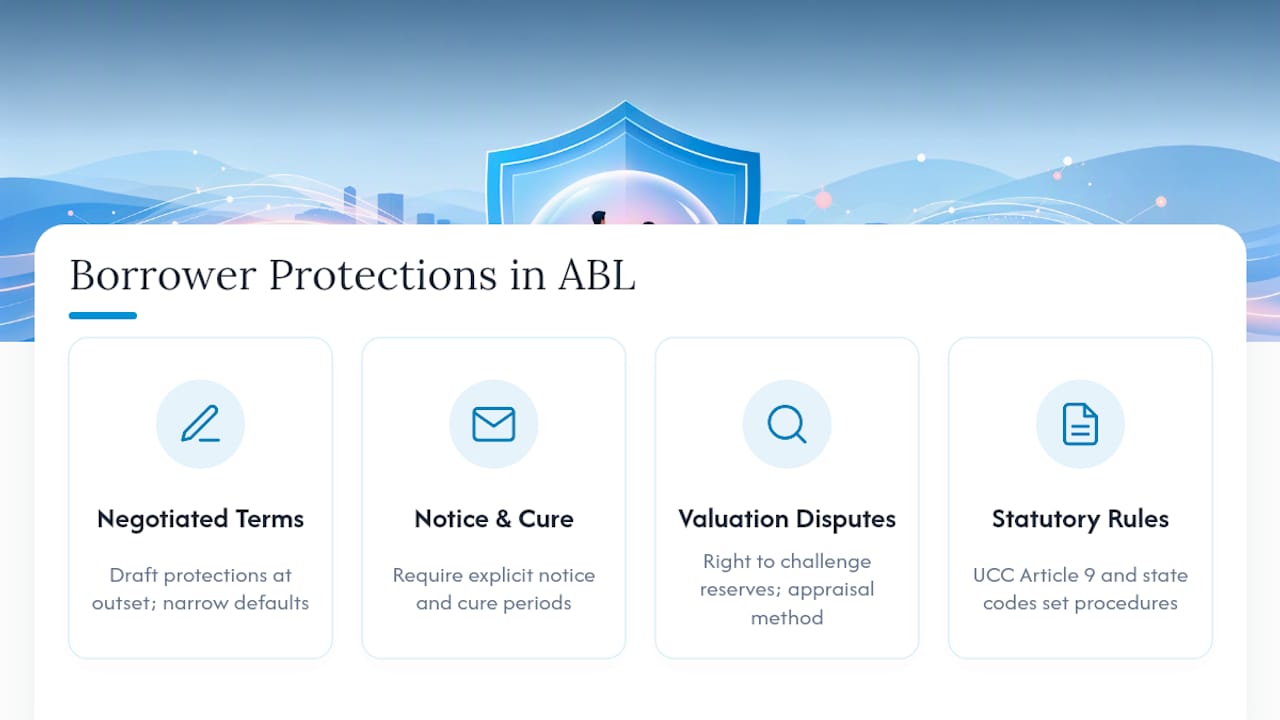
Business owners aren’t without leverage in an ABL relationship, even though the collateral focus tilts the agreement toward the lender by design. The protections just have to be negotiated in, not assumed.
Every ABL credit agreement is a negotiated contract, and courts generally enforce the terms as written, which cuts both ways. That’s precisely why the American Bar Association’s commentary on ABL facilities stresses drafting protections at the outset: narrowly defined events of default, explicit notice requirements before a lender can act, and cure periods that give borrowers a real chance to fix administrative issues before enforcement begins.
Borrowers also generally retain the right to dispute a lender’s collateral valuation or reserve calculation, particularly when the credit agreement specifies an appraisal methodology or requires “commercially reasonable” conduct from the lender. That standard, commercially reasonable, shows up throughout secured lending law and gives borrowers a legal hook to challenge reserves or enforcement actions that seem arbitrary or punitive rather than tied to genuine collateral risk.
State commercial codes and the Uniform Commercial Code’s Article 9 govern how secured lenders can perfect liens and enforce them, and they set baseline procedural requirements a lender must follow before repossessing or selling collateral. None of that eliminates the risk, but it means enforcement isn’t unlimited or instant. Owners who understand these protections, and who negotiate specific contract language reinforcing them, hold considerably more ground than those who sign a standard term sheet without review.
Most ownership risk in ABL gets managed or mismanaged long before a default notice, in how proactively an owner communicates with their lender relationship manager.
There are other routes to working capital, and full asset-based facilities with heavy monitoring and reserve clauses are one of them. Fordhamcapital takes a different approach: a one-page application, access to a network of banks and alternative lenders, and approvals within 24 hours, without the credit-score impact that comes from shopping multiple traditional bank applications one at a time.
That speed matters most for exactly the businesses this article has been talking about, ones facing a cash crunch or a lender relationship that’s grown too restrictive. Fordhamcapital holds an A+ BBB rating and has funded over $120M for small and medium-sized businesses, connecting them with financing options that don’t automatically require the kind of heavy collateral monitoring covered above. If you’re weighing a new facility or trying to get out from under restrictive covenants on an existing one, apply now and compare what a faster, more transparent funding process looks like against the term sheet in front of you.
Can a lender seize my business assets under an asset-based lending agreement? Yes, after a declared default, most ABL agreements give the lender the right to repossess and sell pledged collateral to recover the outstanding balance, following procedures set out under state commercial law and the credit agreement itself.
What triggers a borrowing base reserve? Reserves typically follow a fresh appraisal, a shift in receivables aging, rising customer concentration, or a covenant breach; the restructuring newsletter’s analysis shows how quickly these can escalate once triggered.
How is asset-based lending different from a traditional business loan? Traditional cash-flow loans underwrite primarily on earnings history and credit score, while ABL secures the loan against specific assets like receivables and inventory, with ongoing monitoring tied directly to those asset values.
Does an ABL default affect my ability to get financing later? Yes, a defaulted or restructured ABL facility typically gets reported to commercial credit bureaus and tends to push future lenders toward more restrictive, higher-cost terms.
What’s the fastest way to reduce ownership risk in an existing ABL facility? Negotiate a cap on discretionary reserves and a real cure period for administrative defaults, and tighten internal reporting so borrowing base certificates are accurate and on time every cycle.
This article is general information, not a substitute for advice from a qualified financial advisor. Consult a qualified financial professional about your own circumstances before acting on anything here.
At Fordham Capital, we've made the application process straightforward and reassuring. Dive in and explore your financial options with confidence, knowing there's no impact on your credit score and no obligations. We review your details and offer customized solutions based on what you're looking for.