Fast approval loans are financing solutions that deliver capital to startups within days, not months, giving founders the speed they need to act on real opportunities before they disappear. Understanding how fast approval loans fuel startup growth means recognizing that timing is often the difference between landing a major contract and losing it to a better-funded competitor. Traditional bank loans approve only 20–30% of small business applications and take 30–90 days to fund. That gap kills momentum. The industry term for this category is “alternative business lending,” and it has reshaped how early-stage companies access growth capital. Fordhamcapital has funded over $120M through this model, helping clients generate more than $500M in revenue.
Fast approval lenders use a different scorecard than traditional banks. The focus shifts from credit history to current business performance, which is a major advantage for founders who are building fast but haven’t had years to establish credit.
The core criteria most fast lenders apply:
Traditional banks weight your credit history heavily because they lack the tools to analyze real-time cash flow quickly. Fast approval lenders use automated bank statement analysis and instant credit checks, so they can make a decision in hours rather than weeks. That technology shift is what makes the speed possible.
Alternative lenders evaluate current revenue rather than historical credit records, which democratizes access to growth capital for startups that banks routinely overlook.
Pro Tip: Before applying, pull 3–6 months of bank statements and calculate your average monthly deposits. If that number is above $15,000 and consistent, lead with it. Lenders reward founders who present clean, organized financials upfront.
Speed of capital is a competitive weapon. The practical use cases where quick funding creates real business advantages are specific and measurable.
Bulk inventory at a discount. A supplier offers a 30% discount on a large order, but only for 72 hours. A startup waiting on a 60-day bank loan misses it entirely. Funds available in as little as 2 business days through fast approval lenders make that purchase possible. The math is straightforward: paying a 10% loan fee to capture a 30% discount is a net gain.
Marketing campaigns with measurable ROI. A startup that identifies a high-converting paid acquisition channel can use fast capital to scale that channel before competitors notice the same opportunity. Waiting 90 days for bank approval means the window closes.

Bridging net-30 and net-90 payment gaps. Many B2B startups deliver services or products and then wait 30–90 days for client payment. That gap creates a cash flow problem that has nothing to do with business health. Fast approval loans fill that gap without forcing founders to slow down operations.
Preserving equity. Debt financing lets startups scale without giving up ownership. Every dollar raised through a loan instead of equity is a dollar of future company value the founder keeps.
The key mindset shift is treating fast capital as an investment, not a cost. The question is not “what does this loan cost?” The question is “what does this loan make possible, and what is that worth?”
Pro Tip: Before taking a fast approval loan, write down the specific revenue outcome you expect from deploying the capital. If you cannot name a concrete return, wait. If you can, the math usually favors moving fast.
The timeline difference between traditional and fast approval lending is not marginal. It is structural.
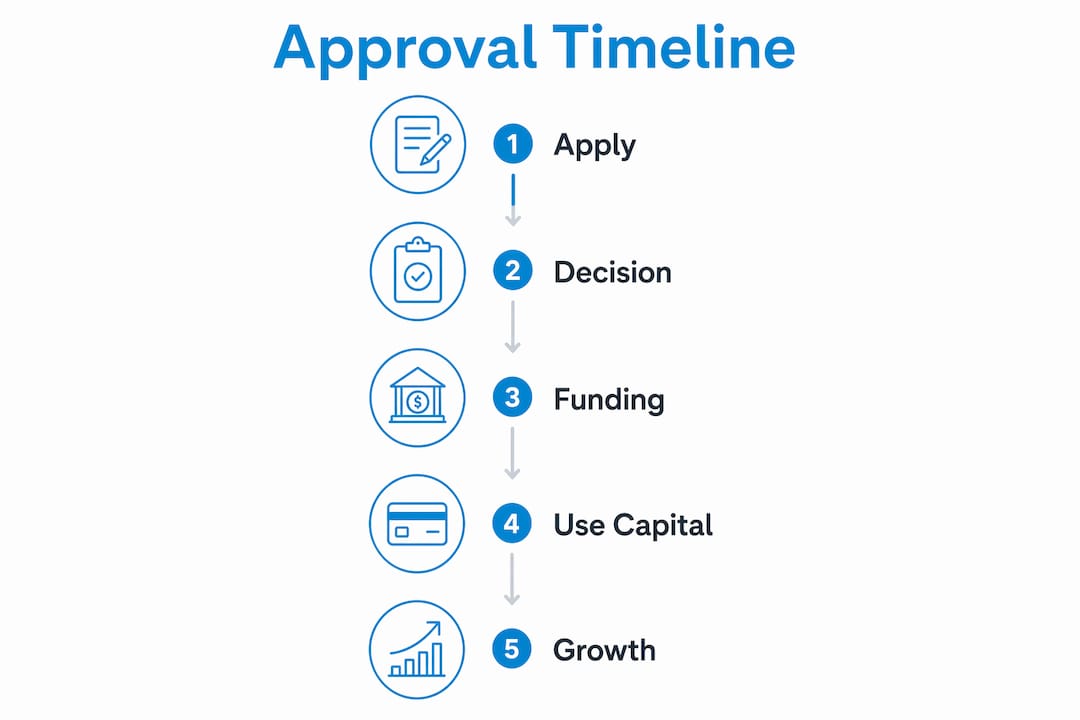
Traditional banks take 30–90 days to fund a loan because their underwriting process involves manual document review, committee approvals, and collateral appraisals. Fast approval lenders use automated cash flow analysis, instant credit checks, and online applications to compress that process into hours.
| Loan Type | Application Time | Approval Decision | Funding Speed |
|---|---|---|---|
| Traditional bank loan | 1–3 days of paperwork | 2–8 weeks | 30–90 days total |
| SBA loan | Several days | 4–8 weeks | 60–90 days total |
| Fast approval lender | 15–30 minutes online | Same day to 24 hours | 1–3 business days |
The Colorado Startup Loan Fund is one example of a government-backed program that has worked to reduce approval timelines for early-stage companies. Even so, most government programs still require weeks of review. Private fast approval lenders consistently outpace them on speed.
The single biggest factor in your approval speed is application readiness. Lenders with automated systems can only move as fast as the documents you provide. A complete application with 3–6 months of bank statements, a valid business license, and basic financial records can cut your approval time in half compared to an incomplete submission.
Pro Tip: Build an “application package” folder now, before you need funding. Include your last 6 months of bank statements, your EIN, your business license, and a one-page summary of your monthly revenue. When an opportunity appears, you apply in 20 minutes instead of scrambling for 3 days.
Fast approval loans are not free money. The speed and flexibility come with real costs that founders need to factor into their decisions.
The main trade-offs:
The strategic answer is to match the loan to the opportunity. Use fast approval loans for short-term, high-return deployments. Use longer-term, lower-cost financing for infrastructure and equipment. Combining both is the approach that avoids operational stagnation while keeping your total cost of capital manageable.
Pro Tip: Use fast approval loans as bridge financing while a longer-term loan application is in process. You capture the opportunity now and refinance into cheaper capital later. This dual-track approach is how experienced founders manage both speed and cost.
Getting approved is step one. Using the capital well is what actually drives growth.
To improve your approval odds:
You can find detailed guidance on improving loan approval odds before you apply.
Smart capital allocation after approval:
| Use Case | Why It Works | Risk Level |
|---|---|---|
| Bulk inventory purchase | Captures discount, increases margin | Low if demand is confirmed |
| Paid marketing campaign | Scales proven acquisition channel | Medium, requires tested ROI data |
| Bridging client payment gaps | Maintains operations, no revenue loss | Low if client is creditworthy |
| Equipment for a signed contract | Revenue is already committed | Low |
| Speculative product launch | Revenue is uncertain | High |
The risk of fast approval loans is not the interest rate. The risk is deploying capital into uses that do not generate a return before the repayment schedule kicks in. Founders who treat fast capital as a surgical tool for specific growth pivots consistently outperform those who borrow broadly and hope for the best.
Avoid over-borrowing. Take what the specific opportunity requires, not the maximum you qualify for. Excess debt with no corresponding revenue plan is the fastest way to turn a growth tool into a liability.
Fast approval loans fuel startup growth by delivering capital in days rather than months, letting founders act on time-sensitive opportunities that traditional bank timelines make impossible.
| Point | Details |
|---|---|
| Lender criteria favor cash flow | Approval requires 3–6 months of history and $15,000+ monthly revenue, not a perfect credit score. |
| Speed is a competitive advantage | Missing a bulk discount or marketing window costs more than a fast loan’s higher fees. |
| Timelines differ dramatically | Fast lenders fund in 1–3 business days; traditional banks take 30–90 days. |
| Match loan type to use case | Use fast loans for short-term, high-return deployments and longer loans for infrastructure. |
| Dual-track strategy reduces cost | Applying for fast and traditional loans simultaneously bridges gaps while securing cheaper long-term capital. |
Most founders I’ve worked with underestimate one specific number: the opportunity cost of slow capital. They see a fast loan’s higher rate and stop there. They don’t calculate what it costs to miss the deal.
Here’s what I’ve found actually matters. A startup that waits 60 days for a bank loan to buy inventory at a 30% discount doesn’t just miss the discount. It misses the revenue cycle that discount would have funded. That compounding effect is invisible in a spreadsheet but very real in a bank account.
The other thing I see consistently is founders treating a bank rejection as a verdict on their business. It isn’t. Bank rejection often pushes startups toward modern, flexible funding that actually fits a fast-growth model better. Banks are built for stability. Fast approval lenders are built for momentum.
My honest advice: build your dual-track funding strategy before you need it. Know which fast lender you would call today if an opportunity appeared tomorrow. Have your application package ready. The founders who move fastest are rarely the ones with the most capital. They’re the ones who prepared before the moment arrived.
Fast approval loans are not a substitute for financial discipline. They are an amplifier for founders who already know where the returns are.
— Rob
Fordhamcapital was built for exactly the situation this article describes: a real opportunity, a tight window, and a traditional bank that moves too slowly.
The one-page application connects you to a wide network of banks and lenders without a hard credit pull. Approvals come within 24 hours. Fordhamcapital holds an A+ BBB rating and has helped founders access over $120M in capital. If you’re ready to move on a growth opportunity and need capital that matches your timeline, the application takes minutes. Learn more about fast funding options built for startups at every stage.
Many fast approval lenders accept credit scores as low as 500, prioritizing monthly revenue and cash flow consistency over credit history. A score above 600 typically improves your rate, but it is rarely a hard requirement.
Fast approval lenders can approve applications within hours and deposit funds within 1–3 business days. Traditional banks and SBA programs typically take 30–90 days from application to funding.
Many fast approval loans are unsecured, meaning no collateral is required. Lenders offset that risk with higher rates and shorter terms rather than requiring you to pledge business assets.
The highest-return uses are bulk inventory purchases at a discount, scaling a proven paid marketing channel, and bridging net-30 or net-90 client payment gaps. Avoid using fast capital for speculative launches where revenue timing is uncertain.
Yes, and experienced founders often do. A dual-track funding strategy uses fast capital to cover immediate needs while a lower-cost traditional loan processes in the background, keeping growth continuous without funding gaps.
At Fordham Capital, we've made the application process straightforward and reassuring. Dive in and explore your financial options with confidence, knowing there's no impact on your credit score and no obligations. We review your details and offer customized solutions based on what you're looking for.