
Lenders evaluate startup repayment ability through five core lenses: cash flow projections, creditworthiness, collateral, business plan quality, and founder execution track record. No single factor wins the deal alone. A startup with strong personal credit but no revenue model will stall at underwriting just as fast as one with great traction but a founder who can’t explain how the loan gets repaid. Here’s what lenders actually look at, and how you can prepare for each criterion:
The numbers lenders care about most aren’t the ones that look best on a pitch deck. They’re the ones that answer one question: can this business generate enough cash to cover its debt?
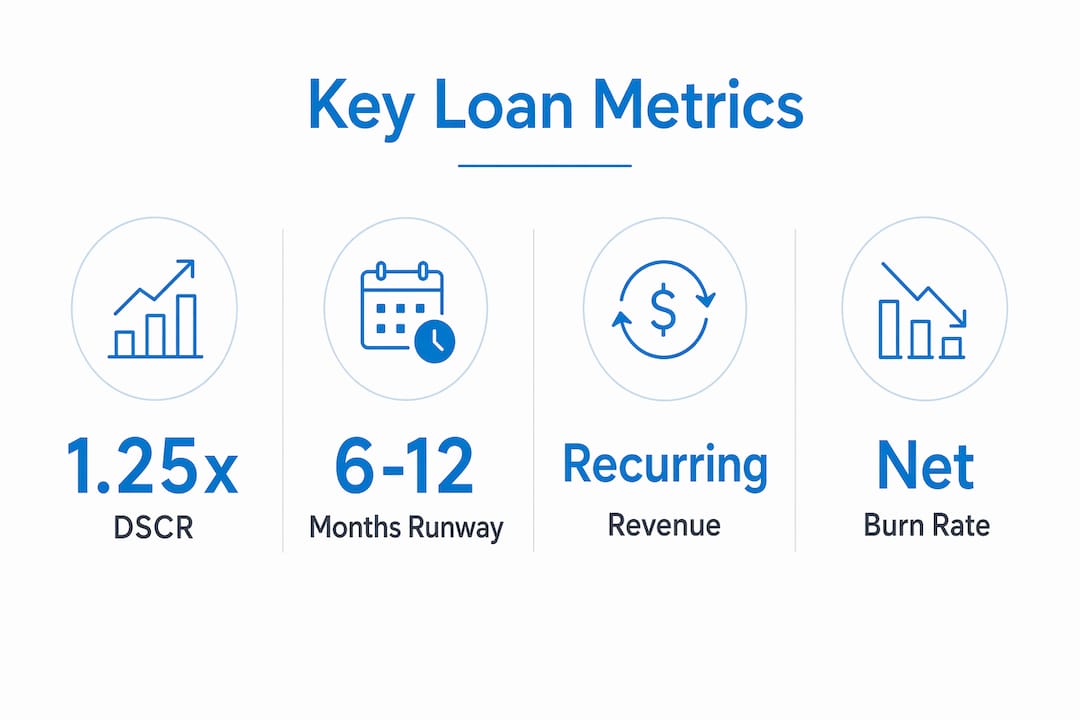
The Debt Service Coverage Ratio is the single most scrutinized metric in startup loan underwriting. A DSCR above 1.25x tells a lender that projected cash flows exceed debt payments by a meaningful margin. Anything below 1.0x means the business can’t cover its obligations from operations alone, which is a hard stop for most lenders.
Cash runway and net burn rate matter just as much as DSCR for early-stage companies. Lenders prefer startups with sufficient runway and a burn rate that stays manageable relative to monthly recurring revenue. A startup burning through cash faster than it earns signals fragility, even if the revenue trend looks promising.
Revenue quality is another dimension lenders probe carefully. Recurring revenue models, particularly SaaS with monthly or annual contracts, score better than one-time project revenue because they’re predictable. Customer concentration above 30% from a single client raises red flags, since losing that client could collapse repayment capacity overnight. Gross margin and unit economics round out the picture, showing whether the business can actually generate cash as it scales, not just grow its top line.
Key financial metrics lenders evaluate:
| Metric | What Lenders Look For |
|---|---|
| Debt Service Coverage Ratio (DSCR) | Projections must show a Debt Service Coverage Ratio above 1.25x to satisfy most lenders. |
| Net burn rate | Under 20–30% of MRR |
| Customer concentration | No single client above 30% of revenue |
| Gross margin | Sufficient to sustain operations and debt service |
| Revenue type | Recurring (MRR/ARR) preferred over project-based |
Lenders also run sensitivity stress tests on several key financial drivers, modeling what happens if revenue drops significantly. If your projections only work in the best-case scenario, expect pushback. Showing that the business survives a meaningful downturn is what separates a fundable plan from an optimistic one.
Financial metric categories relevant for startup loans:
For pre-revenue or early-stage startups, personal credit score is often the first filter a lender applies. Business credit history simply doesn’t exist yet, so lenders use the founder’s personal FICO score as the closest available signal of financial discipline. Minimum personal FICO scores of 680–719 are typically required for SBA microloans, while scores above 720 are preferred for SBA 7(a) loans.
Once a business has been operating for a year or more, business credit scores from bureaus like Dun & Bradstreet, Experian Business, and Equifax Business enter the picture. These scores reflect payment history with vendors, credit utilization, and public records. A strong business credit profile can reduce the weight placed on personal credit, but it rarely replaces it entirely in startup underwriting.

Personal financial statements are another layer lenders examine closely. They want to see liquidity, savings, and personal debt levels, because a founder who is personally over-leveraged represents a compounded risk. If the business struggles, a cash-strapped founder has fewer options to support it.
Creditworthiness factors that affect lender decisions:
Pro Tip: Pull your personal credit report at least 90 days before applying for a startup loan. Errors on credit reports are more common than most founders realize, and disputing them takes time you won’t have mid-application.
Collateral converts an unsecured lending risk into a secured one, and that shift changes everything about how a lender prices a loan. When a lender can attach a claim to a physical asset, the downside of default becomes manageable. Without collateral, the lender absorbs the full loss if the startup fails.
Acceptable collateral for startup loans typically includes real estate, equipment, inventory, and accounts receivable. Lenders apply loan-to-value ratios of approximately 75–80% for real estate and 50–70% for other asset types, meaning they’ll lend a fraction of the asset’s appraised value, not its full worth. Equipment financing is a common entry point for startups because the purchased equipment itself serves as collateral, making approval more accessible than a general-purpose term loan.

Government-backed programs like SBA 7(a) loans partially solve the collateral problem for startups that lack significant assets. The government guarantee reduces lender exposure, which is why these programs often require less stringent financial histories than conventional loans. For founders exploring secured lending criteria, understanding how collateral affects both approval odds and interest rates is worth the time before you sit down with a lender.
Collateral considerations for startups seeking loans:
A lender’s confidence in your startup is directly proportional to the quality of your paperwork. That sounds blunt, but it’s accurate. A well-organized application signals that you understand your business well enough to explain it clearly, which is itself a form of risk mitigation.
The core financial documents lenders expect include profit and loss statements, balance sheets, cash flow statements, two to three years of personal and business tax returns, and forward-looking financial projections. For startups without historical financials, the projections carry extra weight. A comprehensive business plan with 3–5 year financial projections and scenario modeling, including downside cases, increases lender confidence because it demonstrates that you’ve thought through risk, not just opportunity.
Legal documentation matters too. Business registration, licenses, operating agreements, and any relevant permits establish that the company is a real, operating entity. Lenders also respond positively to market validation evidence: letters of intent from prospective customers, signed pilot contracts, or purchase orders show that revenue projections aren’t purely theoretical. For pre-revenue startups, understanding how to apply for a business loan with limited financial history is a practical starting point before assembling your documentation package.
Typical documentation and planning requirements for startups:
Execution risk is the lender’s way of asking: does this team actually know how to run this business? A great market opportunity with the wrong team is still a bad loan. Lenders have seen enough failed startups to know that the plan matters less than the people executing it.
Founder industry experience significantly reduces perceived execution risk. Lenders prefer founders with 5–10 years of relevant experience in their sector, because that background correlates with better decision-making under pressure, stronger industry networks, and a more realistic grasp of unit economics. A first-time founder entering an unfamiliar industry faces a steeper credibility hill to climb, regardless of how compelling the business model looks on paper. Beyond the founder, lenders assess the broader management team. Do you have someone who understands operations? A CFO or financial advisor who can produce credible projections? Gaps in the leadership team get noted. Some lenders conduct direct interviews with founders, and references from prior employers, investors, or business partners can carry real weight in the evaluation. The founding team’s background shapes not just whether you get approved, but what terms you’re offered.
Pro Tip: Prepare a one-page founder bio for each key team member that highlights industry-specific wins, not just job titles. Lenders read these. A specific example of a past business challenge you solved is more persuasive than a list of credentials.
Execution risk and experience factors lenders evaluate:
Not every lender applies the same standards, and understanding that variance can save you months of wasted applications. Community banks and credit unions tend to rely more on relationship-based underwriting, meaning a face-to-face meeting with a loan officer carries real weight. The FDIC’s 2024 Small Business Lending Survey found that banks emphasizing credit bureau data in underwriting are 10–15 percentage points less likely to lend to startups than those using broader evaluation criteria.
Large banks lean heavily on hard data: credit scores, bureau reports, and standardized financial ratios. That approach works well for established businesses with years of records but disadvantages startups almost by design. Small banks, by contrast, are more likely to meet with applicants and use that conversation to fill in the gaps that financial statements can’t. Among banks that hold direct meetings with decision-makers, the likelihood of lending to startups rises to 56–74%, compared to 26% for banks that skip those meetings.
SBA participation reshapes the calculus for large banks specifically. Being an SBA lender is associated with a meaningfully higher likelihood of lending to startups, because the government guarantee absorbs a portion of the default risk. For founders with limited collateral or short operating history, targeting SBA-participating lenders is often the most direct path to approval. Knowing which lender type fits your profile, before you apply, is the kind of preparation that changes outcomes.
Lenders don’t rely on gut instinct alone. Most use structured scoring models that assign weighted values to financial, credit, and qualitative factors, producing a composite score that guides the underwriting decision.
The most common framework is the Five C’s of Credit: Character, Capacity, Capital, Collateral, and Conditions. Character covers creditworthiness and founder reputation. Capacity is the DSCR and cash flow analysis. Capital refers to the owner’s equity investment in the business. Collateral is the asset backing. Conditions include the loan purpose and broader economic environment. Every lender weights these differently, but the framework is consistent enough that preparing for all five gives you a strong foundation across lender types.
Beyond the Five C’s, many lenders use proprietary credit scoring algorithms that pull from credit bureau data, financial statement ratios, and industry benchmarks. SBA lenders use the SBA’s own credit scoring tool for loans under certain thresholds, which incorporates personal credit, business financials, and loan characteristics into a single score. Projection-based underwriting adds another layer: lenders run sensitivity models on your financial forecasts, testing whether the business holds up if revenue falls 20–30% below plan. Providing a robust downside scenario with specific mitigations, not just a best-case projection, is what moves a borderline application toward approval. Founders exploring types of pre-revenue business loans will find that different loan structures weight these scoring components differently, which affects which product fits your stage.
Understanding what lenders want is half the battle. Getting in front of the right lenders, quickly, is the other half. Fordhamcapital works with a wide network of banks and lenders, matching startups and small businesses to financing options that fit their actual profile, not just the ones that look good on a checklist.
The application process takes one page and avoids any credit impact during the initial review. Approvals can come within 24 hours, which matters when you’re working against a funding timeline. Fordhamcapital holds an A+ BBB rating, has funded over $120M, and has helped clients generate more than $500M in revenue. If you’re ready to put your preparation to work, apply now and see what you qualify for.
Lenders assess startup repayment ability through a combination of financial metrics, credit history, collateral, documentation quality, and founder execution track record, with no single factor determining the outcome alone.
| Point | Details |
|---|---|
| DSCR is the core financial threshold | Projections must show a Debt Service Coverage Ratio above 1.25x to satisfy most lenders. |
| Personal credit score is the first filter | Minimum FICO scores of 680–719 are typically required for SBA microloans; above 720 for SBA 7(a) loans. |
| Cash runway signals stability | Lenders prefer 6–18 months of runway with a burn rate under 20–30% of MRR. |
| Collateral shifts loan terms | Real estate collateral is valued at 75–80% LTV; other assets at 50–70% LTV. |
| Founder experience reduces risk | Lenders prefer founders with 5–10 years of relevant industry experience when evaluating execution risk. |
At Fordham Capital, we've made the application process straightforward and reassuring. Dive in and explore your financial options with confidence, knowing there's no impact on your credit score and no obligations. We review your details and offer customized solutions based on what you're looking for.