Revenue-based financing (RBF) is a funding model where a business receives upfront capital in exchange for a fixed percentage of its future monthly revenue until a predetermined repayment cap is met. Unlike a traditional bank loan, there are no fixed monthly payments and no equity given up. Repayments rise when sales are strong and fall when revenue dips. Providers like Kapitus, Wayflyer, and AltCap have built entire businesses around this model, serving the small and mid-sized companies that conventional banks routinely pass over. If you’ve been searching for a flexible funding path that doesn’t require perfect credit or years of financial history, understanding how revenue based financing works is the right place to start.
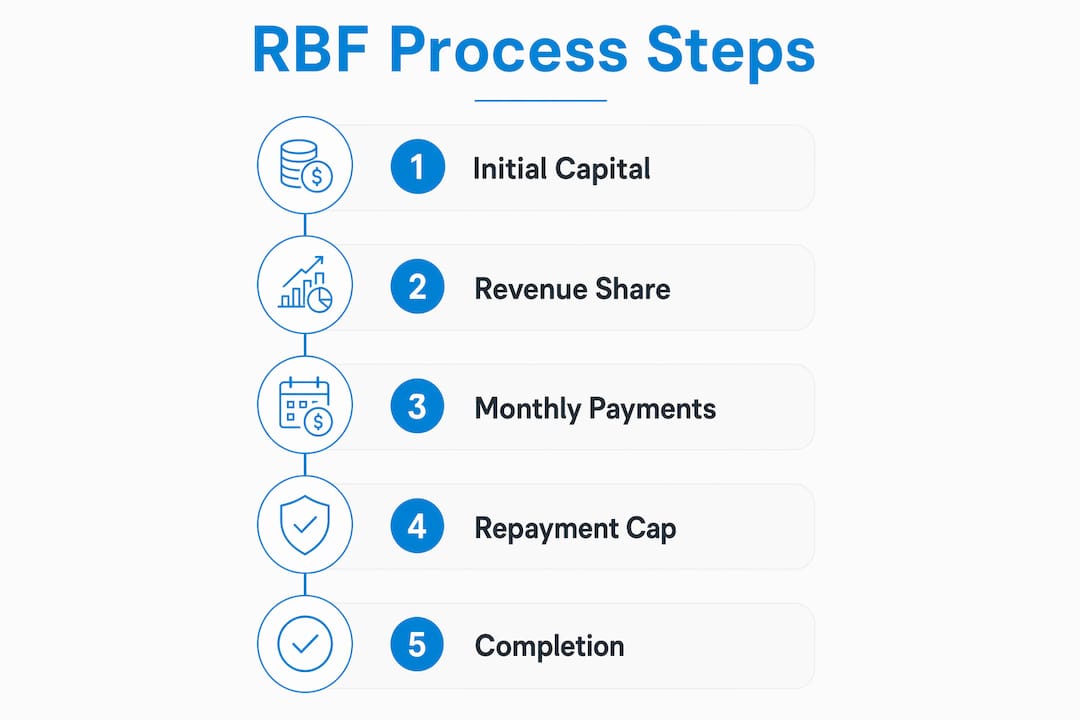
Revenue-based financing exchanges a lump sum of capital for a revenue share agreement. The lender receives a set percentage of your gross monthly revenue every month until the total repayment cap is reached. That cap is expressed as a multiple of the original loan amount.
Repayment caps typically range from 1.2x to 3.0x the borrowed amount, with revenue share percentages usually falling between 1% and 15%, though some deals reach 25%. That means if you borrow $100,000 at a 1.5x cap, you repay $150,000 total, with monthly payments calculated as a percentage of whatever revenue you generate that month.
Payments fluctuate monthly with revenue, ensuring lower payments during slow months and higher payments when business is booming. This structure directly aligns the lender’s return with your company’s performance, which is a fundamentally different relationship than a bank demanding the same check every month regardless of your sales.

The revenue financing model sits between a traditional loan and equity investment. You don’t give up ownership like you would with a venture capital deal. You don’t face a fixed repayment schedule like you would with a Small Business Administration loan. The trade-off is that the total cost of capital is often higher than a conventional bank loan because the lender is absorbing performance risk.
RBF terms vary by provider, deal size, and business profile, but the structure follows a consistent pattern across the industry.
The repayment cap is the ceiling on what you owe. A 1.5x cap on a $50,000 advance means you repay $75,000 total, no matter how long it takes. Repayment periods commonly span 1 to 5 years with no fixed monthly payment or maturity date, since payments fluctuate directly with revenue. This is the defining feature that separates RBF from understanding revenue based loans in the traditional sense.
The revenue share percentage is negotiated upfront. A business generating $80,000 per month with a 5% revenue share pays $4,000 that month. If revenue drops to $50,000 the next month, the payment drops to $2,500. The total owed stays the same; only the pace of repayment changes.
| Feature | Revenue-Based Financing | Traditional Bank Loan | Equity Financing |
|---|---|---|---|
| Repayment structure | % of monthly revenue | Fixed monthly payment | No repayment; equity given |
| Ownership impact | None | None | Dilution of ownership |
| Approval speed | Days to weeks | Weeks to months | Months |
| Credit requirement | Revenue-focused | Credit score heavy | Investor-dependent |
| Cost of capital | Higher (1.2x–3.0x) | Lower (interest rate) | Equity stake |
Pro Tip: Calculate your average monthly revenue over the past 12 months before approaching any RBF provider. Knowing your baseline number lets you model exactly what a 5% or 10% revenue share means for your monthly cash flow before you sign anything.
Some providers structure RBF more like revolving credit lines linked to recurring revenue, allowing businesses to draw capital as needed and repay flexibly. This variation is worth asking about if your capital needs are irregular rather than one-time.
Qualifying for revenue-based financing centers on your revenue history, not your personal credit score. That distinction matters enormously for business owners who have been turned away by traditional lenders.
Qualification requires documentation like 3–6 months of bank statements, profit and loss statements, and payment processor history, with lenders focusing heavily on revenue stability and healthy gross margins. The logic is straightforward: if your revenue is consistent, the lender can model repayment with confidence.
Here is what a typical application process looks like:
Lenders also look at gross margin health. A business with $100,000 in monthly revenue but $95,000 in costs is a poor candidate because a 5% revenue share leaves almost nothing for operations. Businesses with margins above 40% are generally better positioned for RBF.
Pro Tip: If your revenue has seasonal dips, document them proactively. Showing a lender that your slow months are predictable and temporary is far better than letting them discover the pattern themselves during underwriting.
Marketing performance and customer retention metrics increasingly factor into RBF decisions, especially for SaaS and e-commerce businesses. A high customer lifetime value or a low churn rate signals revenue durability, which lenders price favorably.
Revenue-based financing offers real advantages, but it is not the right tool for every situation. A clear-eyed look at both sides saves you from a costly mistake.
“Revenue-based financing aligns investor and founder incentives by tying repayment to revenue performance rather than fixed schedules or equity stakes. That alignment is the model’s greatest strength and its most important selling point for growth-stage businesses.”
The advantages of revenue based financing are most pronounced for businesses with strong, recurring revenue and clear growth plans. The disadvantages hit hardest when margins are thin or revenue is unpredictable.
Knowing how to use revenue financing effectively is just as important as understanding how it works. The model rewards businesses that deploy capital into activities with measurable, near-term returns.
RBF works best as growth capital for ROI-positive activities like paid customer acquisition or inventory purchases, not for covering operational losses or payroll gaps. That distinction is critical. Using RBF to fund a Facebook Ads campaign that generates $3 in revenue for every $1 spent is a sound decision. Using it to cover rent because sales are down is a path to a cash flow crisis.
Follow these steps to deploy RBF capital effectively:
RBF is often preferred by SaaS and e-commerce businesses because their revenue is digital, measurable, and recurring. That said, any business with consistent monthly revenue and a clear growth plan can benefit from the revenue based funding options this model provides. Understanding whether your business qualifies before applying saves time and protects your credit profile.
Revenue-based financing works best when businesses deploy capital into high-margin growth activities, maintain strong gross margins, and model repayment under realistic revenue scenarios before signing.
| Point | Details |
|---|---|
| Core repayment structure | Payments are a fixed % of monthly revenue until a 1.2x–3.0x cap is reached. |
| No equity given up | Owners retain full control; RBF is non-dilutive unlike venture capital. |
| Qualification focus | Lenders prioritize 3–6 months of stable revenue over personal credit scores. |
| Best use of capital | Deploy RBF into ROI-positive activities like paid ads or inventory, not payroll. |
| Key risk to manage | Stress test repayment under low-revenue conditions before signing any deal. |
I’ve talked with hundreds of small business owners who dismissed revenue-based financing because they assumed it was just a merchant cash advance with a better name. That assumption costs them real money. RBF and merchant cash advances share a surface-level similarity, but the structure, cost, and intent are genuinely different. MCA providers typically take a daily fixed percentage of card receipts with no cap on the effective interest rate. RBF deals have a defined repayment ceiling and a negotiated revenue share tied to total revenue, not just card transactions.
The mistake I see most often is business owners treating RBF like a general-purpose loan. They take $150,000, use it to cover six months of operating expenses, and then wonder why they feel squeezed. The revenue share doesn’t care that you spent the money on rent. It still takes its percentage every month. The businesses that win with RBF are the ones that treat it like a growth investment, not a lifeline.
My honest advice: if you can’t clearly articulate which specific revenue-generating activity the capital will fund and what return you expect within 90 days, you are not ready for RBF. That’s not a criticism. It’s a signal to either sharpen your growth plan or look at a different funding structure, like a line of credit, that gives you more flexibility without the revenue share obligation.
RBF is a powerful tool in the right hands. The right hands belong to business owners who know their numbers, have a clear growth lever to pull, and can absorb the revenue share without compromising daily operations.
— Rob
If the revenue based financing model fits your growth plans, Fordhamcapital makes the process straightforward. Fordhamcapital’s one-page application connects you to a wide network of banks and lenders, with approvals arriving in as little as 24 hours. There are no credit score impacts from the initial inquiry, and the team works with businesses that conventional lenders routinely overlook.
Fordhamcapital has funded over $120 million and helped clients generate more than $500 million in revenue, backed by an A+ BBB rating. Whether you need growth capital for a marketing push, an inventory build, or a product launch, the team structures terms around your actual cash flow. Start your application today and get a funding decision without the wait.
Revenue-based financing is a funding model where a business receives upfront capital and repays it as a fixed percentage of monthly revenue until a set repayment cap is reached. There are no fixed monthly payments and no equity given up.
A traditional loan requires fixed monthly payments regardless of revenue performance, while RBF payments rise and fall with your actual monthly sales. RBF also focuses on revenue history rather than personal credit scores during underwriting.
Most providers require at least 3–6 months of consistent monthly revenue, supported by bank statements, profit and loss statements, and payment processor history. Healthy gross margins above 40% strengthen your application significantly.
RBF suits businesses with recurring, measurable revenue and a specific ROI-positive use for the capital, such as paid advertising or inventory. It is not well-suited for businesses with thin margins or those needing capital to cover ongoing operating losses.
Repayment periods commonly span 1 to 5 years, but there is no fixed maturity date. Higher revenue months accelerate repayment, while slower months extend the timeline until the full repayment cap is cleared.
At Fordham Capital, we've made the application process straightforward and reassuring. Dive in and explore your financial options with confidence, knowing there's no impact on your credit score and no obligations. We review your details and offer customized solutions based on what you're looking for.