

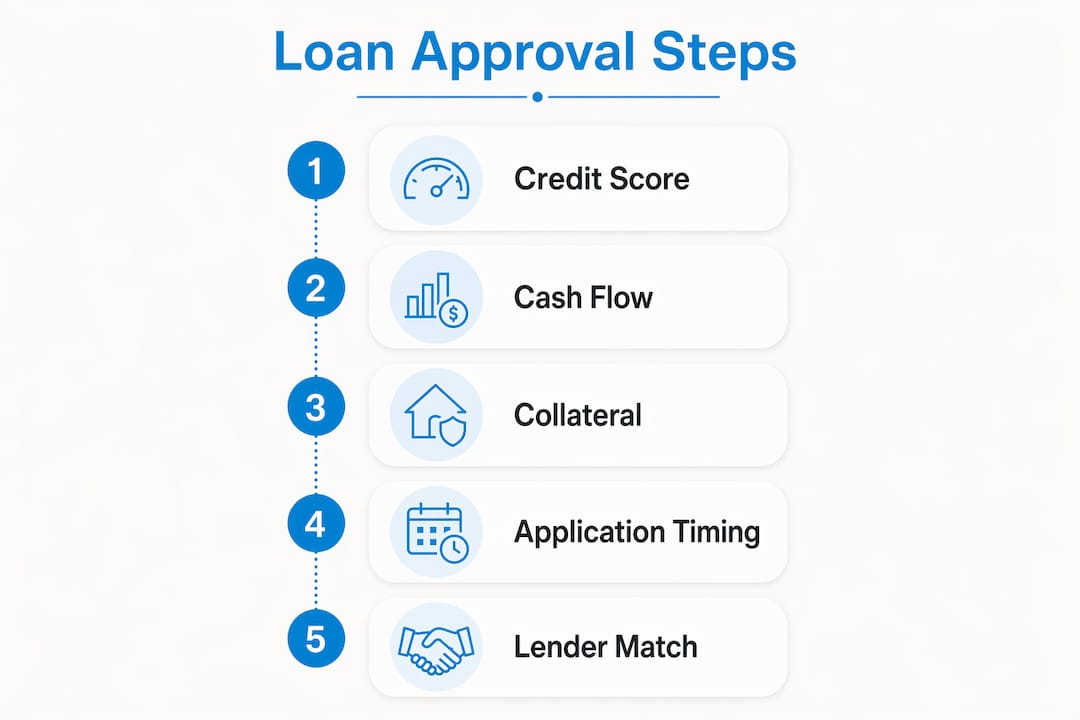
Small business owners can maximize business loan approval odds by preparing three things before they ever submit an application: a clean credit profile, documented cash flow strength, and a lender match that fits their actual risk profile. Lenders in 2026 evaluate your Debt Service Coverage Ratio (DSCR), personal FICO score, FICO SBSS score for SBA loans, and increasingly, alternative data processed by AI underwriting models. This guide covers every factor affecting loan approval, from credit benchmarks to application timing, so you walk into the process with a real advantage.
Your personal FICO score is the first number a lender checks. Most traditional banks and SBA lenders require a score above 680, and scores below that threshold push you toward higher-cost alternative products. The number is not just a gate. It signals payment discipline, credit utilization habits, and financial stability across your personal history.
For SBA loans under $350,000, the FICO Small Business Scoring Service (FICO SBSS) score carries equal weight. FICO SBSS scores below 155 often trigger automatic denials, and most lenders prefer 160 or higher for a smooth approval process. The SBSS model blends your personal credit, business credit, and basic financial data into a single score, so both sides of your financial life matter.
Cash flow is where many small business owners get surprised. Lenders do not just look at your business revenue. They apply a global cash flow analysis, which means your personal household debt, mortgage payments, and personal credit obligations are factored alongside your business income. This combined picture determines whether you can realistically service a new loan.

The specific metric lenders use is the Debt Service Coverage Ratio. A DSCR of at least 1.25 is the minimum for most standard bank and SBA loans, and a ratio of 1.35 or higher is considered strong. A DSCR below 1.25 often triggers an automatic decline, regardless of your credit score. DSCR is calculated by dividing your net operating income by your total annual debt service obligations.
Here are the key metrics to audit before you apply:
Paying down credit card balances to bring utilization below 30% can raise your personal FICO score by 20 to 40 points within a billing cycle or two. That single move can shift you from a borderline approval to a confident one.
Pro Tip: Separate your personal and business bank accounts at least 60 to 90 days before applying. Commingled funds make it nearly impossible for a lender to read your true business cash flow, and it signals poor financial management.
Traditional underwriting relies almost entirely on credit scores and tax returns. If you have a limited credit history, a newer business, or income from gig work or freelance contracts, that model works against you. AI underwriting changes the equation by pulling in data points that traditional models ignore entirely.
AI-powered lenders now analyze rent payment history, utility payments, subscription service records, and gig platform income to build a fuller picture of your financial behavior. The results are significant. AI-driven underwriting models have increased approval rates for thin-file borrowers by up to 27% compared to traditional methods. That is not a marginal improvement. It represents a real funding pathway for business owners who would have been declined five years ago.
Speed is the other major shift. AI models can process applications in under 3 minutes, compared to the days or weeks required by traditional bank underwriting. For a business owner managing cash flow gaps or time-sensitive growth opportunities, that speed is a practical advantage.
If your credit file is thin or your business is under two years old, these are the data points AI lenders typically consider:
Platforms like Sigma Platinum are building business payment account infrastructure that generates exactly the kind of transaction history AI underwriting models reward. If you are building credit from scratch, establishing consistent payment records across multiple channels is a direct strategy for improving loan approval success.
Pro Tip: Use soft pull prequalification tools before submitting any formal application. Soft pulls do not affect your credit score, and they let you compare real offers from AI-powered lenders without triggering the hard inquiries that signal financial distress.
You can also explore business funding with low credit scores as a parallel track while you build your credit profile.
Not every loan product is built for every borrower. Matching your credit profile and business stage to the right loan type is one of the most underused tips for business loan approval.
| Loan Type | Typical Amount | Approval Ease | Collateral Required | Best Use Case |
|---|---|---|---|---|
| SBA 7(a) | Up to $5M | Moderate | Often required | Working capital, expansion |
| SBA 504 | Up to $5.5M | Moderate | Yes (real estate/equipment) | Fixed asset purchases |
| Term Loan | $25K to $500K | Moderate to hard | Sometimes | Equipment, growth capital |
| Working Capital Loan | $10K to $250K | Easier | Rarely | Cash flow gaps, inventory |
| Marketplace/Alternative | $5K to $500K | Easiest | Rarely | Fast needs, thin credit files |
SBA 7(a) loans offer the best terms for qualified borrowers, but the documentation requirements and approval timelines are demanding. SBA 504 loans are specifically designed for fixed asset purchases like real estate or heavy equipment, and they require collateral by structure.
Collateral such as equipment, inventory, or real estate significantly increases approval chances by reducing lender risk, and collateral-backed loans consistently offer better rates and higher approval rates. If you have assets to pledge, use them. If you do not, working capital loans and marketplace lenders are built for exactly that situation.
For borrowers without assets to pledge, funding without collateral is a real option through alternative lenders who rely on cash flow and revenue data instead. Understanding which product fits your profile before you apply saves time and protects your credit score from unnecessary hard pulls.
The application process itself is where many business owners lose ground they worked hard to build. A disorganized or premature application signals risk to lenders, even when the underlying financials are solid.
Follow these steps to approach the process strategically:
Pro Tip: If your documentation is limited, a low documentation business loan may be a faster path to capital while you build a stronger financial record.
Timing matters too. Applying during a period of strong revenue, rather than during a seasonal dip, gives your bank statements their best look. Lenders read trends, not just totals.
Securing a business loan in 2026 requires matching your credit profile, cash flow documentation, and lender selection to the specific criteria each product demands.
| Point | Details |
|---|---|
| DSCR is the core threshold | A ratio of 1.25 or higher is required; 1.35 or above signals strong repayment capacity. |
| FICO SBSS score drives SBA decisions | Target 160 or above to avoid auto-declines on SBA loans under $350,000. |
| AI underwriting opens new doors | Thin-file borrowers see up to 27% higher approval rates when lenders use alternative data. |
| Separate accounts before applying | Commingled finances obscure cash flow and are a top reason for lender rejection. |
| One application beats many | Submit a single well-prepared application after comparing soft pull offers to protect your credit score. |
Most loan denials I have seen come down to one of two things: applying too early, or applying to the wrong lender. Business owners spend months building a product or service, then treat the loan application as an afterthought. They submit with mixed personal and business accounts, no cash flow forecast, and a credit score that has not been reviewed in years.
The DSCR concept catches a lot of people off guard. You might have strong business revenue, but if your personal mortgage, car payments, and credit card minimums eat into your global cash flow, a lender’s model will flag you as overextended. I have seen solid businesses get declined because the owner’s personal finances told a different story than the business bank account.
The other shift I find genuinely exciting is AI underwriting. Gig workers, freelancers, and early-stage founders who were invisible to traditional lenders now have a real path to capital. The data these models use, rent history, utility payments, transaction patterns, reflects actual financial behavior far better than a two-year-old tax return. If you have been told no by a traditional bank, that answer is not final anymore.
My honest advice: treat the loan application like a pitch. Know your numbers cold. Know your DSCR, your FICO SBSS, and your 13-week cash position before you walk into any conversation with a lender. The business owners who get funded are not always the ones with the best businesses. They are the ones who show up prepared.
— Rob
Fordhamcapital works specifically with small and medium-sized businesses that traditional banks overlook. Their one-page application connects you to a wide network of banks and lenders, with approvals possible within 24 hours and no credit impact from the initial inquiry. With over $120M funded and an A+ BBB rating, Fordhamcapital has helped clients generate more than $500M in revenue by putting capital to work quickly. If you are ready to put the strategies in this guide into practice, explore flexible business funding options at Fordhamcapital and find the product that fits your profile and timeline.
Most traditional banks and SBA lenders require a personal FICO score of 680 or above, while SBA loans under $350,000 also require a FICO SBSS score of 155 or higher to avoid automatic denial.
Lenders typically require a Debt Service Coverage Ratio of at least 1.25, with 1.35 or higher considered strong. A DSCR below 1.25 often triggers an automatic decline regardless of credit score.
AI underwriting models analyze alternative data like rent payments, utility history, and gig income, increasing approval rates for thin-file borrowers by up to 27% compared to traditional credit-based models.
Apply to only one lender at a time after using soft pull prequalifications to compare offers. Multiple hard credit inquiries in a short period signal financial distress and lower your credit score.
Start preparing at least 60 to 90 days before applying. Use that time to separate personal and business accounts, reduce credit utilization, and build a 13-week cash flow forecast that lenders increasingly request in 2026.
At Fordham Capital, we've made the application process straightforward and reassuring. Dive in and explore your financial options with confidence, knowing there's no impact on your credit score and no obligations. We review your details and offer customized solutions based on what you're looking for.


.jpg)

