
Speeding up small business loan approval comes down to three factors: complete documentation prepared in advance, the right lender for your business type, and fast communication throughout underwriting. Most delays are not caused by lenders. They are caused by business owners who submit incomplete packages, apply to the wrong institutions, or take days to respond to follow-up requests. The tactics in this guide apply whether you are pursuing an SBA loan, working with an online lender, or approaching a community bank for quick small business funding.
The single fastest way to cut approval time is to have every required document ready before you apply. Incomplete or missing documents are the most common source of SBA loan processing delays, adding 1–2 weeks per information request. That means one missing bank statement can push your closing date back by half a month.
The core document package for most lenders includes two years of business and personal tax returns, a year-to-date profit and loss statement, a current balance sheet, and three to six months of business bank statements. Financial statements should be current within the last 60–90 days to avoid update requests during underwriting. If your most recent P&L is from eight months ago, expect a delay.

The table below shows how document requirements shift depending on the loan product you pursue.
| Document | SBA Loan | Online Lender | Traditional Bank |
|---|---|---|---|
| 2 years business tax returns | Required | Sometimes | Required |
| 2 years personal tax returns | Required | Rarely | Required |
| YTD profit and loss statement | Required | Required | Required |
| Balance sheet | Required | Sometimes | Required |
| 3–6 months bank statements | Required | Required | Required |
| Business plan or projections | Often required | Rarely | Sometimes |
Online lenders typically require fewer documents, which is one reason they can deliver approvals in as little as 24 hours. The trade-off is higher interest rates and stricter repayment terms. Knowing which product fits your situation before you apply saves you from submitting the wrong package to the wrong lender.
Digital organization is not optional. Consistent, descriptive filenames and a centralized loan readiness folder reduce delays by preventing repetitive lender requests. A filename like “2025_P&L_YTD_through_Dec.pdf” tells a loan officer exactly what they are opening. A filename like “scan0047.pdf” forces them to open it, read it, and potentially ask you to resend it labeled correctly.
Create one master folder with clearly labeled subfolders: tax returns, financial statements, bank statements, legal documents, and ownership information. Keep everything in PDF format. Avoid sending compressed ZIP files unless the lender requests them.
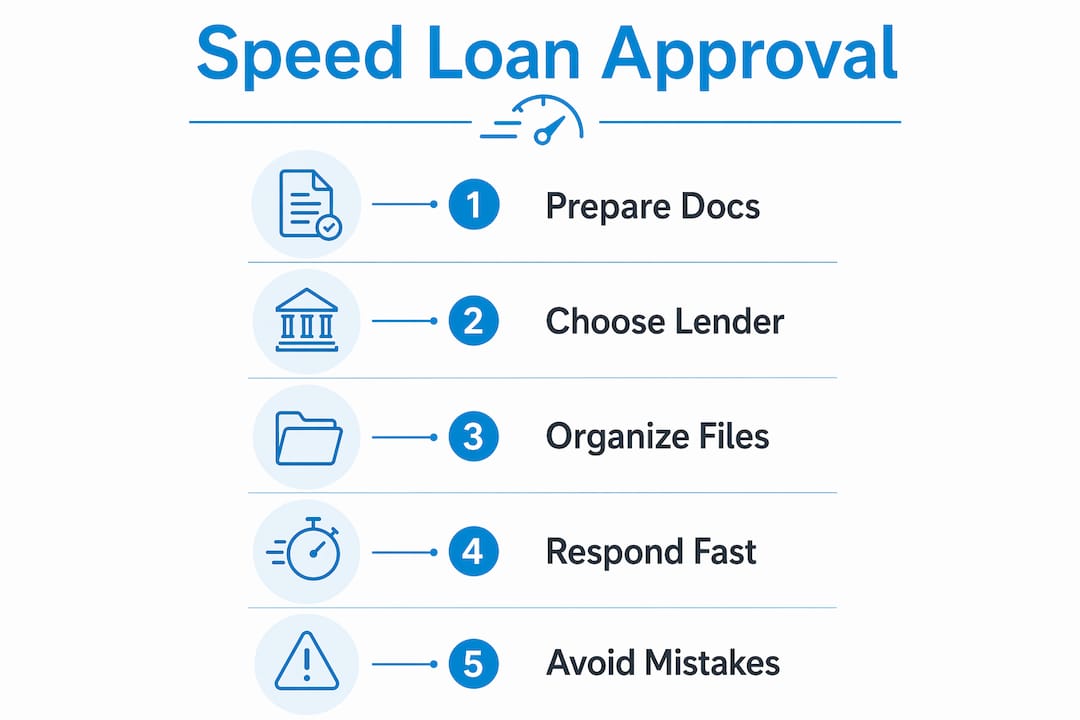
Pro Tip: Attach a one-page summary to your document package that lists every file included, the date range it covers, and your contact information. Loan officers review dozens of applications. Making their job easier makes your approval faster.
Lender selection is the most underrated factor in fast business loan approval. Choosing the wrong institution adds weeks before the process even starts.
SBA Preferred Lenders hold delegated authority from the Small Business Administration, which means they can approve SBA loans without waiting for SBA review. Working with an SBA Preferred Lender and submitting a complete document package enables closing in 30–45 days, faster than the typical 30–90 day range. SBA Express loans go further, offering an approximately 36-hour response time for loans under $500,000. That is a significant advantage for businesses that need capital quickly but still want SBA terms.
Here is how the main lender types compare on approval speed:
The right lender depends on how much you need, how fast you need it, and what terms you can accept. A business needing $50,000 in 48 hours should not apply to a traditional bank. A business seeking $2 million for a real estate purchase should not expect an online lender to be the right fit. You can review a detailed lender comparison guide to match your situation to the right institution before you apply.
Building a banking relationship before you need a loan allows existing account data to speed up lender decisions at competitive rates. If you already have a business checking account at a bank, that institution has months of transaction history on you. That data replaces documents you would otherwise need to provide.
Submitting a strong application is only half the work. The underwriting stage is where most approvals stall, and the cause is almost always slow responses from the applicant.
Responding to lender clarification requests within hours rather than days is the primary driver of speed during the human-interaction underwriting stage. Loan officers are managing multiple files. When you respond fast, your file stays at the top of the queue. When you take three days to reply, it moves to the bottom.
| Stage | Fast response (same day) | Slow response (3+ days) |
|---|---|---|
| Initial document review | 3–5 days | 3–5 days |
| First lender follow-up | +1 day | +4 days |
| Second lender follow-up | +1 day | +5 days |
| Final approval decision | 1–2 days | 1–2 days |
| Total estimated timeline | 6–9 days | 13–16 days |
The difference between a fast approval and a slow one is often not the lender. It is the applicant’s inbox habits. Set a rule: any message from your loan officer gets a reply within two hours during business hours.
Common underwriting requests include updated bank statements, a letter of explanation for a large deposit or withdrawal, proof of business ownership, and clarification on a tax return line item. Prepare for these in advance. If your bank statements show an unusual $40,000 deposit, write a brief explanation before the lender asks.
Pro Tip: Create a simple email template for common lender requests. When a request comes in, fill in the details and attach the document. You can respond in under five minutes instead of drafting a fresh reply each time.
Most approval delays are preventable. The mistakes below account for the majority of processing setbacks small business owners face.
Double-check your application package against the lender’s published requirements before you hit submit. Read every line of your financial statements as if you are the loan officer seeing them for the first time. If something looks confusing to you, it will look confusing to them.
Speeding up small business loan approval requires complete documentation, the right lender match, and same-day responsiveness during underwriting.
| Point | Details |
|---|---|
| Prepare documents early | Gather tax returns, P&L, balance sheet, and bank statements at least 60–90 days before applying. |
| Choose the right lender | SBA Preferred Lenders close in 30–45 days; online lenders can approve in 24 hours for smaller amounts. |
| Respond within hours | Replying to lender requests the same day keeps your file active and cuts total approval time significantly. |
| Organize files clearly | Use descriptive filenames and a structured folder so lenders find what they need without asking twice. |
| Avoid financial inconsistencies | Reconcile your P&L with your tax returns before submission to prevent underwriting delays. |
After working with small business owners across dozens of funding situations, the pattern is clear: the fastest approvals belong to the most prepared applicants, not the most creditworthy ones.
I have seen businesses with strong credit scores wait three months for funding because their bookkeeper was behind on reconciliations. I have also seen businesses with modest credit histories close in under two weeks because the owner had every document ready, responded to every lender message within an hour, and had already built a relationship with their banker. Preparation beats credit score in the race against the clock.
The advice I give most often is this: treat your loan application like a job interview you scheduled six months in advance. You would not show up with a half-finished resume. You would not wait three days to answer a follow-up question from the hiring manager. The same logic applies here.
One thing most guides skip is the value of building a banking relationship before you ever need a loan. Open a business checking account. Keep it active. Let the bank see consistent deposits and responsible cash management. When you apply for funding, that history does real work for you. It replaces documents and shortens the review cycle.
My honest advice on lender selection: do not default to your personal bank out of habit. Check whether they participate in the SBA Preferred Lender Program. If speed matters and the loan amount is under $500,000, look seriously at SBA Express or an online lender. If you want expert guidance without the legwork, a funding partner like Fordhamcapital can match you to the right lender from a broad network without a credit hit.
— Rob
Fordhamcapital built its process around one reality: small business owners need capital fast and cannot afford weeks of back-and-forth with a traditional bank. The one-page application takes minutes to complete, and approvals come within 24 hours through access to a wide network of banks and lenders.
Fordhamcapital has funded over $120 million and helped clients generate more than $500 million in revenue. The process avoids credit impact, which means you can check your options without worrying about your score. Fordhamcapital holds an A+ BBB rating, and its team provides direct, personalized guidance at every step. If you are ready to move fast, start your application today and get a decision within 24 hours.
Approval timelines range from 24 hours with online lenders to 30–90 days with SBA and traditional bank loans. SBA Express loans offer a 36-hour response time for amounts under $500,000.
The core package includes two years of business and personal tax returns, a year-to-date profit and loss statement, a current balance sheet, and three to six months of bank statements. Financial statements should be current within 60–90 days.
Applying to multiple lenders simultaneously can trigger multiple hard credit inquiries, which may lower your score and raise flags with lenders. Using a network-based funding partner like Fordhamcapital lets you access multiple lenders through a single application without a credit impact.
Incomplete or missing documents are the leading cause of SBA loan delays, adding 1–2 weeks per information request. Submitting a complete, well-organized package before the lender asks is the fastest way to avoid this.
Credit score affects eligibility and terms, but it does not determine approval speed. Preparation, document quality, and response time during underwriting have a greater impact on how quickly your loan closes. You can review strategies to maximize approval odds regardless of your credit profile.
At Fordham Capital, we've made the application process straightforward and reassuring. Dive in and explore your financial options with confidence, knowing there's no impact on your credit score and no obligations. We review your details and offer customized solutions based on what you're looking for.