Fast business funding refers to financing options that deliver capital to small businesses within days to a few weeks, covering everything from SBA Express loans and business lines of credit to merchant cash advances and invoice factoring. These types of fast business funding exist because cash flow gaps don’t wait for traditional bank timelines. Whether you’re covering payroll, buying equipment, or seizing a growth opportunity, the right rapid financing option can mean the difference between momentum and stagnation. This guide breaks down eight proven options, including their real-world speeds, costs, and the situations where each one performs best.
The main fast funding types include SBA Express loans, business lines of credit, merchant cash advances, invoice factoring, equipment financing, and working capital loans. Each carries a different speed-to-cost ratio, and understanding that tradeoff is the foundation of every smart funding decision.
SBA Express loans offer up to $500,000 with a mandated 36-hour SBA response on the loan number assignment. That 36-hour window is widely misunderstood. It covers only the initial approval step, not disbursement. Total funding typically takes one to four weeks, depending on how prepared your documentation is and how fast your lender moves through underwriting.

SBA Express loans carry lower interest rates than most alternative options, making them one of the most cost-effective types of emergency business funding available. The tradeoff is paperwork. You’ll need tax returns, financial statements, a business plan, and proof of collateral in most cases. Businesses with clean financials and an experienced SBA lender can hit the lower end of that timeline.
Pro Tip: Choose a lender with SBA Preferred Lender status. These lenders have delegated authority to approve loans without waiting for SBA review, which cuts days off the process.
A business line of credit is a revolving credit facility where you draw funds as needed and pay interest only on the borrowed amount. Draw periods typically run one to five years, and funds can be accessed via bank transfer, check, or debit card. Online lenders can approve and fund a line of credit in as little as one to three business days.
This option is one of the most flexible examples of rapid business financing because you’re not locked into a lump sum. You draw $20,000 for a supplier payment this month, repay it, then draw $35,000 for equipment next quarter. The credit line stays available throughout the draw period. For businesses with unpredictable cash flow cycles, this flexible draw-and-repay structure is difficult to beat.
A working capital loan guide explains how lines of credit and working capital products overlap in practice, which is worth reading before you apply.
Merchant cash advances (MCAs) are among the fastest types of emergency business funding available, with most approvals and funding completed in one to three business days. The lender advances a lump sum against your future sales, then collects a fixed percentage of daily card receipts until the advance plus fees are repaid.
The speed comes at a steep price. MCA APRs can reach 350%, making them one of the most expensive forms of short-term business funding. They are best reserved for genuine short-term emergencies where the cost of not having capital exceeds the cost of the advance. Businesses with strong, consistent card sales are the best candidates. Retailers, restaurants, and service businesses with high transaction volumes tend to use MCAs most effectively.
Invoice factoring converts outstanding receivables into immediate cash. A factoring company purchases your unpaid invoices and advances you 70% to 95% of the invoice value within 24 to 48 hours after approval. The factoring company then collects payment directly from your customers and remits the remaining balance, minus their fee.
This option is purpose-built for B2B businesses that invoice on net-30 or net-60 terms and can’t afford to wait two months for payment. Trucking companies, staffing agencies, and manufacturing firms use invoice factoring regularly to maintain operating cash without taking on traditional debt. The qualification criteria focus on your customers’ creditworthiness, not yours, which makes this a strong option for newer businesses with solid clients.
Equipment financing funds the purchase of specific business assets, from commercial ovens to CNC machines to delivery vehicles. The equipment itself serves as collateral, which reduces lender risk and speeds up approval. Most equipment loans fund within one to seven business days, and some online lenders move even faster for smaller ticket items.
Because the loan is secured by the asset, credit requirements are generally more accessible than unsecured business financing. You preserve working capital while acquiring the equipment you need, and the loan term typically aligns with the useful life of the asset. This is one of the cleaner examples of rapid business financing because the purpose is defined and the collateral is built in.
Working capital loans are short-term loans designed to cover day-to-day operating expenses rather than long-term investments. Online lenders offering working capital products can fund in as little as 24 hours, though terms are shorter and rates are higher than traditional bank loans. These loans are a direct answer to why small businesses need emergency funding: payroll gaps, unexpected supplier costs, and seasonal revenue dips all create immediate cash needs that can’t wait weeks.
Qualification typically requires at least six months in business, a minimum monthly revenue threshold, and a basic credit check. Businesses with low credit scores still have access to working capital products through alternative lenders, though rates will reflect the added risk.
Unsecured business financing covers any funding product that doesn’t require collateral. This includes unsecured business loans, unsecured lines of credit, and some working capital products. Approval is based on revenue, time in business, and creditworthiness rather than pledged assets. For businesses that lack physical collateral or don’t want to risk assets, this category is worth exploring directly.
Funding timelines for unsecured products vary widely. Online lenders can approve and fund unsecured loans in 24 to 72 hours. Traditional banks take longer and have stricter requirements. The guide to funding without collateral covers the specific lender types and qualification strategies that work best for asset-light businesses.
Revenue-based financing (RBF) provides a lump sum in exchange for a fixed percentage of future monthly revenue until a predetermined repayment cap is reached. Unlike MCAs, which pull from daily card transactions, RBF repayments are typically monthly and tied to total revenue. Funding timelines run from two to five business days with most alternative lenders.
RBF works well for SaaS companies, subscription businesses, and e-commerce brands with predictable recurring revenue. The repayment structure flexes with your income: slower months mean smaller payments, which reduces the cash flow strain that fixed-payment loans create. This makes RBF one of the more sustainable alternative funding options for growth-stage businesses that need instant business capital without giving up equity.
No single fast funding option fits every business. The right choice depends on how much you need, how fast you need it, and what your business can qualify for today.
| Funding Type | Typical Speed | Approximate APR Range | Best For |
|---|---|---|---|
| SBA Express loan | 1 to 4 weeks | 10% to 15% | Established businesses needing lower-cost capital |
| Business line of credit | 1 to 3 days | 10% to 99% | Ongoing cash flow management |
| Merchant cash advance | 1 to 3 days | 40% to 350% | Short-term emergencies with strong card sales |
| Invoice factoring | 24 to 48 hours | Varies by fee | B2B businesses with outstanding receivables |
| Equipment financing | 1 to 7 days | 8% to 30% | Asset purchases with built-in collateral |
| Working capital loan | 24 to 72 hours | 15% to 80% | Covering operating gaps quickly |
| Unsecured business loan | 24 to 72 hours | 20% to 99% | Businesses without collateral |
| Revenue-based financing | 2 to 5 days | Varies by cap | Recurring revenue businesses |
Pro Tip: Prepare your last three months of bank statements, your most recent two years of tax returns, and a one-page business summary before you apply anywhere. Lenders who can move fast will only do so if you can match their pace.
The best approach to choosing among quick business financing options starts with two questions: how much do you need, and how soon does it have to arrive?
For amounts under $50,000 needed within 48 hours, merchant cash advances, invoice factoring, or working capital loans are the realistic options. For amounts between $50,000 and $500,000 with a one to four week window, SBA Express loans offer the best cost structure. For ongoing cash flow flexibility without a defined emergency, a business line of credit is the most practical tool.
Mixing funding types is a legitimate strategy. A line of credit handles routine cash flow gaps while invoice factoring covers a specific large receivable. This combination reduces dependence on any single product and lowers overall financing cost. The one combination to avoid is stacking multiple MCAs. High-factor rates and daily repayments tied to sales can create a repayment spiral that drains cash faster than the advance helped.
Getting funded fast requires preparation before you contact a lender. Follow these steps to cut approval time significantly:
The SBA Express 36-hour response is a useful benchmark, but actual funding speed is determined almost entirely by borrower preparedness and lender underwriting capacity, not the SBA clock.
Fast business funding works best when you match the funding type to your specific cash need, timeline, and qualification profile rather than defaulting to the fastest or most advertised option.
| Point | Details |
|---|---|
| Speed vs. cost tradeoff | Faster options like MCAs carry APRs up to 350%; slower options like SBA Express cost far less. |
| Lines of credit for flexibility | Revolving credit lets you draw, repay, and redraw without reapplying, ideal for ongoing cash flow gaps. |
| Invoice factoring for B2B | Advances of 70% to 95% of invoice value fund within 24 to 48 hours, based on customer credit. |
| Document readiness is speed | SBA Express timing depends on borrower preparation, not just the 36-hour SBA response window. |
| Mixing funding types | Combining a line of credit with invoice factoring reduces cost and dependence on any single product. |
The most common mistake I see is treating speed as the only variable. A business owner gets a quote for a merchant cash advance, sees “funded in 24 hours,” and signs without reading the factor rate. Three months later, daily repayments are pulling 20% of gross revenue and the business is in worse shape than before the advance.
Speed matters. But the cost of capital matters more over any period longer than 30 days. A business line of credit that takes three days to fund at 15% APR is almost always a better decision than an MCA that funds in one day at 120% APR. The math is not subtle.
The second mistake is applying for the wrong product based on headline claims rather than actual qualification criteria. SBA Express loans are genuinely good value, but they require documentation that many small businesses don’t have organized. If your books are messy, you won’t get the 36-hour response to work in your favor. You’ll get a request for more documents and a two-week delay.
My honest recommendation: build a line of credit before you need it. The best time to establish revolving access to capital is when your financials are strong and you’re not under pressure. When the emergency arrives, you draw from an existing facility instead of scrambling for a new approval under stress. That single habit separates businesses that manage cash flow well from those that are always reacting to it.
— Rob
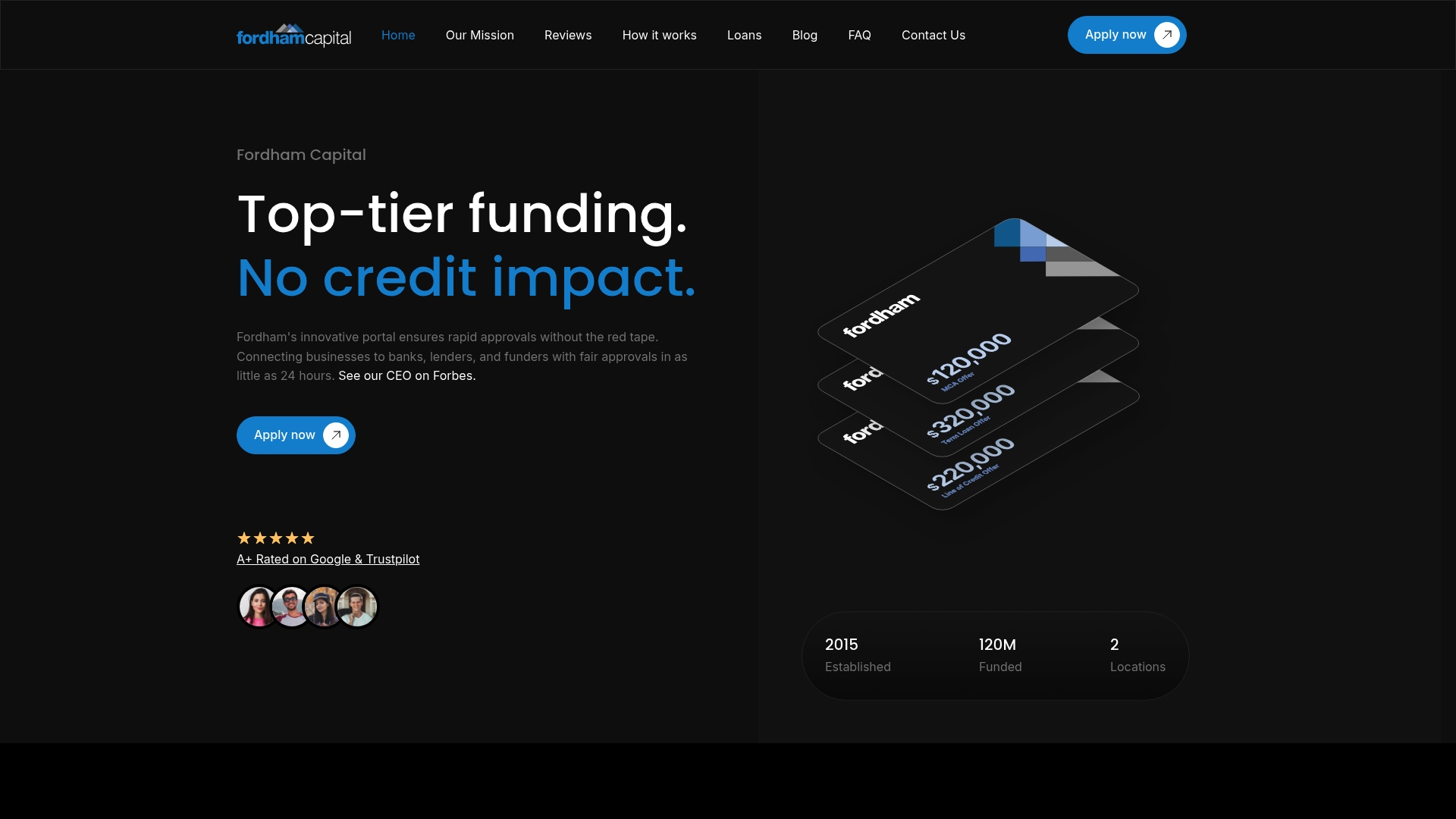
Fordhamcapital works with small and medium-sized businesses that need capital quickly and can’t afford the delays of traditional bank lending. Their one-page application connects you to a wide network of banks and lenders, with approvals available within 24 hours and no credit impact from the initial inquiry. With an A+ BBB rating, over $120M funded, and clients who have generated more than $500M in revenue, Fordhamcapital has built a track record that speaks directly to what small business owners need: speed, transparency, and a funding partner who actually delivers. Explore your fast funding options and see what you qualify for today.
Merchant cash advances and invoice factoring are the fastest types of emergency business funding, with most approvals and disbursements completed within 24 to 48 hours. Business lines of credit from online lenders also fund in one to three business days.
SBA Express loans carry a mandated 36-hour SBA response time, but total funding typically takes one to four weeks due to documentation and underwriting requirements. They offer lower rates than MCAs or online working capital loans, making them better for businesses that can wait slightly longer.
Yes. Invoice factoring qualifies based on your customers’ credit, not yours. Revenue-based financing and some working capital loans also approve based on monthly revenue rather than credit score alone.
MCAs can carry APRs up to 350%, and daily repayments tied to card sales can strain cash flow significantly. Stacking multiple MCAs compounds this risk and can create a repayment cycle that is difficult to exit.
Prepare bank statements, tax returns, and a use-of-funds statement before applying. Choose lenders with automated underwriting or SBA Preferred Lender status, and respond to underwriter document requests within hours to avoid delays.
At Fordham Capital, we've made the application process straightforward and reassuring. Dive in and explore your financial options with confidence, knowing there's no impact on your credit score and no obligations. We review your details and offer customized solutions based on what you're looking for.