Unsecured loan approval hinges on three filters: your credit profile, your debt-to-income (DTI) ratio, and your income stability. Lenders have no collateral to fall back on, so they scrutinize these signals harder than they would for a secured loan.
TL;DR: Prequalify with multiple lenders using a soft credit pull to compare rates without hurting your score. Once you’ve chosen the best offer, submit a full application (which triggers a hard inquiry) with your complete documentation package. Approval can come within hours for strong files.
Key approval elements at a glance:
Lenders evaluate every unsecured application against three core filters. Understanding each one tells you exactly where to focus before you apply.
Your FICO score is the first gate. Most mainstream lenders set minimums around 580–640; anything below that and automated underwriting typically rejects the file outright. Scores of 720 and above move you into the best-rate tier. But the score itself is only part of the picture.

Lenders also review recent delinquencies (a 30-day late payment from six months ago carries more weight than one from four years ago), credit utilization (keeping revolving balances below 30% of your limit helps), and credit mix. A borrower with a mortgage, a car loan, and two credit cards in good standing looks more reliable than someone with five maxed-out cards and nothing else.
DTI measures your total monthly debt payments against your gross monthly income. For owner-guaranteed business loans, lenders typically use your personal DTI, not the business’s. That catches a lot of SMB owners off guard.

The math is straightforward: add up all monthly debt obligations (mortgage or rent, car payments, existing loans, minimum credit card payments), then divide by gross monthly income. A result below 36% is where most lenders are comfortable. Cross 50%, and automated systems flag the file for denial or manual review. Many applicants obsess over their credit score while ignoring DTI, which is the faster fix.
Lenders want to see that income is real, consistent, and likely to continue. For W-2 employees, that means recent pay stubs and the prior year’s W-2. Self-employed borrowers face a higher bar: two years of personal tax returns, 1099s, and often a current profit-and-loss statement. Irregular deposits or a sharp revenue dip in the most recent year can trigger manual underwriting, which adds days to the timeline.
Pro Tip: If you’re self-employed, reconcile your bank statements to your tax returns before applying. Unexplained gaps between reported income and actual deposits are one of the fastest ways to land in manual review.
Automated underwriting handles most clean files instantly, matching your data against the lender’s threshold rules. Human review kicks in when something looks irregular — a recent address change tied to a new business registration, a DTI sitting right at the lender’s internal cutoff, or inconsistent deposit patterns. That human step can stretch a same-day decision into a multi-day process.
Prequalification uses a soft credit inquiry — it pulls enough data to estimate your likely rate and terms without touching your score. A hard inquiry, which happens only when you submit a formal application, causes a small temporary dip. The strategy is simple: prequalify broadly, then apply once.
Here’s how to run the process cleanly:
Pro Tip: Rate-shopping within a short window (typically 14–45 days) may be treated as a single inquiry by FICO scoring models for certain loan types. For unsecured personal loans, the window is narrower — move quickly once you start.
Online platforms let you complete prequalification in minutes and see estimated APRs side by side before committing to anything. That comparison step is where most borrowers leave money on the table by skipping it.
Incomplete applications are one of the most common reasons files stall in underwriting. Gather everything before you submit.
Core documents for all applicants:
Income verification:
Bank statements:
Lenders typically request 2–3 months of consecutive statements to verify deposit patterns and average daily balances. They’re looking for consistency, not just a high balance on one day.
Ancillary documents (lender-dependent):
Having these ready before you start the application cuts processing time significantly and reduces the chance your file gets flagged for a document hold.
| Credit Score Band | Typical APR Range | Likely Decision Speed |
|---|---|---|
| 720+ | 6%–12% | Same day (automated) |
| 660–719 | 12%–20% | Same day to 1 business day |
| 580–659 | 20%–36% | 1–3 business days (possible manual review) |
| Below 580 | Likely declined | N/A |
APRs for unsecured business loans generally run 6%–36%, with your credit score and the lender’s underwriting model driving where you land in that band. State usury laws cap rates in some states, so the ceiling varies by location.
On timing: prequalification takes minutes. Strong profiles can receive approval and funding the same day; weaker files that trigger manual review may wait 2–5 business days. ACH transfers typically post within one business day after approval, though some lenders offer same-day wire for an additional fee.
Most denials trace back to a short list of causes, and most of them are fixable before you reapply.
Common denial reasons:
Fixes to run before reapplying:
Pro Tip: Wait at least 3–6 months before reapplying after a denial. Applying repeatedly in a short window stacks hard inquiries and signals credit distress to the next lender.
If your DTI or credit profile can’t be fixed quickly, a secured product or a lender that specializes in small business loan approval for lower credit profiles may be a better path than reapplying to the same lenders.
Run through this before you apply:
Decision criteria:
Steps to take before submitting any application:
When speed and credit sensitivity are both priorities, working with a specialist like Fordhamcapital, which offers a one-page application and fast approval options, can cut through the friction that slows traditional bank applications.
Unsecured lending approval depends on credit profile, DTI, and income documentation — and prequalifying with soft pulls before committing to a hard inquiry is the single step that protects your score while you shop.
| Point | Details |
|---|---|
| Three core filters | Credit score, DTI ratio, and income stability determine approval for every unsecured loan. |
| DTI threshold | Keep DTI below 36% for best odds; above 50% typically results in an automatic denial. |
| Prequalify first | Use soft-pull prequalification across multiple lenders before accepting any hard inquiry. |
| Document readiness | Have 2–3 months of bank statements, income docs, and ID ready before you start. |
| Fordhamcapital advantage | One-page application, 24-hour approvals, A+ BBB rating, and over $120M funded for U.S. SMBs. |
The approval mechanics described here are accurate, but there’s a layer most articles skip: lenders don’t just check whether you meet the thresholds. They check whether your file is clean enough to clear automated underwriting without triggering a human review. That distinction matters more than most borrowers realize.
A file with a 680 FICO, a 34% DTI, and perfectly reconciled bank statements will often close faster than a file with a 740 FICO and messy, inconsistent deposits. The automated system isn’t just scoring you — it’s looking for reasons to flag your file. Anything that looks like it needs explanation (a large unexplained deposit, a business address that changed three months ago, income that doesn’t match what’s on the tax return) adds days.
The practical implication: documentation quality is as important as the underlying numbers. Borrowers who prepare a clean, consistent package — where every income figure ties back to a bank statement, and every address matches across every document — move through underwriting faster than those who submit first and patch gaps later.
Fordhamcapital’s one-page application and direct lender network are built around exactly this reality: get the right documents in front of the right lender the first time, and the 24-hour approval window becomes realistic rather than aspirational.
If you’ve worked through the checklist above and want a funding path that doesn’t penalize you for not being a Fortune 500 company, Fordhamcapital is built for that gap. The one-page application connects you to a wide network of banks and lenders, and approvals come within 24 hours — not the week-plus timeline that traditional bank underwriting typically requires.
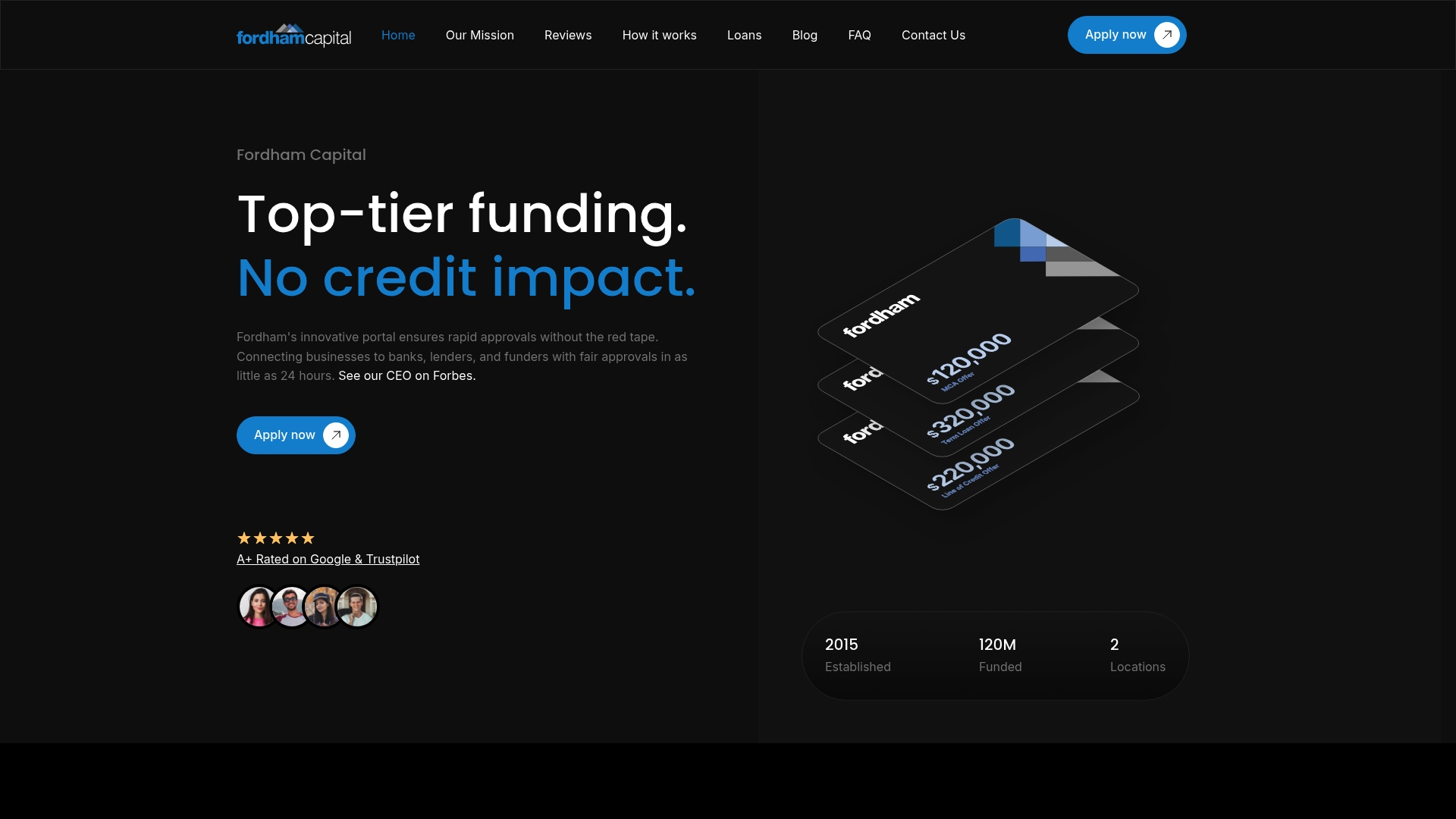
Fordhamcapital holds an A+ BBB rating and has funded over $120M for U.S. small and medium-sized businesses, with clients generating more than $500M in revenue as a result. The process starts with a soft-pull prequalification, so your credit score stays intact while you see what you qualify for.
Ready to move? Apply now and get a decision within 24 hours, or visit Fordhamcapital to review your options before committing.
This article is general information, not financial or legal advice. Confirm current rates, thresholds, and eligibility requirements with lenders or a qualified financial professional for your specific situation.
At Fordham Capital, we've made the application process straightforward and reassuring. Dive in and explore your financial options with confidence, knowing there's no impact on your credit score and no obligations. We review your details and offer customized solutions based on what you're looking for.