
A ROBS (Rollover as Business Start-up) lets you invest your own retirement money in a new C corporation, so you take on no debt but put your nest egg at risk. An SBA loan is borrowed money, guaranteed in part by the government, that you repay with interest and usually back with a personal guarantee. The two are not strict rivals. Many owners use a ROBS to cover the equity an SBA lender requires, then borrow the rest. Below is how they differ, where each one hurts, and how to choose.
The IRS describes a ROBS as an arrangement in which prospective business owners use retirement funds to pay for new business start-up costs. The IRS does not treat these plans as abusive tax avoidance by themselves, but it has run a compliance project on them since 2009 because so many are set up or maintained incorrectly.
The mechanics are fairly standard. You form a C corporation. The corporation adopts a qualified retirement plan. You roll money from an eligible existing 401(k) or IRA into the new plan, and the plan buys newly issued stock in your company. The company now has cash, and you are free to work in it. Because the transaction is a rollover and a stock purchase, it is not a withdrawal, so you do not trigger the usual early-distribution tax and penalty when the structure is done correctly.

That last phrase carries a lot of weight. The setup has to follow plan rules, the stock has to be valued correctly, and the plan has to keep filing on time. You will want an experienced tax attorney or CPA, not just a sales call, before you move a dollar.
The SBA does not lend you the money directly in most cases. It guarantees a portion of loans made by its lending partners, which makes banks more willing to lend to small businesses. The two programs most owners hear about are 7(a), the flexible general-purpose loan, and 504, which is aimed at real estate and major equipment.
You repay principal and interest on a fixed schedule. Whether the business has a good month or a bad one, the payment is due.
| Factor | ROBS | SBA loan |
|---|---|---|
| What you give up | Retirement savings placed in company stock | Interest, fees, and often a personal guarantee |
| Monthly payment | None for the funding itself | Required, fixed schedule |
| Main risk | Losing retirement money if the business fails | Personal liability and loss of business assets on default |
| Who can use it | Owners with a sizable eligible 401(k) or IRA balance | Owners who meet lender and SBA eligibility rules |
| Business structure | Must be a C corporation | Most legal structures, including LLCs |
| Ongoing obligations | Annual plan filings, valuations, nondiscrimination rules | Loan covenants, reporting, payments |
| Typical use | Startup or acquisition equity | Startup, acquisition, expansion, equipment, working capital |
| Amount ceiling | Whatever you have rolled over | Combined 7(a) and 504 financing up to $10 million |
SBA loans typically carry a personal guarantee. The SBA’s own glossary explains that the owner becomes personally liable if the business defaults. The standard SBA note defines collateral as any property taken as security and names guarantors as parties responsible for the debt, as you can see in the SBA Standard Loan Note, Form 147. In a default, a lender can pursue the guarantor as well as business assets.
Collateral rules vary by size. For 7(a) loans of $50,000 or less, the SBA generally does not require collateral. Between $50,001 and $500,000, lenders follow their own commercial lending policies, though a loan should not be declined solely because collateral is thin. If collateral is your sticking point, our guides on SBA loan collateral and business loans without a personal guarantee explain what is realistic, and how to reduce personal liability when borrowing covers the middle ground.
A ROBS creates no loan and no monthly payment. That helps cash flow in the first months, when revenue is least predictable. But the money you invest is your retirement. If the company fails, the stock can be worth nothing, and that loss comes straight out of the account you planned to live on later. There is no lender to share it.
Two more things to weigh:
If your retirement balance is modest, or you are within a decade or so of needing it, a ROBS deserves extra caution. A fee-only financial planner can run that math with you.
Most ROBS problems are not about the idea. They are about upkeep. The IRS notes that promoters often tell owners a special Form 5500-EZ exception for one-participant plans applies. According to the IRS compliance project page, that exception does not fit a ROBS, because the plan, not the individual, owns the business stock, so an annual Form 5500 must be filed.
Before you sign with any ROBS provider, ask:
An attorney who does not earn a commission on the setup is the right person to review the answers.
ROBS setups are usually measured in weeks, since the work is forming the corporation, adopting the plan and moving the rollover. Your old plan administrator can be the slow part. SBA loans typically take longer because a bank has to underwrite the file and the SBA has to be satisfied on its parts. Our breakdown of SBA loan turnaround time runs from about 30 to 90 days and shows what you can do to avoid delays. Missing documents are the most common cause.
If you also meet a lender’s basic criteria, our SBA loan requirements guide shows what to gather before you apply.
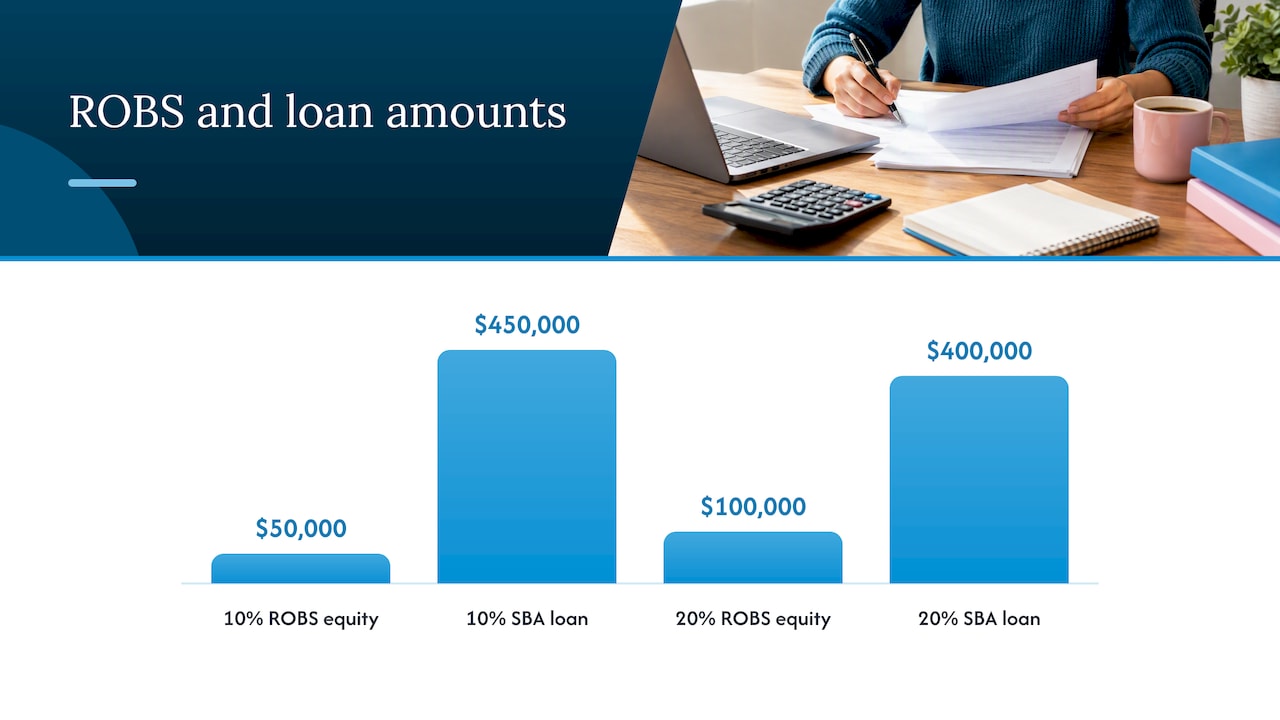
The most useful answer to “ROBS or SBA?” is often “both.” For startups and changes of ownership, SBA 7(a) loans require at least a 10% equity injection from the buyer under the SOP 50 10 8 revisions effective June 1, 2025. Seller notes count only if they are on full standby for the entire loan term, and they may not exceed half of the required injection. Individual lenders can ask for more than the minimum, so the number you hear from your bank may be higher.
A ROBS can supply that equity. Here is a simple worked example, using round numbers for illustration only:
You risk $50,000 of retirement savings instead of $250,000 or more, and the lender carries the bulk of the purchase. If the lender asks for 20% instead, the ROBS portion becomes $100,000 and the loan $400,000. Either way, confirm with your SBA lender first. Lenders differ in how they treat ROBS funds, and the equity has to be documented properly.
One warning: you cannot use SBA loan proceeds to pay for setting up the retirement plan itself. Those costs come from your own pocket.
In 2026 the SBA raised the ceiling. As of the agency’s July announcement, qualified borrowers can combine 7(a) and 504 loans for up to $10 million in SBA-backed financing, up from a previous $5 million. In practice that means up to $5 million in each program. Most small businesses will never need that much, but it matters for owners buying real estate and operating companies together. For a longer look at how the cap changes the choice against standard bank loans, see when SBA beats a conventional loan.
Lean toward ROBS if:
Lean toward an SBA loan if:
Combine them if:
Consider neither if you have enough cash on hand, or if a smaller, faster product such as a line of credit covers what you actually need.
We see owners treat this as a binary choice, and it rarely is. The question we ask first is not which product is better. It is how much a bad year would cost you, and who pays for it.
With a ROBS, you pay, out of retirement. With an SBA loan, you and the lender share the pain, but you carry the guarantee. Neither is wrong. Both go wrong when owners underestimate the first year.
Three habits separate owners who do well from those who struggle. They keep a cash reserve apart from the funding. They borrow for what the business needs, not what it might qualify for. And they apply with a full file rather than rushing a thin one, because a rejected application costs weeks.
We are an intermediary, not a lender. Our job is to put one short application in front of a wide network of banks and alternative lenders, so you can see real offers before you decide, and without a credit-score impact. We do not set a lender’s terms, and we do not advise on retirement plans. For a ROBS, talk to a tax attorney or CPA. For the loan side, talk to us.
— Rob
Sometimes the timeline or the equity requirement does not fit. Fordham Capital connects small and medium-sized businesses with banks and alternative lenders through a one-page application. We can match you with SBA loans, business lines of credit and working capital financing, with no collateral required for the options we show and no impact on your credit to apply. On our site, the SBA loan is listed at 8% per year and the line of credit at 1-3% per month. Working capital has no published price. Final terms come from the lender that makes the offer. See your funding options at Fordham Capital.
Not directly. A ROBS depends on a C corporation that can issue stock to the retirement plan. An LLC would generally need to be taxed as a C corporation or set up under one. Have a tax attorney confirm the structure before you roll over any funds.
Often yes, but the lender decides. Ask your SBA lender early whether it accepts ROBS funds and what documentation it requires. The ROBS stock purchase must be complete and documented before closing.
The lender can pursue the business assets and, if you signed a personal guarantee, your personal assets too. Default also harms your credit and can make future borrowing harder. If you are struggling, contact your lender before you miss payments.
Yes, in a sense. The SBA announced that borrowers can now combine 7(a) and 504 loans for up to $10 million in SBA-backed financing, double the earlier $5 million cap. It is a combined ceiling across the two programs, not a single loan of that size.
At Fordham Capital, we've made the application process straightforward and reassuring. Dive in and explore your financial options with confidence, knowing there's no impact on your credit score and no obligations. We review your details and offer customized solutions based on what you're looking for.