
Approval can land anywhere from 24 hours to several months, and the gap comes down to three things: lender type, loan size, and how ready your paperwork is. Online lenders and marketplaces move fastest because they lean on automated underwriting. Banks and SBA loans take longer because they layer on manual review and, for SBA loans, a federal packaging step. Getting approved is not the same as getting funded. Funding can trail approval by days or weeks depending on closing requirements.
TL;DR:
- Online lenders can approve and fund small loans within 24 hours due to automated underwriting, while traditional banks usually take 10 days, and SBA loans often require 30 to 90 days.
- Larger or more complex loan requests, such as SBA or high-dollar term loans, involve more documentation and verification, extending approval to several weeks or months.
- Using instant bank verification and submitting application materials early in the week can significantly reduce approval and funding times.
- Approval is separate from funding, with online loans sometimes disbursing within a day of approval, but SBA loans may require an additional two weeks or more after approval.
- The speed of approval depends heavily on loan size, lender type, borrower credit, and how quickly applicants respond to requests for additional information.
The honest answer depends entirely on where you apply, but the ranges are consistent enough to plan around.
Online lenders and fintech marketplaces run on automated underwriting, and that’s why they can turn around a decision in 24 hours to a few days. This only holds when you connect bank data instantly rather than uploading PDFs and when the loan amount is modest enough to skip manual review. Bankrate notes online lenders can fund in as little as 24 hours, while traditional lenders typically need a few weeks and SBA loans can stretch to months.
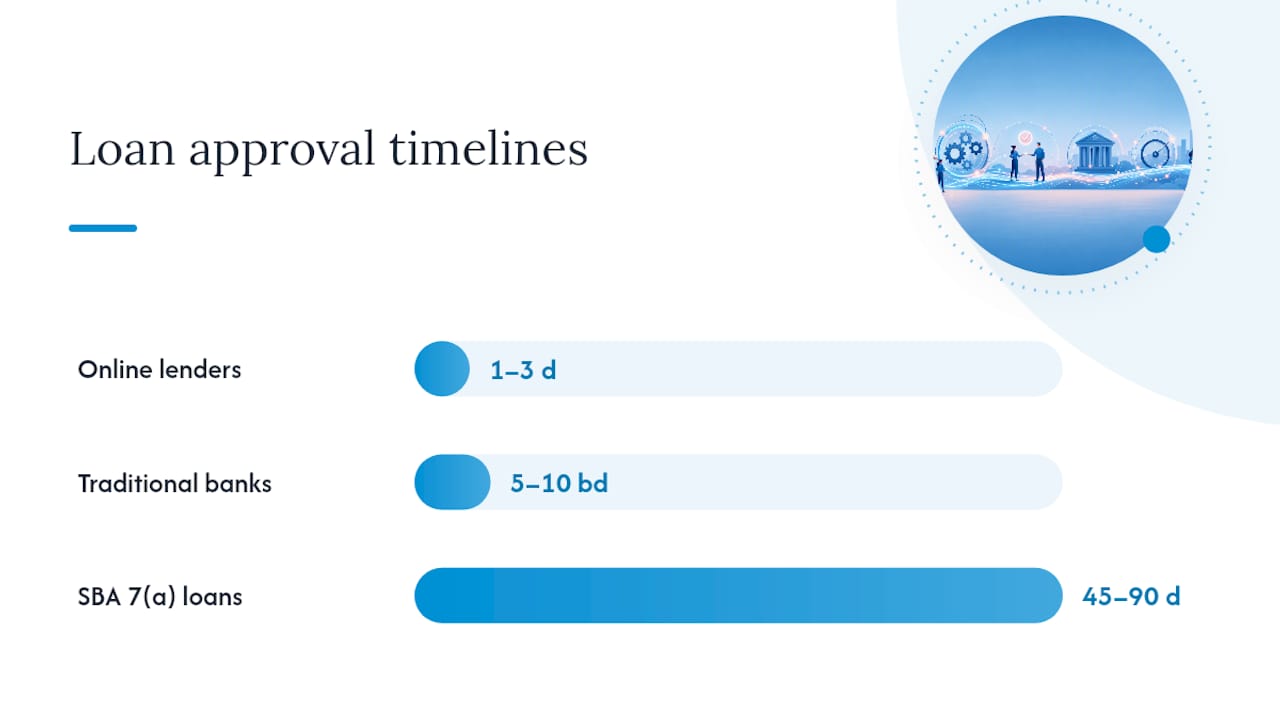
Traditional banks fall in the middle, and the FDIC’s 2024 Small Business Lending Survey gives the clearest picture available: 30% of banks can approve a small, simple loan within one business day, and three out of four banks approve their typical small business loan within 10 business days. That’s a wide spread, and it maps directly to bank size. Larger institutions with dedicated small business lending teams tend to move faster than community banks handling loan requests case by case.
SBA loans are the slowest standard option, generally running 30 to 90 days according to guidance from Capital Bank. The delay isn’t the SBA rejecting or scrutinizing your file endlessly. It’s the packaging: your lender has to assemble documentation, verify eligibility, and route it through SBA review before funds move. Some borrowers see faster outcomes. Citizens Bank points out that well-prepared SBA applicants can occasionally close in under two weeks, though that’s the exception, not the rule.
Lines of credit and working capital products sit closer to the fast end. Once a line is established, draws against it are often near instant, and initial approval for working capital financing can run days rather than weeks because the underwriting criteria are simpler than a term loan tied to specific collateral or use of funds.
A few realistic snapshots:
One lender guide from Fora Financial pegs the median combined approval-to-funding window closer to 45 days across loan types, which is a useful middle marker between the fastest fintech cases and the slowest SBA files.
Borrowers often assume “approved” means the money is on its way. It doesn’t. Approval, underwriting, and funding are separate stages, and each has its own timeline.
A fast-path example: a fintech term loan with instant bank verification can go from application to funds in your account in 48 hours. A slow-path example: an SBA loan requiring amended tax returns can add three to four weeks just to underwriting, before closing even starts.
Every lender runs a version of the same process, but five variables decide whether you’re looking at a two-day turnaround or a two-month wait.
Pro Tip: If your credit and financials are strong, ask upfront whether the lender offers instant bank data verification instead of manual document upload. That one choice can be the difference between a same-day decision and a week-long wait.
The FDIC’s data point worth remembering: three in four banks approve their typical small business loan within 10 business days, but that median hides a lot of variation by bank size and loan complexity. Understanding what lenders actually look for during approval helps you anticipate which of these levers applies to your specific request.
Most delays are self-inflicted, not lender-inflicted. Here’s the order of operations that shortens the wait the most.
If you need capital immediately and can accept a higher cost for it, short-term working capital advances or merchant cash advances close faster than almost anything else. The trade-off is real. You’re paying for speed, and the Small Business Borrowers’ Bill of Rights is a useful read before signing anything with an unfamiliar cost structure. For a broader look at which fast options fit which situations, see this breakdown of fast business funding types. And if delays have already hit your application, this guide on common causes of business loan approval delays walks through how to unstick a stalled file.
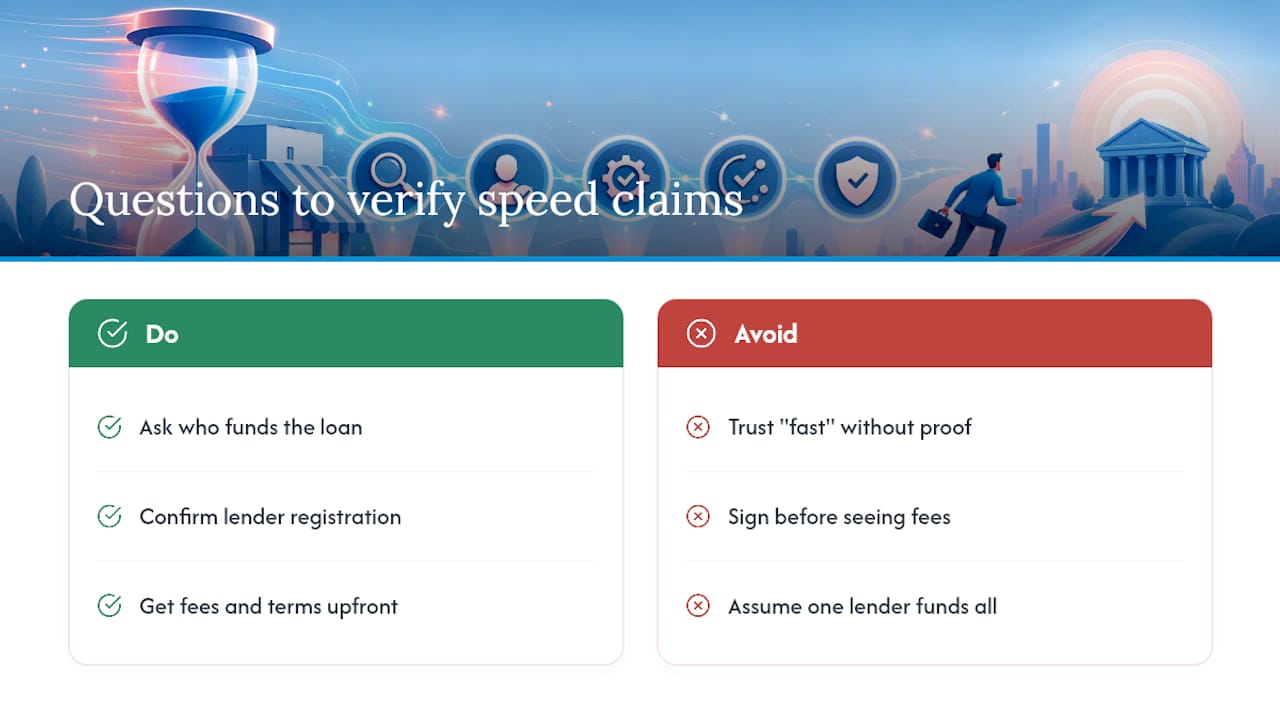
Anyone can advertise “fast approval.” What matters is whether the lender or platform actually has the network and process to back it up.
A one-page application can remove the multi-form intake step that slows down traditional bank applications, and access to a network spanning a wide range of banks and alternative lenders rather than a single underwriting desk enables requests not fitting one lender’s criteria to be routed to another without starting the process over. Some firms hold high BBB ratings and have funded tens of millions to small and medium businesses.
Before trusting any speed claim, ask three things: who actually funds the loan, whether that lender is properly registered, and whether the fees and terms are disclosed before you sign. A partner like The Build is a useful model for vetting service providers the same way.
A fast process only helps you if the funding source behind it is legitimate.
Speed is worth paying for when a delay costs you more than the fee. Missing a bulk inventory discount, covering payroll during a cash gap, or grabbing a time-limited equipment deal all justify a faster, pricier option.
Patience pays off when the goal is long-term financing at the lowest possible rate. If you can wait 30 to 90 days, an SBA loan or bank term loan almost always beats short-term products on cost. The decision rule is simple: high urgency plus tolerance for extra cost points toward fast options; low urgency plus rate sensitivity points toward banks or SBA loans.
— Rob
Fordhamcapital’s one-page application replaces the paperwork pile most lenders require, and it connects your request to a network of banks and alternative lenders instead of a single underwriting queue. That network access is what allows approvals within 24 hours for many applicants, without a hard credit pull affecting your score.
Fordhamcapital offers three main paths depending on what you need: an SBA loan at 8% per year for borrowers who can wait for the lowest long-term rate, a line of credit at 1 to 3% per month for ongoing flexible access to cash, and working capital financing for businesses that need funds fast without collateral. An advisor reviews your situation and routes your application to the lenders most likely to approve it quickly, which cuts out the back-and-forth that slows down direct applications. If you’re ready to see what you qualify for, start your one-page application and get matched with a lender in your network today.
This article is general information, not a substitute for advice from a qualified financial advisor. Consult a qualified financial professional about your own circumstances before acting on anything here.
It ranges from 24 hours with an online lender using instant verification to 30 to 90 days for an SBA loan. The FDIC found that three in four banks approve a typical small business loan within 10 business days.
The monthly payment depends entirely on the interest rate and term length, so there’s no single fixed number. A working capital loan through Fordhamcapital carries no published rate, while a line of credit runs 1 to 3% per month on the amount drawn, so your payment scales with usage rather than a flat loan balance.
Payment size depends on rate and repayment term, and it varies significantly between an SBA loan, a bank term loan, and a line of credit. An SBA loan through Fordhamcapital is priced at 8% per year, and a longer amortization schedule at that rate produces a materially lower monthly payment than a shorter-term product at a higher rate.
Difficulty depends on your credit profile, time in business, and revenue consistency more than the dollar amount itself. Lenders scrutinize larger requests more closely than smaller advances, but a well-documented file with instant bank verification can still clear approval within days rather than weeks.
No. Approval means the lender has agreed to the loan, while funding means the money has actually landed in your account, and the two can be separated by days or weeks depending on closing requirements. Online loans often fund within a day of approval, while SBA loans can take additional weeks after conditional approval clears.
At Fordham Capital, we've made the application process straightforward and reassuring. Dive in and explore your financial options with confidence, knowing there's no impact on your credit score and no obligations. We review your details and offer customized solutions based on what you're looking for.