
Getting business capital without perfect credit history is possible, and more accessible than most owners realize. The key shift is this: alternative lenders evaluate your cash flow, revenue consistency, and time in business rather than leaning entirely on your credit score. Alternative lenders often consider cash flow, business performance, and collateral over credit scores when approving bad credit business loans.
Here are the primary funding types available to business owners with imperfect credit:
A few things to expect across most of these options: higher interest rates than traditional bank loans, possible personal guarantee requirements, and faster funding timelines. Fordhamcapital specializes in exactly this space, connecting business owners with a broad lender network and approving applications within 24 hours through a one-page process.
Understanding how each funding type works helps you pick the right one for your situation. The distinction between secured and unsecured matters here. Unsecured business loans typically require a personal guarantee even when no physical collateral is demanded, meaning you’re personally liable if the business defaults.

| Type of Financing | Approval Requirements | Typical Loan Amounts | Fees and Interest Rates | Time to Funding |
|---|---|---|---|---|
| Merchant Cash Advance | Revenue-based; credit score often 500+ | — | Factor rates; high effective APR | 1–3 days |
| Invoice Factoring | Customer creditworthiness; minimal owner credit check | Up to 50% of invoice value | 1%–5% per month | 1–3 days |
| Business Line of Credit | Credit score 500–600+; at least one year in business preferred | — | Variable; higher for bad credit | 1–3 days |
| Microloans | Flexible; personal credit and business plan reviewed | Up to $50,000 (SBA microloan cap) | Lower rates; typical rates vary | 2–4 weeks |
| Equity Financing | Business potential; no credit check | Varies widely | Equity stake given up; no repayment | Weeks to months |
Merchant Cash Advances work best for businesses with consistent card sales, like retail or food service. The repayment structure adjusts with your revenue, which helps during slow periods. The trade-off is cost: factor rates translate to high annualized rates.
Invoice Factoring is genuinely underused by small businesses. If you have outstanding B2B invoices, you can convert them to cash almost immediately. The factoring company collects from your customers directly, so your personal credit barely enters the picture.
Business Lines of Credit from alternative lenders give you flexibility. You draw only what you need and pay interest on that amount. Bad credit business loans typically carry higher rates and fees due to the increased risk lenders take on, but the revolving structure makes lines of credit worth considering for ongoing working capital needs.
Microloans through SBA-approved intermediaries or Community Development Financial Institutions (CDFIs) often serve businesses that banks overlook. The SBA microloan program caps loans at $50,000, and since newer businesses frequently seek these, having a solid personal credit history helps the lender make its decision.
Equity Financing through angel investors or crowdfunding platforms sidesteps credit entirely. The catch is that you’re selling part of your business. Crowdfunding platforms like Kickstarter or equity-based platforms let you raise capital from many small contributors, while angel investors typically want a meaningful ownership stake and some say in business direction. Grants through programs listed on Grants.gov are another avenue worth exploring, particularly for minority-owned or women-owned businesses.
Pros and cons at a glance:
Your credit score is one input, not the whole picture. Lenders offering small business loans for low credit now accept alternative risk indicators like revenue trends and business plans, which means you have real levers to pull before you apply.
Pro Tip: Before applying anywhere, calculate your average monthly revenue for the past six months. Many alternative lenders use a revenue multiple to determine your maximum loan amount, so knowing this number lets you target lenders whose products actually fit your business rather than wasting applications on ones that don’t.
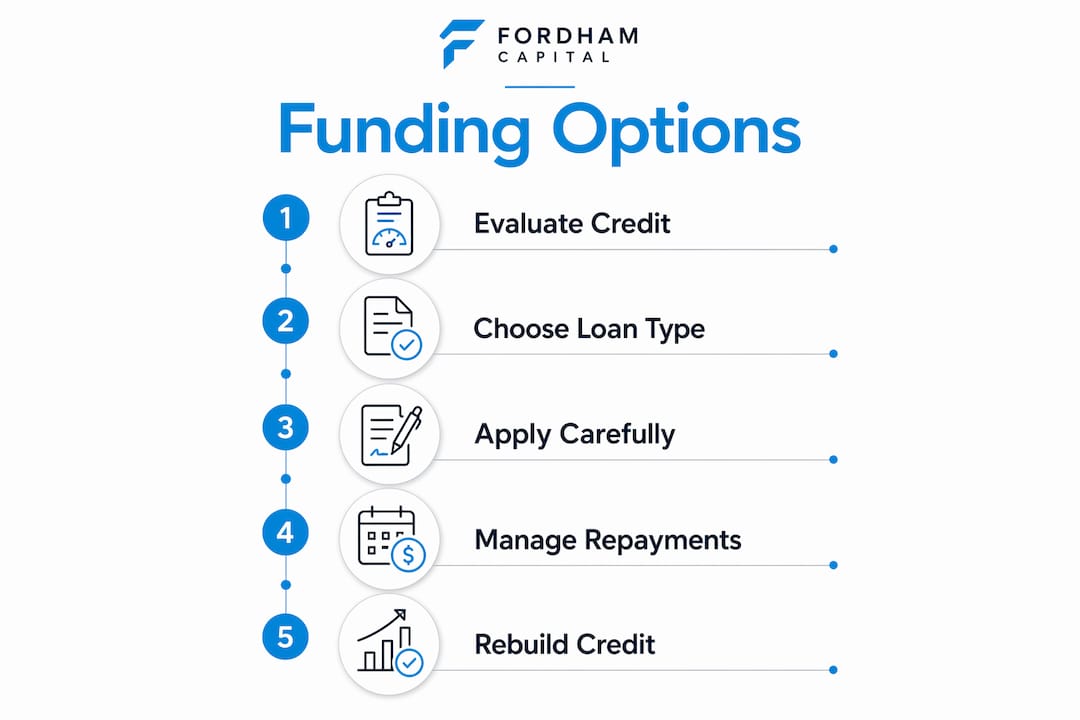
The application process for funding with bad credit follows a clear sequence. Skipping steps, especially the early ones, is where most applications fall apart.
Assess your credit profile and gather documentation. Pull your personal FICO score and your business credit report. Collect six months of bank statements, your most recent tax returns, and any existing financial statements. Know your numbers before a lender does.
Research and shortlist funding types and lenders. Match your credit score and business profile to the right product. If your score is below 580, MCAs and invoice factoring are more realistic starting points than a traditional line of credit. Use resources like how to choose the right lender to narrow your list.
Prepare your financial statements and business plan. Lenders want a profit and loss statement, a balance sheet, and a clear explanation of how you’ll use the funds. If you have collateral to offer, document it. If you don’t, be ready to sign a personal guarantee.
Complete the application carefully, leading with your strengths. Highlight revenue growth, customer retention, or industry experience. If your credit took a hit from a specific event like a medical emergency or a pandemic-related downturn, say so briefly and factually.
Address lender questions transparently. Lenders who work with bad credit borrowers have seen every situation. A written explanation for negative marks on your report can, in some cases, lead a lender to make an exception to minimum score requirements.
Review every offer before signing. Compare the annual percentage rate, not just the monthly payment. Check for prepayment penalties, origination fees, and how repayment is structured. A lower monthly payment stretched over a longer term can cost significantly more than a higher payment on a shorter one.
Fordhamcapital was built specifically for the business owners that traditional banks pass over. The model is direct: a one-page application, a broad network of banks and lenders, and approvals that can come through within 24 hours without a hard credit pull that damages your score.
The track record backs it up. Fordhamcapital has funded over $120M and holds an A+ rating from the Better Business Bureau, with clients collectively generating more than $500M in revenue. That scale reflects consistent execution across a wide range of business types and credit profiles.
A few things that set Fordhamcapital apart:
For small and medium-sized businesses that have been turned away by conventional lenders, Fordhamcapital offers a practical path forward grounded in what your business actually does, not just what your credit file says about the past.
Non-traditional funding comes with legal and tax implications that are easy to overlook when you’re focused on getting approved. Getting these right from the start protects you later.
Personal guarantees create real personal liability. When you sign a personal guarantee on a business loan, your personal assets, including your home and savings, can be pursued if the business defaults. Read the guarantee terms carefully and understand exactly what you’re putting on the line before signing.
Merchant cash advances are not loans in the legal sense. They’re structured as the purchase of future receivables, which means they fall outside many state usury laws that cap interest rates. This is why effective rates on MCAs can be extremely high without violating lending regulations. Know what you’re signing.
Loan proceeds are generally not taxable income. The IRS does not treat borrowed money as income, so receiving a business loan doesn’t create a tax liability. However, if a lender forgives part of your debt, that forgiven amount typically becomes taxable income in the year it’s forgiven.
Interest on business loans is usually tax-deductible. The interest you pay on a loan used for legitimate business purposes is generally deductible as a business expense, which reduces your taxable income. Keep clear records linking the loan proceeds to specific business uses. Consult a CPA or tax advisor to confirm deductibility based on your specific structure, especially for MCAs and factoring arrangements where the “interest” component is structured differently.
Getting funded is step one. Using the experience to build a stronger credit profile is what opens better, cheaper options down the road.

Pay every obligation on time, without exception. Payment history is the single largest factor in both personal FICO scores and business credit scores. Even one missed payment can set back months of progress. Set up automatic payments where possible so timing never becomes an issue.
Keep your credit utilization low. If you have a business line of credit, avoid maxing it out. Staying below 30% of your available limit signals responsible use to credit bureaus and improves your score over time.
Open a secured business credit card if you’re starting from scratch. You deposit funds as collateral, use the card for regular business expenses, and pay the balance monthly. After six to twelve months of consistent use, many issuers upgrade you to an unsecured card and report the positive history to business credit bureaus.
Monitor your reports regularly through Dun & Bradstreet, Experian, and Equifax for business credit, and through the major consumer bureaus for personal credit. Dispute any errors promptly. A strong personal credit score correlates directly with better loan terms and improved approval chances, so every point you add now pays dividends on your next application.
The answer depends on your business’s age and credit history. For newer businesses without an established credit file, lenders rely almost entirely on the owner’s personal FICO score. Banks and SBA-approved lenders generally require personal credit scores above 680, while alternative lenders may accept scores below 600.
Business credit scores, when they exist, range from 0–100 on most major scoring models. A score above 76 indicates low risk; below 50 signals high risk to lenders. The scores factor in payment history, credit utilization, business age, and industry type.
As your business matures and builds its own credit history, the personal score carries less weight. A business with three or more years of operation, consistent revenue, and a strong business credit score can sometimes secure funding even when the owner’s personal credit is imperfect. The SBA notes that operational history is a critical credibility factor, and one year or more of operation often unlocks access to better funding options.
The practical takeaway: work on both simultaneously. Pay personal debts on time, keep personal utilization low, and build business credit through vendor accounts and a dedicated business bank account. The two scores reinforce each other, and lenders notice when both are trending in the right direction.
If you’ve been turned down by a traditional bank or you’re not sure where to start, Fordhamcapital is built for exactly this situation. The one-page application takes minutes, there’s no hard credit pull, and approvals can come through within 24 hours. With over $120M funded and an A+ BBB rating, Fordhamcapital has a proven track record of getting capital to businesses that need it.
Apply now and find out what you qualify for today.
Business capital without perfect credit history is accessible through alternative financing options that prioritize cash flow, revenue history, and business age over credit scores alone.
| Point | Details |
|---|---|
| Credit score isn’t the only factor | Alternative lenders weigh cash flow, revenue, and time in business alongside personal credit scores. |
| Multiple funding types exist | MCAs, invoice factoring, microloans, lines of credit, and equity financing each serve different business profiles. |
| Personal guarantees are common | Most unsecured business loans require a personal guarantee even when no physical collateral is needed. |
| One year in business opens better options | Lenders may finance businesses with as little as 3–6 months history, but at least one year of operation unlocks access to more flexible and lower-cost funding options. |
| Credit rebuilding starts with on-time payments | Consistent payment history on new credit accounts is the fastest path to a stronger score post-funding. |
At Fordham Capital, we've made the application process straightforward and reassuring. Dive in and explore your financial options with confidence, knowing there's no impact on your credit score and no obligations. We review your details and offer customized solutions based on what you're looking for.