

A prepayment penalty is a fee a lender charges when you pay a business loan off before the agreed schedule. Not every business loan has one. Where it exists, it can be a flat percentage, a declining schedule over the first few years, or a formula tied to the interest the lender expected to earn. The only reliable way to know is to read the loan agreement before you sign, and to ask the lender to change the clause if it hurts you.
This guide explains why lenders charge the fee, how the common versions work, what the current SBA 7(a) rule says, and how to decide whether paying early is still worth it.
A lender prices a loan on the assumption that you will pay interest for the full term. If you repay early, that income disappears. Prepayment penalties are included in most commercial mortgage loans to assure lenders they earn the anticipated yield on which the loan was priced. Legal references describe the same purpose: the penalty safeguards the lender from losing interest income that would have accrued had the loan run its course.
That logic explains where penalties show up most often:
Short-term working capital products, lines of credit and many unsecured loans work differently. Their cost is often a fixed fee or a rate on the drawn balance, so there may be no “penalty” in the traditional sense. That does not make early payoff free: some products charge a fixed total cost regardless of when you repay, which means paying early saves you nothing. Read how the cost is built, not just whether the word “penalty” appears.
You will usually meet one of four structures. Your agreement may name them differently, so look at the math, not the label.
| Type | How it works | Where you see it |
|---|---|---|
| Flat percentage | A set percent of the amount you prepay, or of the remaining balance | Term loans, equipment financing |
| Step-down | The percentage falls each year, for example from 5% down to 1% | Commercial real estate and some term loans |
| Yield maintenance | A formula that makes the lender whole for the yield it expected | Commercial mortgages, often securitized ones |
| Defeasance | You replace the loan’s cash flow with a portfolio of securities | Large commercial mortgages |
A step-down penalty gets smaller the longer the loan stays in place. A schedule that reads 5-4-3-2-1 means paying off in year one costs 5% of the amount prepaid, year two costs 4%, and so on until it hits zero. Predictability is the benefit: you can calculate the cost on any date.

Yield maintenance is a complex formula used mainly in commercial mortgage-backed securities loans to make sure the lender receives the same yield as if the loan had reached its full term. It can be small when market rates are above your loan’s rate and large when they are below. For a deeper look at how it works in property financing, this explainer on DSCR loans for multifamily walks through the prepayment provisions that tend to come with commercial real estate debt.
If your loan is tied to a securitized pool, assume these clauses are rigid. They are written into pooling documents, so a lender’s servicer often has little room to waive them.
The SBA’s 7(a) program provides a guarantee to lenders, has a maximum loan amount of $5 million, and you apply through a participating lender. Because the SBA is backing part of the loan, it has its own prepayment rule, called a subsidy recoupment fee, found in 13 CFR § 120.223.
The fee applies only when all three conditions are met:
When it applies, the fee is 5% of the prepayments in the first 12-month period, 3% in the second and 1% in the third. After year three, there is no SBA recoupment fee. The rule sits within the SBA-specific policies for guaranteed loans in 13 CFR Part 120, Subpart B.
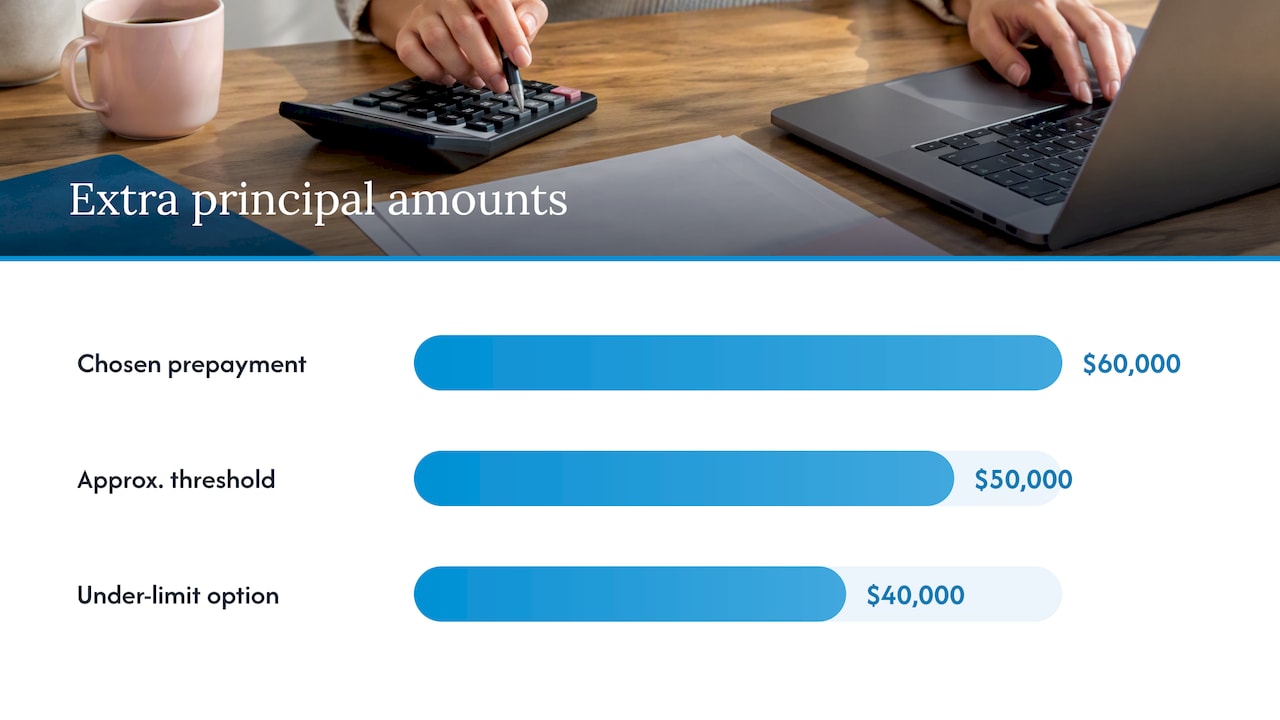
Say you take a $200,000 SBA 7(a) loan with a 25-year term, typical for real estate-backed purchases. Eight months in, you receive a large customer payment and want to send $60,000 extra toward principal.
If you instead sent $40,000, you would stay under 25% and the recoupment fee would not apply. Confirm the exact computation with your lender, because the figure depends on how the balance and prepayments are measured. This is an illustration, not a quote.
Two practical consequences follow. A shorter-term 7(a) loan, under 15 years, does not carry this fee at all. And ordinary scheduled payments never trigger it: the rule targets extra principal you choose to pay.
SBA 504 loans work differently, with their own declining schedule tied to the loan’s term. If you are financing property or heavy equipment through a 504, ask the certified development company for the exact schedule in writing.
If you are comparing SBA financing with other options, our guide to what you can and can’t do with SBA loan proceeds helps you match the loan to the purpose before you worry about exit terms.
The clause rarely carries the heading “Prepayment Penalty.” Look for these phrases in the note, the loan agreement and the term sheet:
For commercial loans, the penalty is typically negotiated at the front end, when the lender issues a letter of intent or term sheet. That is your moment of greatest leverage. Once you sign closing documents, the options shrink to paying it or waiting it out.
Before signing, ask these questions and get the answers in writing:
Our checklist of business loan agreement terms to check before you sign covers the rest of the document, from default triggers to personal guarantees.
Because the fee is a contract term, you can often shape it. Commercial-loan practitioners commonly suggest tackling it before closing. The requests that tend to work are narrower than “remove it”:
Competing offers are your best leverage. If two lenders quote similar rates and one has no penalty, the other has a reason to move. Be honest about what you are likely to do: if you plan to sell the business or refinance in two years, say so, and price the loan with that in mind.
The easiest penalty to avoid is the one that is not in the product. When you compare offers, look at:
For how rate and fees fit together, see our explanation of APR versus interest rate, because a lower stated rate with a heavy exit fee can cost more than it looks.
Paying off a loan early can be worthwhile if the interest savings outweigh the prepayment penalty. The test is simple: compare the interest you will not pay with everything it costs to leave.
An illustration with round numbers, not a quote:
Now change one thing: you owe $50,000 at 12% with only three months left. Remaining interest is a few hundred dollars, the penalty is still $1,000, and waiting is cheaper.
If you are paying off by refinancing, count the new loan’s costs too: origination fees, closing costs and any appraisal or legal charges. Our guides on origination fees and closing costs show typical ranges. For the property side of the same question, a refinance checklist with the math shows how investors test whether a refinance still pays after fees.
Also weigh what else the cash could do. If paying a 9% loan early drains the cash you need for inventory that earns more, or leaves you with no buffer, the penalty is not the only cost. Our piece on paying off a business loan early and the companion on refinancing to cut payments walk through both calculations.
We connect small and medium-sized businesses with banks and alternative lenders, and we are an intermediary, not a direct lender. That vantage point shows a pattern: owners compare rate, approval speed and monthly payment, and the exit terms come last, if at all. Speed matters, and our one-page application is built for it, but a fast yes is only useful if you know what leaving the loan will cost.
Our advice is practical. Ask for the payoff terms in the same conversation as the rate. Get the prepayment language in writing before you accept an offer. If you expect your cash flow to improve, favor products that let you repay without a formula, and if a lender insists on a penalty, push for a short schedule or a carve-out for payments from cash flow. And never assume a government-backed loan has no early-payoff cost: the SBA rule above has specific triggers, and knowing them lets you plan extra payments around the 25% line.
Our advisors can show you the prepayment terms on each offer next to the rate and fees, so you compare the full picture and not one number.
— Rob
If you are weighing financing now, Fordham Capital offers SBA loans, business lines of credit and working capital financing through a network of banks and lenders. One short application gets you in front of multiple options, with no collateral required and no credit score impact to apply. Our published pricing shows SBA loans at 8% per year and lines of credit at 1-3% per month; working capital has no published price. Final terms, including any prepayment provisions, come from the lender that makes the offer, so check them before you accept.
No. Many term loans, lines of credit and shorter-term products have none, while commercial mortgages and some long-term loans often do. It is a negotiated contract term, so check the agreement and ask the lender directly before you sign.
Only in specific cases. The SBA fee applies to loans with maturities of 15 years or longer, when you voluntarily prepay more than 25% of the balance in one of the first three years. The rate is 5%, 3% or 1% depending on the year, and nothing applies after year three.
Often, yes, especially before closing and when you hold competing offers. Ask for a shorter schedule, a cap, an annual free prepayment allowance or a carve-out for payments from cash flow. Securitized commercial mortgages with yield maintenance or defeasance are much harder to change.
It can be, when the interest you avoid is greater than the penalty plus any costs of replacing the loan. Calculate the remaining interest, subtract the penalty and fees, and compare the result with what else the cash could earn in your business.
At Fordham Capital, we've made the application process straightforward and reassuring. Dive in and explore your financial options with confidence, knowing there's no impact on your credit score and no obligations. We review your details and offer customized solutions based on what you're looking for.


