
Before signing anything, compare the full APR across offers and confirm whether the fee is deducted from your proceeds or tacked onto your principal, since either choice changes what you actually receive.
TL;DR:
- Lenders charge higher origination fees for online and alternative lenders, up to about 10%, due to faster underwriting and looser qualification standards.
- Fees can be deducted from proceeds or added to the loan principal, significantly affecting the true cost and APR of the loan.
- Borrowers should always compare full APRs, not just fee percentages, to understand the actual cost of borrowing across different offers.
- SBA loans include additional fees like guaranty and processing fees, which can be passed to borrowers or absorbed by lenders, impacting total costs.
- Building relationships, offering collateral, and thoroughly preparing documentation can help negotiate lower origination fees.
An origination fee covers the cost of putting a loan together: reviewing your application, verifying financials, underwriting the risk, and preparing legal documents. Lenders bundle several line items into this single charge rather than billing for each task separately.
Typical components include:
The economic reason behind these fees comes down to information. A lender has to build a picture of your business’s creditworthiness before it can price risk accurately, and that work costs money regardless of whether the loan closes. Research on lending relationships finds that borrowing from a new financial institution is associated with materially higher up-front origination costs than borrowing from a lender you already have a track record with, reflecting the cost of producing firm-specific information from scratch.
That is worth remembering if you are shopping multiple lenders for the first time: a fee quote from an unfamiliar bank or online lender may run higher simply because that lender has no history with your business, not because the loan itself is riskier.
It helps to separate origination fees from other closing costs. Origination fees pay for the work of creating the loan. Other charges, such as appraisal fees, title insurance, or UCC filing fees on secured loans, pay for specific third-party services tied to collateral or compliance. Lenders sometimes lump these together on a term sheet, so ask for an itemized breakdown before you compare offers.
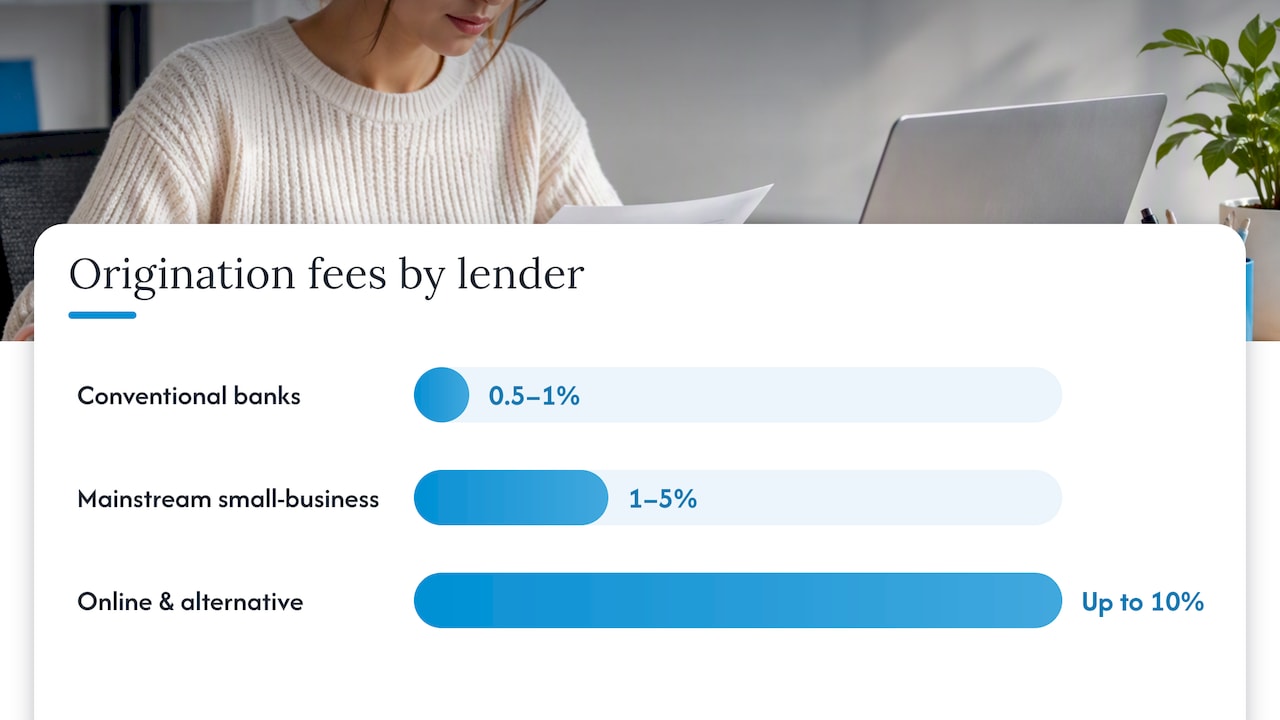
Origination fees vary widely depending on where you borrow. Conventional banks tend to charge the least, while some online and alternative lenders charge considerably more to compensate for faster underwriting and looser qualification standards.
| Lender type | Typical origination fee range |
|---|---|
| Conventional banks | About 0.5% to 1% |
| Mainstream small-business lenders | 1% to 5% |
| Online and alternative lenders | Up to approximately 10% |
These figures come from NerdWallet’s breakdown of business loan origination fees, which notes that online lenders occupy the higher end of the range in exchange for speed and more flexible credit requirements.
Several factors push an individual quote up or down within these bands. Your credit profile matters: stronger personal and business credit scores generally unlock lower fees because they reduce the lender’s underwriting workload. Loan size plays a role too, since fixed costs like document preparation get spread over a smaller base on a small loan, often pushing the percentage fee higher. Term length and whether the loan is collateralized also factor in, as secured loans can carry lower fees because the collateral reduces the lender’s risk exposure.
Watch for promotional fee waivers. A lender that waives the origination fee entirely may recover that cost through a higher base interest rate, and the same NerdWallet guidance warns that these waivers are sometimes offset dollar for dollar elsewhere in the loan terms. The only reliable way to catch this is to compare the full APR on every offer, not just the fee line item.
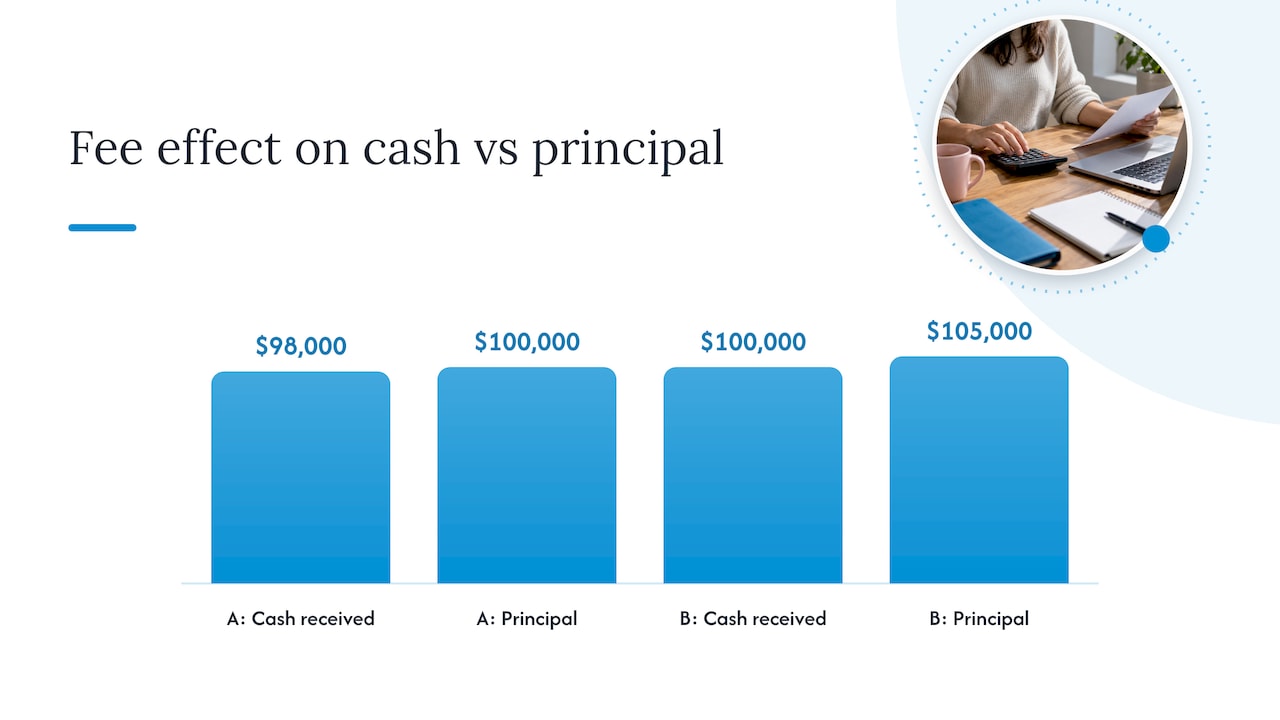
Two loans with identical headline rates can cost very different amounts once fees enter the picture, and the mechanics depend on whether the fee is deducted from your proceeds or added to your principal.
Both structures raise your effective cost above the stated interest rate, and the only way to see the true difference is to convert each offer into an APR. APR annualizes the interest rate together with mandatory fees like origination charges, which is exactly why the Consumer Financial Protection Bureau recommends comparing APR rather than the stated interest rate alone. Two loans quoting the same 8% interest rate can carry very different APRs once origination fees, points, and closing costs are factored in.
A $100,000 loan with a 2% origination fee and a 7% stated rate can carry an APR well above 7% once the fee is annualized into the cost, according to the CFPB’s explanation of APR versus interest rate. That gap is the real cost of the fee, expressed in terms you can actually compare across lenders. If you are weighing speed against cost on a time-sensitive deal, our guide to when speed beats the lowest offer walks through that tradeoff in more detail.
SBA-backed loans carry their own layer of fees on top of whatever your lender charges for origination. Understanding which ones can land on your invoice helps you avoid surprises at closing.
Because fee treatment varies by lender and by loan program, always ask directly how SBA-related charges appear on your specific quote before you compare it to a conventional loan offer. If you are evaluating whether your business qualifies for SBA financing in the first place, our overview of 2026 SBA loan requirements covers the eligibility basics.
Origination fees are rarely fixed in stone, especially once you have multiple offers in hand to compare.
Pro Tip: Before you negotiate, ask every lender for the same disclosures: full APR, itemized fee schedule, and an amortization table. Comparing apples to apples is the only way a negotiation actually works in your favor.
Our guide to budgeting for business loan closing costs breaks down typical ranges and negotiation angles in more depth if you want to go further before your next conversation with a lender.
Origination fees are generally not deducted as a lump sum in the year you pay them. Instead, they are typically capitalized and amortized over the life of the loan, similar to how interest expense is treated over time, though specific treatment depends on your entity type and how the fee is structured on your closing documents.
If your financing involves fixed-asset collateral, it is worth understanding how those structures are typically fee-based and we recommend reviewing options like DSCR loans if you are comparing asset-based financing alongside traditional business loans. None of this replaces a conversation with a tax professional who can review your specific loan documents and entity structure before you file.
Some lenders make fee comparison deliberately difficult by leaning on nonstandard terminology or incomplete disclosures. A short checklist before you sign protects you from surprises.
A useful script: “What is the APR on this offer, and can you show me an itemized fee schedule along with the amortization table before I sign?” Any lender unwilling to answer that directly is worth a second look.
We built our platform around the idea that comparing loan offers should not require a finance degree. Our one-page application connects small and medium-sized businesses to a network of banks and alternative lenders.
When fee structures differ across offers, we help clarify whether a given quote deducts the fee from your proceeds or adds it to your principal, so you can see your actual net funding before you decide. Our explainer on common working capital uses covers how businesses typically put this type of financing to work once funded.
My take after walking through these numbers: the fee percentage printed on a term sheet tells you almost nothing on its own. What matters is the APR, because that number already accounts for whether the fee reduces your proceeds or inflates your principal, and it is the only figure that lets you stack one offer against another honestly.
Speed is sometimes worth paying for. If a narrow window to buy inventory, cover payroll, or lock in a supplier discount would generate more value than the extra cost of a faster, higher-APR loan, that tradeoff can make sense. Just make the comparison with full numbers in front of you, not a gut feeling.
— Rob
We know the fee comparison process described above can feel like homework, which is exactly why we built a platform that does the heavy lifting. Submit one application, and we connect you to a network of banks and alternative lenders so you can see real offers side by side, including how each one treats its origination fee.
If you are ready to see what you qualify for, explore SBA loans, lines of credit, and working capital options through our platform and request full fee disclosure on every offer before you decide.
This article is general information, not a substitute for advice from a qualified financial advisor. Consult a qualified financial professional about your own circumstances before acting on anything here.
A loan origination fee covers the lender’s cost of processing, underwriting, and closing your loan, including application review and document preparation. It typically runs 1% to 5% of the loan amount, though the exact structure varies by lender type.
Business loan interest is generally deductible as a business expense, while origination fees are usually capitalized and amortized over the life of the loan rather than deducted in a lump sum. The exact treatment depends on your entity type and loan structure, so confirm specifics with a CPA before filing.
Loan amounts depend on your business’s revenue, credit profile, time in business, and the lender or program you use, and SBA-backed loans now allow combined 7(a) and 504 financing up to $10 million for eligible borrowers. We work with a network of lenders that can match you to an amount based on your specific financials.
Qualifying for a large loan typically requires strong revenue history, solid credit, and often collateral, with SBA programs being one common path given the newly expanded $10 million combined limit for eligible borrowers. Approval difficulty varies significantly by lender and program, so comparing multiple offers through a network rather than a single bank often surfaces more realistic options.
At Fordham Capital, we've made the application process straightforward and reassuring. Dive in and explore your financial options with confidence, knowing there's no impact on your credit score and no obligations. We review your details and offer customized solutions based on what you're looking for.