
Physicians and practice owners have five main financing routes: SBA loans for the lowest rates and longest terms, conventional bank practice loans for established borrowers, equipment financing for hard assets, lines of credit for reimbursement gaps, and alternative or marketplace lenders when speed matters more than price. Start by pulling two years of tax returns and a current P&L, then match your goal to the route above before you apply.
TL;DR:
- SBA loans typically offer the lowest rates and longest terms but require more documentation and a longer approval process of 60 to 90 days.
- Alternative lenders provide faster approval within 24 hours but generally come with higher interest rates and less favorable terms.
- Borrowers should gather two years of tax returns, current profit and loss statements, and a clear purpose summary before applying to streamline the process.
- Careful negotiation on fees, covenants, and prepayment penalties can significantly reduce the overall cost and risk of the loan.
- Oversights like incomplete financials, unverified lenders, or not comparing full term sheets can lead to delays, higher costs, or unfavorable borrowing conditions.
Medical practice loans aren’t one product. They’re a category, and picking the wrong one costs you money and months. NerdWallet’s breakdown of practice financing groups the market into four practical buckets, and each solves a different problem.
Term loans work best for acquisitions and general working capital, typically running several years with fixed monthly payments. SBA 7(a) loans cover acquisitions, working capital, and refinancing with government-backed terms; SBA 504 loans are built specifically for real estate and heavy equipment, often with below-market fixed rates on the real estate portion.
Commercial real estate loans and construction financing follow separate underwriting tracks entirely, often requiring appraisals and, for new builds, staged draws tied to construction milestones.
Every practice loan traces back to a specific need, and lenders underwrite differently depending on which one you’re solving.
A dermatology practice buying a laser system, for instance, faces a very different underwriting conversation than an internal medicine group acquiring a retiring physician’s patient base. Lenders price the risk differently because the collateral and revenue predictability differ.
Underwriters look at four things above everything else: your personal and business credit, your practice’s cash flow, how long you’ve been operating, and how predictable your specialty’s revenue is. A dermatology or dental practice with steady cash-pay revenue underwrites differently than a startup group practice still building its payer mix.
Lenders typically request:
Insurance billing patterns matter more than most physicians expect. A practice heavy in Medicare or Medicaid reimbursement gets scrutinized for collection timelines, since underwriters know those payers move slower than commercial insurers.
Pro Tip: Pull your business and personal credit reports 60 days before applying. Fixing a reporting error or paying down a revolving balance below 30% utilization can move you into a better rate tier before a lender ever sees your file.
Getting from inquiry to funded capital follows a fairly consistent sequence, though the timeline varies enormously by lender type.
Conventional banks often take four to eight weeks from application to funding. SBA loans commonly run 60 to 90 days given the additional government paperwork. For 504 loans, the certified development company’s own review applies. Alternative and marketplace lenders can move in days, sometimes offering approval within 24 hours of a completed application. The most common delay is incomplete documentation, so submitting a full package upfront, rather than trickling in documents as requested, cuts real time off the process.
The interest rate on a term sheet almost never equals what you actually pay. Term length, whether the rate is fixed or variable, and whether the loan includes an interest-only period all swing your effective monthly payment substantially. An interest-only period of six to twelve months can ease cash flow during a practice transition, but it defers principal and stretches total interest paid over the life of the loan.
Collateral expectations vary by loan size and lender type. SBA loans and larger conventional term loans usually require a personal guarantee, and real estate or major equipment loans often use the asset itself as collateral. Understanding collateral requirements before you apply helps you avoid a deal that stalls in underwriting over a lien dispute.
When comparing offers, add the monthly payment, amortized fees, and any covenant risk (like a minimum cash balance requirement) into one number. SBA-backed loans tend to close slower but carry lower rates and longer terms than most alternative lending products, which is exactly the tradeoff you’re weighing when you compare a term sheet side by side.
SBA 7(a) loans offer competitive rates and longer amortization for practice acquisitions and working capital, while SBA 504 loans do the same for real estate and heavy equipment. The tradeoff is time. Underwriting a government-backed loan simply takes longer than a bank’s own conventional practice loan program.
A lender or broker who specializes in medical practice financing understands payer mix, licensing timelines, and how a dental versus a physical therapy practice generates revenue differently. That specialization often shows up as faster underwriting, not just better bedside manner.
Before you sign anything, run through purpose, amount, timeline, collateral tolerance, and covenant terms. A loan that’s cheap on paper but locked into a rigid minimum cash balance can hurt you more than a slightly pricier loan with flexible terms.
Watch for red flags: fee structures the lender won’t put in writing, pressure to sign before you’ve reviewed terms, or claims about approval speed that don’t match the lender’s NMLS Consumer Access registration record. Verifying a lender’s registration takes five minutes and tells you whether you’re dealing with a licensed entity or a broker reselling your application to someone else.
Pro Tip: Score every offer on three axes only, fit, cost, and timeline, and weight them based on your actual priority. A physician buying a practice next month should weight timeline heavily; a physician refinancing existing debt should weight cost.
Fordham Capital operates as a marketplace, connecting practices with a network of banks and alternative lenders rather than underwriting loans directly. That model matters when speed is the priority.
This route fits a clinician who needs working capital fast, or one who’s been passed over by a conventional bank despite solid practice revenue. It’s not a replacement for comparing SBA terms if you have the runway to wait 60 to 90 days for a lower rate. Always compare the full term sheet, not just the headline number, and loop in your accountant or financial advisor before signing.
Getting funded is the milestone everyone focuses on, but what happens in the following months determines whether the loan actually helps your practice or becomes a drag on it.
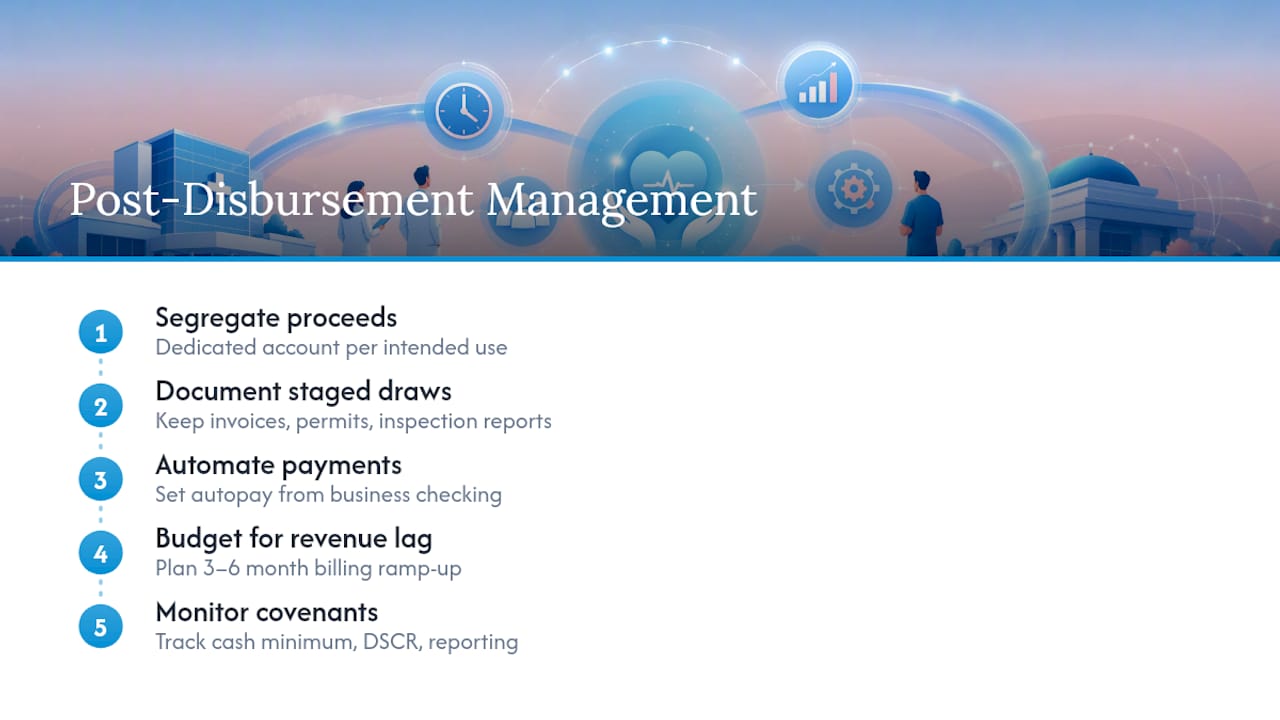
If your loan disbursed as a lump sum, resist the temptation to let it sit in your general operating account where it blends with day-to-day cash flow. Separate it into a dedicated account tied to its intended use, whether that’s a buildout, an equipment purchase, or an acquisition, so you can track spend against your original plan and prove use of proceeds if your lender or the SBA ever asks.
Staged disbursements, common in construction and acquisition financing, come with their own management task. Each draw usually requires documentation showing the prior stage’s work is complete, so keep contractor invoices, permit approvals, and inspection reports organized as you go. A missed draw deadline because of a paperwork gap can stall a buildout for weeks.
Set up loan payments on autopay tied to your business checking account, and build the payment into your monthly budget before revenue from the new equipment or expanded space actually materializes. Practices that finance a new imaging suite, for example, often see a three to six month lag between installation and full billing capacity as staff train and payer credentialing catches up. Budget for that lag, not for the revenue you expect once everything’s running.
Finally, track your loan covenants if your agreement includes any, minimum cash balance, debt service coverage ratio, or reporting requirements. Missing a covenant, even unintentionally, can trigger a technical default that complicates future borrowing.
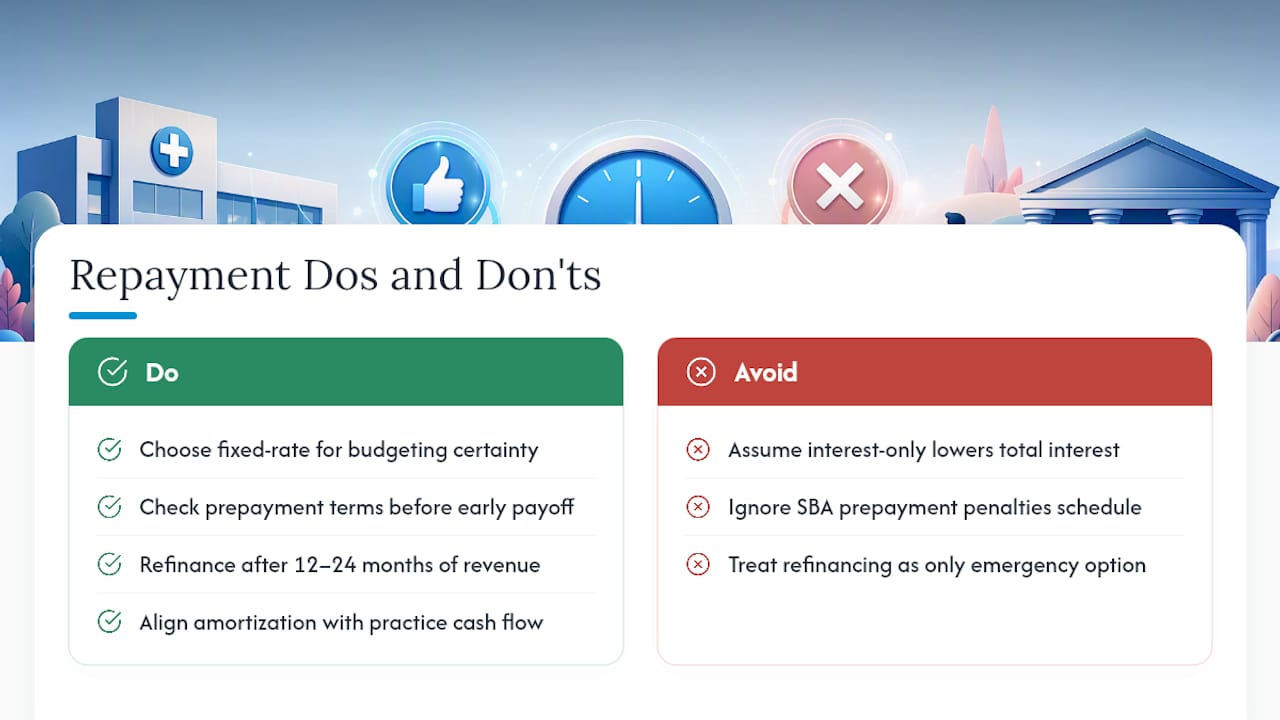
Most practice loans repay through fixed monthly installments covering principal and interest, but the structure underneath that simple description varies more than physicians expect. Fixed-rate term loans give you payment certainty for budgeting; variable-rate loans, common with some bank lines and SBA products, mean your payment moves with an index rate like the prime rate.
Interest-only periods, often available in the first six to twelve months of a practice acquisition or buildout loan, lower your payment while revenue ramps up. That flexibility comes at a cost. You’re not paying down principal during that window, so total interest paid over the loan’s life increases unless you make voluntary principal payments once cash flow allows.
Prepayment strategy deserves real attention. Some SBA loans carry prepayment penalties on a declining schedule, often the highest in year one and phasing out by year three. If you expect a windfall, from a partner buyout or a strong revenue year, check your prepayment terms before assuming an early payoff saves you money.
Refinancing is a legitimate repayment strategy, not just an emergency measure. Practices that took on higher-cost alternative financing to move fast on an acquisition often refinance into an SBA or conventional loan once they’ve established 12 to 24 months of clean revenue history, locking in a lower rate for the remaining term.
Whatever structure you choose, align your loan’s amortization schedule with your practice’s actual cash flow cycle. A practice with seasonal revenue swings benefits from a lender willing to structure slightly higher payments during strong months and lower ones during predictable slow periods, rather than a rigid flat payment that ignores your real cash pattern.
Physicians often treat a term sheet as a final offer instead of a starting point. Rate, fees, prepayment penalties, and covenant terms all have more flexibility than most borrowers assume, especially when you’re bringing solid financials to the table.
Start by getting at least two competing offers before you negotiate anything. A lender who knows you’re comparing terms elsewhere has real incentive to sharpen their number, and you can’t credibly push back on a fee or rate without a benchmark to point to.
Origination fees are frequently negotiable, particularly on larger loans where the lender’s absolute dollar profit is already substantial. Ask directly whether the fee is fixed or flexible. Prepayment penalties are worth pushing on too, especially if you anticipate refinancing or paying off the loan early once your practice’s revenue stabilizes.
Covenant terms deserve as much negotiating attention as rate. A minimum cash balance requirement or a debt service coverage ratio that’s too aggressive for your specialty’s typical cash flow pattern can put you in technical default during a normal slow month, even when your practice is fundamentally healthy. Push for covenants that reflect realistic seasonal or reimbursement-cycle variation, not a generic small-business template.
Timing your negotiation matters too. Lenders have more room to move on price near the end of a quarter or fiscal year when they’re trying to hit funding volume targets. It’s a small lever, but it’s real, and it costs nothing to ask which week works best to finalize terms.
Finally, get every negotiated change in writing before closing. A verbal agreement to waive a fee or adjust a covenant means nothing if it doesn’t appear in the final loan documents you sign.
The most common mistake is applying with incomplete financials, then scrambling to produce documents piecemeal as underwriting requests them. Every gap adds days, and multiple gaps can add weeks to a timeline that should have taken four to six.
Underestimating total capital need ranks second. Physicians frequently budget for equipment or buildout costs but forget the working capital cushion needed to cover payroll and overhead during the ramp-up period before revenue catches up, especially with insurance reimbursement lagging 30 to 90 days behind services rendered.
Mixing personal and business finances confuses underwriters and muddies your actual cash flow picture. If your practice’s bank statements show personal expenses running through the business account, expect a lender to ask questions that slow down your file.
Ignoring credit issues before applying, rather than addressing them, costs more than most physicians realize. A single missed payment or high credit utilization ratio can push you into a materially worse rate tier, and fixing it after the fact takes months, not the days you have before a purchase agreement deadline.
Accepting the first offer without comparing terms is a mistake born of urgency, and lenders know it. Physicians eager to close on a practice acquisition often skip the shopping step entirely, missing better rates or terms available elsewhere for the same underwriting profile.
Finally, failing to verify a lender’s registration before sharing sensitive financial documents exposes you to unnecessary risk. A quick check through NMLS Consumer Access confirms you’re dealing with a properly licensed entity, and resources from FINRA help validate any broker or intermediary involved in structuring your financing.
Fordham Capital’s model is built for the physician who doesn’t have three months to wait on an answer: one page to fill out, a network of banks and alternative lenders reviewing your file, and approvals in as little as 24 hours.
Before you apply now, gather your last two years of tax returns, a current profit and loss statement, your business license or medical board certification, and a one-paragraph summary of what the funds are for. If you’re weighing SBA eligibility against a faster alternative route, reviewing SBA loan requirements first helps you understand what you’d be trading for speed. Whichever direction you go, compare the full term sheet, not just the headline rate, and confirm the terms work for your practice’s actual cash flow before you sign anything.
Pick loan terms that protect your monthly cash flow before you chase the lowest headline rate, and favor lenders who actually understand how reimbursement cycles work. The cheapest loan on paper is worthless if its payment schedule doesn’t match when your money actually arrives.
If there’s one habit worth building, it’s this: read the covenant section before the rate section. Rate gets negotiated. A bad covenant gets discovered the hard way.
— Rob
This article is general information, not a substitute for advice from a qualified financial advisor. Consult a qualified financial professional about your own circumstances before acting on anything here.
At Fordham Capital, we've made the application process straightforward and reassuring. Dive in and explore your financial options with confidence, knowing there's no impact on your credit score and no obligations. We review your details and offer customized solutions based on what you're looking for.