
A fintech business loan is business financing arranged through a digital-first lender or marketplace that uses automation and alternative data instead of a traditional bank’s paperwork-heavy process. That single shift, replacing manual underwriting with software and bank-transaction data, is why fintech lenders can hand a small business a decision in hours instead of weeks.
Here is what that means for you in practice. Fintech lending leans on tools like Plaid to pull real-time cash flow data straight from your business bank account, so approval decisions rely less on your personal credit score and more on how your business actually performs day to day. Industry research from Annual Reviews frames the core difference as experience: fintech replaces the branch visit and the loan officer meeting with a one-page online form. Fordham Capital built its own model around that same idea, connecting applicants to a network of banks and alternative lenders through a single digital application.
Three things to know before you go further:
Fintech lending doesn’t eliminate risk pricing. It just moves the underwriting decision from a loan officer’s file review to an algorithm reading your bank statements in real time.
Fintech business loans use digital underwriting and alternative data to approve and fund faster than most banks, trading longer terms and lower rates for speed and broader access.
| Point | Details |
|---|---|
| Core definition | A fintech business loan is arranged through a digital-first lender using automation and bank or sales data instead of manual review. |
| Speed vs. cost trade-off | Expect decisions in 24 to 72 hours, often paired with higher rates or shorter terms than a bank loan. |
| Underwriting signals | Lenders weigh bank cash flow, merchant processor data, and accounting records alongside credit score. |
| Compare before signing | Always convert factor rates to an annualized cost and get the repayment schedule in writing. |
| Fordham Capital’s role | Fordham Capital’s one-page application and lender network can deliver approvals within 24 hours for qualifying small businesses. |
Fintech business lending means a lender uses software, data integrations, and often algorithmic scoring models to evaluate and fund a loan application, rather than routing it through a branch-based manual review. The mechanics matter more than the marketing term. A fintech platform typically connects to your business bank account, payment processor, or accounting software through an API, pulls months of transaction history, and scores your business against a model built from thousands of similar borrowers.
Three kinds of players use this model, and it helps to know which one you’re dealing with:
The distinction that matters most for you as a borrower isn’t who technically holds the loan. It’s the experience. Stripe’s research on fintech lending notes that AI and machine learning let these platforms underwrite faster and at greater scale than manual review allows, which is exactly why a fintech application feels closer to a checkout flow than a bank meeting.
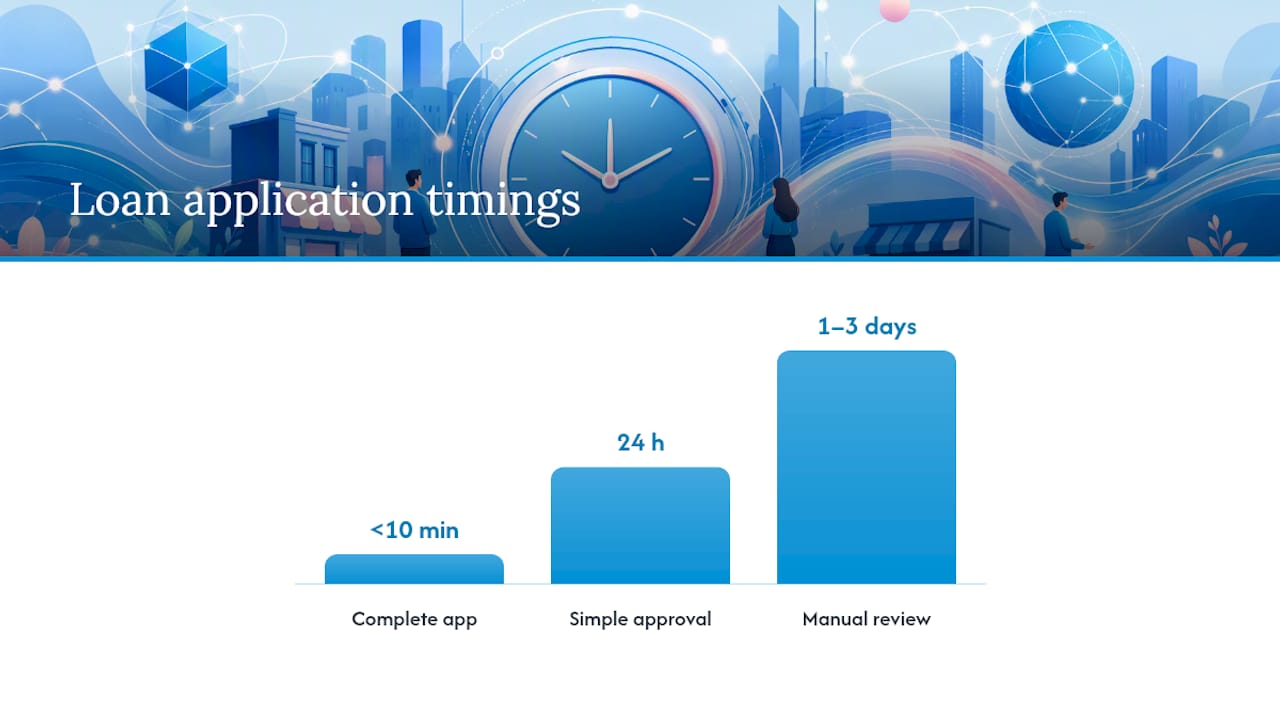
The sequence runs: apply online, connect your data, get scored automatically, receive a decision, then get funded, often within a few business days. Each step compresses what used to take a loan officer weeks into a process that runs largely without a human touching your file until final review.
You start with a short online form, frequently a single page asking for basic business details, revenue estimates, and time in business. From there, the platform prompts you to connect your bank account directly (through Plaid or a similar service) or upload recent statements. Many lenders also pull data from your payment processor or accounting software like QuickBooks to verify revenue trends. An identity check runs in parallel, and the underwriting engine scores the combined data against its risk model.
BuiltIn’s coverage of fintech lending points out that many platforms can deliver approvals and deposit funds within 24 hours for straightforward applications. Even more complex files, ones needing manual review of a specific document, typically resolve in one to three business days rather than weeks.
The whole process is designed to replace a stack of paperwork with a data connection. If you can log into your bank account, you can usually complete the hardest part of the application in under ten minutes.
Fintech lenders offer several distinct products, and picking the wrong one for your situation is one of the most common mistakes small business owners make. Each one repays differently, and matching the product to the actual cash need matters more than chasing the lowest advertised rate.
Term loans and lines of credit tend to carry the longest repayment windows among fintech products. Invoice factoring and MCAs move faster but come with shorter terms and tighter repayment cadences, since the lender is essentially advancing against money you’re already expected to collect. A detailed breakdown of non-bank financing types can help you match a specific product to your situation before you apply.
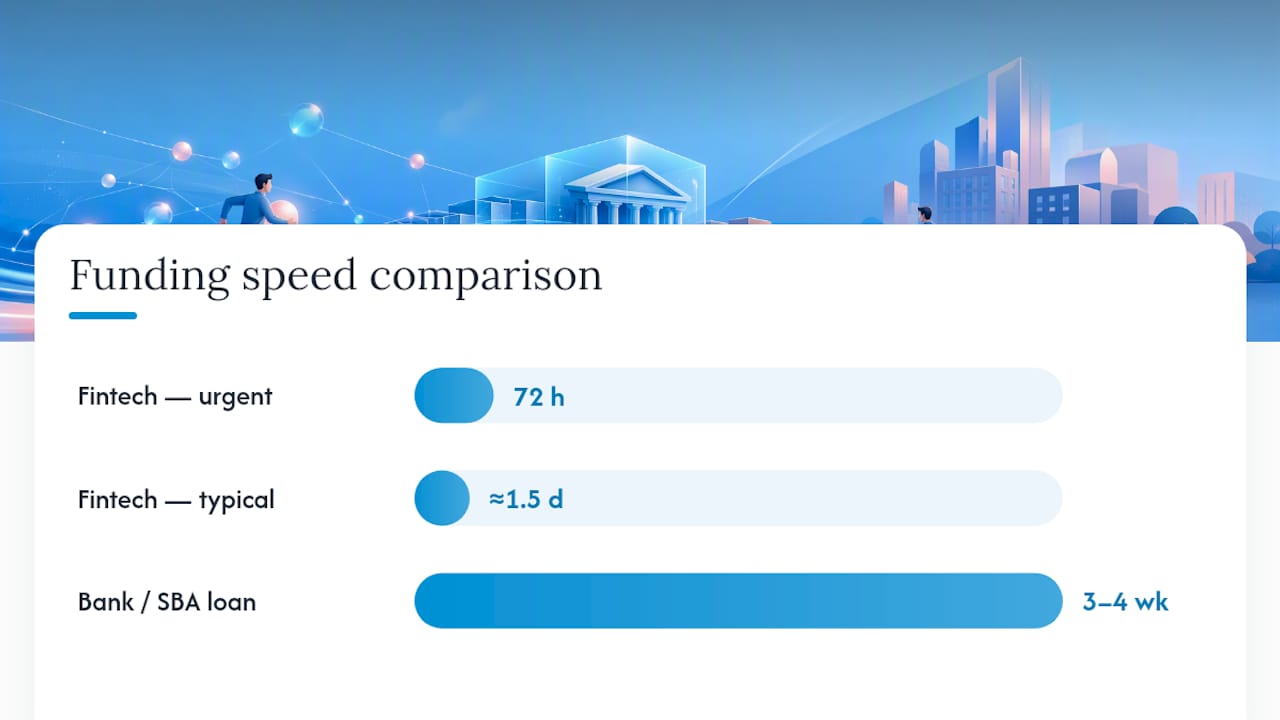
Speed is the headline advantage, but it’s not the only one, and it doesn’t come free. NerdWallet’s analysis of alternative lending confirms what most small business owners already sense: online lenders approve and fund faster than banks, but that convenience usually shows up as a higher rate or a shorter repayment term somewhere in the fine print.
Advantages:
Disadvantages:
Statistic in context: where a bank term loan or SBA loan might carry a single-digit to low-teens annual rate with terms stretching several years, fintech products compress that timeline dramatically, often into months, and price that convenience into the cost. If you need $50,000 for new equipment and can wait three to four weeks, a bank or SBA loan may still win on total cost. If you need that same $50,000 within 72 hours to cover a seasonal inventory buy, fintech is often the only realistic path.
Fintech underwriting looks past your credit score to the operating signals your business generates every day. That shift is the entire premise behind Plaid’s fintech lending research, which found that platforms assess the “strength of the business” through bank activity, merchant data, and revenue trends rather than credit history alone.
The specific signals lenders pull include:
This matters most for businesses with a credit score that doesn’t tell the full story, a young company, a recent dip from an unrelated setback, or an owner who hasn’t built extensive personal credit. Not every fintech borrower is credit-limited, either; plenty of fast-growing, digitally-native businesses choose these platforms purely for the speed and integration advantage, even with solid credit scores. Understanding the factors lenders weigh in approval decisions before you apply puts you ahead of most applicants.
Pro Tip: Sync your accounting software (QuickBooks, Xero, or similar) to your bank account at least a month before applying. Clean, connected records let automated underwriting score you faster and more favorably than a pile of exported PDFs.
Comparing offers means converting every number to the same basis, and this is where most small business owners get burned. A factor rate and an APR are not the same measurement, and lenders know most applicants won’t do the math to translate one into the other.
Run through this checklist on every offer:
| What to Check | Why It Matters |
|---|---|
| APR vs. factor rate | A 1.3 factor rate on a 6-month term can equal an APR well above that, even though it looks like a flat 30% markup |
| Origination fees | A 3% fee on $50,000 removes $1,500 before you see a dollar |
| Repayment cadence | Daily withdrawals on a slow sales week can trigger overdrafts |
| Prepayment penalty | Some fixed-cost products charge the full amount even if you repay in half the time |
If a lender resists explaining how their factor rate translates to an annualized cost, treat that as a warning sign, not a technicality. Resources for comparing fast-approval lenders can help you build this comparison before offers start arriving.
Gathering your bank access, recent bookkeeping, and a clear explanation of what the money is for will speed up nearly every fintech application you submit. Lenders reward applicants who show up organized, because clean data lets their automated systems score you without a manual follow-up request that adds days to the timeline.
Businesses managing physical inventory should also review their inventory tracking systems before applying, since clean inventory records often strengthen a loan file when the funds are earmarked for stock purchases.
Fordham Capital fact box: Fordham Capital uses a one-page application with approvals possible within 24 hours, connecting applicants to a wide network of banks and alternative lenders. The company holds an A+ BBB rating, has funded more than $120 million, and reports that clients have generated over $500 million in revenue after securing funding. Reviewing how business funding applications actually work before you start gives you a realistic picture of the digital process end to end.
The biggest risk isn’t the lending model itself. It’s accepting an offer without understanding exactly what you’re agreeing to repay and when. Fast funding should never mean fast-tracked past the fine print.
Watch for these red flags before signing anything:
Before accepting funding from any platform, check its Better Business Bureau rating, ask for a sample contract in advance, and confirm any state licensing that applies to the lender type. Always ask, in writing, for the full APR-equivalent cost and the exact repayment schedule; a legitimate lender will provide both without hesitation.
A lender who can’t or won’t give you a written repayment schedule before you sign isn’t offering you fast funding. They’re offering you a decision you can’t fully evaluate.
Choose fintech when speed and flexibility outweigh the premium you’ll pay for them, and lean toward a bank when the opposite is true. This decision rubric strips out most of the guesswork:
A retailer needing $30,000 for a holiday inventory buy in November can’t wait six weeks for a bank decision; fintech is the practical answer. A business planning a $200,000 equipment purchase with a comfortable runway should shop the bank and SBA route first. Reviewing real examples of fast funding use cases helps clarify which category your situation falls into.
Fordham Capital exists because too many capable small businesses get turned away by traditional banks over a technicality, thin credit history, a seasonal dip, a business younger than three years, despite having the cash flow to support a loan. Fintech underwriting solves a real problem for those borrowers, and that’s worth explaining honestly, trade-offs included, rather than pretending speed comes free.
Fordham Capital operates as a marketplace, connecting applicants to a wide network of banks and alternative lenders rather than funding loans directly. The company’s track record speaks to that model: an A+ BBB rating, over $120 million funded, and clients who’ve gone on to generate more than $500 million in combined revenue after securing capital through the one-page application and 24-hour approval process.
That transparency matters because a marketplace model only works if it’s actually matching businesses to the right lender, not just the first one willing to say yes.
If waiting weeks for a bank decision isn’t an option, Fordham Capital’s one-page application connects you to a network of banks and alternative lenders built specifically for businesses that need capital now, without a hard credit pull upfront or collateral requirements slowing things down.
After you submit your application, expect a response tied to the same speed this article has covered throughout: many applicants hear back within hours, with funding often following in one to three business days once you accept an offer. You’ll need basic business bank statements and a short explanation of how you plan to use the funds, the same short list covered earlier. Fordham Capital holds an A+ BBB rating and has funded over $120 million for small businesses across the country, and every offer comes with clear written terms so you can compare it against any other financing you’re considering before you accept. Start your application now to see what you qualify for.
What is a fintech business loan in simple terms? A fintech business loan is financing arranged through a digital lending platform that uses automated data analysis, rather than manual bank underwriting, to approve and fund your loan, often within a few days.
How do fintech loans work compared to bank loans? Fintech loans work by pulling your bank, sales, and accounting data through digital connections to score your application algorithmically, while bank loans typically rely on manual document review and longer processing times.
Are fintech business loans more expensive than bank loans? Fintech loans often carry higher rates or shorter terms than bank loans, since lenders price in the risk of faster approvals and looser credit requirements, so comparing the full annualized cost matters.
What documents do I need for a fintech business loan application? Most fintech lenders ask for recent bank statements, your EIN, accounting software access, and merchant processor statements if applicable, plus a brief explanation of how you’ll use the funds.
Is Fordham Capital a direct lender or a marketplace? Fordham Capital operates as a marketplace, connecting applicants to a wide network of banks and alternative lenders through a single one-page application rather than funding loans directly.
This article is general information, not a substitute for advice from a qualified financial advisor. Consult a qualified financial professional about your own circumstances before acting on anything here.
At Fordham Capital, we've made the application process straightforward and reassuring. Dive in and explore your financial options with confidence, knowing there's no impact on your credit score and no obligations. We review your details and offer customized solutions based on what you're looking for.