SBA loan proceeds must go toward sound business purposes that match what your loan authorization says, full stop. The broad permitted categories are real estate and site improvements, buildings, equipment and fixed assets, inventory and supplies, working capital, and certain debt refinancing. Spend outside those lines, or outside the specific purpose your lender approved, and you risk default, loss of the SBA guarantee, or worse.
TL;DR:
- Borrowers must strictly use SBA loan funds for approved categories like real estate, equipment, inventory, working capital, or debt refinancing, with no diversions.
- Larger project requests require detailed documentation such as contractor bids, purchase agreements, and a clear line-item breakdown of costs.
- Misusing funds for personal assets, paying off unrelated debts, or reallocating expenses without approval can result in legal consequences and loss of guarantee.
- Proper documentation includes signed vendor quotes, bank statements, invoices, and a detailed, itemized budget aligned with the loan authorization.
- Transparent, fast communication with lenders about any misuse or reallocation is critical to avoid penalties or potential legal action.
The federal regulation governing this is 13 CFR §120.120, and it spells out categories rather than a vague spending mandate. Proceeds can go toward acquiring land, making site improvements, purchasing or renovating existing buildings, and constructing new ones. They can also cover fixed assets and equipment, both purchase and installation costs included.
For 7(a) and microloan borrowers specifically, the rule extends further: proceeds can fund inventory, supplies, raw materials, and general working capital. That last category is the one lenders scrutinize hardest, because “working capital” can mean payroll, rent, marketing, or a dozen other things, and vague answers make underwriters nervous.
Permitted uses under the regulation include:
Pro tip: If your plan touches more than one category, say so explicitly on your application. A borrower who writes “equipment and installation, plus 90 days of working capital” gets underwritten faster than one who writes “business needs.”
Larger construction or acquisition requests almost always draw a request for project-level detail: contractor bids, purchase agreements, or a cost breakdown by line item.
Not every SBA program treats “use of proceeds” the same way, and matching your project to the right program matters as much as writing a clean application.
The 7(a) loan program is the most flexible. It covers real estate purchase or improvement, working capital, equipment and machinery, furniture and fixtures, debt refinancing, and even ownership changes. Delivery methods like SBA Express and the Working Capital Pilot program speed up smaller requests, and the typical program cap sits at $5 million.
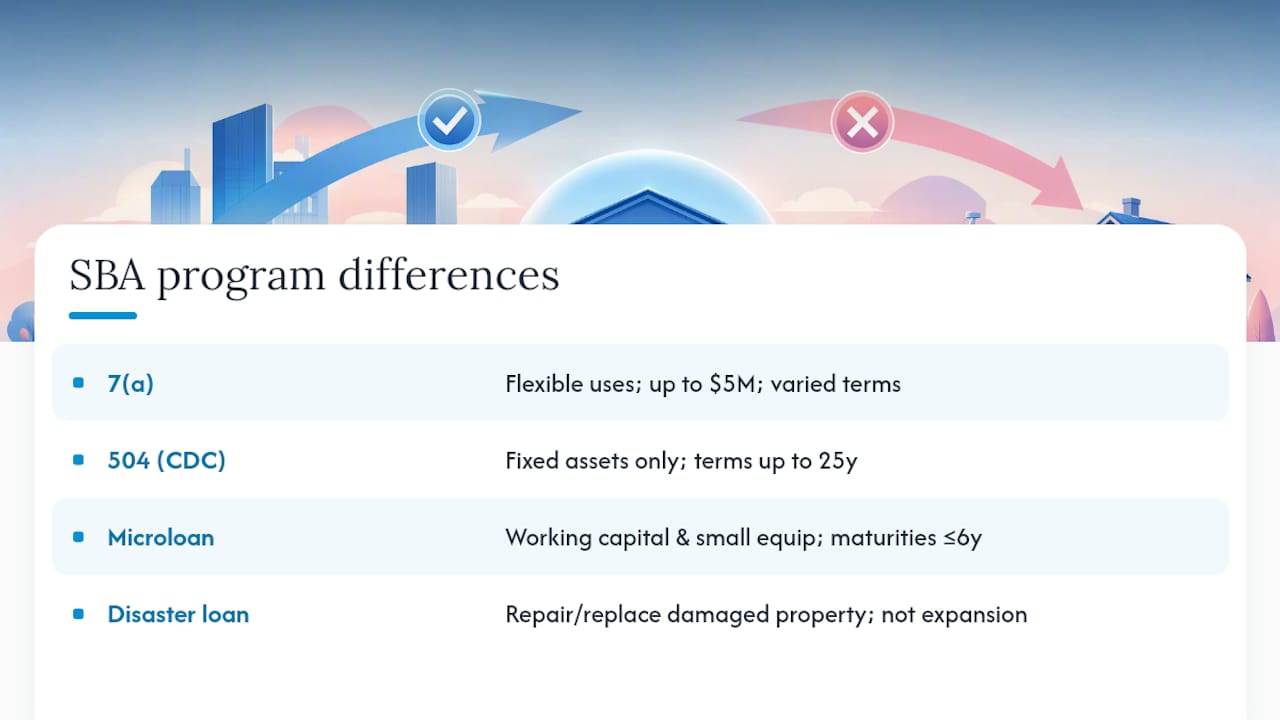
CDC/504 loans exist almost exclusively for fixed assets: land, buildings, and major equipment. There’s no working capital allowance here. The tradeoff is favorable terms, with real estate maturities running up to 25 years and equipment financing often set around 10 years, tied to the asset’s useful life.
Microloans, offered through nonprofit intermediaries, fund working capital and smaller purchases of supplies, equipment, and fixtures, with maturities capped at 6 years. Disaster loans occupy their own lane entirely: proceeds are restricted to repairing or replacing damaged property, inventory, or equipment, not general expansion.
13 CFR §120.130 draws the line clearly, and the violations here trip up more borrowers than most people expect. Payments to associates of the small business are prohibited except for reasonable compensation for services rendered. Certain refinancing scenarios are restricted, floor-plan financing has its own limits, and taxes held in trust for someone else can’t be touched.
The “replacement of funds” issue trips people up constantly: if you already spent your own cash on a project, then apply for an SBA loan and try to reimburse yourself, that’s typically not allowed. Common red flags include:
If it doesn’t benefit the small business directly, don’t spend the loan on it.
For 7(a) loans, SBA Form 1050, the Settlement Sheet, certifies that proceeds were disbursed exactly as the loan authorization specified. Your lender completes it at closing, and it becomes the anchor document if the SBA ever reviews the file.

Beyond that single form, you need a paper trail that survives scrutiny months or years later. Keep invoices, paid receipts, signed vendor contracts, payroll records tied to loan-funded positions, and bank statements showing exactly when and where disbursed funds landed.
Before your funds disburse, work through this:
Pro tip: Keep a dedicated project folder, physical or digital, from day one. Lenders and SBA reviewers reconstruct spending faster when everything sits in one place instead of scattered across email threads and old bank apps.
Lenders frequently apply internal policies tighter than what federal regulation requires, and the stated use of proceeds is often the first thing an underwriter tests for credibility. A vague answer like “grow the business” gets far more pushback than a line-item budget with vendor quotes attached.
Underwriters treat use of funds as a core credit-risk question. Even a fully permitted purpose needs a believable story behind it, backed by numbers.
Strengthen your application with:
Understanding what underwriters actually check against your approval factors before you apply saves weeks of back-and-forth later.
Consequences scale with intent, but even honest mistakes carry real risk. Under 13 CFR §123.9, misuse can lead to loan acceleration, denial or repurchase of the SBA guarantee, collection action, and in cases of deliberate fraud, criminal referral.
If you discover an inadvertent misuse:
Acting fast and transparently is almost always better than hoping a reviewer never notices.
Most applicants stumble on documentation, not eligibility. They know their equipment purchase or working capital need qualifies, but they show up without vendor quotes or a real budget attached. Fordham Capital’s one-page application and A+ BBB-rated process cut through a lot of that friction by connecting you directly with lenders who know what to ask for. Before you apply anywhere, sketch a simple project budget. It’s the single fastest way to look credible on paper.
— Rob
Traditional bank underwriting can drag a straightforward equipment purchase or working capital request into weeks of paperwork exchanges. Fordham Capital shortens that timeline with a one-page application and approvals within 24 hours, connecting you to a wide network of banks and alternative lenders without a hard credit pull.
We don’t guarantee eligibility for any specific SBA program, but we do help you present your funding need clearly and match you with lenders suited to your situation, whether that’s business growth financing or a straightforward working capital request. If you’ve already worked through your permitted-use budget, apply now and see what a lender network built for speed can do for your timeline.
At Fordham Capital, we've made the application process straightforward and reassuring. Dive in and explore your financial options with confidence, knowing there's no impact on your credit score and no obligations. We review your details and offer customized solutions based on what you're looking for.