
Yes, soft pull business loans are real, and several legitimate financing paths let you get prequalified without a hard credit inquiry. Merchant cash advances, invoice factoring, and payment-processor loans routinely rely on soft pulls or skip personal credit checks entirely, underwriting on revenue and transaction history instead. The catch: many lenders still require a hard pull before they release funds, and the products that avoid it tend to cost more. This guide breaks down the mechanics, the eligibility signals, the shopping tactics, and where a marketplace like Fordham Capital fits.
TL;DR:
- Most soft-pull business financing options, such as merchant cash advances and invoice factoring, do not require a hard credit inquiry for approval.
- These products often carry higher costs, shorter repayment terms, and do not help build your credit compared to traditional bank loans.
- Final approval typically triggers a hard pull only after an initial soft prequalification, so verifying this step in writing is crucial.
- Soft-pull options are best suited for established businesses with steady revenue, long operating histories, and strong transaction records.
- Using marketplaces like Fordham Capital can reduce multiple application impacts by providing multiple offers with a single soft credit check.
A soft pull is a credit check that doesn’t affect your score. A hard pull does, and it can drag your score down for a stretch of time. Lenders, landlords, and even you (checking your own report) can run soft inquiries all day without consequence. Hard inquiries are different. They’re the kind a lender runs when you formally apply for financing, and each one shows up on your credit report for up to two years, according to Nav’s lending guide.
Here’s the practical distinction that matters for your business:
Fast fact: Soft inquiries leave your score untouched, but hard inquiries can lower it and stay visible on your report for up to two years, per Nav’s data on credit pulls. That’s a long shadow for what might be a five-minute application.
Most online lenders now use a two-step process: a soft pull to give you a conditional offer, then a hard pull only if you accept. That structure lets you compare several lenders’ terms before any inquiry touches your credit file, which is exactly the leverage smart borrowers use to shop without cost.
Not every product handles credit the same way. Some categories were built around alternative underwriting from the start, which is why they lean on soft pulls or skip personal credit checks almost entirely. Here’s how the main ones work and what they cost you in return.
Each of these trades something for that soft-pull convenience. MCAs and factoring cost more than a bank loan. Payment-processor loans move fast but tie repayment to your sales volume, which can squeeze cash flow in a slow season. Microlenders are gentler on credit but usually cap how much you can borrow. None of them build your credit the way a reporting term loan does, a point worth remembering if your long-term goal is a stronger credit file, not just faster cash today.
Lenders that skip the hard pull are underwriting using different data sources, such as business revenue and transaction history, rather than relying primarily on credit scores.
The signals that matter most:
Borrowers who tend to qualify easily include established e-commerce sellers with steady payment-processor volume, high-transaction retail merchants with consistent card sales, and service businesses sitting on a stack of unpaid invoices from creditworthy clients. If any of that describes you, a soft-pull product probably has a lane built for your situation. Revenue-based underwriting has become the default alternative to score-based decisions for exactly this reason.
If your business has strong credit, a long operating history, and you can wait two to four weeks for funding, a traditional bank loan or an SBA 7(a) loan will almost always beat a soft-pull product on cost. SBA loans require full underwriting and typically a hard pull, but the rates and terms are hard to match anywhere else.
The application flow for most alternative lenders follows a predictable pattern, and knowing it in advance saves you from an unpleasant surprise on your credit report.
It usually goes: soft-pull prequalification, then a conditional offer with estimated rates and terms, then a hard pull only when you formally accept and move toward funding. Many online lenders follow this exact sequence, letting you compare offers with zero credit impact until you commit, according to LendingTree’s overview of no-credit-check options.
Before you sign anything, get clarity in writing. Ask lenders directly:
Pro Tip: Get every prequalification offer in writing, including whether a hard pull is coming, before you click “accept.” A phone rep’s verbal reassurance doesn’t show up if a dispute happens later, but an email or portal disclosure does.
Limit yourself to lenders that document their soft-pull process upfront. If a lender can’t clearly answer whether your acceptance triggers a hard inquiry, that’s your answer: assume it does, and shop elsewhere first. Comparing three or four documented prequalifications costs you nothing on your credit file. Comparing three or four formal applications can cost you real points.
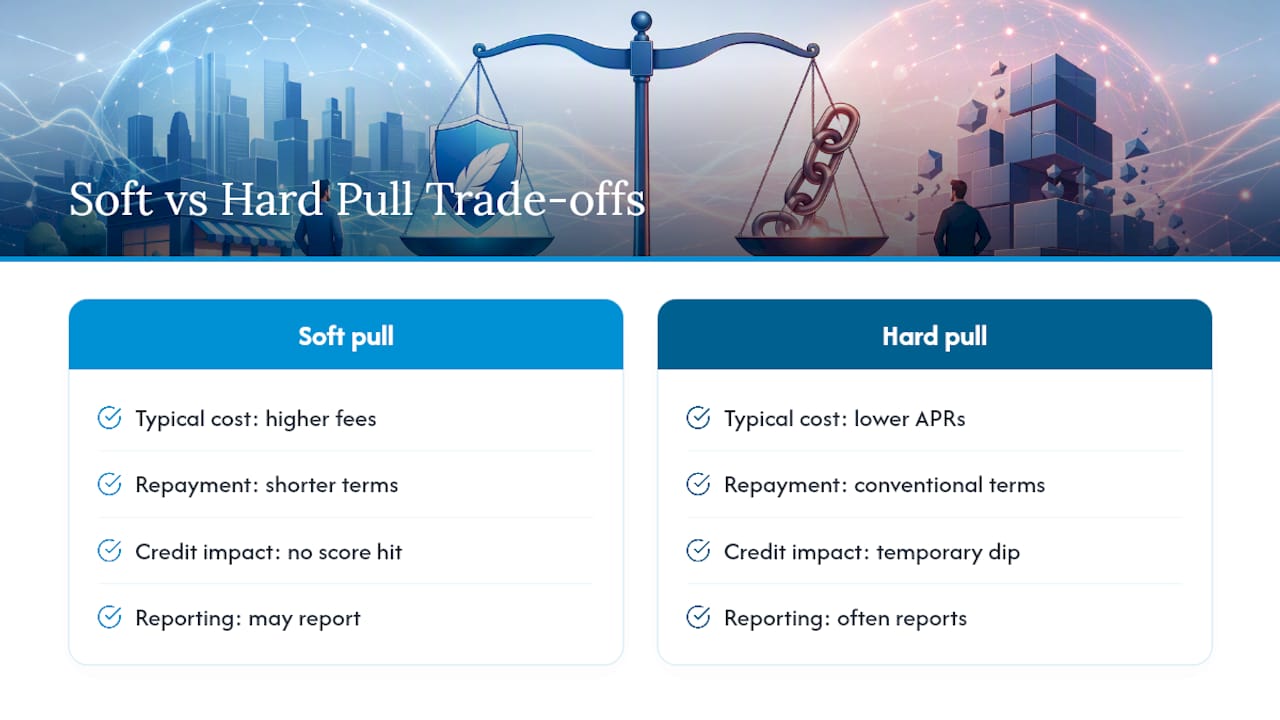
Soft-pull convenience isn’t free. It usually shows up as a higher price tag, different repayment structure, or a missed opportunity to build your credit file.
Merchant cash advances quote “factor rates” instead of APRs, typically somewhere between 1.1 and 1.5 times the amount borrowed, but translated into an annual percentage rate, that can land well above what a bank loan would charge. Alternative options that skip hard credit checks generally carry higher fees and shorter repayment terms than traditional bank or SBA financing, according to NerdWallet’s small business loan research.
By the numbers: Hard inquiries cause a temporary score dip and stay on your report for up to two years, while soft inquiries never touch your score at all, per Nav. Weigh that two-year shadow against the extra cost of a soft-pull product. Sometimes protecting your score for a few points is worth paying more. Sometimes it isn’t.
Reporting behavior is the other piece owners overlook. Some soft-pull products report your payment history to business credit bureaus, which helps you build a track record for cheaper financing later. Others don’t report at all, meaning you pay a premium and get zero credit-building benefit in return. Before you accept an offer, ask specifically whether the lender reports to Dun & Bradstreet, Experian Business, or Equifax Business. If building credit matters to you long-term, that answer should weigh as heavily as the price.
Here’s the practical trade-off in one line: if your business qualifies for a traditional loan and can tolerate a single hard pull, that route is often cheaper over the life of the loan than a soft-pull product with a steep factor rate. Soft-pull financing earns its premium when speed or credit protection outweighs the extra cost, not as a default first choice.
Picking the right soft-pull product comes down to a short checklist, a handful of direct questions, and knowing which answers should make you walk away.
Questions worth asking every lender you’re considering: What type of credit check does prequalification use? What are the exact fees, beyond the headline rate? How fast is funding once approved, same day or 24 to 48 hours? Is this a recourse or non-recourse arrangement? Can I see a sample contract before I apply?
Pro Tip: If a lender guarantees approval before reviewing any of your financials, treat that as a red flag, not a selling point. Legitimate underwriting, even the soft-pull kind, always looks at revenue, deposits, or receivables before making an offer.
Watch for these warning signs specifically: guaranteed approval regardless of your financials, upfront fees required before funding is confirmed, vague or shifting language about total repayment cost, and pressure to sign within hours. Any one of these should slow you down. If a lender checks out on all five checklist items and answers your questions in writing, you’re in reasonable territory to move forward. If they dodge even one, keep shopping. Documenting your eligibility before you apply anywhere puts you in a stronger negotiating position across the board.
Fordham Capital built its process around the exact problem this article covers: getting real financing offers without torching your credit score to find them. The application is a single page. Instead of you cold-applying to a dozen lenders and racking up hard pulls along the way, Fordham Capital matches your business against a network of banks and alternative lenders and can return approvals within 24 hours.
That network structure matters more than it sounds. A marketplace model means:
Fordham Capital carries an A+ Better Business Bureau rating, has funded more than $120 million to small and medium-sized businesses, and reports that its clients have gone on to generate over $500 million in revenue. Those numbers reflect a company built specifically to serve businesses that conventional banks tend to overlook, exactly the owners this article is written for.
Every soft-pull product on this list is legitimate, but that doesn’t mean they’re equally good for you. My honest read after breaking down the mechanics: the borrowers who come out ahead are the ones who treat prequalification as a comparison tool, not a formality to rush through.
Rule one, always get the prequalification in writing before you touch a formal application. Rule two, calculate total repayment in dollars, not just the headline rate or factor number. Rule three, if building long-term business credit matters to you, weight lender reporting behavior as heavily as price. A slightly more expensive product that reports to Dun & Bradstreet often pays for itself the next time you borrow.
My actual advice: get prequalified through a marketplace that documents its soft-pull process, ask the five questions from the checklist above, and don’t accept anything until you’ve seen the terms in writing. That single habit protects your score and your bottom line at the same time.
— Rob
Fordham Capital’s whole model exists so you’re not gambling your credit score just to see what you qualify for. One page, one application, and a network of banks and alternative lenders competing to fund your business, with approvals often landing within 24 hours.
Instead of filing separate applications with five lenders and racking up hard pulls along the way, you submit once through Fordham Capital’s application and let the matching happen on the back end. If credit protection matters to you, ask directly whether your specific offer requires a hard pull before you accept anything. That question costs you nothing, and Fordham Capital’s team will give you a straight answer. Start your application today and see what you qualify for before committing to anything.
At Fordham Capital, we've made the application process straightforward and reassuring. Dive in and explore your financial options with confidence, knowing there's no impact on your credit score and no obligations. We review your details and offer customized solutions based on what you're looking for.