

If you need working capital now, Fordham Capital is the fastest path for most U.S. small and medium-sized businesses. One-page application, no credit score impact, approvals within 24 hours, and access to a network of banks and alternative lenders in a single submission.
Here is what you get from the start:
Pro Tip: Have three months of bank statements and your most recent tax return ready before you start the application. Lenders move faster when the documents are already there.
Fast, flexible U.S. business capital is most accessible through a marketplace platform that connects you to multiple lenders in a single application, with approvals possible within 24 hours.
| Point | Details |
|---|---|
| Match product to need | Working capital loans for cash flow, SBA for long-term growth, equipment financing for assets. |
| Speed vs. cost trade-off | Faster online lenders typically cost more; bank and SBA loans are cheaper but take weeks. |
| Documentation speeds approval | Bank statements, tax returns, and ID ready at submission cuts approval time significantly. |
| SBA ranges vary widely up to multi-million dollar amounts | SBA 7(a) loans cover a broad range for qualified businesses with longer timelines. |
| Fordham Capital | A+ BBB-rated marketplace with $120M+ funded, one-page application, and 24-hour approvals. |
The term “business capital” covers a wide range of products, and the right one depends almost entirely on what you need the money for and how fast you need it.
Working capital loans are short-term funds meant to cover operating costs: payroll, inventory, rent, or a cash-flow gap between invoices. They are the most common product for businesses with immediate needs and typically fund faster than any other category.
Business lines of credit work like a credit card for your business. You draw what you need, pay it back, and the credit replenishes. Useful for businesses with recurring but unpredictable cash needs, like contractors or seasonal retailers.
Equipment financing is secured against the equipment itself, which lowers lender risk and often means better rates. A restaurant buying commercial ovens or a construction company purchasing machinery are the classic use cases.

SBA-backed loans through programs like the 7(a) and 504 offer some of the most affordable long-term financing available to small businesses, with amounts ranging from small to large. The trade-off is time: SBA underwriting is thorough, and approval can take weeks.
Merchant cash advances and revenue-based products advance you a lump sum against future sales. They are fast and accessible, but the effective cost is usually the highest of any category. Use them only when speed is the absolute priority and you have strong, consistent revenue.
Grants and equity round out the picture. Grants are debt-free capital from government agencies, nonprofits, or corporations, but they are competitive and often industry-specific. Equity funding from venture capital or angel investors suits high-growth startups willing to trade ownership for capital. For most small businesses, neither is a fast solution.
For funding for US startups or businesses with limited revenue history, the fastest realistic options are online lenders and marketplace platforms, not banks or SBA programs.
Apply, get matched, review offers, receive funds. That is the full flow for a marketplace route, and the fastest cases move from application to funded account in under 48 hours.
Here is the step-by-step breakdown:
Approvals within 24 hours are achievable through the Fordham Capital network when documentation is complete at submission.
A practical loan application checklist covering financials, documentation, and a clear statement of how you will use the funds consistently improves approval odds and cuts the time to funding. The businesses that stall in underwriting are almost always the ones who submitted incomplete documents.
Eligibility varies by product, but most online lenders and marketplace platforms work with a broader range of businesses than traditional banks.
Common eligibility criteria across most online lenders:
Credit profile matters, but it is not always the deciding factor for faster online products. Established businesses with strong credit are better positioned for bank or SBA loans, while newer or lower-credit businesses often rely on online lenders that move faster but typically cost more. If your credit is a concern, resources on funding with credit challenges can help you identify realistic options.
Documents lenders most commonly request:
The SBA’s programs add layers: lender matching, counseling, and eligibility rules tied to business size, purpose, and ownership character. SBA routes are worth pursuing if you qualify, but they require more documentation and more time.
| Funding category | Min. time in business | Credit profile | Typical speed |
|---|---|---|---|
| Fast online loans | 6–12 months | Fair to good | 24–48 hours |
| Bank loans | 2+ years | Good to excellent | 1–4 weeks |
| SBA loans | 2+ years | Good to excellent | 2–12 weeks |
| Equipment financing | 1+ year | Fair to good | 3–10 days |
| Business line of credit | 1+ year | Fair to excellent | 1–7 days |
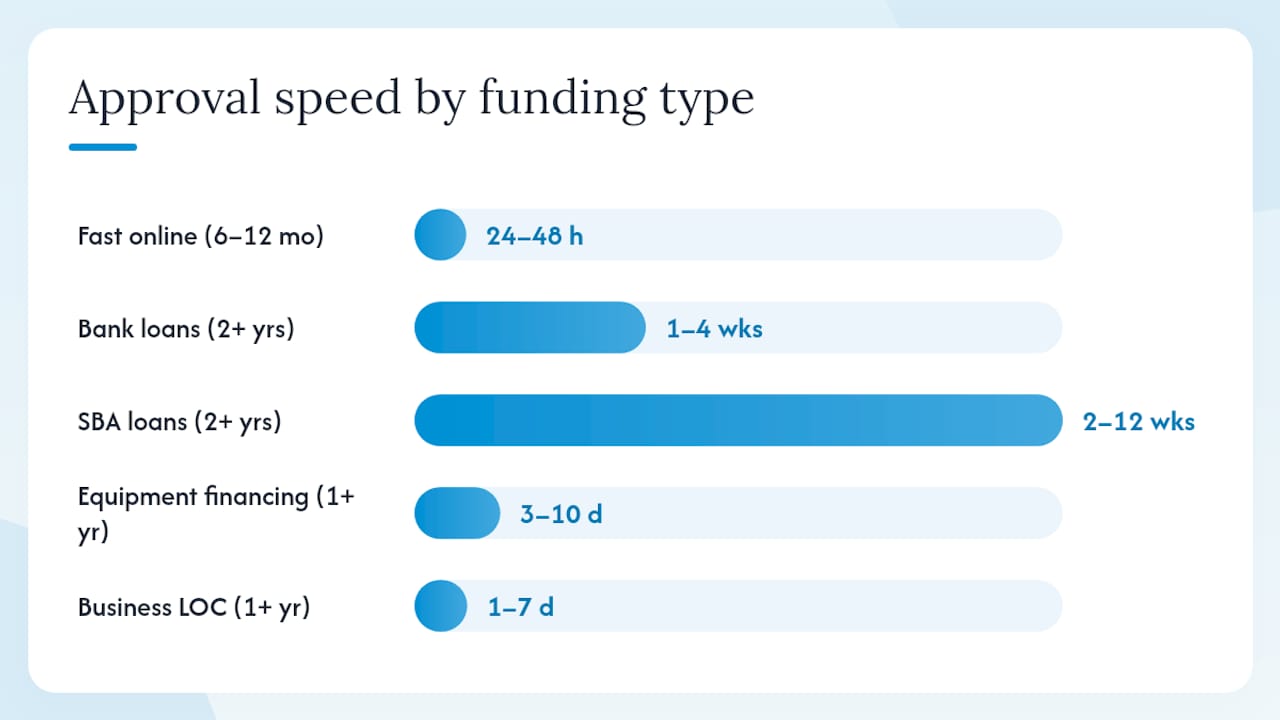
Speed and cost move in opposite directions. The fastest products almost always carry the highest effective cost; bank and SBA loans are the cheapest but require the most time and documentation.
Key terms to compare across any offer:
A short example: a $50,000 working capital loan at a 1.3 factor rate means you repay $65,000 total. If that repayment happens over 12 months, the effective APR is well above 50%. The same $50,000 through an SBA 7(a) loan at a fixed rate over 10 years costs a fraction of that annually, but you will wait weeks to receive it.
Pro Tip: Ask every lender for the total repayment amount and the APR in writing before you accept. Any lender who resists giving you those two numbers in plain language is a red flag.
Alternative funding sources like fintech lenders and peer-to-peer platforms trade higher cost or equity dilution for speed and accessibility. That trade-off is sometimes worth it; the key is going in with eyes open.
Funding ranges vary widely by product and business profile. Here is a realistic picture:
Typical ranges: $10,000–$250,000 for online working capital loans and lines of credit; up to $5.5 million for SBA 7(a) loans for qualified businesses.
By product:
What speeds things up: complete documentation at submission, strong and consistent monthly revenue, a clear stated use of funds, and a business bank account that shows regular activity. What slows things down: missing documents, manual underwriting review triggered by unusual revenue patterns, collateral requirements on larger amounts, and SBA-specific eligibility verification.
For businesses pursuing rapid funding, the marketplace route is the most practical starting point because a single application reaches multiple lenders simultaneously.
Match the product to the need, not the other way around. A business that needs $30,000 for payroll next week should not be applying for an SBA loan. A business planning a $500,000 equipment purchase should not be taking a merchant cash advance.
| Business need | Best funding match | Why |
|---|---|---|
| Immediate cash flow gap | Online working capital loan | Fast approval, flexible use |
| Ongoing operating expenses | Business line of credit | Draw only what you need |
| Equipment purchase | Equipment financing | Asset secures the loan, lower rates |
| Long-term growth capital | SBA 7(a) or bank loan | Lowest cost over time |
| High-growth startup | Equity or venture capital | No repayment, but ownership dilution |
| Debt-free capital | Grant programs | No repayment, but competitive and slow |

Different financing types map to different needs: banks and credit unions for low interest, SBA for qualified long-term financing, online lenders for speed. Knowing which lane you are in before you apply saves time and protects your credit.
Red flags to watch for when evaluating lenders:
Once you decide on a product, prepare a backup set of documents, compare at least two offers before accepting, and confirm the total repayment amount in writing. For businesses planning to use capital for expansion, having a clear deployment plan also strengthens your application.
Fordham Capital fits the brief for most small and medium-sized U.S. businesses that need capital quickly and want access to multiple lenders without multiple applications.
The core advantages:
Fordham Capital has funded over $120M for U.S. small businesses, with clients collectively generating more than $500M in revenue.
The marketplace model is the key structural advantage. Instead of applying to one lender and waiting, you submit once and reach a network of banks and alternative lenders simultaneously. That means more offers, faster, with less paperwork per lender. How small business funding networks work explains the mechanics in more detail, but the practical result is straightforward: better odds of approval and a faster path to funded.
The conventional advice is to always pursue the cheapest capital first. In theory, that means SBA loans before anything else. In practice, that advice ignores the reality most small business owners face: SBA applications take weeks, require strong credit and documentation, and are not available to businesses under two years old.
Marketplace funding through a platform like Fordham Capital is the right first move when speed and access are the actual constraints. If you need capital in days, not weeks, a marketplace gets you there. If your credit profile does not yet qualify for bank rates, a marketplace still connects you to lenders who will work with your profile.
The smarter play for many businesses is a blended approach: use fast marketplace funding to cover an immediate need or bridge a gap, while simultaneously preparing an SBA application for longer-term, lower-cost capital. Fast-online lenders and fintech platforms are increasingly used as bridge capital while businesses pursue more affordable long-term financing. That is not a compromise; it is a capital strategy.
What I would push back on is the idea that speed and cost are always in conflict. A business that misses payroll, loses a key contract, or runs out of inventory waiting for a bank approval has paid a real cost, just not one that shows up on a term sheet.
Most small business owners spend more time researching funding than actually applying. Fordham Capital cuts that gap. One page, no hard credit pull, no collateral required, and a network of banks and alternative lenders competing for your business.
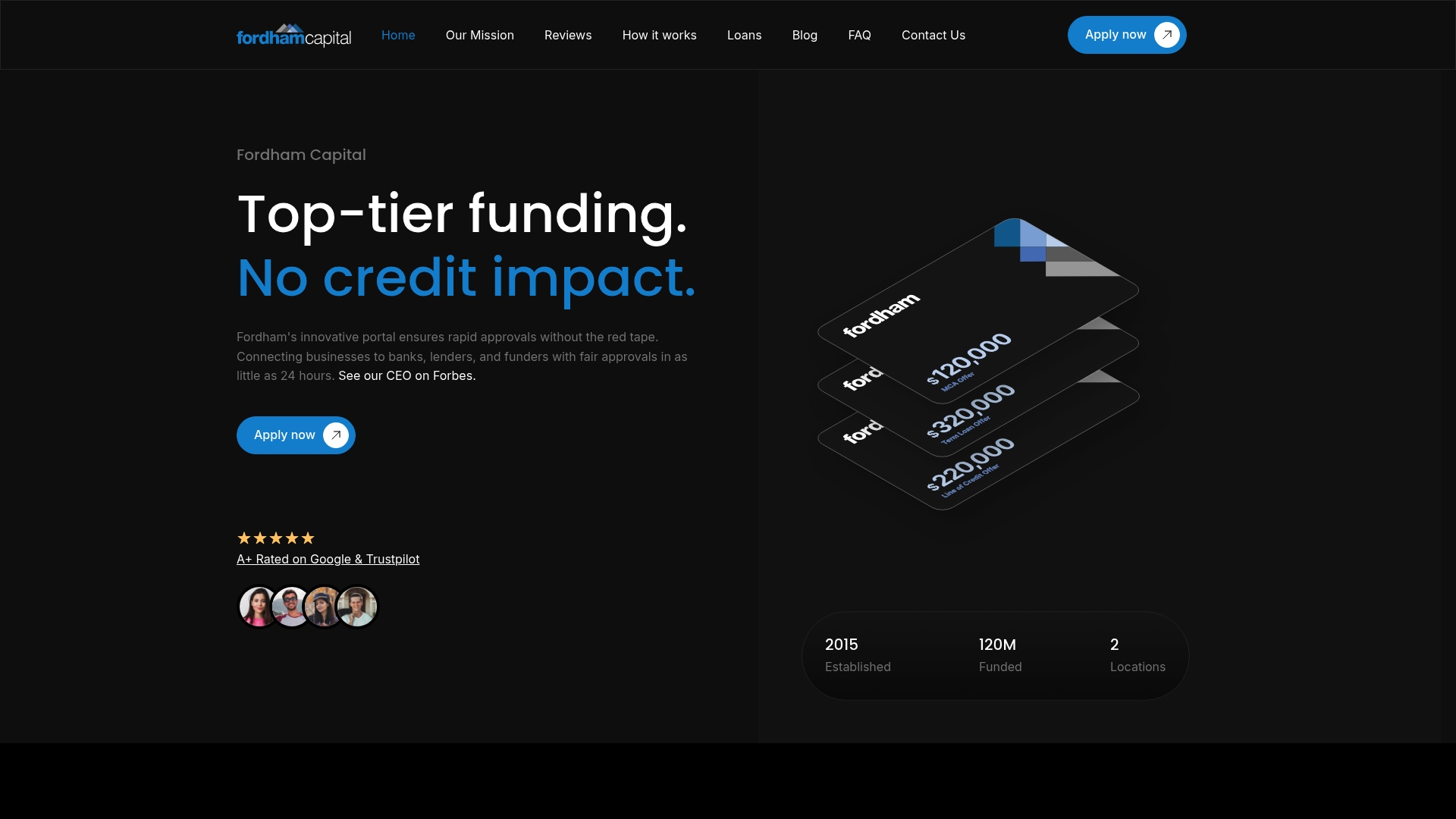
You get approvals within 24 hours, funding amounts that scale from $10,000 into the millions for qualified businesses, and a team with an A+ BBB rating and $120M+ in funded deals behind them. Whether you need working capital, a line of credit, or SBA-backed financing, the application routes you to the right lenders automatically.
Apply now at Fordham Capital and find out what you qualify for today.
These resources help you verify program details, compare options, and prepare a stronger application:
At Fordham Capital, we've made the application process straightforward and reassuring. Dive in and explore your financial options with confidence, knowing there's no impact on your credit score and no obligations. We review your details and offer customized solutions based on what you're looking for.


