
The number that matters isn’t the advertised rate. It’s the APR, because that figure folds in fees the headline rate hides. Before you apply anywhere, pull your credit score, last two years of revenue, and time-in-business numbers. They determine which of these bands you’ll actually land in.
TL;DR:
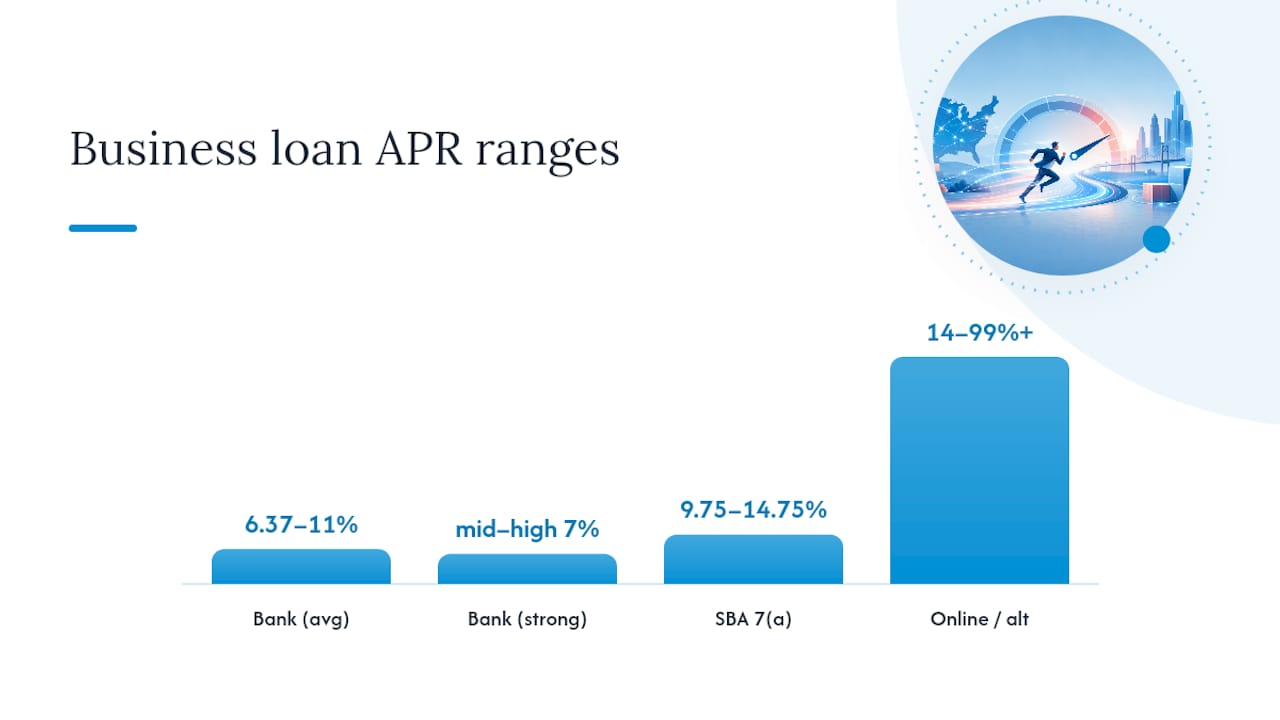
- Bank term loans typically range from 6.37% to 11% APR, with the lowest rates available to businesses with strong credit and long banking relationships.
- SBA 7(a) loans are capped at about 9.75% to 14.75% APR, depending on loan amount, with smaller loans often having higher spreads due to government caps.
- Online lenders charge much higher rates, from approximately 14% to over 99% APR, reflecting greater risk and faster, less documented approval processes.
- Your credit score, collateral, cash flow stability, and industry risk significantly influence the interest rate you qualify for on any loan.
- Always compare APRs, which include fees, rather than just interest rates, to accurately gauge the true cost of financing options.
Banks remain the cheapest source of capital for borrowers who qualify, and the numbers back that up clearly. Aggregated lending data puts average bank term loan rates between 6.37% and 11% APR as of mid-2026, with the tightest pricing going to businesses with strong revenue history and clean credit. Nav’s rate tracking shows median fixed-rate bank term loans landing in the mid-to-high 7% range toward the end of 2025, with variable-rate products running slightly above that.
The Kansas City Fed’s small business lending survey is the closest thing to a national pulse check on bank lending conditions. Its quarterly data tracks not just rates but how willing banks are to extend credit at all, which matters just as much when demand for capital tightens.
SBA loans sit in a different bracket entirely, because the government caps how much lenders can charge. The SBA’s FY2026 rate notice sets fixed-rate caps as high as 14.75% and variable-rate caps up to 13.25%, scaled by loan amount. Smaller loans typically carry higher allowable spreads than large ones.
Where rates stand right now:
By the numbers: The prime rate sat at 6.75% in late 2025 after a year of Fed easing, and that single number ripples through nearly every variable-rate business loan and SBA cap calculation in 2026. When the Fed moves, your renewal rate moves with it, even if nothing about your business changed.
That prime-rate link is why 2026 pricing looks a bit friendlier than it did two years ago. SBA variable-rate loans are pegged directly to prime plus a set spread, so every quarter-point cut from the Fed shows up in your next payment.
Not every loan product prices the same way, and lumping them together is how business owners end up comparing numbers that aren’t actually comparable. Here’s how the major categories break down.
That last point trips up more borrowers than any other single issue on this list. A factor rate of 1.3 sounds modest until you realize it means paying back $130,000 on a $100,000 advance, often within just a few months, which is where the eye-popping effective APRs come from.
What moves you between bands within a single product category? Mostly three things: your personal credit score, whether you can offer collateral, and how consistent your monthly revenue looks on paper. A borrower with a 720 credit score and two years of steady deposits will see a materially different SBA quote than one with a 640 score and choppy cash flow, even applying for the identical loan amount from the identical lender.

Lenders don’t pull numbers out of the air. Every quote reflects a handful of variables, and knowing which ones carry the most weight tells you where to focus your energy before you apply.
Pro Tip: Pull your business and personal credit reports before you apply anywhere. Errors on credit reports are common, and fixing a mistake can move you into a better pricing tier before a lender ever sees your file.
The interest rate is only what a lender charges to borrow the money. APR adds in origination fees, closing costs, and other charges baked into the loan, which is why comparing APRs rather than sticker rates is the only honest way to shop.
Here’s a quick example. Say a lender quotes 6% interest on a $100,000 one-year loan, but tacks on a 3% origination fee ($3,000). You’re effectively borrowing $97,000 while repaying $106,000 worth of principal and interest. Run that through an APR calculation and the true cost lands closer to 9%, not 6%.
Fees that commonly widen the gap between rate and APR:
Merchant cash advances skip APR disclosure entirely in many cases, quoting only a factor rate. A 1.25 factor rate on a $50,000 advance means repaying $62,500, and if that happens over four months, the annualized cost can exceed 150%, far above what the factor rate alone suggests. Always ask a lender to convert any factor rate or fee structure into an APR equivalent before you sign anything.
Banks and SBA lenders both offer competitive pricing, but they get there through different mechanics, and the right choice depends on how much time you have.
SBA rate caps work off a formula: prime rate plus a spread that shrinks as the loan size grows. A $50,000 SBA loan might carry a higher allowable spread than a $400,000 loan, which is why SBA rate caps vary noticeably by loan amount even in the same year.
If you have the runway to wait two months and want the lowest total cost over a 10-year term, SBA usually wins. If a supplier discount or a seasonal opportunity closes in two weeks, that math flips fast.
Getting a competitive quote starts well before you fill out an application. Lenders reward preparation, and a clean file often moves you into a better pricing tier before negotiation even starts.
Pro Tip: Ask every lender to quote APR, not just interest rate, in writing before you compare offers. A lender that hesitates to provide APR upfront is usually one whose fees don’t hold up well against competitors.
The rate tables above are only half the story. The other half is how fast you can actually get capital in hand once you know what to expect. Fordham Capital built its process around a one-page application specifically because most small-business owners don’t have six weeks to wait on a bank’s underwriting queue, and shouldn’t have to sacrifice clarity on pricing to move quickly.
Fordham Capital works across a network of banks and alternative lenders, which means an applicant sees multiple offers rather than a single take-it-or-leave-it quote, with approvals often coming back within 24 hours. That structure matters most for businesses without heavy collateral or perfect credit, where a single-lender application can mean weeks of waiting for a rejection. Fordham Capital holds an A+ BBB rating, has funded more than $120 million, and has helped clients generate over $500 million in revenue, numbers that reflect a track record built on getting deals done, not just quoted. For a business chasing a seasonal window or a supplier discount, that speed can outweigh a marginally lower rate sitting six weeks away.
— Rob
Fordham Capital’s edge isn’t a lower advertised rate. It’s skipping the weeks-long, single-lender gauntlet and seeing what a network of banks and alternative lenders will actually offer you, side by side, without it touching your credit score.
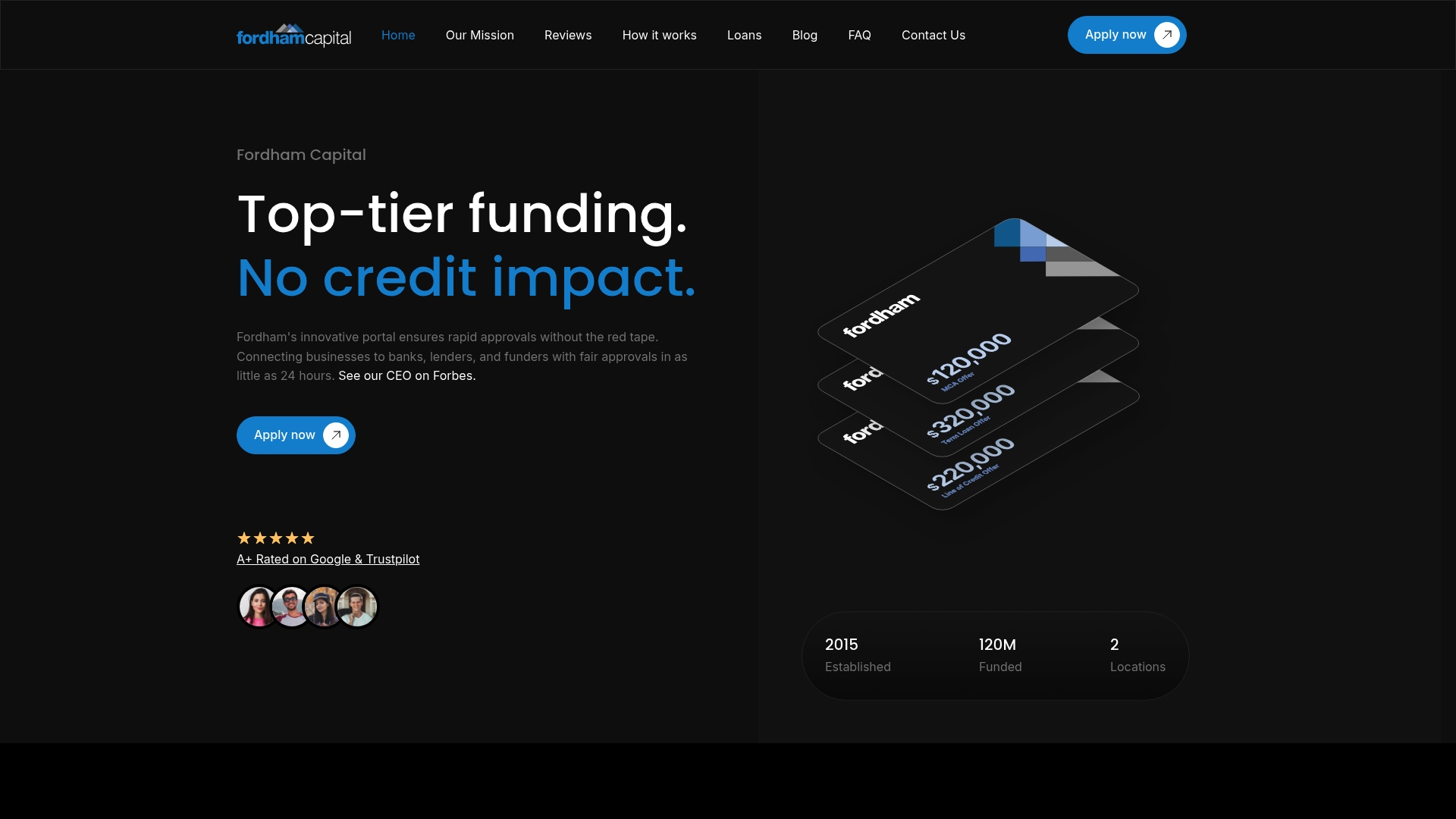
The application itself is one page. You’ll want your last few months of bank statements and a rough sense of your monthly revenue on hand, since that’s what determines which lenders in the network are the right fit for your file. Once submitted, Fordham Capital matches your profile against its lender network and can return approvals within 24 hours, each one showing the actual APR and fee structure so you’re comparing real numbers, not marketing rates. If a fast timeline matters more to your business right now than shaving a point off the rate, or if you’d simply rather see several offers than gamble on one bank’s decision, apply now and see what the network returns. You can also review Fordham Capital’s full funding options at Fordhamcapital before you start.
For live updates beyond this guide, three sources are worth bookmarking. The Kansas City Fed’s lending survey tracks bank rate trends and credit availability quarterly. The SBA’s official rate notices spell out exact caps by loan size and structure. And before signing with any lender, run its name through NMLS Consumer Access to confirm licensing and registration status. Businesses exploring financing tied to specific growth strategies, including franchise funding options, should check program-specific rate rules separately, since caps and terms can differ from standard small-business products.
This article is general information, not a substitute for advice from a qualified financial advisor. Consult a qualified financial professional about your own circumstances before acting on anything here.
At Fordham Capital, we've made the application process straightforward and reassuring. Dive in and explore your financial options with confidence, knowing there's no impact on your credit score and no obligations. We review your details and offer customized solutions based on what you're looking for.