
Paying off a business loan early usually makes sense when the interest you save beats any prepayment penalty and you have enough cash left for daily operations. Check your loan contract first: a penalty higher than your remaining interest cost erases the entire benefit. Run the actual numbers before wiring a lump sum, because the math often surprises people in both directions.
TL;DR:
- Prepayment penalties on SBA loans decrease from 5% to 1% over three years and vanish afterward, making early payoff more cost-effective after year three.
- The interest savings from early repayment can be offset by penalties, especially in the initial years, so run precise calculations to determine if payoff makes financial sense.
- Using a payoff calculator helps compare interest saved versus penalties and opportunity costs, guiding whether to pay early, refinance, or preserve cash for growth.
- Extra payments and refinancing can be better options than full payoff if they avoid penalties and align with current lower interest rates or liquidity needs.
- Tapping alternative funding sources like lines of credit can preserve cash flow better than early loan payoff when liquidity or growth opportunities are priorities.
Paying down a business loan ahead of schedule isn’t automatically the smart move it sounds like. It genuinely helps in some situations and quietly hurts you in others.
The upside is real. You stop paying interest on the remaining balance, which on a five or six-figure loan can add up to thousands of dollars. Your debt-to-income ratio improves, which matters the next time you apply for financing. If the loan was secured, paying it off frees up that collateral for other uses. And your monthly obligations drop, which lowers the fixed costs you have to cover every month regardless of revenue.
The downside gets ignored more often than it should:
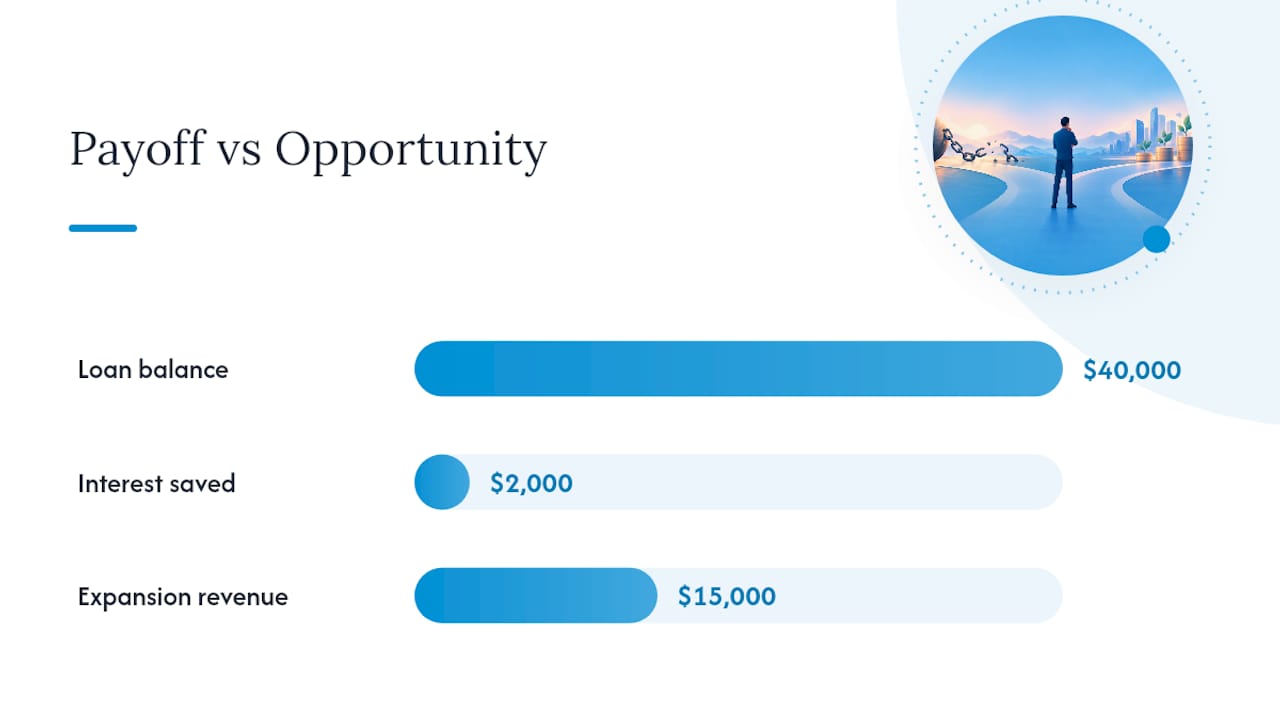
A restaurant owner sitting on $40,000 in leftover loan balance might save $2,000 in interest in paying it off today. But if that same $40,000 could cover a kitchen expansion that generates $15,000 a year in new revenue, the payoff starts to look like the worse deal.
Lenders structure prepayment penalties three main ways: a flat fee, a percentage of the remaining balance, or a charge equal to some portion of the interest you would have paid. Percentage-based penalties are the most common, and they typically run 1% to 5% of the outstanding balance, according to NerdWallet.
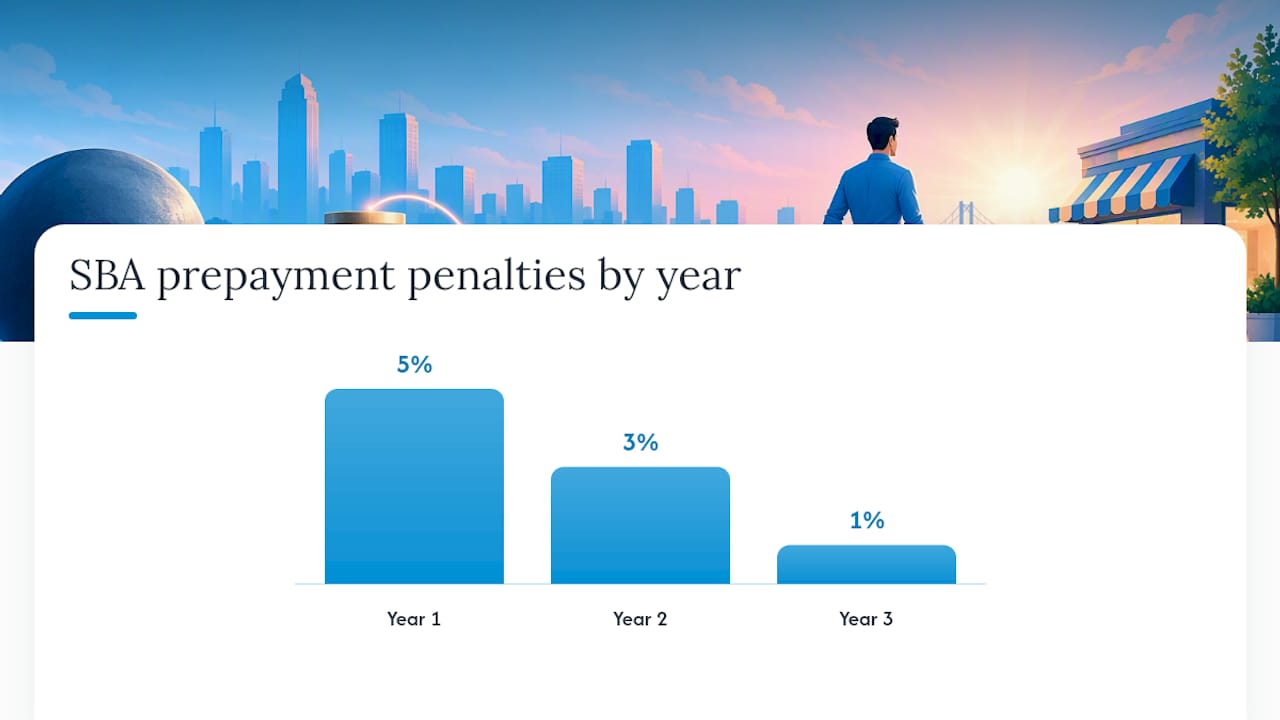
Most penalty schedules are front-loaded. The fee shrinks the longer you’ve held the loan, which rewards borrowers who wait rather than rushing to pay off debt in year one.
SBA loans follow a specific, scaled structure worth memorizing if you have a 7(a) or 504 loan:
That schedule means an SBA borrower who can wait until year four pays nothing extra to retire the loan early. Lenders are required to spell out these terms in the loan agreement itself, and if you can’t find the clause, LendingTree recommends asking the lender directly rather than assuming there isn’t one.
Deciding whether early payoff makes financial sense comes down to three steps you can do with a calculator and your loan statement.
Here’s a simplified example using a $50,000 loan balance with $6,000 in remaining interest:
The break-even point is simple: if the penalty exceeds the interest you’d save, paying off early costs you money outright. If it doesn’t, the real question shifts from “does this save money” to “is this the best use of the cash.” A business loan calculator that factors in fees and APR can run this comparison faster than doing it by hand.
Full payoff isn’t your only option, and it’s often not the best one.
Pro Tip: Before you call your lender to negotiate, pull your payment history and a copy of the loan contract. Lenders are more willing to waive or reduce a penalty for borrowers with a clean payment record, and asking a few months before your penalty window closes often gets a better response than asking after you’ve already missed it.
A payoff calculator turns guesswork into a real answer. Enter these inputs to see where you stand:
The output tells you interest saved, months shaved off the term, and the penalty threshold where payoff stops making sense. NerdWallet’s business loan payoff calculator lets you test both a one-time lump sum and recurring extra payments side by side, which matters because the two strategies produce different savings even on the same loan.
Sometimes the smarter move isn’t payoff at all. If liquidity is tight or a growth opportunity needs capital now, tapping a lender network for working capital or a fresh line of credit can preserve cash that an early payoff would otherwise lock away. Fordhamcapital works with small and medium businesses through a one-page application, connecting them to a network of banks and alternative lenders for SBA loans, lines of credit, and working capital, often with approval decisions inside 24 hours.
Here’s how I’d think about it if I were the one staring at the payoff balance. Payoff usually wins when there’s no penalty, the rate is high, and you have no better use for the cash. Alternatives usually win when the penalty outweighs the interest saved, you need liquidity, or growth spending would earn more than the interest costs. Check your contract, run the calculator, then decide.
— Rob
Some lenders offer routes to capital faster than the traditional bank process, without a hard credit check and without collateral requirements. Instead of draining cash reserves to retire a loan early, businesses may access SBA Loans, Lines of Credit, or Working Capital through marketplace platforms, matched to what the business needs right now.
A one-page application process can connect borrowers to a network of banks and alternative lenders, with approval decisions often delivered within 24 hours. Some companies have high BBB ratings and have funded substantial amounts for small and medium businesses that traditional banks frequently overlook. If you’re weighing an early payoff against a refinance or a working capital cushion, apply now and get matched with the option that actually fits your cash position.
Confirm SBA prepayment schedules directly through SBA.gov, and model your own numbers with NerdWallet’s payoff calculator.
SBA 7(a) loans with terms over 15 years only trigger a penalty when you prepay 25% or more within the first three years, with the fee dropping from 5% to 3% to 1% each year before disappearing entirely, according to the SBA.
Penalties typically run 1% to 5% of the remaining balance and can be charged as a flat fee, a percentage, or a remaining-interest calculation, per NerdWallet. Not every lender charges one, so checking your contract or asking directly is the fastest way to know for sure.
Extra recurring principal payments and occasional lump sums both work, as long as your lender applies them without triggering a prepayment fee. A payoff calculator can show you how many months extra payments can shave off a loan balance.
The payment depends heavily on the rate, term, and loan type, so there’s no single figure that applies to every loan. Fordhamcapital’s SBA Loan option runs at 8% per year, and plugging that rate into an amortization calculator with your actual term will give you a precise monthly figure.
It can shorten your credit history with that lender and slightly reduce your active credit mix, but it also lowers your debt-to-income ratio, which helps future applications. The net effect is usually neutral to positive, especially if you’re planning to seek new financing soon after.
At Fordham Capital, we've made the application process straightforward and reassuring. Dive in and explore your financial options with confidence, knowing there's no impact on your credit score and no obligations. We review your details and offer customized solutions based on what you're looking for.