
Refinancing a business loan can lower your rate or shrink your monthly payment, but only if the interest and fee savings beat what’s left on your current loan. If your rate is well above today’s bank or SBA ranges, your credit or revenue has improved since you first borrowed, or you’re juggling several loans that could become one, refinancing is worth running the numbers on. If the fees and remaining term don’t leave room for real savings, hold off.
TL;DR:
- Refinancing makes sense if your current rate is above bank or SBA benchmarks, especially if your credit or revenue has improved since the original loan.
- Watch out for high fees such as origination, underwriting, appraisal, and prepayment penalties that can offset the interest savings from refinancing.
- The decision to refinance should be based on comparing the total costs, including fees and remaining interest, of the current and new loans.
- Using an intermediary platform can offer faster approval and multiple lender options, especially if your business profile doesn’t fit a single lender’s criteria.
- Preparing key documents like payoff statements, tax returns, and financial statements in advance can speed up approval and help accurately assess refinancing benefits.
Most business owners don’t wake up and decide to refinance business loan debt on a whim. Something triggers it, usually a number that finally looks wrong on the monthly statement.
Start by comparing your current rate against what’s actually available. Bank term loans typically run 6.37% to 10.98%, while online lenders can charge anywhere from 14% up into the high double digits depending on your risk profile. If you locked in your loan when rates were higher, or your credit has climbed since then, you may be paying for risk you no longer represent.
A few concrete signs mean it’s time to run the math:
Any one of these alone might not justify the paperwork. Two or three together usually do.
A lower rate on paper doesn’t always mean a better deal once fees enter the picture. This is where a lot of refinancing plans fall apart, and it’s worth slowing down here before you sign anything.
The fees that matter most:
Extending your term can shrink the monthly payment while quietly increasing what you pay in total interest over the life of the loan. And if a lender wants collateral as a condition of a lower rate, you’re trading a cheaper payment for real exposure if the business hits a rough stretch.
Rate ranges by lender type give you a baseline before you request quotes. Bank and credit union term loans generally land at the low end of the market, SBA-backed loans sit close behind with stronger terms but slower processing, and online lenders trade speed for a meaningfully higher APR.
The process is more procedural than complicated, but skipping a step tends to cost you money or time later.
Pro Tip: Request your old lender’s exact per diem interest before closing on a new loan. Payoff quotes expire, and a delayed closing can add days of extra interest you didn’t budget for.
Lenders evaluate a refinance application almost the same way they’d evaluate a brand new loan. SoFi’s overview of the refinancing process confirms that documentation requirements mirror a first-time application: tax returns, bank statements, profit and loss statements, and balance sheets.
Your DSCR carries real weight in this review. Many commercial lenders look for a ratio above a certain threshold (often around 1.25), indicating your business generates sufficiently more operating income than needed to cover debt payments. Fall below that, and you’ll either get declined or offered a smaller loan with a higher rate.
Here’s what typically lands on a lender’s checklist:
If your numbers are borderline, a few quick fixes can move the needle: dispute any errors on your credit report, pay down revolving balances to lower utilization, and be ready to explain any one-time revenue spike or dip a lender might flag. Fordham Capital’s breakdown of approval factors lenders weigh covers this in more depth.
There’s no universal shortcut here, no “2% rule” that works across every business loan the way some rules of thumb claim. The only reliable method is comparing your full cost under the old loan against your full cost under the new one.
The formula is straightforward:
Run both amortization schedules. If the new loan’s combined fees and interest come in a few thousand dollars below what you’d pay finishing out the old one, even with the longer term, refinancing wins. If the new term stretches so far that total interest balloons past the old loan’s remaining cost, it doesn’t.
Before modeling anything, gather your exact payoff amount, remaining term, current rate, a real quote (not an estimate) from the new lender, and every fee attached to that quote. Loan repayment strategy resources can help you stress test different term lengths against your cash flow before committing.
Going straight to your bank makes sense if you already have a strong relationship there and your DSCR and credit clear their bar comfortably. That path can also be slower, and it only shows you one lender’s pricing.
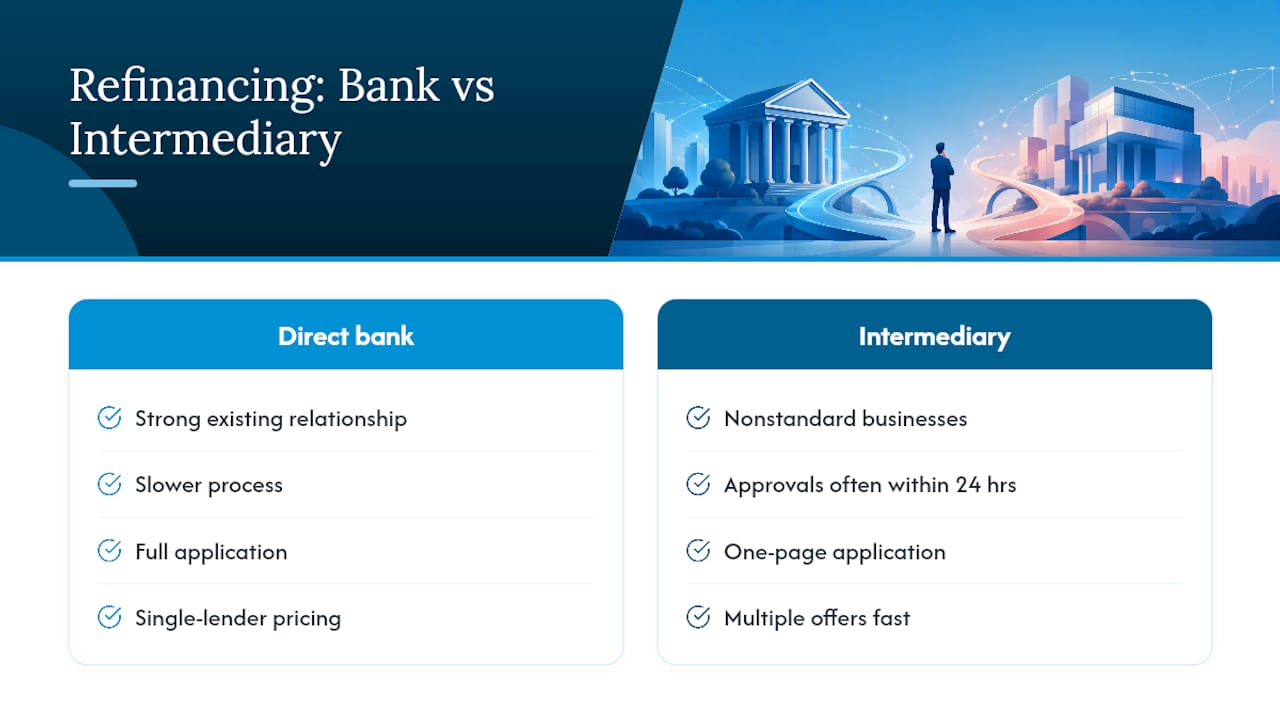
An intermediary model exists for businesses that don’t fit neatly into one bank’s box. A one-page application routes your request across a network of banks and alternative lenders simultaneously, and approvals often come back within 24 hours. That track record matters when you’re deciding who to trust with your financials, and the BBB’s accreditation standards are a reasonable way to check any lender or intermediary before you apply.
Use a direct bank relationship when you have one and time isn’t pressing. Use a network when you need multiple offers fast or your business doesn’t fit a single lender’s narrow criteria.
— Rob
If the math checks out and refinancing makes sense for your business, the application itself shouldn’t be the hard part. Fordham Capital built its process around a one-page application that routes your request across a wide network of banks and alternative lenders at once, without a hard credit pull upfront and without requiring collateral to get started.
Before you apply, have your loan payoff statement, the last two to three years of tax returns, recent bank statements, and a current profit and loss statement ready. Lenders in the network use these same documents, so having them organized ahead of time is what actually speeds up an approval. Once submitted, most applicants hear back with lender options within 24 hours, giving you a real comparison instead of a single take-it-or-leave-it offer. If you’re ready to see what rate and terms your business qualifies for, you can apply now and get a direct read on your options without committing to anything.
Rate ranges cited here come from NerdWallet’s business loan rate data and Finder’s lender comparison. SBA program details are drawn from the SBA’s official loan programs page, and documentation guidance follows SoFi’s refinancing overview. For lender credibility checks, the Better Business Bureau remains a solid starting point.
At Fordham Capital, we've made the application process straightforward and reassuring. Dive in and explore your financial options with confidence, knowing there's no impact on your credit score and no obligations. We review your details and offer customized solutions based on what you're looking for.