
Interest rate is the loan’s base rate used to compute your payments; APR is the annualized cost that bundles interest and certain fees. Use APR to compare total cost between offers, and use interest rate to estimate your monthly payment or when you plan to hold the loan for only a short stretch.
TL;DR:
- The APR includes upfront fees like origination charges and points, which can significantly increase the total cost compared to the interest rate alone.
- The gap between interest rate and APR depends on fees and loan term length, narrowing over longer durations.
- Comparing loan offers requires matching terms, understanding which fees are included in APR, and calculating both monthly payments and total costs based on your expected holding period.
- APR may mislead for adjustable-rate mortgages or early payoff plans, since it assumes holding the loan for its entire term.
- Small-business borrowers should prioritize speed and simplified applications, as traditional lenders often delay, whereas firms like Fordham Capital offer faster, more flexible options.
An interest rate is the annual percentage a lender charges you for borrowing the principal. It does not include fees, and it is the number that gets converted into a periodic rate to calculate what you owe each month.
Rates come in two forms, and the type you have changes how predictable your payments are:
The interest rate alone tells you what a lender charges to use its money, but not the total cost of the loan including fees.
APR, or annual percentage rate, takes the interest rate and layers in many of the costs a lender charges to originate the loan. According to the Consumer Financial Protection Bureau, APR includes interest, origination fees, mortgage insurance, and other closing costs the lender requires, which is why it typically runs higher than the interest rate alone.
Common inclusions and exceptions to watch for:
Federal law requires this disclosure. The Truth in Lending Act mandates that lenders show APR on consumer loan paperwork, which is why every Loan Estimate you receive carries both figures side by side.
The clearest way to see the gap between interest rate and APR is a real disclosure. In a sample Loan Estimate published by the CFPB, the interest rate is listed at 3.875% while the APR comes in at 4.274%.
| Metric | Sample value |
|---|---|
| Interest rate | 3.875% |
| APR | 4.274% |
| Gap driven by | Origination charges, points, and other closing costs |
That gap comes entirely from fees the lender spreads across the loan term. The math behind it treats every upfront charge as if it were paid gradually over the full life of the loan, which nudges the annualized rate upward. The longer the term, the smaller that nudge tends to look, since the fees get amortized over more years.
Pro Tip: If you’re considering discount points, calculate your break-even period before assuming the lower advertised rate saves money, since APR only reflects true savings if you keep the loan for its full term.
Which number matters depends on how long you expect to keep the loan and what decision you’re making.
APR is a useful standardized number, but it has blind spots. On adjustable-rate mortgages, APR cannot predict where your rate lands after the fixed period ends, so it understates risk for anyone who holds an ARM past the initial term.
The safeguard is documentation. The CFPB’s regulation requires lenders to spell out these figures in the Loan Estimate and later the Closing Disclosure, so reading both documents line by line is the only reliable way to catch what APR alone might smooth over.
Shopping multiple lenders only works if you’re comparing identical terms. Run through this sequence before signing anything.
Pro Tip: Ask each lender to walk you through their Loan Estimate side by side with a competitor’s. If they hesitate, that’s a signal to look elsewhere.
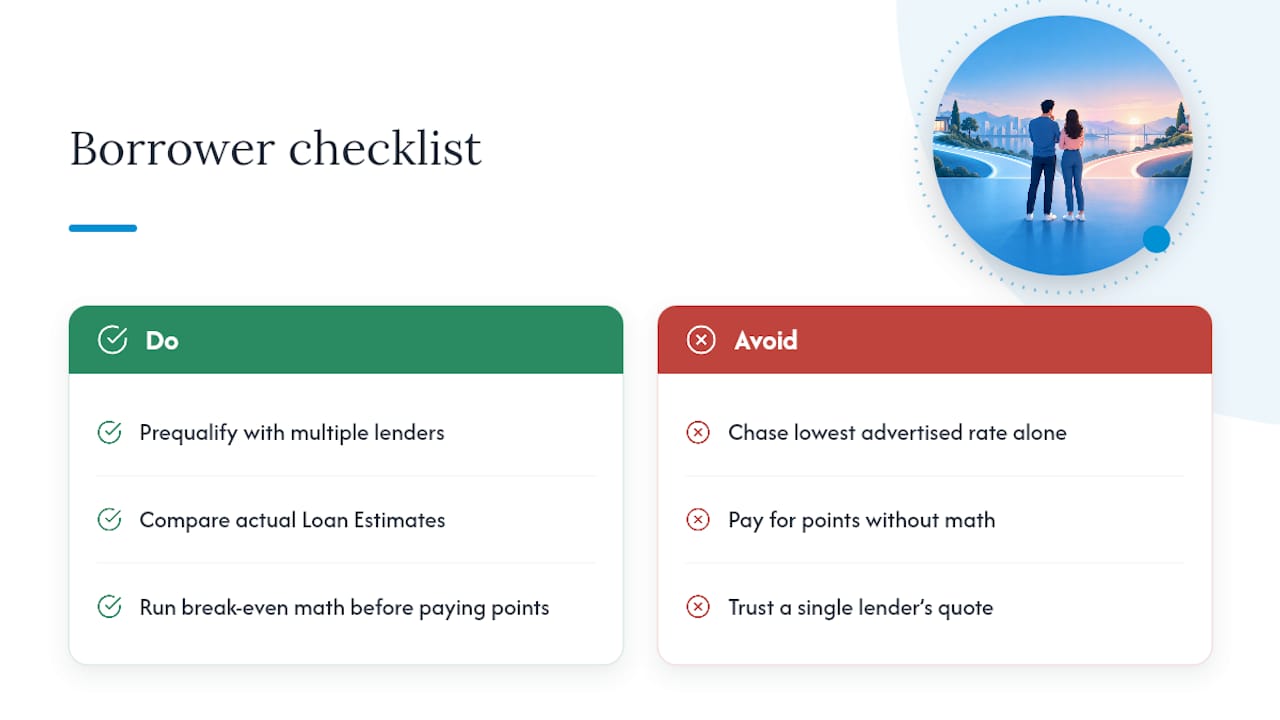
The most common mistake is chasing the lowest advertised rate without checking what fees ride along with it. A rate that looks half a point cheaper can lose that advantage entirely once origination charges and points are added back in.
Prequalify with more than one lender, compare actual Loan Estimates, and run the break-even math before paying for points. That single habit catches most of the costly surprises.
— Rob
Mortgage shopping and business financing follow similar logic, but small-business owners often need speed more than they need to parse fee disclosures line by line. Traditional bank underwriting can take weeks, and that delay costs real opportunity for a business trying to scale.
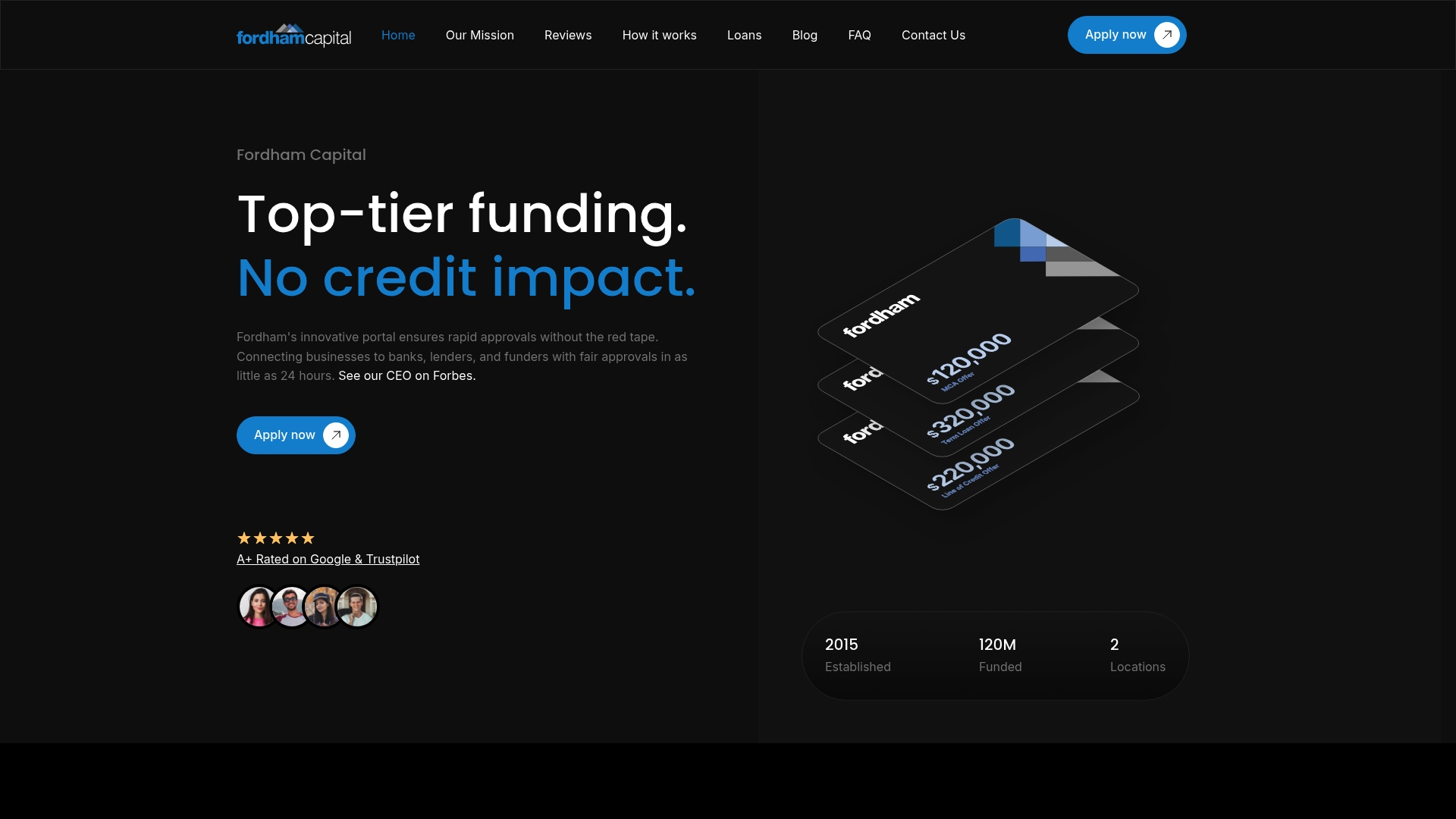
Fordham Capital connects small and medium-sized businesses to a network of banks and alternative lenders through a single application, without affecting your credit score to get started.
If comparing rates and fees across traditional lenders feels like more friction than your business has time for, start an application with Fordham Capital and see what offers come back.
This article is general information, not a substitute for advice from a qualified financial advisor. Consult a qualified financial professional about your own circumstances before acting on anything here.
APR is usually higher because it adds lender fees to the base interest rate, as shown in the CFPB’s sample Loan Estimate where 3.875% interest becomes a 4.274% APR. On products with few or no upfront fees, the two figures can land close together or match.
For most credit cards, APR and interest rate refer to the same number, since revolving credit rarely carries the origination fees that widen the gap on mortgages. Card issuers often list separate APRs for purchases, cash advances, and balance transfers, so check which one applies to your balance.
Buying points lowers your interest rate in exchange for an upfront fee, and that fee gets folded into the APR calculation. Because APR assumes you keep the loan for its full term, points only pay off if you hold the loan long enough to recoup that upfront cost, so calculating a break-even period before buying points is worth the ten minutes it takes.
Compare APRs when you plan to keep the loan for its full term, since the CFPB recommends APR as the standardized way to weigh total cost across lenders with different fee structures. Focus on the interest rate instead if you expect to refinance, sell, or pay off the loan early.
At Fordham Capital, we've made the application process straightforward and reassuring. Dive in and explore your financial options with confidence, knowing there's no impact on your credit score and no obligations. We review your details and offer customized solutions based on what you're looking for.