

You can build business credit even with poor personal credit. The path is narrower, the costs are higher, and some doors stay closed until your profile improves, but the doors that matter most can open faster than most people expect.
The single most useful first move: legally separate your business from yourself. Get an EIN from the IRS, open a dedicated business checking account, and apply for at least one vendor account that reports to a business credit bureau. That sequence, done correctly, starts building a credit profile that lenders evaluate independently of your personal FICO score.
Here is the short version of what the rest of this guide covers:
“Poor credit history is one of the main reasons why loan applications for small businesses are often declined. Poor credit history can also impact insurance rates and the attractiveness of your business to potential partners, suppliers, and vendors.” — U.S. Small Business Administration
A typical U.S. FICO score is around the middle range. Scores below a certain threshold commonly result in declines or collateral requirements by traditional banks. That is the gap this guide is designed to help you close, or work around, while you close it.
The short answer: it depends entirely on who is lending and what product you are applying for.

Traditional banks and most SBA-backed loan programs lean heavily on the owner’s personal credit, especially for businesses with thin or no business credit history. When a lender asks for a personal guarantee, which is standard for most small business loans, your personal FICO score becomes a direct input into their decision. The logic is straightforward: if the business can’t repay, the lender wants confidence the owner can.
Blended scoring models complicate this further. The FICO Small Business Scoring Service (FICO SBSS), used by many SBA lenders, pulls both personal credit data and business financial data into a single score. A weak personal score can drag down your SBSS result even if your business financials look healthy. This is why some borrowers are surprised to get declined despite strong revenue.
Alternative and revenue-focused lenders operate differently. Many weigh monthly bank deposits, gross revenue, time in business, and recurring contracts far more heavily than a personal FICO number. Some accept scores in the 500s when business performance compensates. The trade-off is cost: these products typically carry higher rates and shorter terms than bank loans.
The practical implication is this: the weaker your personal credit, the more you need to show compensating strengths. Strong monthly deposits, documented recurring revenue, and clean business bank statements can shift the conversation from “your score is too low” to “let’s look at what products fit your cash flow.”

Pro Tip: Prepare a short, honest explanation of past credit issues along with documentation showing current cash flow stability. Many lenders, particularly community lenders and credit unions, accept reasonable explanations. A one-paragraph letter that attributes a past delinquency to a specific, resolved event is far better than leaving the lender to guess. Pair it with 3–6 months of bank statements showing consistent deposits.
Understanding how business funding impacts your personal credit score is also worth reviewing before you apply, since some products create hard inquiries on your personal report while others do not.
The most accessible options for entrepreneurs with low personal credit fall into six broad categories. Each has different cost structures, reporting characteristics, and eligibility requirements.
| Product Type | Reports to Business Bureaus? | Personal Guarantee Required? | Primary Underwriting Focus | Typical Cost Range |
|---|---|---|---|---|
| Net-30 vendor accounts | Yes (if you verify) | Rarely | Purchase history, business age | Low to none |
| Secured business credit cards | Yes (most do) | Sometimes | Security deposit | Moderate APR |
| Invoice factoring | Rarely | Rarely | Customer creditworthiness | 1% per invoice |
| Equipment loans | Sometimes | Often | Collateral value | Moderate APR |
| Revenue-based financing / MCA | Rarely | Rarely | Daily/weekly revenue | Factor rate (high effective APR) |
| Microloans / community lenders | Sometimes | Sometimes | Business plan, cash flow | Low to moderate APR |
Net-30 vendor accounts are the lowest-friction starting point. You apply for trade credit with a supplier, they extend net-30 payment terms, and if they report to Dun & Bradstreet or Experian Business, each on-time payment builds your PAYDEX score. The catch: not every vendor reports, and you must verify before you apply.
Secured business credit cards work similarly to secured personal cards. You deposit collateral, typically a few hundred to a few thousand dollars, and the card issuer extends a credit line against it. Most secured business cards report to business bureaus, which makes them one of the cleaner credit-building tools available.
Invoice factoring and revenue-based financing judge repayment ability primarily on your sales and outstanding invoices, not your personal FICO. A factoring company buys your receivables at a discount; a revenue-based lender advances capital and collects a percentage of daily or weekly sales until the advance is repaid. Both can move fast, but neither typically reports to business bureaus, so they fund operations without building your credit profile.
Equipment loans use the equipment itself as collateral, which reduces lender risk and can open doors even with weak personal credit. Microloans through SBA-approved intermediaries and Community Development Financial Institutions (CDFIs) often have more flexible underwriting and are specifically designed for businesses that don’t qualify for conventional financing.
Pro Tip: Prioritize tradelines and secured products that explicitly report to Dun & Bradstreet, Experian Business, or Equifax Small Business if your immediate goal is a separate business credit profile. Revenue-based products and MCAs can solve a cash flow problem today, but they won’t build the credit profile you need for better terms tomorrow. Run both tracks in parallel when possible.
For a deeper look at product options matched to low-credit borrowers, the business funding with low credit scores guide covers eight specific routes with eligibility details.
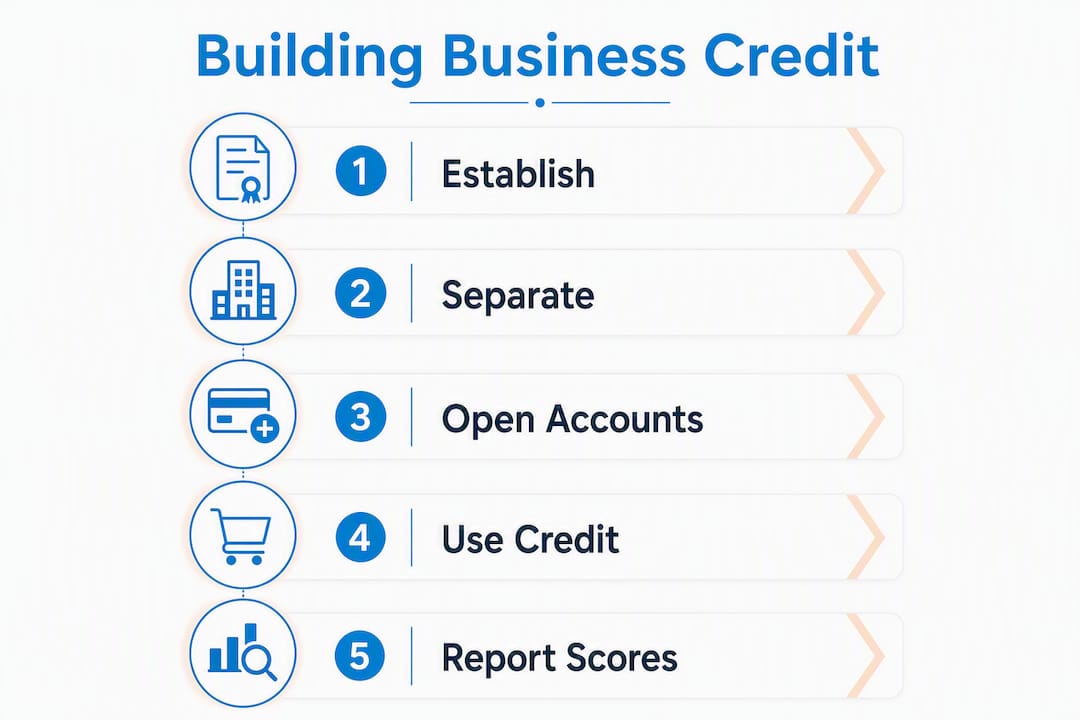
Building a business credit profile is a process, not an event. The steps below are sequential because each one creates the foundation the next step requires.
Building business credit requires accounts that explicitly report to business bureaus. Before you apply to any vendor or card issuer, ask directly: “Do you report payment history to Dun & Bradstreet, Experian Business, or Equifax Small Business?” If they can’t confirm it in writing, assume they don’t.
Commingling funds is one of the most common mistakes early-stage entrepreneurs make, and it creates two problems at once: it weakens your legal liability protection and it muddies the financial records lenders need to evaluate your business on its own merits. Every business expense goes on the business account. Every personal expense comes from personal funds.
When personal credit is weak, many lenders substitute verifiable business performance metrics. Understanding what they look for lets you prepare the right documents before you apply, which reduces friction and speeds decisions.
The core metrics most alternative underwriters evaluate:
The SBA itself doesn’t set a single personal credit minimum. Individual lenders set their own thresholds, which means a community lender or SBA microloan intermediary may approve a borrower that a large bank would decline. Strong business financials can compensate in these scenarios, particularly when paired with a clear explanation of past credit issues.
Checking lender eligibility criteria before you apply is one of the most practical things you can do. Many loan products publish minimum time-in-business and revenue floors that filter out applicants automatically. Matching your profile to those criteria first avoids hard inquiries on your personal report and wasted application time.
The standard document package for most alternative lenders includes 3–6 months of business bank statements, recent business tax returns, a profit-and-loss snapshot, and any outstanding invoices or contracts that demonstrate recurring revenue. For equipment loans, add the equipment title or purchase quote.
Pro Tip: Format a one-page cash flow summary before you apply anywhere. List monthly inflows, major fixed expenses, and your two or three largest customers (by revenue, not name if confidentiality matters). Underwriters see dozens of applications; a clean one-pager that answers their first three questions immediately reduces friction and signals that you run an organized operation.
For a detailed breakdown of what lenders weigh in their decisions, the business loan approval factors guide covers revenue thresholds, collateral requirements, and time-in-business standards across product types.
Initial tradeline activity can begin showing in business credit reports within 3–6 months of consistent on-time payments. A visible PAYDEX score from Dun & Bradstreet typically requires at least two or three reporting tradelines with payment history. Bank-level products, the ones with lower rates and higher limits, generally require 12 months or more of established business payment history.
Cost is where alternative financing for bad-credit borrowers diverges sharply from conventional lending. Bad-credit business loans typically carry minimum personal credit score thresholds in the 500–630 range, but the trade-off is cost: higher interest rates, origination fees, and in the case of merchant cash advances, factor rates that can translate to very high effective annual percentage rates.
Factor rate math works like this: a $50,000 advance at a 1.4 factor rate means you repay $70,000 total, regardless of how quickly you pay it back. If you repay in 6 months, the effective APR is far higher than the factor rate alone suggests. Always convert factor rates to APR before comparing products.
Microloans through SBA-approved intermediaries tend to carry more reasonable rates and are specifically designed for borrowers who can’t access conventional financing. Secured business cards have moderate APRs but low credit limits initially. Net-30 vendor accounts typically carry no interest if paid within terms.
The biggest trap for entrepreneurs with poor personal credit is taking on financing that costs a lot but does nothing to build their credit profile. The second biggest is missing the warning signs of predatory terms.
Red flags to watch for:
Common mistakes that slow credit building:
Business credit reporting operates on a different timeline than personal credit. A one-day-late payment to a vendor that reports to Dun & Bradstreet can appear on your business report within weeks, and unlike personal credit, there is no 30-day grace period before a late payment is reportable. Pay business accounts early, not just on time.
For more on protecting your credit profile during the borrowing process, this guide on protecting your credit score covers how to minimize personal credit impact while building business credit.
The table below maps specific actions to time windows and the outcome each action produces. Use it as a working checklist, not a suggestion list.
| Time Window | Key Actions | Success Metric |
|---|---|---|
| Days 0–30 | Get EIN; form LLC or corporation; open business checking account; register D-U-N-S number; set up business phone and website | Legal separation complete; D-U-N-S number issued |
| Days 30–90 | Open 2–3 net-30 vendor accounts that report to business bureaus; apply for a secured business credit card; automate all payments; create one-page cash flow summary | First tradeline reported to D&B or Experian Business |
| Days 90–180 | Monitor all three business credit bureau reports; verify tradeline entries are accurate; apply for a second secured card or small alternative line of credit; gather 3–6 months of bank statements | Visible PAYDEX score; second bureau listing active |
| Month 6–12 | Seek larger tradelines or alternative financing that reports to bureaus; prequalify for small lines of credit; review personal credit for errors and begin repair steps | Prequalification for a small business line of credit; improved lender access |
A few notes on execution. The administrative steps in days 0–30 take less time than most people expect, often a week or two, but they are the prerequisite for everything that follows. Skipping entity formation or using your SSN instead of an EIN on vendor applications means the payment history builds on your personal profile, not a separate business one.
The 30–90 day window is where most entrepreneurs stall. Opening accounts is easy; using them consistently and paying early is what generates the payment history that moves scores. Set up automatic payments from your business checking account the day you open each account.
Fordham Capital fits naturally into the 90–180 day window and beyond, particularly if you need capital now to stabilize cash flow or to fund operations while your tradelines mature. Once you have 3 months of consistent bank deposits, a marketplace application can surface lenders that weigh those deposits heavily. The bad credit business financing checklist pairs well with this timeline if you want a more granular document-by-document breakdown.
Building business credit with poor personal credit is achievable through legal separation, reporting tradelines, and alternative lenders that underwrite on cash flow, not just personal FICO scores.
| Point | Details |
|---|---|
| Separate your identity first | Get an EIN, form an LLC, and open a business bank account before applying for any credit. |
| Only reporting tradelines build credit | Confirm vendors and cards report to D&B, Experian Business, or Equifax Small Business before opening accounts. |
| Alternative lenders weigh revenue | Many accept personal FICO scores in the 500s when monthly deposits and gross revenue are strong. |
| Expect 3–6 months for first results | Initial tradeline activity appears in business reports within 3–6 months; bank-level access typically requires 12+ months. |
| Fordham Capital for faster funding | Fordham Capital’s one-page application connects businesses to lenders that evaluate cash flow and alternative underwriting signals. |
The conventional advice on business credit with bad personal credit tends to focus almost entirely on the credit-building side: get your EIN, open vendor accounts, wait. That advice is correct, but it misses a practical tension that most entrepreneurs face in the real world.
Credit building takes time. Cash flow problems don’t wait.
The question a funding specialist asks first isn’t “what’s your credit score?” It’s “what does your bank account look like right now?” Three months of consistent deposits, even modest ones, tell a lender far more about repayment ability than a FICO number that reflects events from two years ago. Underwriters at many online lenders prioritize consistent bank deposits and recurring revenue over a single personal FICO number, which means improving business cash flow can materially increase approval odds even while personal credit recovers.
The mistake I see most often is entrepreneurs who spend six months building tradelines while their business bleeds cash, when a short-term alternative product could have stabilized operations and created the payment history they needed simultaneously. A merchant cash advance or revenue-based product is expensive, but if it keeps the business running and generates the bank deposit history that unlocks better financing in month nine, the math can work in your favor.
The flip side is also true. Taking high-cost financing when you don’t need it, just to “build credit,” is a waste of money. If your cash flow is stable and you can afford to wait, the tradeline-building path is cheaper and cleaner.
The practical shortcut: before you apply anywhere, pull your three business bureau reports and your business bank statements for the last three months. Those two documents tell you exactly where you stand and which products you’re likely to qualify for. Fordham Capital’s marketplace approach is built around exactly this, matching businesses to lenders based on the full picture of cash flow and business performance, not just a credit score. A one-page application, no credit score impact, and access to multiple lenders at once is a meaningful advantage when you’re trying to move fast.
Bad personal credit narrows your options at traditional banks, but it doesn’t close the door on business funding. Fordham Capital’s marketplace connects small and medium-sized businesses to a network of banks and alternative lenders that evaluate revenue, cash flow, and business performance alongside credit history.
The application takes one page. Approvals can come within 24 hours. There’s no credit score impact from applying, and no collateral requirement. Fordham Capital has funded over $120M for businesses across the country, with an A+ BBB rating, and its clients have generated more than $500M in revenue.
If you need capital now to stabilize cash flow, bridge a gap while your tradelines mature, or access lenders that accept weaker personal credit when business metrics compensate, this is the direct path.
Apply now at Fordham Capital and get matched to lenders that fit your business profile today.
These are the authoritative resources referenced throughout this guide, plus tools for monitoring your business credit profile.
This article provides general information about business financing and credit building. It is not legal, financial, or tax advice. Loan eligibility, rates, and terms vary by lender and business profile. Confirm current program requirements with the SBA, individual lenders, or a qualified financial advisor before applying.
At Fordham Capital, we've made the application process straightforward and reassuring. Dive in and explore your financial options with confidence, knowing there's no impact on your credit score and no obligations. We review your details and offer customized solutions based on what you're looking for.





.jpg)

