Yes, you can get business funding after bankruptcy. It usually takes time, a clear story about what went wrong, and a lender that looks at today’s cash flow instead of only your credit history. Waiting periods run from about a year with some alternative lenders to several years with traditional banks, and the product you choose (SBA loan, line of credit, working capital) changes both the speed and the cost.
This guide covers how long you should expect to wait, what lenders weigh, which funding types fit a post-bankruptcy business, what a $50,000 loan costs per month, and what to do if you are still inside a Chapter 11 case.
Yes. Chapter 7 filers can still obtain business loans, although it is often harder and the choices may be narrow in the first years after discharge. The same source notes that the SBA does not exclude businesses solely because of a past bankruptcy. What matters is the individual lender’s underwriting and risk tolerance.
That last point is where most owners get stuck. A “no” from one bank says very little about the next lender. A bank that wants five clean years and a lender that reads twelve months of bank statements are looking at very different things.
Two situations are worth separating from the start:
In both cases, the story you tell and the documents behind it carry real weight.
There is no single legal waiting period for private business lending. There are patterns, though. According to Nolo’s guide to small business loans after bankruptcy, the average wait is two to three years. Traditional banks typically want three to five years, while alternative lenders may consider an application after 12 to 24 months. Chapter 13 may be viewed more favorably than Chapter 7 because it involves a repayment commitment.
| Lender type | Typical wait after discharge | What they lean on |
|---|---|---|
| Traditional bank | 3 to 5 years | Credit history, collateral, long track record |
| SBA-approved lender | Varies by lender; some want several years | Cash flow, character, business plan, personal guarantee |
| Alternative lender | 12 to 24 months for some | Revenue, bank deposits, time in business |
| Invoice factoring or asset-based | Often shorter, depends on the provider | Your customers’ invoices or your assets |
The waiting period is not the same as how long the bankruptcy stays on your report. Chapter 7 can remain on a consumer credit report for up to 10 years, and Chapter 13 for up to 7 years, according to the Consumer Financial Protection Bureau. Many lenders will work with you well before that clock runs out, but your score will keep recovering for years.
Also note that a Chapter 7 case moves fast: most unsecured debts are discharged within roughly three to six months of filing. Your waiting clock normally starts at discharge or dismissal, not at filing. Ask each lender which date it uses.
A lender reviewing a post-bankruptcy file is asking one question: has anything changed? You answer it with evidence.
Bank statements showing steady deposits are the strongest single document for a business that cannot lean on credit. Many lenders in the alternative space care more about three to twelve months of revenue than about a score from years ago. Clean, consistent deposits beat a high but erratic month.
On-time payments on everything you owe now: rent, vendors, equipment, taxes, personal accounts. The CFPB is blunt that there are no shortcuts to rebuilding credit: paying all bills on time, every time is the foundation. It also points out that a secured credit card can help you establish a fresh record when you do not qualify for an unsecured one.
A medical event, a lost major customer, a divorce, a disaster, or a pandemic-era collapse reads very differently from repeated mismanagement. Write a short, factual explanation and attach proof where you have it. Do not hide the bankruptcy: it is on your report, and a lender who finds it unexplained will assume the worst.
“Working capital” is not a plan. “Buy $18,000 of inventory for the fourth quarter, based on last year’s sales” is. A specific purpose that ties directly to revenue makes repayment believable.
One item deserves attention before anything else. SBA programs treat a prior loss to the federal government (a defaulted federal loan, for example) very differently from an ordinary bankruptcy. If that applies to you, talk to an SBA-approved lender and a bankruptcy attorney before applying anywhere.
SBA-backed loans usually offer the longest terms and the lowest rates available to small businesses. The SBA does not issue most of them. The loan comes from a bank or other lender, so eligibility depends on both SBA rules and that lender’s underwriting. Expect questions about the bankruptcy type, the time since discharge, your current income and your business plan.
The tradeoff is time. SBA files take longer to document, and lenders that are cautious about bankruptcy may ask for more equity, a co-owner with stronger credit, or a longer seasoning period. Our guide to SBA loan requirements walks through what the paperwork usually includes, and what SBA loan proceeds can and can’t be used for is worth reading before you build your use-of-funds statement.
A line lets you draw only what you need and pay for what you use. For a business rebuilding its track record, a modest line used and repaid on schedule is both a cash cushion and a way to show lenders a clean payment history. On our site, lines of credit are listed at 1-3% per month, so a balance carried for long periods gets expensive. Treat it as short-term fuel, not permanent funding.
Working capital products are built for speed: they fund payroll, inventory, or a gap between invoices and payment. Approval leans on revenue rather than a pristine score. The price varies by lender and by your profile, so ask for the total repayment amount in dollars before you accept.
These are the other tools commonly mentioned for post-bankruptcy businesses:
If you want more background reading on traditional and alternative capital, the finance and business downloads collect guides and templates you can use while you plan.
| Option | Speed | Collateral | Relative cost | Best for |
|---|---|---|---|---|
| SBA loan | Slowest | Often required or personal guarantee | Lowest | Larger, planned investments |
| Line of credit | Fast once approved | Often none | Moderate to high | Ongoing cash gaps |
| Working capital | Fast | Often none | Moderate to high | Inventory, payroll, short opportunities |
| Invoice factoring | Very fast | Invoices | Fee per invoice | B2B with slow-paying customers |
| Merchant cash advance | Very fast | Future sales | High | Short, high-return needs only |
| Asset-based | Moderate | Assets | Moderate | Asset-rich businesses |
Owners searching this topic often ask for the monthly payment on $50,000. This is standard amortization math (equal monthly payments, interest on the declining balance, no fees), so treat it as a baseline. Real offers add origination fees and sometimes different payment structures.
| Interest rate (APR) | 36 months | 60 months | 84 months |
|---|---|---|---|
| 8% | $1,566.82 | $1,013.82 | $779.31 |
| 12% | $1,660.72 | $1,112.22 | $882.64 |
| 20% | $1,858.18 | $1,324.69 | $1,110.31 |
Three things stand out. A longer term lowers the payment but raises the total interest. The gap between 8% and 20% over 60 months is about $311 a month, which adds up to over $18,000 across the loan. And the payment you can afford today is not the one that matters: the one you can afford in your slowest month is.
Before you accept anything, divide the monthly payment by your average monthly revenue after fixed costs. If it takes more than a modest share, shorten the amount or lengthen the term.

A business in Chapter 11 usually keeps operating as a debtor in possession. The rules are different from ordinary borrowing: a debtor in possession generally needs court approval for transactions outside the ordinary course of business, including a new loan, according to U.S. Trustee Program guidelines. The U.S. Trustee Program also describes the debtor in possession as having a fiduciary duty to run the business efficiently so creditors are paid as much as possible.
In practice, that means:
This is the stage for debtor-in-possession financing and counsel-led negotiation, not a quick online application. Once your plan is confirmed and you are performing under it, ordinary lending conversations get easier.
If your personal credit is the main issue, business credit with bad personal credit and qualifying for business loans despite credit challenges go deeper. If collateral is the hurdle, see why collateral requirements block business loans.
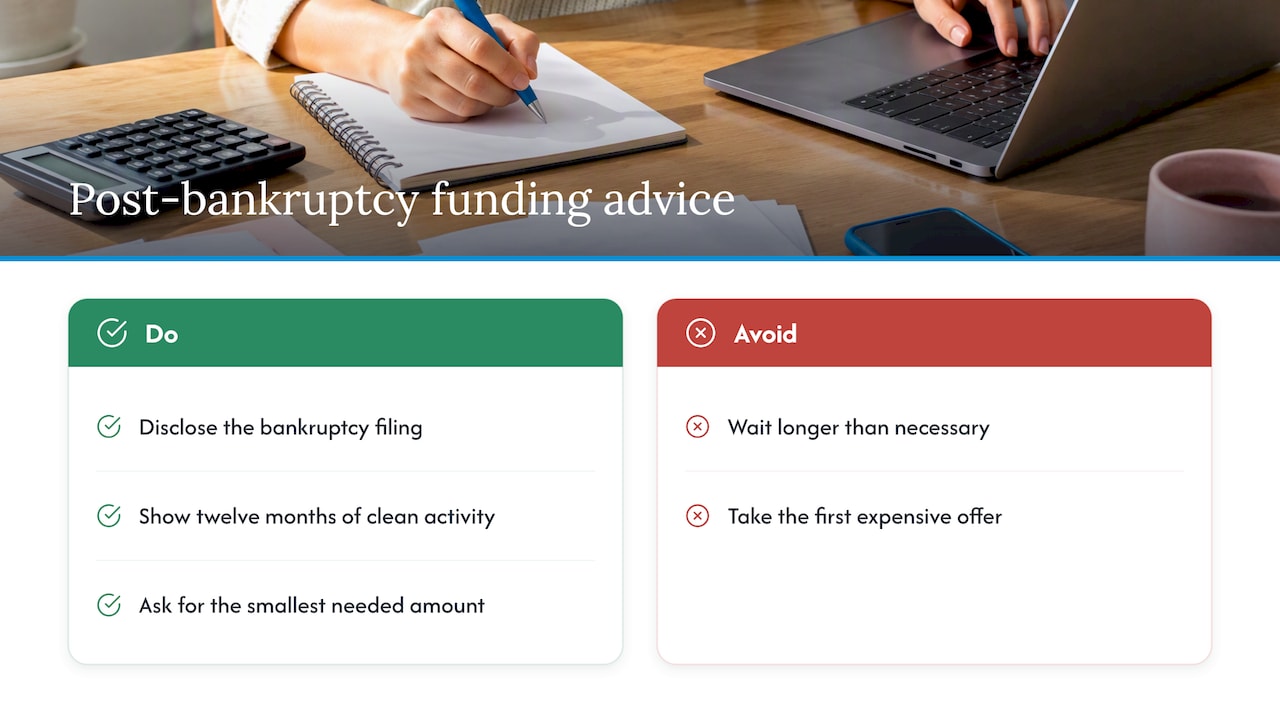
We talk to owners who have been through bankruptcy more often than people expect, and the pattern is consistent. They assume the door is closed, so they either wait far longer than necessary or take the first expensive offer that says yes. Both cost money.
Our view is simple. One lender’s rejection is information about that lender’s rules, not about your business. That is why we built Fordham Capital as a marketplace: one short application opens access to a wide network of banks and alternative lenders, so the lender that actually fits your situation gets to look at it. We are an intermediary, not a lender, which means we have no reason to push one product over another except what suits you.
Our advice for post-bankruptcy owners: be honest about the filing, show twelve months of clean activity, and ask for the smallest amount that solves the real problem. Rebuilding through a manageable line or working capital facility, repaid on time, opens up cheaper SBA money later. We would rather you borrow $30,000 and repay it well than borrow $80,000 and relive the last chapter.
— Rob
Fordham Capital connects small and medium-sized businesses with banks and alternative lenders through a one-page application. Applying does not affect your credit score, no collateral is required to get started, and approvals can come within 24 hours. We hold an A+ rating with the Better Business Bureau and have funded over $120M for our clients.
On our site, SBA loans are listed at 8% per year and lines of credit at 1-3% per month; working capital has no published price, because it depends on your profile. Final terms always come from the lender, and approval is never guaranteed. See the funding options and apply with Fordham Capital, or review the full range on our main page.
Yes, though it is often harder in the first years after discharge. Alternative lenders may consider you after 12 to 24 months, while traditional banks often want three to five years. Strong recent revenue and on-time payments help at any stage.
It is possible. The SBA has no blanket rule against past bankruptcies, but each SBA-approved lender sets its own standards, so one decline does not mean all will decline. Prior losses to the federal government are a separate and more serious problem, so discuss that with a lender and an attorney first.
Over 60 months, it is about $1,013.82 at 8%, $1,112.22 at 12%, and $1,324.69 at 20%, before any fees. Shorter terms raise the payment but cut total interest.
It depends on the lender and the type of credit check. Fordham Capital’s application does not impact your credit score. Before applying elsewhere, ask whether the lender uses a soft or hard inquiry.
At Fordham Capital, we've made the application process straightforward and reassuring. Dive in and explore your financial options with confidence, knowing there's no impact on your credit score and no obligations. We review your details and offer customized solutions based on what you're looking for.