
Seasonal business funding is short-term or flexible capital that carries a company through the stretch when money goes out faster than it comes in: stocking up before peak, hiring early, paying rent and insurance in the off-season. For most seasonal owners the best fits are a business line of credit or a working capital product for the swing, and an SBA loan when you can wait longer for a lower rate. Which one is right depends on how big the gap is, how fast you need the money and what you can afford to repay while sales are still ramping.
This guide walks through each option, what it costs, how to time your application and which offers to walk away from.
A landscaper, a ski shop, a tax preparer and a Halloween retailer all share one problem. Revenue arrives in a few months, while costs run all year. The squeeze usually shows up in three places:
People who study cash flow in seasonal industries stress that this is a timing problem more than a profit problem. One trade article on fuel delivery businesses with seasonal demand makes the point that understanding cash flow, not just profit, is a matter of survival. A business can be profitable over twelve months and still miss payroll in February.
That is why the question is rarely “Can I get a loan?” and more often “Which structure lets me borrow in month two and repay in month eight without strangling the next slow season?”
We cover the same gap from the cash-management angle in our guide on closing seasonal cash gaps in 30 to 90 days.
There is no single best product. Here is how the common ones compare.
| Option | Best for | Speed | Cost profile | Main risk |
|---|---|---|---|---|
| Business line of credit | Recurring, uneven needs | Fast once set up | Pay interest on what you draw | Costly if balances linger |
| Working capital financing | One-time pre-season spend | Often within days | Higher than bank loans | Short, aggressive repayment |
| SBA 7(a) loan | Larger, planned needs | Slowest | Typically lowest | Paperwork and wait time |
| Invoice financing | B2B sellers with unpaid invoices | Fast | Fees on advanced amount | Only works if you invoice |
| Merchant cash advance | Last resort | Very fast | Often highest | Repayment tied to sales, factor-rate pricing |
A line of credit works like a revolving tab. You are approved for a limit, draw what you need for inventory or payroll, and repay as sales come in. When you repay, the room comes back. For seasonal owners this is often the best match, because the need repeats every year and you only pay for the days you use the money.
The line of credit we arrange through our lender network is published at 1-3% per month. Because that is a monthly figure, do the math before you draw: a balance that sits for six months costs far more than one repaid in six weeks. The discipline is to draw for a purpose and repay from the first strong weeks of the season.
Working capital funding gives you a lump sum for day-to-day costs: stock, payroll, rent, a truck repair before the spring rush. It is typically the quickest way to cash, which matters when a supplier deadline is next week. Our guide to what a working capital loan is explains how repayment works, and the piece on working capital for inventory covers the pre-season stock-up in detail.
Pricing varies by lender and by your revenue profile, so we do not publish a single rate for working capital. You see actual terms before you accept anything.
The SBA does not lend directly. Its 7(a) program provides a guarantee to lenders, which makes them more willing to approve small businesses. According to the SBA, 7(a) loans go up to $5 million and working capital is a permitted use, with terms generally up to 60 months for working capital. The price for that is time: more documentation and a longer approval window than an online product.
Our SBA loan offer is published at 8% per year. If you can plan six to ten weeks ahead of your season, it is worth pricing out, especially for a larger expansion. For how the base rate rules move pricing, see our breakdown of SBA rates and the March 1 base rate rule.
If you sell to other businesses, such as a caterer working with corporate clients or a contractor billing property managers, unpaid invoices can become cash. One industry write-up notes that invoice financing can advance up to 90% of an invoice’s value right away, which bridges the wait without a traditional term loan. We compare the mechanics with a real example in our $100,000 AR financing versus factoring article.
A merchant cash advance gives you a lump sum in exchange for a share of future sales. The Consumer Financial Protection Bureau describes this kind of sales-based financing and notes that providers often price it with a factor rate, such as 1.2x, rather than an annual rate. A 1.2x factor on $20,000 means you repay $24,000 no matter how quickly you pay it back, and a short payback period makes the effective annual cost far higher than the factor suggests. For a seasonal business, daily or weekly remittances during a slow stretch can also hurt. Use one only after you have compared the alternatives above.
If your business was hurt by a declared disaster, such as a hurricane that wiped out your season, the SBA’s disaster loan program offers low-interest loans to help businesses recover. That is a separate path from ordinary seasonal swings, and it only applies after an official declaration.
Say you run a lawn and landscape company. Every March you need about $30,000 for mulch, plants, equipment servicing and two seasonal crew members before the first big invoices go out in May. This is an illustration, not a quote.
On a line of credit priced at 2% per month (inside the 1-3% range we publish), drawing $30,000 for three months costs roughly $600 per month in interest, or about $1,800 in total if the balance is not paid down. If you start repaying in May as invoices clear, the real cost is lower, because interest accrues on the remaining balance.
Compare that with paying a flat fee on a lump sum where the total repayment is fixed up front. If you repay early, you may save nothing. The question to ask any lender is always: what do I owe in total if I pay this back in half the time?
Now flip it. If the same $30,000 came as a merchant cash advance at a 1.2x factor, you would owe $36,000, a $6,000 cost for money you may need for only 90 days. That is the difference between a product priced for how long you hold it and one priced as a fixed fee.

Most seasonal owners wait until the pinch is obvious. By then your recent sales are at their lowest, and that is exactly what a lender sees. Apply earlier.
Banks tend to want collateral, longer histories and steady monthly deposits, which is the opposite of what a seasonal business shows on paper. The Office of the Comptroller of the Currency notes in its small business roadmap that online lenders attract owners with faster decisions and lighter collateral requirements, but those benefits often come with higher interest rates and less favorable repayment terms.
That trade-off is real, and you should weigh it honestly. Faster money costs more. The goal is to pay for speed only where speed matters, and to use slower, cheaper capital where you can plan ahead. Our overview of why businesses choose non-bank lenders goes deeper, and eight types of fast business funding lays out the full menu.
If you carry a lot of inventory or receivables, an asset-based structure may suit you. A trade panel reported by Commercial Baking points out that asset-based lenders focus on collateral value, such as inventory or receivables, while cash flow lenders often test financial covenants quarterly. For a business with volatile revenue, fewer covenant tests can mean fewer surprises.
If you have limited assets or imperfect credit, unsecured options exist through alternative lenders. They tend to look harder at recent revenue and bank deposits than at your personal score, and they price accordingly.
Searches for seasonal funding often lead to grant promises. Be careful. The SBA states that it does not provide general grants for starting or expanding a business. Its grants are limited to areas such as scientific research and export promotion. Anyone promising a “guaranteed” grant for ordinary operating costs is a warning sign.
The FTC has acted on this. In one case, it described a grant-writing firm that promised guaranteed grants to small businesses and charged for services that delivered little. In another, the agency announced that a business financing company and its CEO were permanently banned from providing financing and related services to settle allegations that it deceived small business owners.
A short checklist before you pay or sign anything:
The OCC also warns that business financing does not carry the same consumer protections as personal loans, so due diligence falls on you. That is the reason to compare several offers side by side.
We talk with seasonal owners who say the same thing: the bank was polite, slow and then said no. In our experience the problem is rarely the business. It is the paperwork format, which is built for companies with flat monthly revenue.
So we built around one idea. A short application, a wide network of banks and alternative lenders, and an advisor who looks at your seasonal curve instead of an average that hides it. We act as an intermediary, not a direct lender, which means you are not limited to one product and one set of terms. For some owners the answer is a line of credit they reuse every year. For others it is a one-time working capital advance, and for a few it is an SBA loan, because they started early enough.
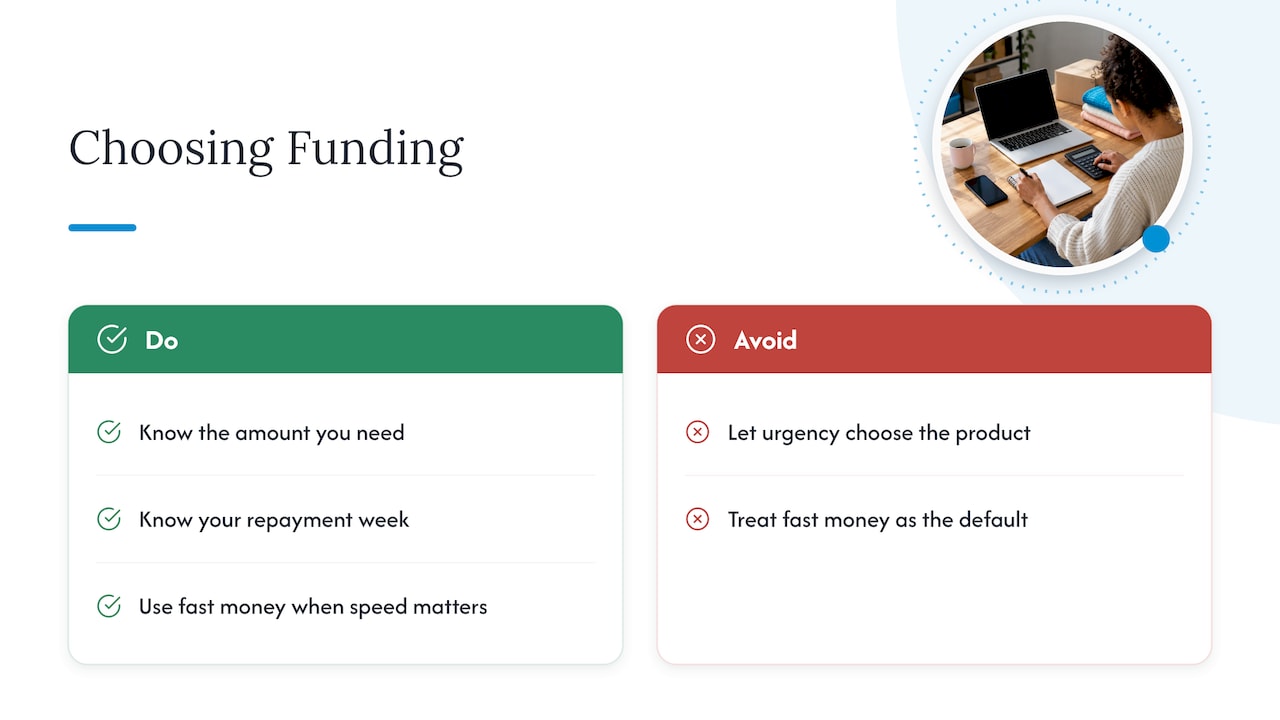
Our advice is plain. Know the number you need, know the week you will repay and do not let urgency pick the product for you. Fast money is a tool for the moments when speed matters, not a default.
— Rob
If you want to see what is available for your business, we offer an SBA loan at 8% per year, a line of credit at 1-3% per month and working capital financing, all through a one-page application. Applying does not affect your credit score, no collateral is required and approvals can come within 24 hours. Start on the Fordham Capital application page and tell us when your season starts and what you need to cover.
For most owners, a business line of credit fits best because you draw during the build-up and repay as sales arrive. Working capital financing suits a one-time pre-season expense, and an SBA 7(a) loan suits larger planned needs if you can wait through a longer process. The right choice depends on the size of the gap and how quickly you need the money.
Often yes, though terms will reflect the risk. Alternative lenders weigh recent revenue and cash flow heavily, not only a personal score. Expect higher costs than a bank loan, and compare total repayment amounts before you accept.
Not general ones. The SBA says it does not give grants to start or expand a typical business, and offers promising guaranteed grants are commonly fraudulent. Some state and local programs exist, so check official government sites rather than paying a third party.
About 60 to 90 days before your cash runs lowest, while recent revenue still looks strong. For an SBA loan, start even earlier because the process takes longer than online products.
At Fordham Capital, we've made the application process straightforward and reassuring. Dive in and explore your financial options with confidence, knowing there's no impact on your credit score and no obligations. We review your details and offer customized solutions based on what you're looking for.