

Both moved this year under a new SBA rule letting lenders price loans off Treasury or SOFR benchmarks instead of just Prime. Check SBA’s monthly CATRAN tables before you sign anything. A lender’s quote is only good if it falls under that month’s published cap.
TL;DR:
- The new SBA rule allows lenders to price loans based on Treasury yields or SOFR benchmarks, potentially shifting rates by over one percentage point from Prime.
- Borrowers should verify which base rate their lender is using and compare it against the SBA Optional Peg Rate before accepting any offers.
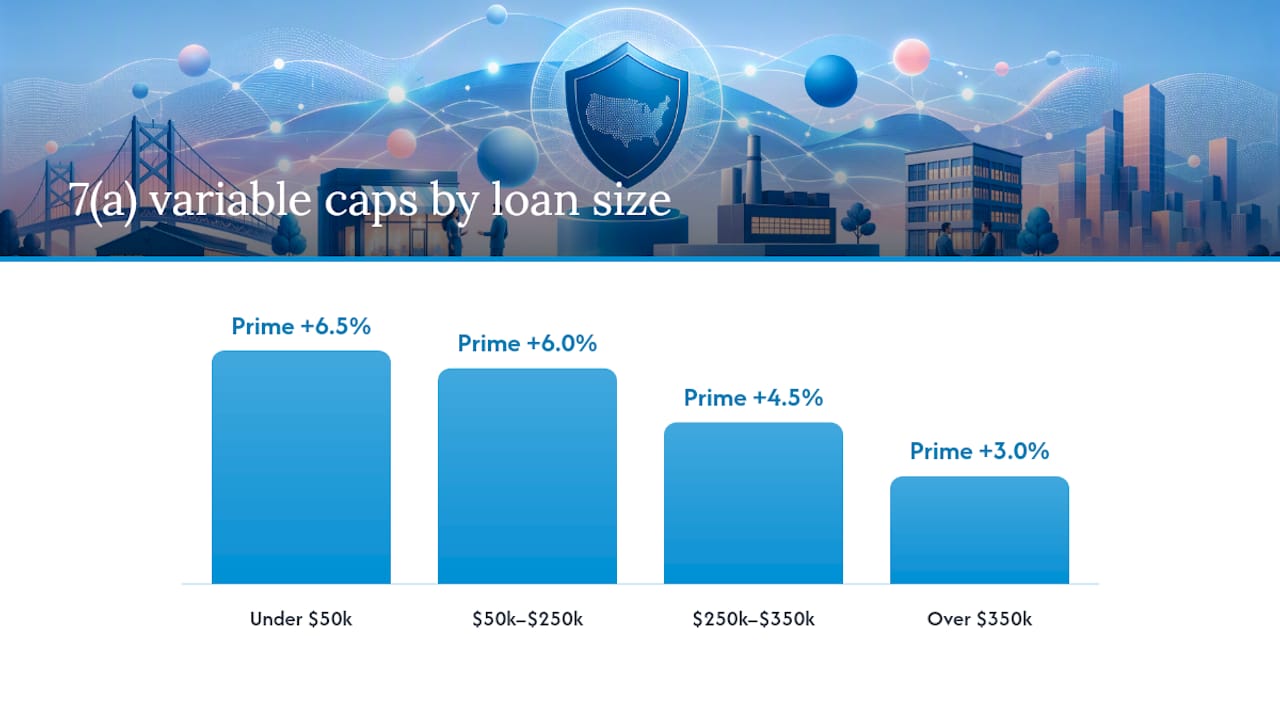
- Variable-rate SBA 7(a) caps decrease as loan size increases, with loans over $350,000 capped around Prime plus 3%, but lenders often add smaller spreads to lower-risk borrowers.
- Different SBA programs have varying cost structures, with 504 fixed rates in the low to mid 6%, while microloans generally have higher effective rates in the 8% to 13% range.
- Asking upfront about base rate selection, credit profile, collateral, and fees can significantly influence the final interest rate and total loan cost.
The biggest shift in SBA lending this year has nothing to do with the economy and everything to do with paperwork. Starting March 1, 2026, a new Federal Register rule under 13 CFR Part 120 lets 7(a) lenders price loans off three new benchmarks: the 5-year Treasury, the 10-year Treasury, or SOFR. Before this, lenders were mostly stuck choosing between Prime and the SBA’s Optional Peg Rate. Now they have five options, and which one your lender picks can move your effective rate by a full percentage point or more over the life of the loan.
This matters because Prime doesn’t always move in the same direction as Treasury yields or SOFR. When the Federal Reserve holds rates steady, but bond markets anticipate cuts, Treasury-based pricing can drift lower even while Prime sits flat. A lender using the 10-year Treasury as its base might quote you meaningfully different terms than one still defaulting to Prime, even on the identical loan amount and term.
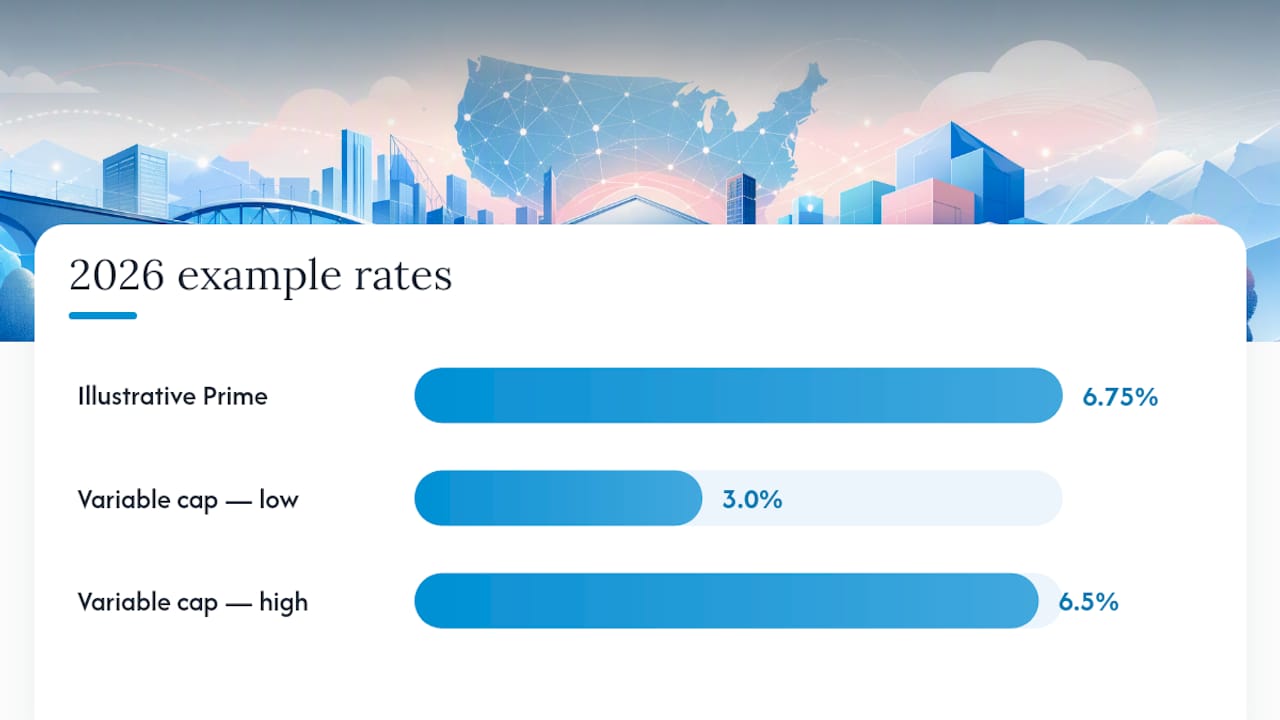
Here’s the quick 2026 snapshot borrowers should keep in front of them:
Statistic to watch: market summaries citing an illustrative 6.75% prime figure show 7(a) variable caps translating to roughly Prime plus 3.0% to 6.5% across loan-size buckets, with many approved borrowers landing well under the ceiling. That’s the number lenders can’t legally exceed, not the number they’ll necessarily quote you.
The practical takeaway: don’t assume your lender is using the cheapest available base rate. Ask which one they use before you compare offers, and cross-check the current SBA Optional Peg Rate against whatever benchmark they’ve quoted.
SBA doesn’t set your rate directly. It sets a ceiling, and your lender prices somewhere at or below it based on your credit profile, loan size, and how much risk they’re willing to eat.
For variable-rate 7(a) loans, the caps generally scale down as loan size goes up, since SBA assumes larger loans carry proportionally lower risk per dollar:
These figures reflect the kind of bucketed structure market summaries like Nav publish using a current prime illustration, and they line up with the ranges lenders reference when quoting borrowers. Fixed-rate 7(a) loans run a bit higher than variable caps at origination, since the lender is locking in rate risk for the full term instead of passing it to the borrower month to month.
Here’s the part most borrowers miss: the cap is a maximum, not a target. Lenders add smaller spreads to lower-risk borrowers because they can still make their margin without pushing to the ceiling.
That gap is exactly why asking about base-rate selection up front isn’t optional homework. It’s the single biggest lever in your control before you even start negotiating spread.
Full details on how these variable ranges break down by tier are available in a dedicated breakdown of 2026 SBA interest rates.
Not every SBA program prices the same way, and picking the wrong one for your situation can cost you thousands in avoidable interest.
504 loans split into two pieces: a bank-funded first mortgage and a Certified Development Company (CDC) debenture that carries a fixed rate set monthly by debenture sale results. Recent 504 debenture rates for the 10-, 20-, and 25-year terms have landed in the low to mid 6% range, making 504 loans attractive for real estate and heavy equipment purchases where a long, fixed rate matters more than flexibility.
SBA Express loans mirror standard 7(a) caps but apply to loans capped at $500,000, with faster turnaround since lenders get delegated authority to approve without waiting on SBA’s own review.
Microloans, capped at $50,000 and administered through nonprofit intermediaries rather than banks, typically run higher than 7(a) rates: intermediary margins usually push effective rates into the 8% to 13% range, reflecting the smaller loan size and higher per-dollar servicing cost.
Disaster loans operate on a separate track entirely, with eligibility tied to a declared disaster rather than general creditworthiness. Rates on these tend to run lower than commercial 7(a) products, though they come with narrower use-of-funds restrictions and documentation tied specifically to disaster recovery.
The interest rate is only half the cost story. SBA charges an upfront guarantee fee on 7(a) loans that scales with loan size, and it’s paid regardless of how competitive your rate ends up being.
On top of the guarantee fee, expect lender-specific charges: processing or underwriting fees, and if real estate is involved, attorney and title costs. That’s a real dent in your available capital before you’ve drawn a single dollar for operations.
Pro Tip: Ask your lender to itemize every fee in writing before you sign, and compare that total against the loan’s effective APR, not just the headline interest rate. A lower rate with high fees can cost more than a slightly higher rate with a lean fee structure.
A full breakdown of what to expect on closing costs, including typical fee ranges by loan type, is covered in this guide to business loan closing costs.
Every SBA-guaranteed loan rate follows the same basic formula: base rate plus lender spread, capped by SBA’s published maximum for that loan’s size and type. What changed in 2026 is the menu of base rates lenders can choose from.
SBA requires lenders using a Treasury-based rate to reference the market rate as of 5:00 p.m. Eastern on the final business day of the previous month, which means your variable rate for any given month is locked in by a snapshot taken weeks earlier, not a live daily number. SBA publishes the resulting alternative base rate options monthly through CATRAN, the same portal that carries the standard rate tables.
Rates move differently across benchmarks, which is exactly why Treasury-yield tracking data matters more to borrowers now than it did before March 2026.
Caps set the ceiling. Your actual quote depends on factors entirely within your control to improve.
Before accepting any quote, ask your lender four direct questions: which base rate they’re using, what spread they’re adding, whether the resulting rate respects SBA’s published cap for your loan size, and whether prepayment penalties or yield maintenance apply. Knowing the answers turns a vague quote into a number you can actually compare against a competing offer.
Pro Tip: Get your financials audited or reviewed before you apply, even if it’s not required. Lenders consistently price cleaner books lower, because verified numbers reduce their underwriting risk. Borrowers unsure whether they qualify at all should check the current SBA loan eligibility requirements before spending time on an application.
SBA loans usually win on total cost, not on speed. A bank term loan or online lender can often fund in days, while an SBA loan, even a fast-tracked Express product, typically takes weeks due to guarantee processing.
If your priority is lowest lifetime cost and you can tolerate a longer approval window, SBA financing usually wins. If you need capital in days, not weeks, a line of credit or short-term working capital product makes more sense despite the higher rate.
Navigating five possible base rates, tiered guarantee fees, and program-specific caps is exactly the kind of complexity that keeps qualified borrowers from applying at all. Fordham Capital positions itself around cutting through that friction: the company reports an A+ BBB rating, more than $120 million funded, and a one-page application designed to get borrowers matched with lenders quickly rather than buried in paperwork.
A marketplace connector like this works because it surfaces multiple lender offers at once, which means borrowers see how spread and base-rate choices actually compare instead of taking a single lender’s quote at face value. That visibility alone can be the difference between accepting a Prime-based offer and finding a Treasury or SOFR-based alternative that better fits current market conditions.
If there’s one thing worth hammering home, it’s this: the base-rate question isn’t a technicality, it’s the first thing you should ask every lender who quotes you a number. Two lenders can offer the identical spread and still land on very different final rates depending on whether they’re pricing off Prime, a Treasury yield, or SOFR.
Beyond that, documentation does more heavy lifting than most borrowers expect. Clean financials, a clear debt-service picture, and collateral you can point to on paper consistently move spread down, regardless of which base rate a lender chooses.
— Rob
Comparing five possible base rates, tiered guarantee fees, and lender-specific spreads by yourself takes real time, and most small business owners don’t have a spare month to shop rates while their working capital keeps shrinking. Fordham Capital’s SBA loan, line of credit, and working capital matching platform uses a one-page application to connect you with lenders across its network, with approvals reported within 24 hours and no upfront credit impact.
Instead of calling banks one by one to ask which base rate they use, you submit one application and let lenders compete for your business. If speed matters as much as price, or you’re not sure whether 7(a), 504, or a working capital line fits your situation best, start an application at Fordham Capital and get real offers to compare side by side.
For current caps, check SBA’s monthly CATRAN tables directly. For the legal text behind the 2026 base-rate rule, see the Federal Register notice and its follow-up interest-rate guidance. Treasury and SOFR benchmarks are tracked via FRED and the New York Fed.
This article is general information, not a substitute for advice from a qualified financial advisor. Consult a qualified financial professional about your own circumstances before acting on anything here.
Microloans, capped at $50,000, wouldn’t cover this amount, so a standard 7(a) or Express loan is the usual fit.
There’s no SBA rule in the 2026 program changes that doubled the standard 7(a) loan cap, which remains at $5 million for most borrowers. What did change is the base-rate structure, not the loan-size ceiling. Check SBA’s official program pages before relying on any claim about a limit increase.
For a rough estimate, use an SBA payment calculator with your lender’s actual quoted base rate and spread rather than a generic assumption, since the March 2026 base-rate options mean two lenders can quote very different numbers on the same loan size.
The most significant 2026 change isn’t eligibility criteria, it’s the expanded base-rate options lenders can use when pricing 7(a) loans. Standard eligibility factors, including size standards, for-profit status, and demonstrated repayment ability, remain unchanged; a full checklist is available in Fordham Capital’s SBA eligibility guide.
Fordham Capital connects borrowers to a network of banks and alternative lenders rather than lending directly, using a one-page application to speed up matching. Current SBA loan pricing through the platform varies depending on the lender you’re matched with and your credit profile; consult the client’s website for up-to-date pricing details.
At Fordham Capital, we've made the application process straightforward and reassuring. Dive in and explore your financial options with confidence, knowing there's no impact on your credit score and no obligations. We review your details and offer customized solutions based on what you're looking for.


