You qualify only if your business is a for-profit, U.S.-based operation that meets SBA size standards, and since March 2026 you must be a U.S. citizen or U.S. national living in the United States. If you clear those gates, it likely fits quick, smaller capital needs.
TL;DR:
- Express loans are capped at $500,000 with a 50% SBA guaranty; standard 7(a) loans reach $5 million, and combined 7(a) and 504 financing can reach $10 million.
- Delegated lender authority drives Express speed, so ask whether the lender processes applications in house and which Form 1919 answers could trigger SBA review.
- Lenders often want three years of personal and business returns, financial statements dated within 60 days, and Form 413 dated within 90 days of approval.
- Credit score, cash flow, time in business, and collateral rules vary by lender, so a single rejection is not final; compare lenders’ criteria.
SBA Express is not a separate loan program. It is a delivery method inside the 7(a) loan program, the SBA’s main small-business lending product. The difference shows up in who makes the decisions. With standard 7(a) processing, the SBA reviews the file. With Express, a lender that holds delegated authority makes the credit decision itself, using its own credit policies and a lighter set of SBA application requirements.
That shift is why Express usually moves faster. Instead of waiting in an SBA review queue, your file is underwritten by the lender’s own credit team, much as it would be for a similarly sized conventional loan. The lender still has to document the loan file properly, but several application-stage items required for standard 7(a) processing are waived, so there are fewer pieces to chase down.
Because of the $500,000 ceiling, Express tends to suit smaller, time-sensitive needs. Typical examples include:
If you need much more capital than that, or the project is large and complex, standard 7(a) or a 7(a) and 504 combination is the better lane. We cover that distinction in the terms section below.
One practical point: Express speed depends on the lender, not on you. Not every SBA lender has delegated authority, and those that do set their own internal rules. Asking early whether a lender processes Express loans under delegated authority saves weeks.
Eligibility has two layers. The SBA sets baseline rules that apply to every 7(a) loan, and the lender adds its own credit criteria on top. Start with the SBA layer, because failing it ends the conversation no matter how strong your financials are.
Your business generally must meet all of the following:
Size standards vary by industry, measured by either average annual receipts or number of employees. A restaurant and a manufacturer are measured differently, so check your NAICS code against the SBA’s size table before you apply. Lenders will do this check too, so surprises are rare, but knowing your status in advance keeps you from wasting time.
A core 7(a) criterion, including for Express, is the “credit elsewhere” test: applicants must show they cannot obtain the desired financing on reasonable terms from non-federal sources. In practice, this does not mean you need to be rejected by multiple banks. It means the lender documents that, given your profile, the loan as structured is not readily available on comparable terms without the SBA guaranty. Maybe the term is longer than a conventional lender would offer, or the collateral position is thinner than a bank would normally accept.
Related to that is repayment ability. Lenders look at your business cash flow, your debt obligations and your history to decide whether the business can carry the payment. A strong credit score helps, but cash flow evidence is what carries most files.
This is the biggest recent change. Effective March 2026, all small business owners applying for an SBA-guaranteed loan, including SBA Express, must be U.S. citizens or U.S. nationals with their principal residence in the United States. Non-citizens and foreign nationals are no longer eligible. The SBA also published a procedural notice on revised ownership, citizenship, and residency requirements for 7(a) and 504 loans that updates the documentation and verification procedures lenders follow.
If you are a business owner who held a green card or a visa and previously qualified, check your status against the current notice before spending time on an application. If you are unsure how the rule applies to your ownership structure, ask a lender or an immigration or business attorney rather than guessing.
The SBA wants to know who stands behind the business. Applications require disclosure of owners, and lenders typically collect personal information and financial statements from individuals with meaningful ownership. Expect to list every owner and be ready to explain the ownership percentages. You will also be asked about other businesses you own or control, because affiliation can affect your size status.
You will also answer character and background questions about legal history, past defaults and delinquent government debt. Honest, complete answers matter more than perfect ones, since an incomplete disclosure can derail a file late in the process. If you have unresolved delinquent federal obligations, deal with them before applying.
A complete file is the single most controllable factor in how fast your loan closes. Lenders prioritize complete documentation precisely because gaps are the most common cause of delays. Here is what you should expect to assemble.
The Form 413 point deserves a closer look. It is not just a formality: lenders use it to understand the owner’s overall financial position, and a mismatch between the statement and your tax returns or credit report is a common reason for follow-up questions.
Lenders may still request additional materials depending on your industry or loan purpose. Having a scanned, named folder for each category lets you respond to those requests the same day.
Understanding who decides what helps you pick the right lender and set expectations. The SBA sets the floor: eligibility, size, citizenship and residency, and the structure of the guaranty. Under delegated authority, the lender decides almost everything else about creditworthiness.
SBA guidance allows lenders processing Express loans to use commercially reasonable credit analysis consistent with their similarly sized non-SBA loans. That means credit score thresholds, debt service coverage expectations and minimum time in business vary from lender to lender. One lender may lean on a business credit score, another on personal credit, and another on a cash flow model. Two lenders can reach different answers on the same file, which is a good reason not to treat a single decline as final.
Collateral practices are set largely by the lender. Under SBA guidance, for loans over $50,000, lenders follow their own written collateral policies. At the same time, the SBA’s position is that collateral inadequacy should not be the sole reason for denial. In other words, a lender may ask for business assets or a lien on real estate, but a thin collateral position by itself should not sink an otherwise sound loan. Our deeper look at how SBA loan collateral works for U.S. businesses walks through what lenders typically request and how to respond.
Lenders may also set expectations about owner contribution to a project, particularly for acquisitions or major purchases. These are lender and program-specific, so ask directly rather than assume.
Express speed holds only while the application stays inside the lender’s delegated authority. Certain answers on Form 1919, along with some eligibility questions and structural features, can push a file into non-delegated SBA review. Once that happens, you are effectively on the standard 7(a) timeline and the speed advantage shrinks. Ask your lender up front which answers or features would trigger SBA review so you can anticipate it.
The program limits are fixed by the SBA, while pricing and most terms are negotiated with the lender.
Maximum amount. SBA Express loans top out at $500,000, well below the $5 million cap on standard 7(a) loans.
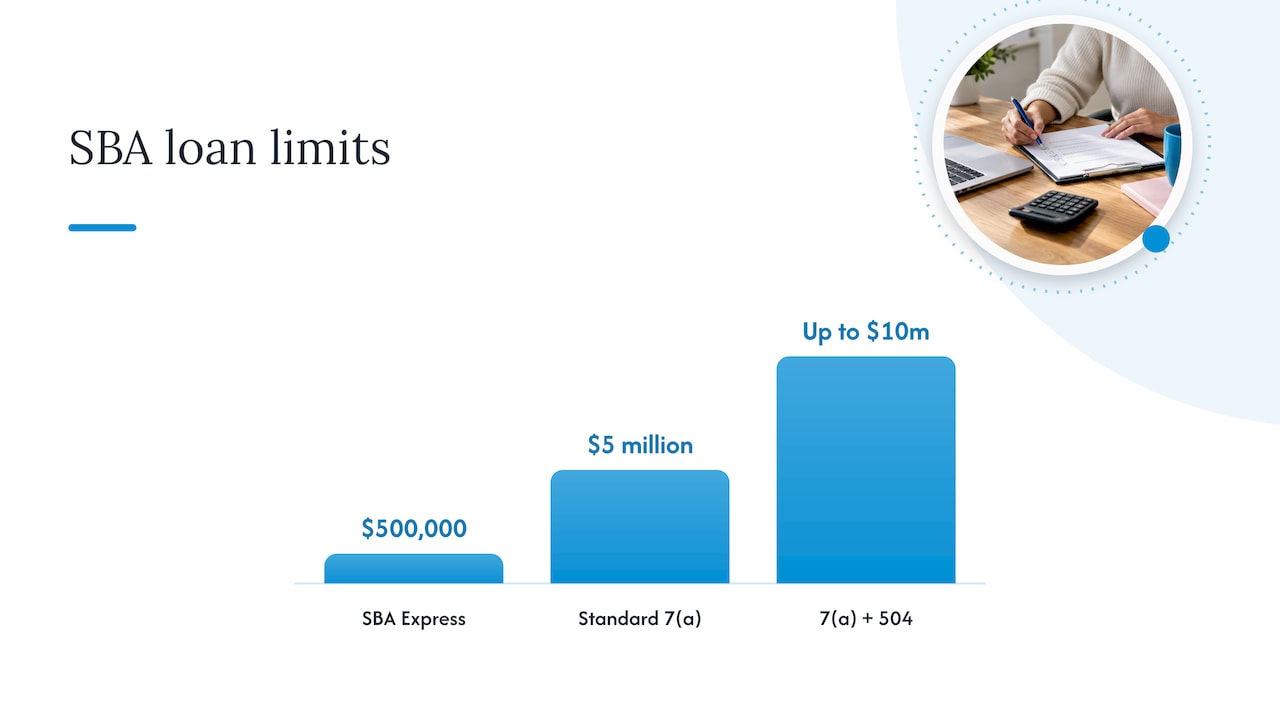
Guaranty. The SBA provides a 50% guaranty on Express loans. Other 7(a) loans can carry higher guaranty percentages depending on size. A lower guaranty means the lender carries more risk, which helps explain why Express relies so heavily on the lender’s own credit judgment.
Terms and pricing. Repayment terms, interest rates and fees are agreed with the lender within SBA limits. Term length generally depends on the loan purpose: working capital and equipment tend toward shorter terms, real estate toward longer ones. For current rate rules and the questions borrowers are asking, see our guide on SBA rates in 2026. Expect to see an SBA guaranty fee and lender fees in the cost picture, and ask for a full fee schedule in writing before you commit.
Larger capital needs. In 2026 the SBA announced that small businesses may combine 7(a) and 504 loans for up to $10 million in total SBA-backed financing. That is a different path from Express, but it is useful context if your needs may outgrow the $500,000 cap.
Here is a quick snapshot of the key limits:
The SBA Express maximum is $500,000, while 7(a) loans remain capped at $5 million. Express is built for smaller, faster requests, not large projects.
The process is straightforward when you prepare for it. Here is the usual sequence:
Timelines vary by lender and by how complete your file is. Express generally moves faster than standard 7(a), often measured in weeks rather than months, but there is no guaranteed number. Complete documentation and a lender comfortable with delegated processing shorten the path. Missing items, unreturned lender questions and unresolved eligibility problems lengthen it.
The most common delay is a trigger that moves your file into non-delegated SBA review. When that happens, the application follows standard review steps and the clock extends. If speed matters to you, discuss this risk with the lender before submitting. For realistic benchmarks and tactics, we break down SBA loan turnaround times and how to move faster, and our guide on business loan approval time covers ways to speed things up.
Use this list to arrive at a lender with a file that is ready on day one. Preparation is where Express speed is actually won or lost.
Documents to gather
Financial housekeeping
Operational checks
Questions to ask your lender
Most owners we talk to assume speed is something the lender controls. In our experience, the files that fund quickly are the ones that arrive complete, consistent and matched to a lender that actually uses delegated authority. A strong business with a messy file often waits longer than a solid business with a tidy one.
That is why we built our process around a one-page application and a wide network of banks and lenders. Instead of you guessing which lender may fit your profile, we connect you with lenders in our network. We have funded businesses and hold a BBB rating, which reflects how we treat the people we serve.
Active follow-up matters as much as the initial submission. Underwriters send questions, and a same-day response keeps a file moving while a week of silence can push it to the bottom of the stack.
There is also an honest question of when a marketplace partner makes sense. If you already have a relationship with a bank that processes Express loans and you know your file is clean, applying directly can work well. If you do not know which lenders fit, or you have been declined before, a partner who can place your file across multiple lenders saves time and guesswork.
— Rob
If your business clears the eligibility rules above, the next step is getting in front of the right lender with a file ready to go. That is the work we do every day. We connect small and medium-sized businesses to banks and alternative lenders, so you spend your time running your business instead of chasing applications.
Here is what we offer:
And here is how we work, based on what we have built and what we claim for ourselves:
Start by sharing your business details with us on our site. An advisor reviews your goals, matches you with suitable lenders and tells you plainly what documents will speed your file. If you want to see where you stand on eligibility first, our guide to SBA loan requirements for 2026 is a good companion read. Reach out and we will take it from there.
This article is general information, not a substitute for advice from a qualified financial advisor. Consult a qualified financial professional about your own circumstances before acting on anything here.
The biggest change is the March 2026 rule limiting SBA-guaranteed loans, including SBA Express, to U.S. citizens and U.S. nationals who live in the United States. The SBA also allows combined 7(a) and 504 financing for larger projects, which is separate from Express.
Express loans generally move faster than standard 7(a) loans, often in weeks rather than months, because lenders decide under delegated authority. Actual timing depends on the lender and how complete your documents are. A file that triggers SBA review takes longer.
The maximum is $500,000, with a 50% SBA guaranty. Larger requests generally go through standard 7(a) processing, which carries a higher cap.
An SBA business loan is a loan made by an approved lender and partly guaranteed by the U.S. Small Business Administration. The guaranty reduces lender risk, which can make financing available to businesses that might not qualify for conventional terms.
At Fordham Capital, we've made the application process straightforward and reassuring. Dive in and explore your financial options with confidence, knowing there's no impact on your credit score and no obligations. We review your details and offer customized solutions based on what you're looking for.