
Yes, business funding scams are common, and they target small business owners specifically because urgency clouds judgment. If someone contacts you about a grant, loan, or cash advance and asks for money upfront or promises guaranteed approval, stop responding, don’t send payment, verify the source independently, save every message, and report it to the FTC or SBA immediately.
TL;DR:
- Most scams request upfront fees or guarantee approval before an actual review, which real lenders and government programs never do.
- Fake grant schemes often involve unsolicited messages claiming pre-approval and requests for payment via unverified email domains ending in .com, .net, or .biz.
- Predatory cash advances may promise quick funding but hide extremely high effective interest rates and can include clauses that allow lenders to recover funds without a hearing.
- Scammers frequently spoof caller IDs and send fake links, so always verify contact details, hover over links, and never open attachments from unknown sources.
- Before signing, request written terms, verify licensing, and consult a financial professional if contract clauses related to judgment or collateral are unclear.
Scammers know small business owners want free money, so they build entire schemes around impersonating government agencies offering grants or stimulus funds. A text or email arrives claiming you’ve been “pre-approved” for a federal grant, and all you need to do is pay a small processing fee or verify your bank account.
Real government grant programs never work that way. The government will not ask you to pay a fee to unlock a grant, according to Usa. Watch for these specific tells:
Confirm anything that sounds like a government program through USA.gov, the SBA’s official site, or a direct .gov search. If a caller claims to represent an agency, hang up and dial the number listed on the agency’s actual website, not the number they gave you.
The rule with legitimate lenders is simple: you never pay to get approved. Any broker demanding a fee before releasing funds, or guaranteeing approval regardless of your credit or revenue, is running a scam. The SBA does not lend directly and doesn’t charge fees to guarantee a loan, so anyone claiming to be the SBA and asking for payment is impersonating the agency.
Watch for these broker and lender warning signs:
Merchant cash advances deserve special caution. MCAs aren’t loans, they’re purchases of future receivables, priced with a factor rate instead of an annual percentage rate (APR). Depending on repayment speed, the effective APR can be very high, reaching levels that may be difficult to afford. The FTC has already banned certain MCA providers and ordered redress for small businesses harmed by unauthorized bank withdrawals and deceptive collection tactics.
Before signing anything, request written terms, ask the provider to state an APR-equivalent, and scan the contract for a confession-of-judgment clause, a provision that can let a lender obtain a court judgment against you without a hearing.
Scammers don’t just email. They spoof caller ID to look like your bank or a government office, and they text links that mimic real lender portals. Follow these steps before you respond to anything:
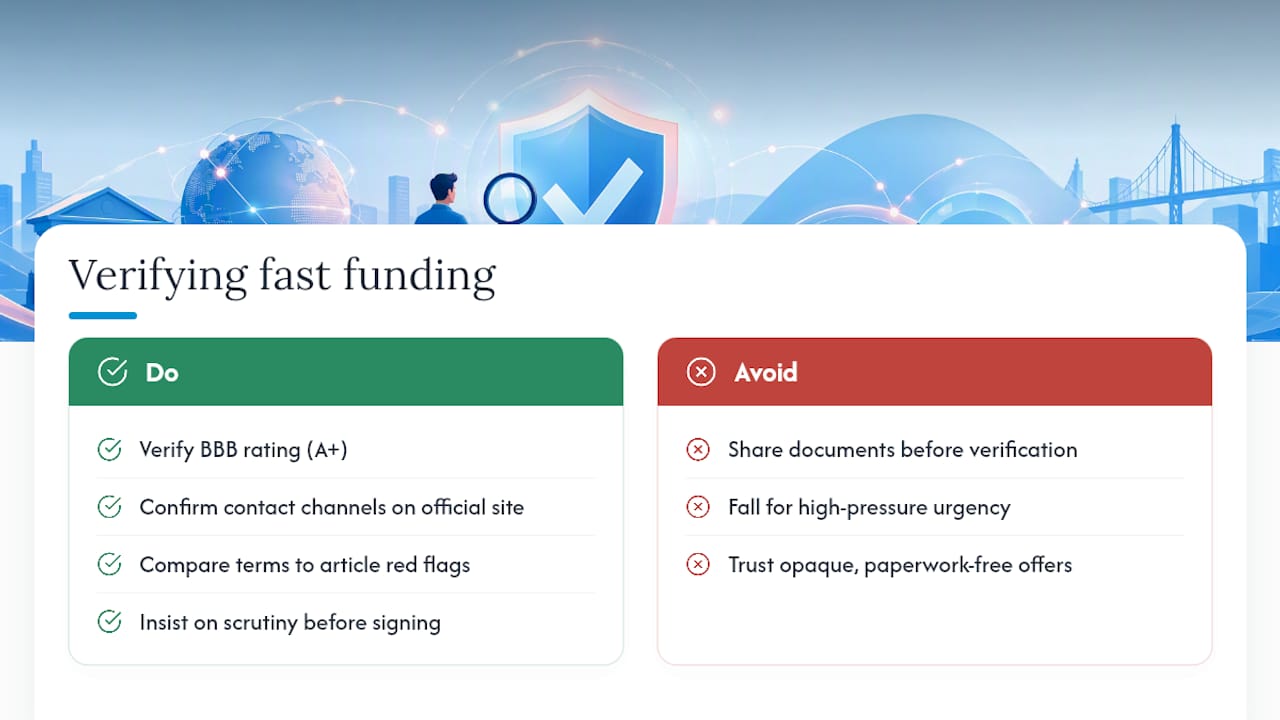
Every legitimate funding offer holds up under scrutiny. Every scam collapses the moment you ask basic questions. Run through this list before responding to any funding pitch:
Pro Tip: Ask the lender or broker for their NMLS number or state lending license before you share any financial documents. A legitimate outfit will have one ready; a scammer will stall or change the subject.
If a contract includes clauses you don’t fully understand, especially anything touching judgment, collateral, or personal guarantees, pause and get a second opinion from an attorney or a trusted financial advisor before you sign. Comparing offers side by side against a resource like how to choose the right lender for small business helps you spot which details are standard and which ones aren’t.
Speed matters here almost as much as it does when chasing legitimate funding. Move through these steps in order:
If you’re dealing with an MCA that’s pulling unauthorized withdrawals or enforcing a confession-of-judgment clause, talk to an attorney quickly. These cases move fast in court, and waiting even a few weeks can narrow your options for protecting your credit score during business borrowing.
Prevention beats cleanup every time. A few habits cut your exposure dramatically:
Pro Tip: Keep a simple incident log, even a shared spreadsheet, tracking every suspicious call, email, or offer your team receives. Patterns that look random individually often reveal a coordinated scam campaign once you see them together.
Train whoever answers your phones or inbox to recognize the basic red flags: urgency, upfront fees, and vague identities. A five-minute conversation with your staff now saves hours of cleanup later. If you’re evaluating how funding applications actually flow through underwriting, a resource on how small business funding networks operate helps you separate real intermediary marketplaces from the scams mimicking them, and a tool like this bank statement income calculator shows you roughly how lenders actually read your cash flow, so a legitimate underwriting conversation looks noticeably different from a scam script.
Scammers exploit the exact thing every small business owner feels: the pressure to get capital before a payroll date or a slow month turns into a crisis. That urgency is the lever they pull. Speed on its own isn’t the problem, opacity is.
A one-page application was built specifically because the traditional funding process buries owners in paperwork and uncertainty, not because shortcuts are inherently risky. The company holds an A+ BBB rating, and every contact channel used is listed openly on the official site, so you can verify the company before you share a single document. If you’re comparing an SBA Loan, a business line of credit, or working capital financing, check our terms against the red flags in this article first. A legitimate funding partner will never mind the scrutiny.
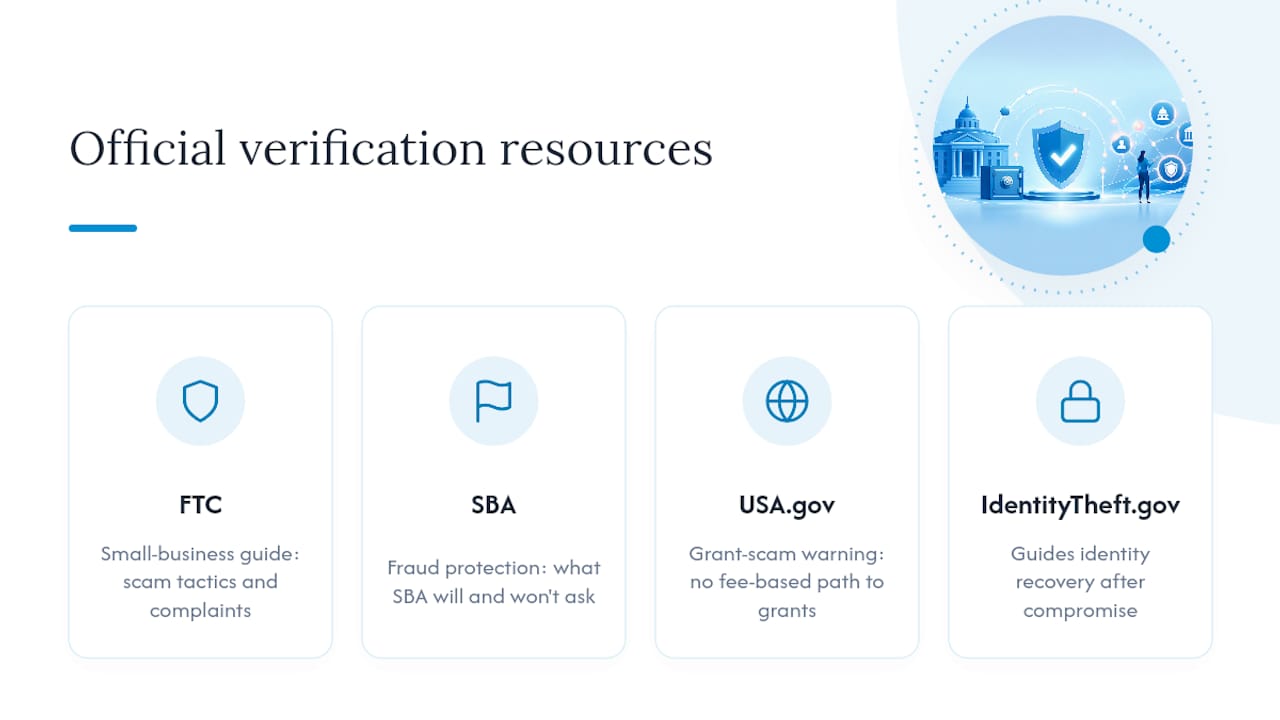
Bookmark these before you need them. The FTC’s small business guide covers common scam tactics and where to file a complaint. The SBA’s fraud protection page explains what the agency will and won’t ask of you. USA.gov’s grant scam warning confirms there’s no legitimate fee-based path to government money, and identitytheft.gov walks you through recovery if your information was compromised.
This article is general information, not a substitute for advice from a qualified financial advisor. Consult a qualified financial professional about your own circumstances before acting on anything here.
Fake grant offers impersonating federal agencies, advance-fee loan schemes demanding payment before approval, and predatory merchant cash advances with hidden factor rates are the most frequent tactics small business owners report. Phishing texts and spoofed calls claiming to be from the SBA or your bank round out the current wave, often designed to harvest banking details directly.
A legitimate funder never asks for payment before approving funds, provides written terms on request, and has a verifiable physical address and working contact line. The SBA doesn’t lend directly or charge fees for loan guarantees, so anyone claiming otherwise while representing the agency is misrepresenting themselves.
Register your business numbers with the Do Not Call Registry, enable your carrier’s call-blocking features, and never confirm personal or financial details with an unsolicited caller. Hang up and call back using a number you find independently on the company’s official website.
The five patterns that show up most often are fake government grants, advance-fee loan scams, predatory merchant cash advances with undisclosed terms, phishing emails or texts spoofing real lenders, and fraudulent credit-repair pitches bundled into funding offers. Each relies on urgency and a request for money or information before any real underwriting happens.
At Fordham Capital, we've made the application process straightforward and reassuring. Dive in and explore your financial options with confidence, knowing there's no impact on your credit score and no obligations. We review your details and offer customized solutions based on what you're looking for.