
Yes, interest you pay on a bona fide business loan is generally tax deductible when the debt meets IRS tests and the proceeds go toward business purposes. Three things can limit that deduction: the Section 163(j) cap, mixed personal and business use of the loan, and the fact that principal repayments are never deductible. The IRS Q&A on business interest and Publication 535 spell out the details.
TL;DR:
- For 2026, businesses averaging $32 million or less in gross receipts over the prior three years avoid Section 163(j); larger firms face its interest cap.
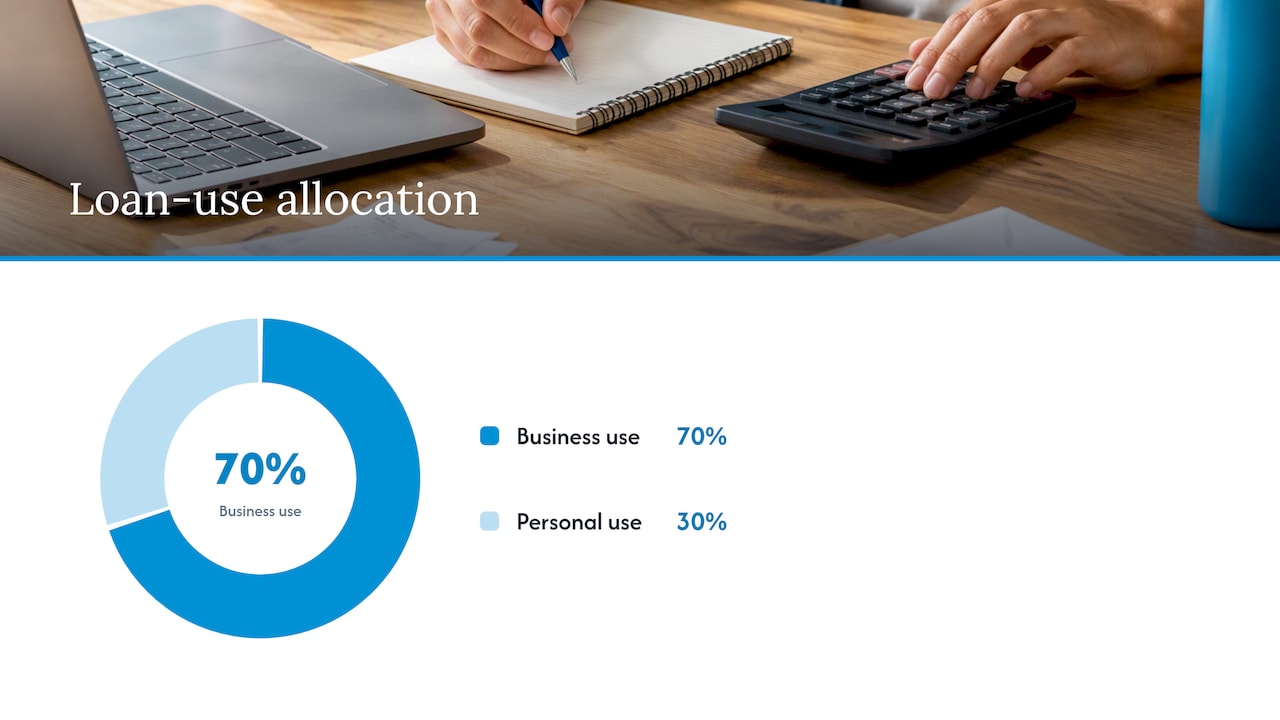
- When proceeds serve personal and business needs, deduct only the business share; a $100,000 loan used 70% for business makes 70% of interest deductible.
- Interest disallowed under Section 163(j) carries forward, while partnerships and S corporations apply the limit at the entity level and pass amounts to owners.
- For related party loans, use a signed note, a market rate, a fixed repayment schedule, and consistent payments; retain records linking each draw to business spending.
Not every payment labeled “interest” qualifies for a deduction, and not every loan arrangement holds up if the IRS looks closely. To treat interest as a deductible business expense, we need to satisfy a few core tests rooted in how real debt works between a genuine borrower and lender.
Beyond these tests, you have to show that the proceeds actually went to work in the business. According to IRS guidance, the single most overlooked issue is proving actual business use of the funds, since money that sits idle or gets diverted to personal use can jeopardize the deduction entirely (IRS). Related-party loans, such as one from a family member or another company you own, draw extra scrutiny if they lack a written note, a market interest rate, and consistent repayment history.
Pro Tip: Keep a simple log showing the date, amount, and business purpose of every draw from a loan, especially if the lender is a relative or an affiliated entity.
Once you have interest that qualifies, the next question is how much of it you can actually deduct in a given year. Section 163(j) caps the deduction for many businesses, though a large share of small businesses never bump into the limit at all.
Under Section 163(j), businesses with average annual gross receipts at or below the exemption threshold for the 2026 tax year are exempt from the limitation, meaning businesses averaging that amount or less in gross receipts over the prior three years sit outside the limitation entirely (IRS). For businesses that exceed it, the allowed deduction for business interest is capped at the sum of three components:
Disallowed interest above that cap does not disappear. It carries forward to future tax years, where it can be deducted once ATI and income allow for it (IRS). Partnerships and S corporations apply the 163(j) limitation at the entity level first, then pass the allowed and carryforward amounts through to partners or shareholders, which means the calculation often needs a tax professional’s attention rather than a do-it-yourself spreadsheet.
Interest and principal get lumped together on a loan statement, but the IRS treats them very differently. Only the interest portion of your payment is deductible. Principal payments on a business loan are not deductible business expenses, regardless of what the loan funded (IRS). If you borrow $50,000 and repay it over five years, the repaid principal simply reduces your liability on the books; it never shows up as a tax deduction.
Loans issued at a discount introduce another wrinkle: original issue discount, or OID. When a lender advances less than the face value of a note, the difference is treated as interest and generally must be deducted over the life of the loan using the constant-yield method, rather than all at once (IRS Publication 925). Some interest also has to be capitalized into the cost of an asset instead of deducted immediately, under uniform capitalization rules, which typically applies to interest tied to constructing property or producing certain goods.
A few items commonly get mistaken for deductible interest:
Publication 535 walks through these distinctions in more depth, including how allocation and capitalization rules interact (IRS).
When a loan funds both business and personal expenses, only the business-use share of the interest is deductible. The IRS traces how proceeds were actually spent rather than how the loan is labeled, so a “business loan” used partly to pay personal credit card debt only yields a partial deduction.
The allocation math generally works like this:
Say a business owner borrows $100,000 and uses $70,000 to purchase inventory and equipment, while $30,000 covers a personal home renovation. That is a 70% business-use allocation. If the loan carries $8,000 in annual interest, $5,600 is deductible as a business expense, and the remaining $2,400 is treated as nondeductible personal interest. Publication 535 confirms that allocation applies whenever a loan serves multiple purposes, and the allocation can shift from year to year if proceeds are drawn down and repaid at different times (IRS).
Supporting that allocation on paper matters as much as getting the math right. Keep bank statements showing where funds landed, invoices or receipts for business purchases made with loan proceeds, and a simple worksheet that ties each draw to its use. Without that trail, an examiner has little reason to accept a split you claim after the fact.
When you can deduct interest also depends on your accounting method. Cash-basis taxpayers deduct interest in the year it is actually paid, while accrual-basis taxpayers deduct it in the year it accrues, regardless of when the cash leaves the account. Prepaid interest generally has to be spread over the period it covers rather than deducted all at once, even for cash-basis filers.
Where the deduction shows up on your return depends on your business structure:
Disallowed interest carried forward from a prior year gets picked up again on Form 8990 in the year it becomes deductible, subject to that year’s ATI and income limits (IRS).
A deductible interest claim is only as strong as the paperwork behind it. At minimum, keep a signed promissory note, an amortization schedule showing the interest and principal split on every payment, bank or ledger entries matching each payment, and receipts or invoices proving how the proceeds were spent.
Pro Tip: Store your loan documents, amortization schedule, and allocation worksheet together in one folder per tax year so you are never searching for proof mid-audit.
Fast, well-documented funding matters here. A marketplace with a straightforward one-page application makes it easier to get clean, traceable loan terms from the start, which is exactly the kind of paperwork a deductible interest claim depends on.
Most owners lose part of their interest deduction not because the rules are unclear, but because nobody tracked how the money was actually spent. Three habits fix that: track every dollar of loan proceeds against a business purpose, keep the note and amortization schedule on file, and loop in a CPA before year-end rather than during filing season. Check the gross receipts threshold annually, since it adjusts and determines whether 163(j) even applies to you.
— Rob
When you need capital that supports a clean interest deduction, the paperwork trail starts with the loan itself. We connect business owners to SBA loans, lines of credit, and working capital financing through a network of banks and alternative lenders, all through a one-page application with no credit score impact and no collateral required.
Approvals can come within 24 hours, which means you spend less time waiting and more time documenting exactly how those funds get deployed into the business. Check your funding options and get the kind of clear loan terms that make tax time easier.
This article is general information, not a substitute for advice from a qualified financial advisor. Consult a qualified financial professional about your own circumstances before acting on anything here.
The loan itself is not deductible since borrowed funds are not taxable income and principal repayments are not an expense. The interest you pay on that loan is generally deductible when the debt is legitimate and the proceeds fund business operations (IRS).
Many owners assume that simply borrowing money guarantees a deduction, but the IRS has flagged proving actual business use of the proceeds as the most commonly missed step. Funds that sit unused or get diverted to personal spending can jeopardize the deduction even when the loan itself qualifies as business debt (IRS).
There is no flat dollar cap on deductible interest for most small businesses, since businesses with average gross receipts of $32 million or less over the prior three years are exempt from the Section 163(j) limitation entirely for 2026 (IRS). Businesses above that threshold face a cap tied to business interest income, 30% of adjusted taxable income, and floor plan financing interest.
Yes, the same core rules apply regardless of loan type: the debt must be legitimate, legally binding, and the proceeds used for business purposes for the interest to qualify. You can review allowable uses for SBA loan proceeds or common business line of credit uses to confirm your funding plan supports deductibility.
Disallowed business interest under the Section 163(j) limitation is not lost. It carries forward to future tax years and can be deducted later once your adjusted taxable income and income limits allow for it (IRS).
For the primary rules behind everything covered here, start with the IRS Q&A on the business interest limitation, IRS Tax Topic 505 on interest expense, IRS Publication 535 on business expenses, and the statutory text at 26 U.S.C. § 163. If you are dealing with a dispute or need broader tax planning around financing decisions, the guides on IRS business levy exemptions and proactive tax planning for small business owners offer useful background from tax professionals.
At Fordham Capital, we've made the application process straightforward and reassuring. Dive in and explore your financial options with confidence, knowing there's no impact on your credit score and no obligations. We review your details and offer customized solutions based on what you're looking for.