
A business loan cosigner can unlock approval or a lower rate when that person brings meaningfully stronger credit or income than you do on your own. But cosigning transfers real legal and credit risk onto someone else, and if you already clear a lender’s thresholds, adding one adds little beyond exposure for a person you care about. SBA loans, notably, don’t work this way at all.
TL;DR:
- A strong cosigner with a credit score of 700 or higher and stable income can significantly improve approval chances and loan terms.
- SBA loans do not accept third-party cosigners; instead, they require personal guarantees from owners holding 20% or more equity.
- A cosigner’s liability begins immediately, and missed payments will negatively impact both credit reports and future borrowing ability.
- Lenders often blend both profiles’ financials using specific methods, with a stronger cosigner increasing the likelihood of approval and better rates.
- Alternative fast funding options exist that do not require a cosigner, such as platforms offering instant approvals through a single application.
A cosigner signs the loan agreement alongside you and becomes equally responsible for repayment from day one, whether or not you ever miss a payment. That’s the core distinction people miss: a cosigner shares liability immediately and typically has no ownership stake in the business. A co-borrower, by contrast, usually has partial ownership and access to the funds, not just the repayment obligation.
A guarantor sits one step removed. Guarantors only owe money if you default first, a legal concept called secondary liability. The Consumer Financial Protection Bureau explains that cosigning means agreeing to repay a loan if the primary borrower cannot, and it puts cosigners on notice: they’re legally on the hook and their own credit takes the hit if payments slip.
Here’s where it gets confusing for SBA applicants specifically. The SBA’s 7(a) loan program requires personal guarantees from any owner holding 20% or more of the business, not third-party cosigners layered on top. That’s a program rule, not a lender preference, and it trips up a lot of first-time applicants.
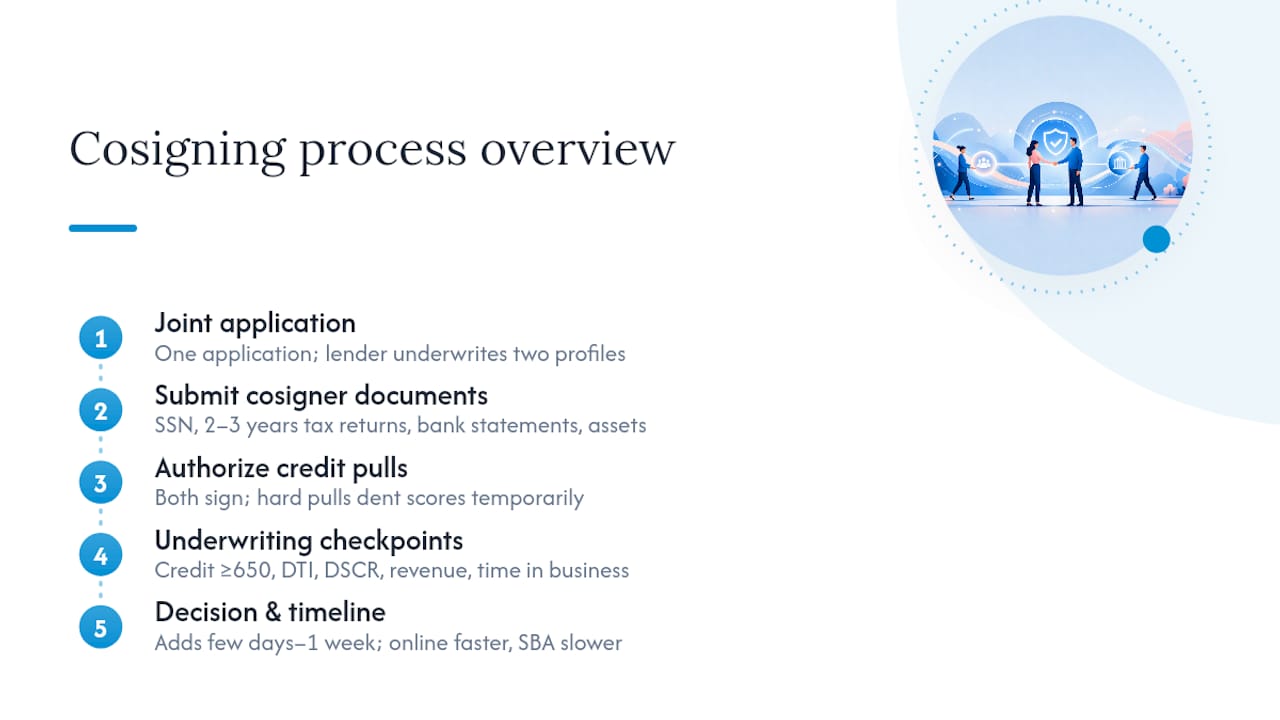
Adding a cosigner means submitting one joint application, but the lender underwrites two full financial pictures instead of one. Your cosigner will need to hand over a Social Security number, two to three years of tax returns, recent bank statements, and proof of assets like property or investment accounts, according to Fit Small Business’s breakdown of cosigner requirements. Both of you sign authorization for a hard credit pull, which will temporarily dent both credit scores by a few points.
Underwriters then run the numbers against a handful of standard checkpoints: personal credit scores (many lenders want 650 or higher from at least one party), debt-to-income ratio, debt-service coverage ratio, time in business, and annual revenue. Weak collateral often triggers a request for a cosigner mid-process rather than at application. Business loan approval factors like these interact, so a cosigner rarely fixes a single weak metric in isolation.
Timeline wise, expect the cosigner’s documentation to add a few days to a week onto underwriting, since most lenders process the second applicant’s file in parallel rather than after yours. Online and alternative lenders tend to move faster than traditional banks here; SBA loans, given the extra paperwork, run longer regardless of whether a cosigner is involved.
The best candidates are usually people already invested in your success: a spouse, a business partner, a family member, or occasionally a senior employee or outside investor with skin in the game. Professional or paid guarantor services exist, but they’re expensive and rare in small-business lending, and most lenders view them with more suspicion than a personal relationship.
What actually moves the needle is a credit score meaningfully above yours, typically 700 or higher, paired with stable W-2 or documented income, low existing debt, and verifiable assets like a home or savings account. A cosigner with a 710 score barely outperforms a borrower already sitting at 680.
How much that strength matters also depends on the lender’s methodology. Some use a strongest-applicant approach and lean entirely on the better profile; others blend both applicants into a weighted average that still favors the business owner. Ask which method a lender uses before assuming a stellar cosigner will fully offset a shaky application.
A cosigner tends to change outcomes when your personal credit is thin or damaged, your business is too new to show revenue history, you lack collateral to secure the loan, or you’re asking for more capital than your current profile supports on its own. In each of those cases, a stronger second profile gives underwriters a reason to say yes instead of no.
A cosigner won’t help in a few predictable situations:
If a cosigner isn’t the right fit, other paths exist first: offering collateral, spending three to six months improving your own credit, requesting a smaller loan amount, or working with a CDFI, a community development financial institution built to serve borrowers that conventional banks pass over.
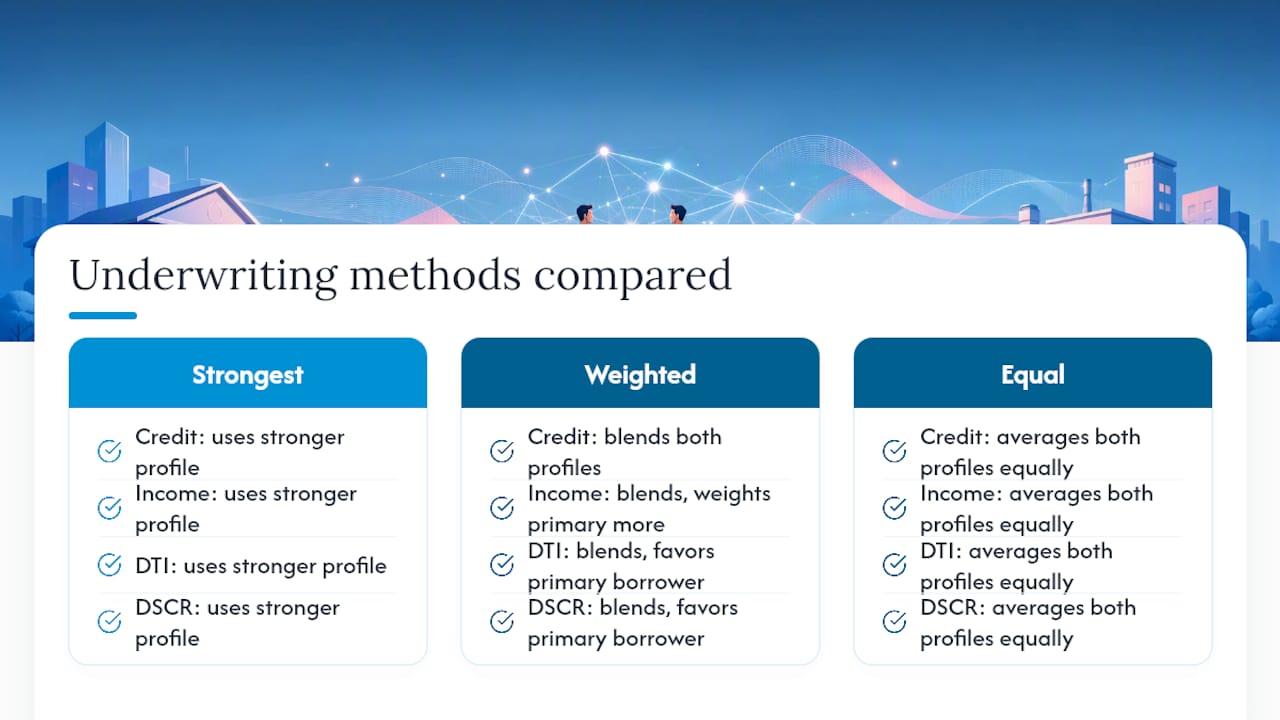
Lenders don’t treat cosigner credit as a simple bonus. They plug it into the same debt-to-income and debt-service coverage ratio calculations used for the primary applicant, then combine the two profiles using one of three underwriting methods, according to NerdWallet’s analysis of co-signer lending.
The strongest-applicant method uses whichever profile clears the bar. If your cosigner has excellent credit and income, this approach gives you the biggest lift. The weighted-average method blends both profiles but usually weights the primary borrower more heavily, since the business owner carries the operational risk. The equal-average method, less common, treats both applicants’ numbers as equally influential.
The practical effect varies by lender and loan type, but a genuinely strong cosigner can sometimes shift an application from a decline to an approval, or unlock a modestly larger loan amount than the business would qualify for alone. Rate improvements are possible too, though nowhere near guaranteed. A cosigner with excellent credit doesn’t erase a business’s thin revenue history or short operating track record. Even after approval, some lenders still require collateral or a personal guarantee from the owner on top of the cosigner’s signature, so don’t assume cosigning replaces every other protection a lender might want.
The upside is straightforward: better approval odds, potentially a lower rate, and sometimes avoiding a collateral requirement altogether. The downside falls almost entirely on the cosigner, and it’s worth being blunt about it.
Pro Tip: Put a written side agreement in place between you and your cosigner before you sign anything with the lender. Spell out who pays what, under what circumstances the cosigner gets released (refinancing once your credit improves, or substituting a different guarantor), and how you’ll communicate if a payment is at risk. A simple payment-monitoring habit, like sharing account access or monthly statements, catches problems before they hit anyone’s credit report.
Start with people who already have a stake in your success rather than strangers or paid services. Trusted family members, business partners, and early investors tend to make far better cosigners than a “professional guarantor,” an arrangement that’s costly, uncommon in small-business lending, and often a red flag to underwriters.
Once you’ve identified someone, walk them through the ask with real documentation, not just a favor request:
Treat this like a formal ask, not a casual one. The person saying yes is putting their own financial future on the line for yours.
These terms get used interchangeably, and that’s exactly where borrowers get tripped up. A cosigner shares liability from the start. A guarantor only pays if you default first. A personal guarantee is a specific legal commitment, usually made by a business owner, promising to repay business debt with personal assets if the company can’t.
For SBA-backed loans, the distinction isn’t optional. The SBA requires personal guarantees from any owner with 20% or more equity, full stop, and there’s no cosigner substitute for that rule. Check current SBA loan requirements before assuming a cosigner will smooth your application.
If you’re weighing your options, a guarantor or offering collateral is often the safer route compared to pulling a family member into a full cosigning arrangement, especially when a smaller, more targeted commitment would satisfy the lender just as well. No personal guarantee options exist too, worth exploring before you ask anyone to sign on.
Speed matters in small-business lending, but so does the relationship you’re about to put on the line. Our honest read: exhaust the alternatives first. Improve your credit for a few months, offer collateral, or shrink the loan request before you ask a family member or partner to cosign. If you do move forward with one, put everything in writing. A handshake agreement doesn’t protect either of you when a payment gets missed.
— Rob
If chasing down a cosigner feels like more risk than it’s worth, there’s a more direct route to funding. A platform connects small and medium-sized businesses to a network of banks and alternative lenders through a single one-page application, with approvals possible within 24 hours and no impact on your credit score just to check what you qualify for.
This makes the most sense if you need capital quickly, would rather not put a family member’s credit on the line, or simply want to see what non-cosigner options are available before committing to anything. Because this platform works across a wide lender network rather than a single bank, it can match your application to a lender whose criteria actually fit your business, without the extra underwriting cycle a cosigner adds. Apply now and you’ll typically hear back on your options the same day, with no obligation to accept an offer you don’t like.
It’s often easier than applying alone if your cosigner has significantly stronger credit or income, but the lender still evaluates both profiles against its own thresholds, so approval isn’t automatic.
Monthly payments depend entirely on the rate and term the lender offers, which varies by credit profile, collateral, and whether a cosigner is involved, so there’s no single fixed figure across lenders.
No. A cosigner must be an individual who personally guarantees repayment; a business entity like an LLC can sometimes serve as a co-borrower, but that’s a legally different arrangement.
Qualifying at that level typically requires solid revenue history, a strong credit score, manageable debt ratios, and often collateral. Platforms like this can match your application to lenders whose criteria fit that loan size without requiring a cosigner.
At Fordham Capital, we've made the application process straightforward and reassuring. Dive in and explore your financial options with confidence, knowing there's no impact on your credit score and no obligations. We review your details and offer customized solutions based on what you're looking for.