

No legitimate U.S. lender offers guaranteed approval for startup business loans — and any lender making that promise is a warning sign worth taking seriously. That said, poor credit does not close every door. Founders with low credit scores have secured real funding through the right channels. Here are the realistic options, ranked by accessibility for bad-credit startups:
The single most practical move: apply through a marketplace like Fordham Capital to see what you actually qualify for right now, then pursue an SBA microloan or CDFI loan simultaneously for lower-cost capital. Speed and cost are a trade-off — you rarely get both at once.
One immediate safety note: if a lender promises guaranteed approval, charges large up-front fees before any decision, or pressures you to sign within hours, walk away. Those are textbook predatory-lender tactics.
The product you pursue matters as much as the lender you approach. Different funding structures carry different underwriting logic, and some are genuinely built for founders who cannot show a strong FICO score.

| Funding Type | Typical Min. Credit Score | Time in Business Required | Speed to Funding | Relative Cost |
|---|---|---|---|---|
| SBA microloan | Varies (often 500–580 or higher) | None required | 2–6 weeks | Low |
| CDFI loan | 500–580 | Flexible | 2–6 weeks | Low–moderate |
| Equipment financing | mid-500s | Flexible | 1–2 weeks | Moderate |
| Invoice factoring | 500+ (customer credit matters more) | None required | 1–5 days | Moderate |
| Revenue-based financing | mid-500s | 3–6 months preferred | 24–72 hours | High |
| Merchant cash advance | 500+ | 3–6 months preferred | 24–72 hours | Very high |
| Business line of credit | 650–680 or higher | 6–12 months typical | 1–2 weeks | Moderate–high |
| Marketplace origination | Varies by matched lender | Flexible | 24 hours to 1 week | Varies |
Match your situation to the right product:
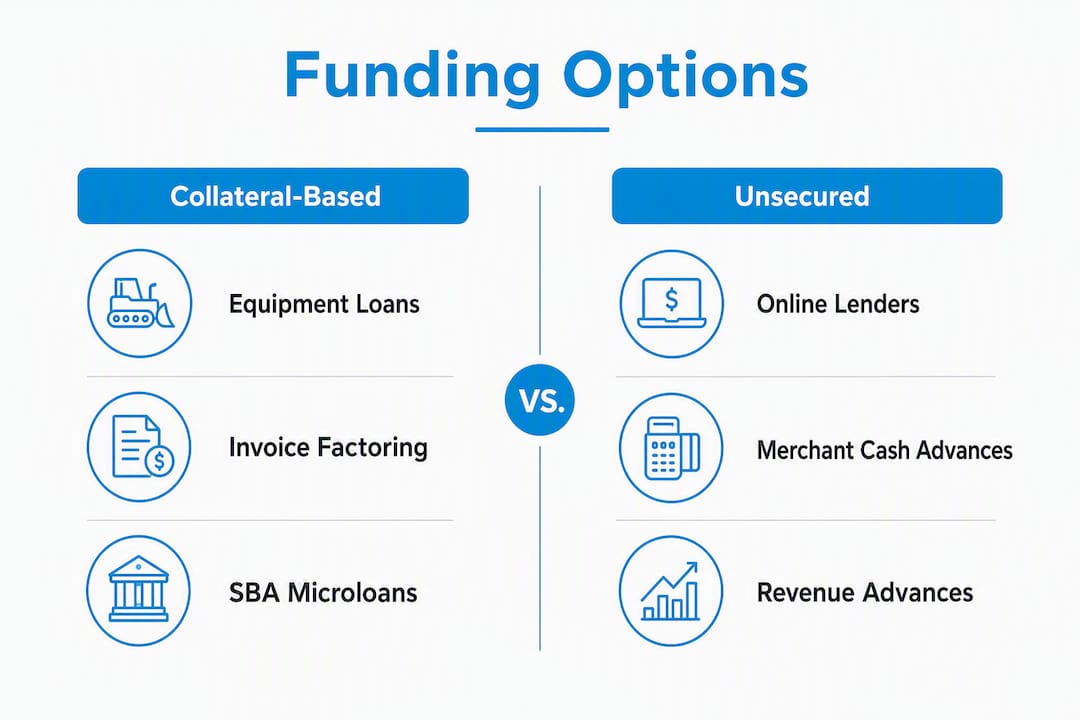
Products that use collateral or receivables — equipment financing and invoice factoring especially — underwrite primarily on asset value or invoice quality, not your FICO score. That structural difference is what makes them accessible when a bank term loan is not.
SBA microloans are issued through nonprofit intermediaries, carry a statutory maximum of $50,000, and average loan sizes are often much smaller. For larger startup capital needs, they may not be enough on their own.
FICO is one input, not the whole file. Underwriters at different lender types weight factors differently, and knowing which factors matter to which lender lets you apply strategically rather than randomly.
| Underwriting Factor | SBA / CDFI | Online Lender / Fintech | Equipment Lender | Invoice Factor |
|---|---|---|---|---|
| Personal credit score | Important (500–580 typical) | Moderate (500–580+ accepted) | Less critical | Minimal |
| Time in business | Flexible (some CDFIs accept startups without revenue) | 3–12 months preferred | Flexible | Not required |
| Monthly revenue | Reviewed; projections accepted | Often required ($5K–$10K/mo) | Less critical | Invoice volume matters |
| Collateral | Business assets, personal guarantee | Rarely required | Equipment itself | Invoices / receivables |
| Business plan quality | High weight | Low weight | Low weight | Not reviewed |
| Cash flow / bank statements | High weight | High weight | Moderate | Low |
| Industry risk | Reviewed | Reviewed | Moderate | Low |
| Owner financials | Reviewed | Reviewed | Moderate | Minimal |
Many online lenders accept scores as low as 500–580, while SBA 7(a) loans typically expect 650–680 or higher and conventional banks generally want 680+. CDFIs sit in the middle, often accepting mid-500s when the business plan and community mission are compelling.
What underwriters look for beyond the score:
Marketplaces like Fordham Capital package your file to highlight non-FICO strengths before routing it to alternative lenders. That pre-packaging step matters: an underwriter who sees a well-organized file with strong projections and a clear use-of-funds statement reads the application differently than a bare credit pull.
For a deeper look at how lenders assess repayment ability, the factors lenders evaluate go well beyond the score on your report.
Applying with a weak credit profile and no preparation is the fastest way to collect rejections. A few targeted moves before you submit can shift the outcome.
Prioritized action list:
Pro Tip: When your credit score is the weak point in your file, lead with your strengths. Put your signed contracts, strong bank deposit history, or equipment collateral at the front of the application packet. Underwriters read files in order; a strong opening shapes how they interpret everything that follows.
Adding a cosigner or guarantor with excellent personal credit is one of the few reliable ways to improve approval odds and potentially secure better rates. The liability distinction between the two is worth discussing with a financial or legal advisor before you commit either party.

For a fuller playbook on maximizing your loan approval odds, the steps above are a starting point, not a ceiling.
Understanding the contractual liability implications of cosigning is also worth reviewing. Contractual liability in lending affects both parties and should be clear before anyone signs.
Speed and cost move in opposite directions in startup lending. The faster the money arrives, the more expensive it tends to be.
Typical timelines by product type:
Cost ranges to expect:
Fast-access products carry the steepest price. Merchant cash advances and revenue-based advances often express cost as a factor rate rather than an APR, which can translate to very high effective annual rates. Equipment financing and invoice factoring sit in a moderate range. SBA microloans carry the lowest rates of any product on this list, which is exactly why the slower process is worth tolerating when you are not in a cash emergency.
The practical strategy: if you need capital urgently, use a fast-access product for an immediate, revenue-generating purpose, then refinance into SBA or CDFI debt once your business has 6–12 months of history. Industry practitioners consistently recommend this staged approach rather than locking into high-cost debt long-term.
For a side-by-side look at fast-approval lender trade-offs, the cost differences between product types are significant enough to affect which option you should pursue first.
Missing one document is enough to stall or kill an application. Assemble this packet before you submit anywhere.
Core documents:
Substitutes for time-in-business history:
Packaging tips:
Pro Tip: For online applications, name your files clearly (“Smith_LLC_BankStatements_Jan-Jun2025.pdf”) and compress them below 10MB each. Disorganized uploads slow review and signal that the applicant may be disorganized in their business operations too.
The bad credit business financing checklist covers additional document scenarios for founders in specific industries or funding situations.
When your credit score is below the threshold most banks want, the practical problem is not just qualification — it is knowing which lenders will actually look at your file. Applying to the wrong lenders wastes time and can generate hard credit pulls that further damage your score.
Fordham Capital operates as a marketplace: one application routes your file to a network of banks and alternative lenders, surfacing the offers you realistically qualify for without impacting your credit score. The application is a single page. Approval decisions typically come within 24 hours. The platform has funded over $120M and carries an A+ BBB rating, which matters when you are handing over sensitive financial documents to a third party.
The practical advantage: Fordham Capital’s model pre-packages your file to highlight non-FICO strengths before lenders see it. For a founder with a 540 credit score and two signed customer contracts, that framing difference can be the gap between a denial and an offer.
The platform connects founders to third-party lenders, so the final loan terms, rates, and fees come from those lenders, not from Fordham Capital directly. Review any offer carefully before accepting, and compare the effective APR across options the platform surfaces. When SBA or CDFI routes are viable for your timeline, they will almost always be cheaper. Fordham Capital’s value is speed and breadth of matching, not necessarily the lowest rate.
For founders who want to understand the unsecured lending approval process before applying, that context helps you evaluate offers more clearly once they arrive.
Startups with bad credit can access real funding by choosing the right product type, preparing a strong application file, and treating fast-access capital as a bridge rather than a permanent solution.
| Point | Details |
|---|---|
| No guaranteed approval exists | Any lender promising guaranteed approval is a red flag; walk away and verify lender legitimacy first. |
| Match product to your situation | Use collateral-based or receivables-based products (equipment financing, invoice factoring) when FICO is weak. |
| Cosigner is your highest-leverage move | A cosigner with strong credit can shift a denial to an approval and improve your rate. |
| Stage your financing | Use fast-access capital for urgent needs, then refinance into SBA or CDFI debt as your business history builds. |
| Fordham Capital for fast matching | One-page application, 24-hour decisions, no credit score impact — practical for surfacing realistic offers quickly. |
Most founders searching for guaranteed-approval startup loans are not naive — they are desperate, and desperation is exactly what predatory lenders exploit. The guarantee framing is designed to feel like relief. It is not.
What actually works is less exciting but more reliable: matching the right product structure to your specific situation, preparing a file that leads with your strengths, and being honest about the trade-off between speed and cost. Founders who succeed with bad credit almost never find a single perfect loan. They find a workable first loan, use it to build history, and refinance into better terms six to twelve months later.
The staged approach is not a consolation prize. It is the strategy. A merchant cash advance that funds your first inventory order, generates revenue, and gives you three months of bank statements is worth more than six months of searching for a bank that does not exist.
Speed matters, but so does not signing a predatory deal in a moment of urgency. Read every term sheet. Confirm the lender’s license through NMLS Consumer Access. If the lender cannot tell you their effective APR in plain language, that is your answer.
Fordham Capital gives founders with poor credit a practical starting point: a one-page application that matches you to banks and alternative lenders without a hard credit pull. The platform covers SBA loans, business lines of credit, working capital financing, and other products — all accessible through a single submission.
To start, you need basic business information, your intended loan amount, and a sense of what you will use the funds for. The matching process typically returns decisions within 24 hours. Because Fordham Capital connects you to third-party lenders, you will review each offer’s terms independently before accepting anything. That transparency is the point: you see real offers from real lenders, not a pre-packaged product with hidden fees.
When SBA or CDFI routes fit your timeline, pursue them alongside your marketplace application. When you need capital within days, the marketplace route is the faster path. Apply through Fordham Capital to see what you qualify for now.
At Fordham Capital, we've made the application process straightforward and reassuring. Dive in and explore your financial options with confidence, knowing there's no impact on your credit score and no obligations. We review your details and offer customized solutions based on what you're looking for.


.jpg)


