
Underwriting is the process a lender uses to decide if your business can repay a loan, and it hinges on one question more than any other: does your cash flow comfortably cover the new debt payment? The single biggest thing to prepare is proof of durable cash flow, usually measured by debt-service coverage ratio, backed by clean, complete documents. Get those two things right and everything else in the file falls into place.
TL;DR:
- Maintaining a debt-service coverage ratio of at least 1.25x, with a practical minimum of 1.15x, is crucial to pass underwriting and secure favorable loan terms.
- Providing complete, organized financial documentation such as tax returns, bank statements, and a debt schedule can significantly reduce approval delays and improve your chances.
- Addressing issues like unexplained deposits, low cash flow, or unresolved liens before applying increases the likelihood of avoiding outright loan declines.
- A strong, well-prepared file enables faster underwriting, which typically takes days, but delays often stem from slow responses or missing information.
- Using a wider network of lenders or applying through a marketplace can streamline the process when your file is clean but your risk appetite varies across institutions.
Underwriting is the analysis a lender runs on your financials, credit, and business operations to decide whether to approve a loan and on what terms. It boils down to risk measurement: how likely is this business to pay back this specific amount on this specific schedule?
Underwriters work with two kinds of information. Hard information is quantifiable: your credit score, tax return figures, bank balances, and bureau data that feeds directly into a scoring model. Soft information is judgment based, things like a loan officer’s read on your industry outlook, your management experience, or how you’ve handled a rough quarter in the past.
How much weight each type gets depends on the lender. The FDIC’s Small Business Lending Survey found that large banks lean heavily on automated underwriting and hard data for small loan amounts, while community banks tend to rely more on loan officer judgment and relationship knowledge. That difference explains why the same business can get a fast algorithmic decline at a big bank and a thoughtful yes at a smaller one.
A few things shift how the process runs:
Every commercial loan assessment eventually maps back to five factors, sometimes called the five Cs of credit: capacity, capital, collateral, conditions, and character. Capacity, meaning your ability to generate enough cash to cover debt payments, matters most. Lenders quantify it with debt-service coverage ratio (DSCR), calculated as net operating cash flow divided by total debt payments. A DSCR of 1.25x is a common benchmark for a clean pass, and many lenders treat 1.15x as the practical floor below which they won’t move forward.
Capital looks at what you and other owners have personally invested; lenders want to see skin in the game, not just borrowed money doing all the work. Collateral covers what secures the loan, though it’s worth knowing that even loans marketed as unsecured often still require a personal guarantee, so “no collateral” rarely means no personal liability. Conditions cover the loan’s purpose, your industry’s health, and the broader economy. Character covers your credit history and management track record, the human trust factor underneath the numbers.
Here’s how the standard document request maps to those five factors:
| Document | What it proves |
|---|---|
| 2-3 years business and personal tax returns | Historical income and capacity |
| 3-6 months business bank statements | Current cash flow and deposit consistency |
| Personal financial statement (PFS) | Capital and personal liquidity |
| Debt schedule | Existing obligations affecting capacity |
| Interim financials (P&L, balance sheet) | Recent trend and conditions |
Missing even one of these routinely stalls a business credit evaluation before it starts.
Every lender’s loan underwriting process follows roughly the same sequence, though the pace varies by lender and loan type.
The analytical work itself often takes only a few days. What stretches timelines to one to four weeks is the back-and-forth of document requests and committee scheduling. You can shorten that window mainly by responding to requests within hours, not days, and by front-loading a complete file.
Most declines trace back to a handful of repeat offenders, and nearly all of them are fixable if you catch them early.
Pro Tip: Before you submit anything, pull your own bank statements and highlight every deposit over $5,000 with a one-line explanation. Underwriters spend a disproportionate amount of time chasing unexplained deposits, and answering the question before it’s asked can shave days off review.
You don’t need a finance degree to test your own readiness before you apply. Run this checklist in order.
Most owners with organized books can assemble this in three to five business days. If a lender comes back asking for more, respond the same day with exactly what’s requested, nothing extra, nothing withheld: “Attached is the updated debt schedule and the bank statement with deposits annotated as requested.” That kind of clean, responsive turnaround is what keeps a file moving instead of stalling in queue.
Pro Tip: Calculate your DSCR before a lender does.
A reputable business funding marketplace holds a high BBB rating and has funded substantial capital for small and medium-sized businesses, largely by routing one application across a wide network of banks and alternative lenders instead of forcing owners through separate underwriting cycles at each institution.
A marketplace model helps most in specific situations:
Direct-bank applications can still be equally strong, or better, when you have an established banking relationship and a straightforward, well-documented request. For readers weighing SBA loan requirements specifically, that program-specific path is worth understanding before you choose a lane.
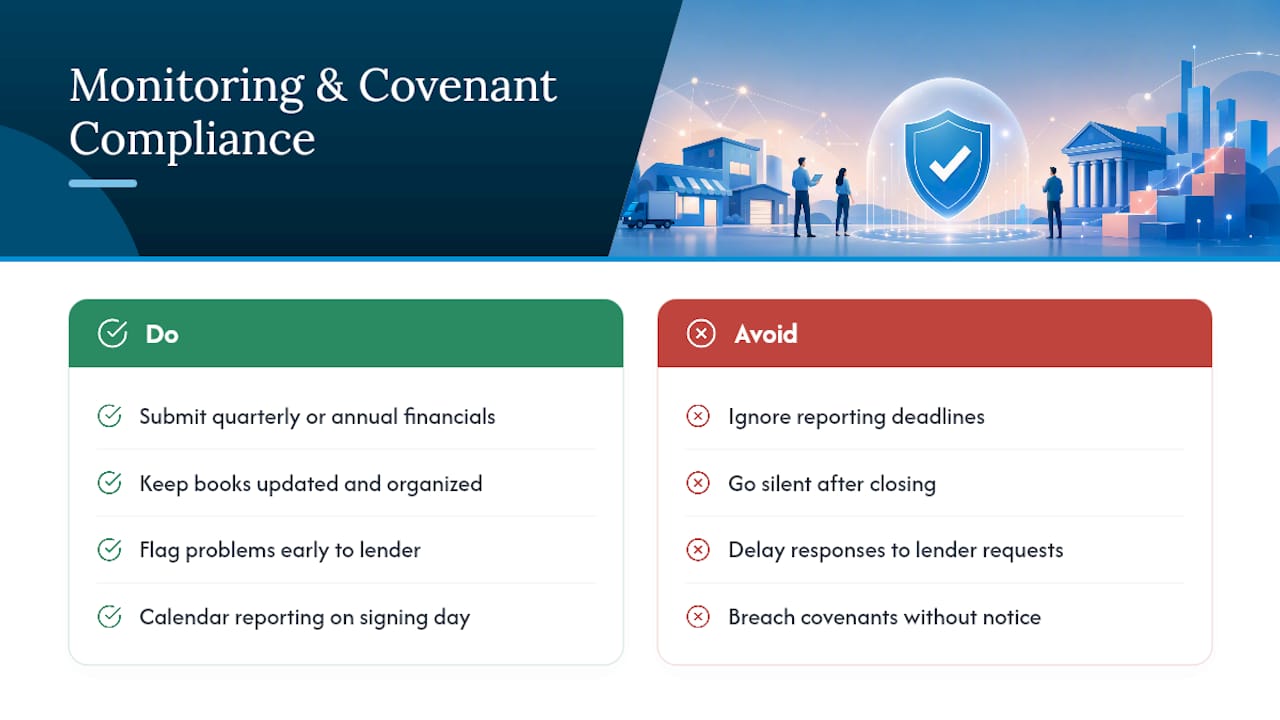
Getting approved isn’t the finish line. Most business loans, especially larger ones or those with covenants attached, come with ongoing monitoring requirements that continue for the life of the loan.
Lenders typically require periodic financial reporting, often quarterly or annual updates to your P&L, balance sheet, and sometimes updated debt schedules. This lets the lender re-verify that your DSCR and overall financial health haven’t slipped below the thresholds that got you approved in the first place.
Covenants are specific conditions written into the loan agreement, things like maintaining a minimum DSCR, capping additional debt without lender approval, or keeping working capital above a set level. Breach one, and you’re in technical default even if you’ve never missed a payment. Lenders usually notice through the reporting you submit or through periodic account reviews, and most will work with you on a waiver or amendment if you flag a problem early rather than let them discover it.
The practical lesson: treat the reporting requirement as seriously as the original application. A business that stays organized after closing, updated books, prompt responses to lender requests, proactive communication about a rough quarter, rarely runs into covenant trouble. One that goes quiet often ends up renegotiating from a weaker position. If your loan carries covenants, calendar the reporting deadlines the same day you sign, not the week they’re due.
Underwriters don’t evaluate your business in a vacuum. They weigh your industry against current default trends, and they adjust for macroeconomic conditions that affect every borrower, not just you.
Certain industries carry structurally higher risk ratings: restaurants, construction, and retail have historically higher failure rates than professional services or healthcare, and underwriters price that risk into terms even when your individual numbers look strong. If you operate in a higher-risk category, expect closer scrutiny of your specific DSCR and possibly a request for a larger cash reserve or a personal guarantee you might not need in a lower-risk sector.
Economic conditions move the goalposts too. When interest rates rise, your existing debt payments get more expensive relative to income, which can quietly push your DSCR below a lender’s floor even if revenue hasn’t changed. During broader economic slowdowns, lenders often tighten underwriting guidelines for loans across the board, raising minimum DSCR requirements or shortening the loan terms they’re willing to offer. This is one reason business financing approval that felt straightforward two years ago can feel harder today even for a business with stable numbers.
None of this is arbitrary. Lenders that survive downturns are the ones that priced industry and macro risk correctly during the underwriting stage, which is exactly why a file with strong compensating factors, healthy cash reserves, diversified revenue, low existing leverage, tends to get more favorable terms regardless of which way the broader economy is heading.
The conventional advice on business loan underwriting spends too much time on credit scores and not enough on cash-flow documentation. Underwriters are trained to trust numbers they can verify quickly, and an owner who does that verification work in advance, reconciled deposits, a clear debt schedule, a one-page explanation of anything unusual, removes almost all the friction that turns a two-week review into a six-week one.
Where most owners underinvest is in understanding their own DSCR before a lender calculates it for them. That single number predicts more decline outcomes than any other input, yet most applicants find out where they stand only after submitting. Calculate it yourself first. If it’s thin, fix the ask size or the term length before you apply rather than after a decline shows up on your record. That single habit, done consistently, outperforms almost any other underwriting preparation an entrepreneur can make.
— Rob
Fordham Capital exists for the exact friction this guide just walked through: chasing documents across multiple banks, waiting weeks for a single committee decision, and risking a credit hit before you even know your odds. Applying through Fordham Capital starts with one page, not a folder of separate applications, and that single submission reaches a wide network of banks and alternative lenders at once, with no credit score impact and no collateral required to get started.
Whatever your situation calls for, Fordham Capital connects you to it: an SBA Loan at 8% per year for owners who qualify for the program’s longer terms, a Line of Credit priced at 1 to 3% per month for flexible, revolving access to cash, or Working Capital financing for businesses that need funds fast without a rigid structure. Expect the same document request outlined earlier, tax returns, bank statements, a debt schedule, and personal financial statement, but packaged once and routed to the lenders most likely to say yes. Approvals often come back within 24 hours. If you’ve assembled your file using the checklist above, the fastest next step is to start your application and see which lenders in the network respond first.
Not automatically. Underwriting produces a risk assessment and recommendation, but final approval often still requires committee sign-off or a formal offer letter, especially for larger loans or SBA-backed products subject to program-specific rules.
Decline rates vary widely by lender type and loan size, but the most common cause is insufficient cash flow relative to debt payments. Keeping your DSCR above the 1.25x benchmark substantially improves your odds of a clean pass.
Payment depends entirely on the interest rate, term length, and whether the loan is amortizing or interest-only, so there’s no single universal figure. A lender calculates this during underwriting by testing whether your projected cash flow can cover that specific payment at the required DSCR threshold before approving the amount.
Underwriter compensation varies by lender, region, and experience level, and current figures aren’t publicly standardized in a way this guide can cite reliably. It’s a specialized role within lending institutions, distinct from the loan officers who work directly with applicants.
Start with three years of tax returns, six months of bank statements, and a debt schedule listing every existing obligation. These three documents let a lender assess your basic capacity before requesting anything more detailed.
At Fordham Capital, we've made the application process straightforward and reassuring. Dive in and explore your financial options with confidence, knowing there's no impact on your credit score and no obligations. We review your details and offer customized solutions based on what you're looking for.