
Qualifying for business financing with bad credit is harder, but it’s far from impossible. The bad credit business financing checklist below gives you the exact preparation steps lenders actually care about, so you walk into any application with your best shot at approval.
Here’s what you need to have ready:
The sections below break each item down in full.
Lenders who work with bad credit borrowers still have floors, and knowing them before you apply saves you from wasted hard inquiries.
Pro Tip: Before applying anywhere, check whether the lender uses a hard or soft credit pull for prequalification. A soft pull lets you shop without dinging your score.
Thorough documentation is one of the few things fully within your control. Lenders use it to assess repayment ability when your credit score doesn’t tell the whole story.
The America’s SBDC network offers free guidance on organizing these documents if you’re unsure where to start.
Not every product is built for your situation. These are the ones worth your time.
For a deeper look at how these options stack up for low-score borrowers, the funding options for low credit breakdown covers eight real paths worth reviewing.
Your score is one input, not the whole picture. Business revenue and operating history carry real weight in the decision, and a strong showing on these factors can offset a weak score.
Understanding the full picture of what lenders look for helps you frame your application around your strongest points.
A few mistakes show up repeatedly among bad credit borrowers. Knowing them in advance costs nothing.
Pro Tip: When evaluating a lender, check their BBB rating and look for reviews that mention transparency around fees. A lender who explains costs clearly upfront is one you can work with.
For guidance on identifying trustworthy lenders, secured loan specialists can also help you understand what responsible lending looks like before you commit.


Fordhamcapital was built for exactly the businesses traditional banks pass over. The numbers back that up: Fordhamcapital carries an A+ BBB rating and has funded over $120 million, with clients generating more than $500 million in revenue as a result.
What sets Fordhamcapital apart in practice:
For businesses that have been turned away elsewhere, Fordhamcapital’s track record and structure make it a practical first call, not a last resort.
Two moves can push many borrowers past the 551 threshold that separates high-cost products from more affordable options, and neither requires months of waiting.
Dispute credit report errors first. Pull your reports from all three bureaus at AnnualCreditReport.com and look for accounts you don’t recognize, incorrect balances, or payments marked late that weren’t. Disputing errors is free, and correcting them can raise your score within 30–60 days.
Reduce credit utilization. If your business or personal credit cards are above 30% utilization, paying them down has an immediate scoring effect. Utilization is recalculated every billing cycle, so a payment made today shows up on next month’s report.
Beyond those two, pay every current obligation on time for 60–90 days before applying. Payment history is the largest single factor in your score. Even a short streak of on-time payments signals to lenders that the past issues are behind you. For a practical guide on protecting your score while actively borrowing, that resource covers the mechanics in detail.
Bad credit financing costs more. That’s the honest starting point. But understanding the structure helps you compare products accurately and avoid paying more than you have to.
APR vs. factor rate: Traditional loans quote an annual percentage rate (APR). Merchant cash advances use a factor rate, typically 1.1–1.5, which means you repay $1.10–$1.50 for every dollar borrowed. Factor rates look small but translate to very high effective APRs when the repayment period is short.
What to expect by credit tier: Borrowers below 551 typically face APRs of 40–150% on short-term products. Above that threshold, SBA-backed and bank products come in significantly lower, often in the 10–30% range depending on loan type and term.
Common fees to watch: Origination fees (typically 1–5% of the loan amount), prepayment penalties, and draw fees on lines of credit all affect your true cost. Ask for the total cost of capital, not just the rate, before signing anything.
Factor in repayment structure: Daily ACH repayments, common with MCAs, can strain cash flow even when the total cost seems manageable. Weekly or monthly repayment schedules are easier to plan around. Crossing the 551 score threshold often means moving from daily ACH products to more flexible repayment structures, which is a meaningful operational difference.
Timeline varies significantly by product and lender type. Here’s a realistic breakdown.
Alternative online lenders move fastest. Prequalification takes minutes; approval can come within 24 hours; funding often hits your account within 1–3 business days of signing. This speed comes with higher rates.
SBA loans sit at the other end. The SBA loan process involves more documentation, lender underwriting, and in some cases SBA review. Expect 2–8 weeks from application to funding for a 7(a) loan. Microloans through nonprofit intermediaries can move faster, sometimes 2–4 weeks.
Invoice factoring can fund within 24–48 hours once the factoring company verifies your invoices and your clients’ creditworthiness. It’s one of the fastest options for businesses with outstanding receivables.
Equipment financing typically takes 1–5 business days, since the collateral is clearly defined and the underwriting is more straightforward.
To speed up your approval, the single most effective step is submitting a complete application with all required documents on the first pass. Incomplete submissions are the primary cause of delays across every lender type.
Bad credit doesn’t have to mean a slow, painful funding process. Fordhamcapital gives small business owners a direct path to capital without the traditional bank runaround.
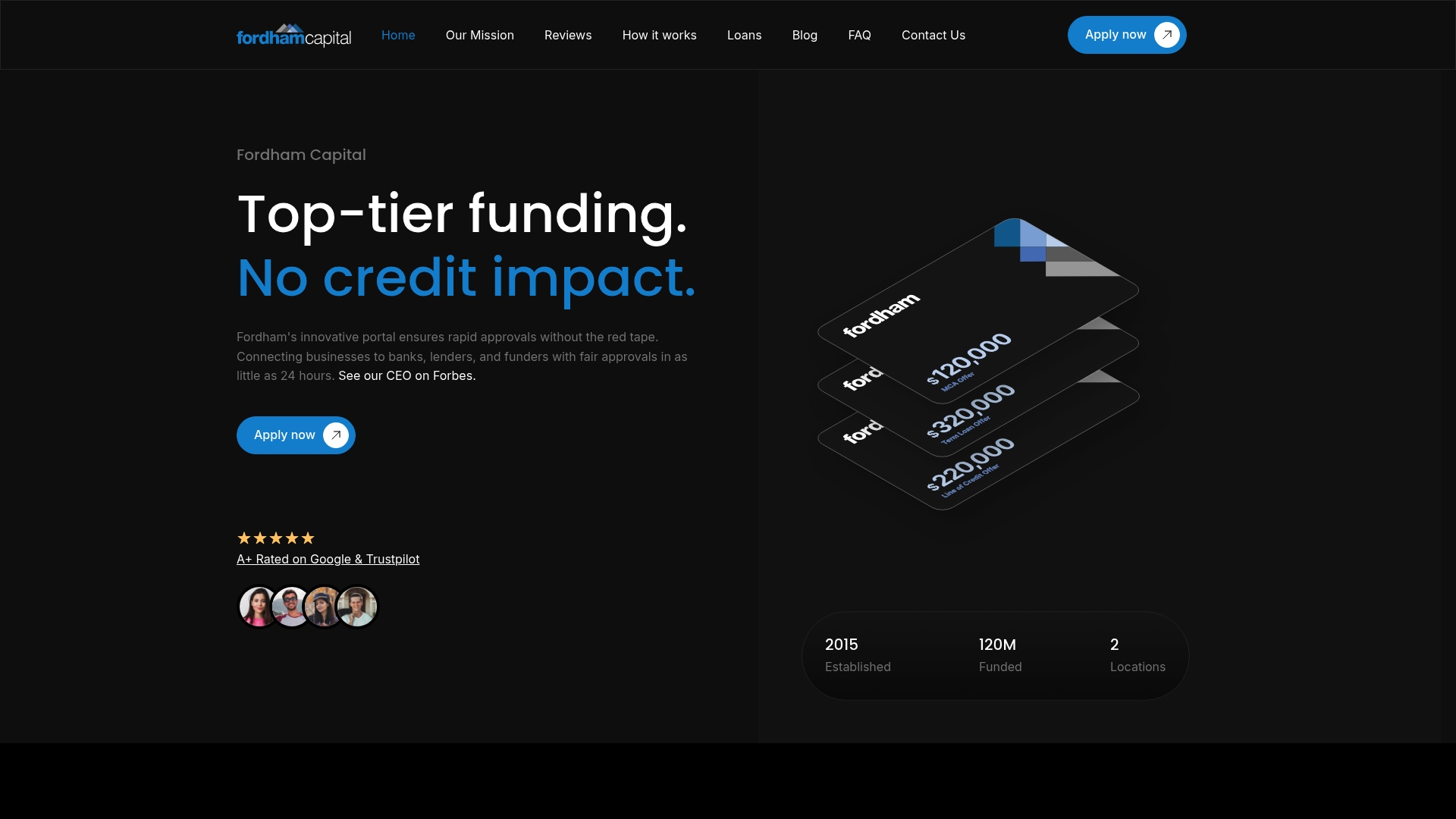
The one-page application takes minutes, approvals come back within 24 hours, and the process is structured to avoid any impact on your credit score during prequalification. Fordhamcapital’s network spans banks and lenders across the country, which means your application gets matched to the institution most likely to fund your specific profile, not just the first one available. With over $120 million funded and an A+ BBB rating, the track record is there.
If you’ve been turned down before or you’re not sure where to start, apply now and get a decision within one business day.
Bad credit business financing is accessible when you prepare the right documents, target the right loan type, and understand what lenders actually weigh beyond your score.
| Point | Details |
|---|---|
| Credit score threshold matters | Scores above 551 unlock SBA-backed and bank products with significantly lower rates than high-cost alternatives. For borrowers below 551, choices are typically high-cost products with APRs in the 40–150% range. |
| Documentation drives decisions | Lenders use complete financial statements, tax returns, and a clear business plan to assess repayment ability when credit is weak. |
| Loan type must match your situation | Invoice factoring, equipment financing, and SBA microloans each serve different needs and have different credit requirements. |
| Dispute errors and cut utilization | Correcting credit report errors and reducing utilization can raise your score within 30–60 days, improving your options. |
| Fordhamcapital for fast funding | Fordhamcapital offers 24-hour approvals, a one-page application, and has funded over $120M with an A+ BBB rating. |
At Fordham Capital, we've made the application process straightforward and reassuring. Dive in and explore your financial options with confidence, knowing there's no impact on your credit score and no obligations. We review your details and offer customized solutions based on what you're looking for.