
Pre-revenue startup financing is defined as capital secured before a business generates consistent income, and it is fully achievable when founders meet specific lender criteria. To successfully apply for a business loan as a pre-revenue startup, you need strong personal credit, a detailed business plan, and the right loan type for your stage. Lenders cannot evaluate cash flow history, so they shift their focus to your personal financial profile, your plan’s credibility, and any early proof of demand. This guide covers what lenders look for, which loan products fit pre-revenue companies, and how to prepare an application that stands up to scrutiny.
Personal credit is the single most important factor lenders evaluate for pre-revenue startups. Because no business revenue history exists, lenders use your personal credit score as a proxy for financial responsibility. Scores above 620 are typically the minimum threshold, though stronger scores unlock better rates and higher amounts. Your personal credit also determines whether a lender will even review the rest of your application.
A detailed business plan is the second pillar of a strong application. Lenders want to see realistic financial projections, a clear use-of-funds breakdown, and a credible path to revenue. Contracts, letters of intent, and pre-orders serve as early traction evidence that can meaningfully improve lender confidence. A business plan without financial projections reads as speculation; one with signed contracts reads as a business.

Collateral and personal guarantees round out the lender’s risk assessment. Most early-stage loans require a personal guarantee, which means your personal assets are exposed even if the loan is issued to your business entity. Lenders also look for any pledgeable assets, such as equipment, inventory, or real estate. Understanding approval factors for lenders before you apply saves you from surprises during underwriting.
Key documentation lenders typically require includes:
Pro Tip: Pull your own credit reports before applying. Checking your own credit does not affect your score, and fixing errors before a lender sees them can raise your score by 20 to 50 points.
Pre-revenue founders have more loan options than most realize, but each product fits a different situation. Matching the loan type to your actual need prevents overborrowing and keeps repayment manageable.
The SBA Microloan program is the most accessible government-backed option for startups with no revenue. It offers up to $50,000 with an average disbursement of around $16,131 as of FY2025. Interest rates run 8–13%, with repayment terms up to seven years. Loans are processed through nonprofit CDFI intermediaries, which often provide business counseling alongside the capital. A credit score of 620 or above is typically required.
Equipment financing uses the purchased equipment itself as collateral, which lowers the lender’s risk and makes approval more accessible. Funding amounts range from $5,000 to $5M+, and approval can happen in as little as one to seven days. A credit score around 600 is often sufficient. This option works well for startups that need specific machinery, vehicles, or technology to begin operations.
Business credit cards offer a fast, flexible source of short-term capital. Credit limits can reach $10,000 to $100,000+ with introductory 0% APR periods of 12–15 months. Approval typically requires good to excellent personal credit (670 or above) and can come through in one to seven days. The 0% window gives founders a genuine interest-free runway if they pay the balance before the promotional period ends.
Community Development Financial Institutions (CDFIs) specialize in funding businesses that traditional banks overlook. They weigh community impact and business potential alongside credit scores, making them a realistic option for founders with limited credit history. Many CDFIs also offer technical assistance, which is valuable for first-time borrowers. Early-stage capital examples from CDFI programs show how founders have used these funds to cover initial operating costs before revenue begins.
Pre-revenue loan types vary significantly in cost, speed, and eligibility. The table below summarizes the key differences:
| Loan type | Credit score needed | Max amount | Approval speed | Best for |
|---|---|---|---|---|
| SBA Microloan | 620+ | $50,000 | 2–8 weeks | General startup costs |
| Equipment financing | 600+ | $5M+ | 1–7 days | Equipment purchases |
| Business credit card | 670+ | $100,000+ | 1–7 days | Short-term expenses |
| CDFI loan | Flexible | Varies | 1–4 weeks | Underserved founders |
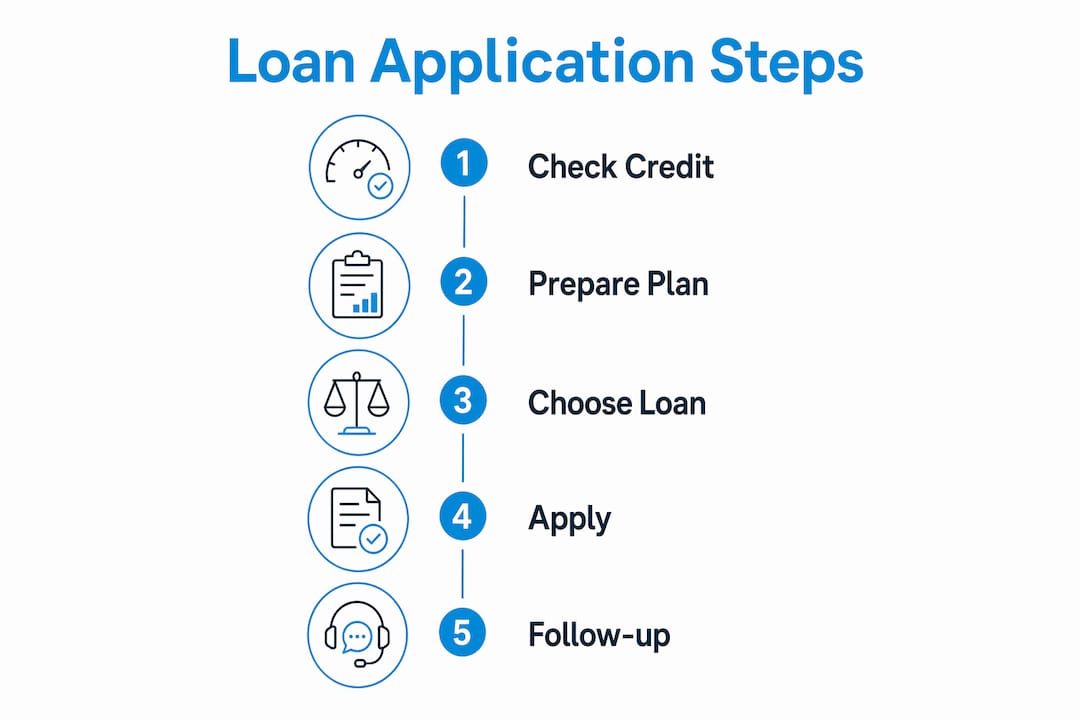
A strong application does not happen the day you decide to apply. Preparation starts weeks or months before you submit anything to a lender.
Check and repair your personal credit. Pull reports from Equifax, Experian, and TransUnion. Dispute any errors. Pay down revolving balances to below 30% utilization. Every point above 620 improves your options.
Build your business plan. Write a plan that includes an executive summary, market analysis, product or service description, and 12-to-24-month financial projections. The role of a business plan in loan approval is significant. Lenders treat a vague plan as a red flag.
Gather your documents. Collect your EIN, business registration, personal tax returns, and any contracts or letters of intent. Organize them before you start applying so you can respond to lender requests quickly.
Write a clear loan use and repayment plan. State exactly how you will use the funds and how you plan to repay them. Lenders want to see that you have thought through the repayment mechanics, not just the spending.
Prequalify before you formally apply. Many lenders offer soft-pull prequalification that does not affect your credit score. Use this step to gauge your approval odds before triggering a hard inquiry.
Apply selectively. Applying to multiple lenders at once creates application fatigue and generates multiple hard inquiries that lower your score. Start with one or two lenders whose criteria match your profile.
Respond to lender requests fast. Delays in providing documents stall underwriting and signal disorganization. Treat every lender request as urgent.
Handle rejection constructively. Ask the lender for the specific reason for denial. Use that feedback to fix the gap, whether it is a credit score issue, a documentation gap, or a mismatch in loan type.
Pro Tip: Prequalification is free and score-safe. Use it at two or three lenders before committing to a formal application. It tells you where you stand without costing you credit points.
The most costly mistake founders make is focusing only on interest rates while ignoring total loan cost. Origination fees, prepayment penalties, and the cost of a personal guarantee all affect the true price of borrowing. Understanding all-in costs before signing is non-negotiable.
Other common errors include:
“Most unsecured or alternative financing requires a personal guarantee, increasing the founder’s personal financial risk. Understanding all-in costs, including fees and guarantees, is vital before borrowing.” Founders who sign personal guarantees without reading the terms often discover the full exposure only after a default.
Pre-revenue startups can secure business loans by combining strong personal credit, a credible business plan, and the right loan product for their current stage.
| Point | Details |
|---|---|
| Personal credit drives approval | Scores above 620 are the baseline; higher scores unlock better rates and more options. |
| Business plan quality matters | Include financial projections and early traction evidence like contracts or pre-orders. |
| Match loan type to your stage | SBA Microloans and equipment financing fit pre-revenue needs better than revenue-linked products. |
| Apply selectively | Multiple simultaneous applications damage your credit score and lower approval odds. |
| Personal guarantees carry real risk | Your personal assets are exposed on most early-stage loans, so read every term carefully. |
The founders who get funded are rarely the ones with the most polished pitch decks. They are the ones who treated the loan application like a business problem: they gathered evidence, managed their credit deliberately, and chose lenders whose criteria they actually met.
The biggest shift I have seen in 2026 is that lenders are more willing to consider non-revenue signals than they were five years ago. Signed letters of intent, certifications, and even social proof of demand carry real weight now. That is a meaningful opening for pre-revenue founders who are willing to do the work of documenting their traction.
My honest advice: start with the smallest loan that solves your immediate problem. A $15,000 SBA Microloan that you repay on time does more for your borrowing future than a $75,000 loan you struggle to service. Sequencing your funding stages from low-risk, non-dilutive sources toward larger debt as your business matures is the approach that protects both your personal credit and your equity.
Founders also consistently underestimate how much a personal guarantee changes the risk calculus. Borrowing through a business entity does not protect your personal assets when a guarantee is attached. Know what you are signing before you sign it.
— Rob
Fordhamcapital was built for founders that traditional banks overlook. The application takes one page, approvals come within 24 hours, and the process does not trigger a hard credit inquiry upfront. Fordhamcapital has funded over $120M and holds an A+ BBB rating, which reflects a track record of transparent, founder-focused lending.
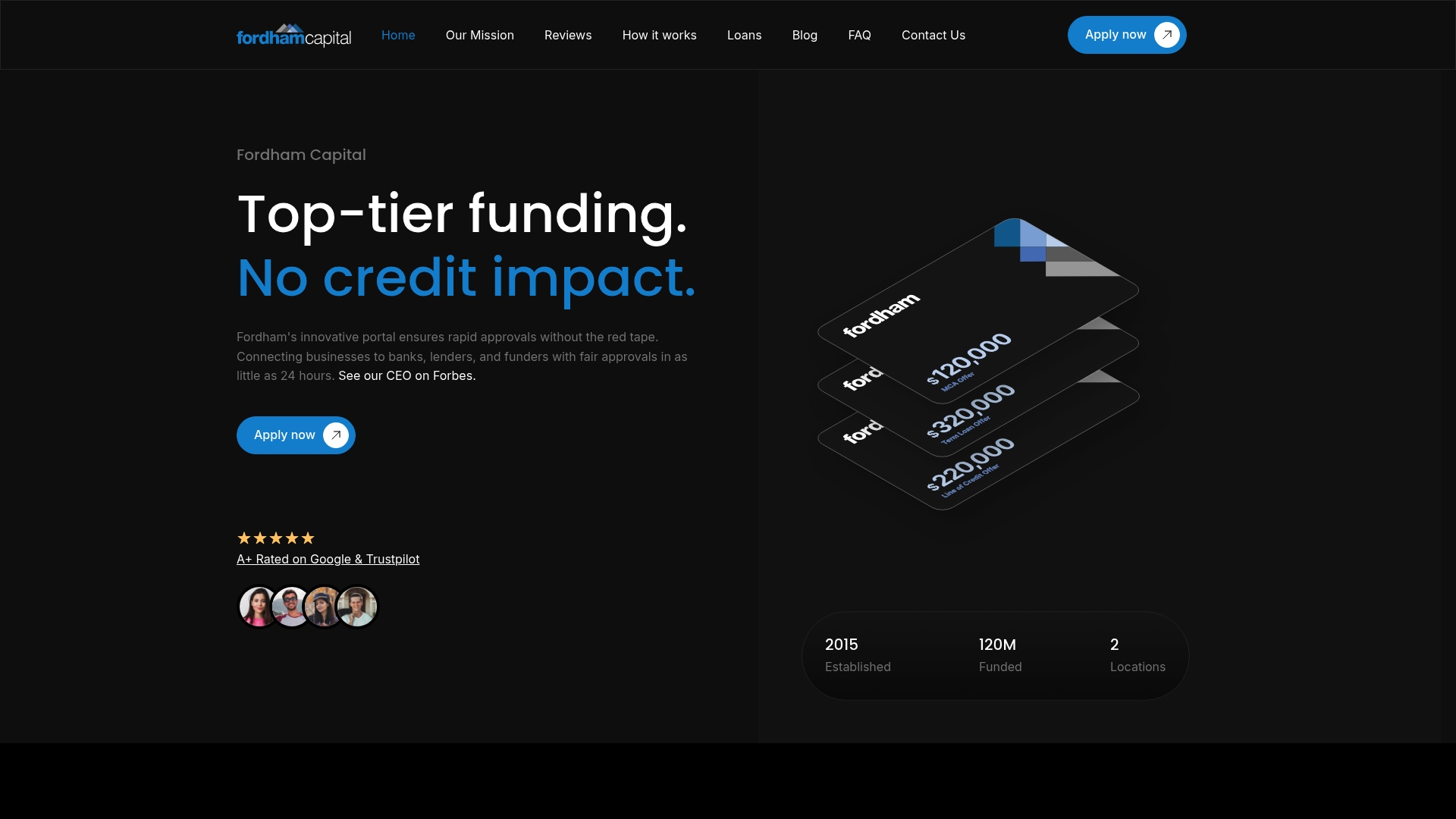
For pre-revenue startups, Fordhamcapital’s network of banks and lenders means your application reaches the right audience, not just the nearest branch. The team matches your profile to lenders whose criteria you can realistically meet, which protects your credit and saves time. If you are ready to move forward, apply now and get a funding decision without the delays that come with conventional bank applications.
Yes. Lenders like SBA Microloan intermediaries and CDFIs evaluate personal credit, business plans, and early traction evidence rather than revenue history alone.
Most startup loan programs require a personal credit score of 620 or above, though business credit cards typically require 670 or higher for approval.
You need a business plan with financial projections, personal tax returns, business registration documents, a credit report, and any contracts or letters of intent that show early demand.
SBA Microloans and equipment financing are the best fits for pre-revenue startups. Both are accessible with limited credit history and do not require existing revenue to qualify.
A formal application triggers a hard inquiry that can lower your score by a few points. Using soft-pull prequalification first lets you assess your odds without affecting your credit.
At Fordham Capital, we've made the application process straightforward and reassuring. Dive in and explore your financial options with confidence, knowing there's no impact on your credit score and no obligations. We review your details and offer customized solutions based on what you're looking for.