The time it takes to fund a business depends on the product. Fast working capital and lines of credit can move in days. SBA loans usually take 30 to 90 days from application to funding. Equity rounds can take months, and the gap between rounds is often years. Below is a realistic picture of each path, the stages inside it, and what you control.
Here is how the main routes compare. These are ranges from the sources cited in this article, not guarantees. Your lender, loan size and file quality change the result.
| Funding route | Typical application-to-cash window | What mostly drives the timing |
|---|---|---|
| Online working capital or line of credit | About 1 to 5 business days at many lenders | Bank statements, identity checks, how fast you reply |
| SBA Express | About one month | Lender underwriting, closing paperwork |
| SBA 7(a) standard | 60 to 90 days | Full underwriting, collateral review, possible SBA review |
| SBA 504 | 60 to 90 days or longer | Real estate or equipment documentation, multiple parties |
| SBA microloan | 7 to 30 days | Intermediary lender process, smaller amounts |
| Equity (angel, seed, Series A and beyond) | Months, often with a long wait between rounds | Traction, investor demand, diligence, negotiation |
The SBA figures come from NerdWallet’s SBA timeline breakdown, published in 2022, so treat them as estimates. The fast online range comes from a Yahoo Finance explainer on fast business loans.
A headline like “approved in 24 hours” describes one stage, not the whole trip. Every business loan passes through the same stages. Only their length changes.
The SBA’s own page lists processing turnaround of 5 to 10 business days for Standard 7(a) loans and 2 to 10 business days for 7(a) Small loans. That is the SBA’s window only. It does not include the lender’s underwriting, closing and disbursement, which is why the full journey is longer.
We go deeper on the SBA side in our guide to SBA loan turnaround time and on the general range in small business loan timelines.

Online lenders and marketplaces exist because many small businesses need money faster than a bank branch can move. The Federal Reserve’s Small Business Credit Survey notes that firms seeking funds quickly often turn to nonbank lenders, and that banks and nonbanks use different underwriting models.
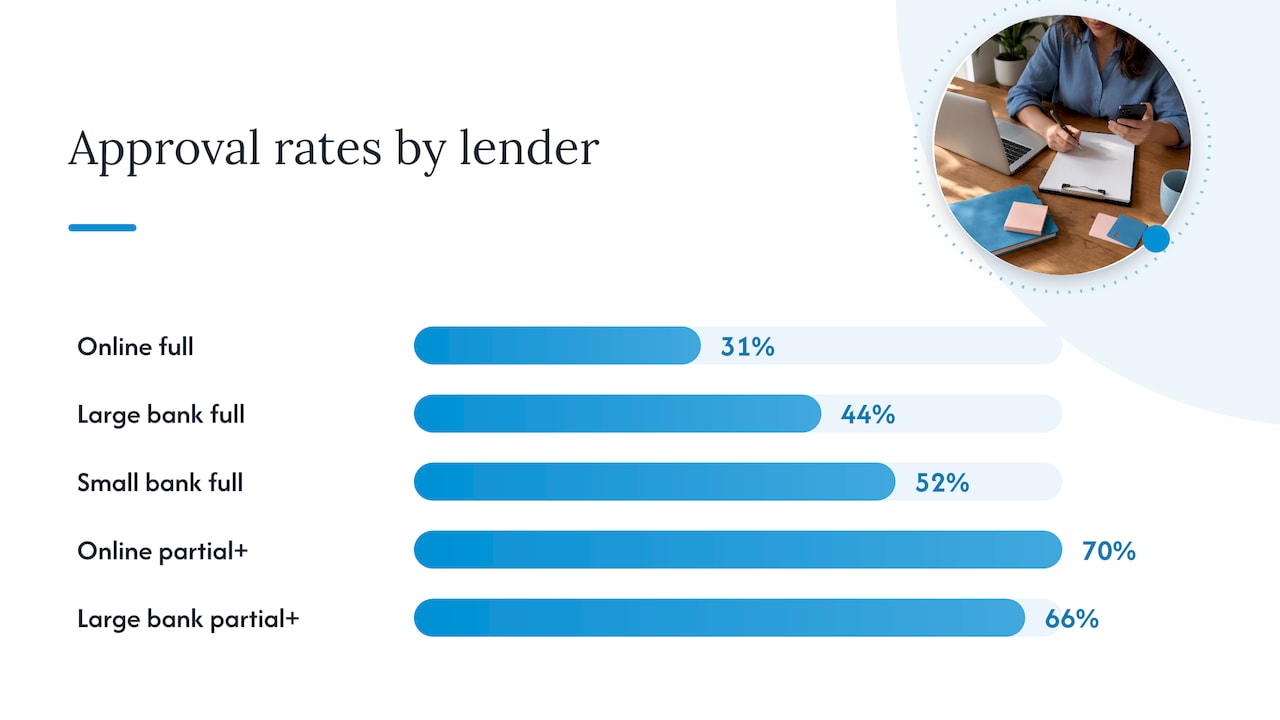
It also shows the tradeoff. In 2023, online lenders fully approved 31% of applicants, against 44% at large banks and 52% at small banks. Speed does not equal certainty of getting everything you asked for. The same survey data show that at-least-partial approval ran 70% at online lenders and 66% at large banks.
Smaller requests tend to move faster. The survey found that half of applicants sought $100,000 or less and 30% sought $50,000 or less. These are the amounts that digital processes handle well, because there is less to appraise and fewer parties to coordinate.
If you can wait, SBA-backed loans are worth a serious look. They carry negotiated rates within SBA maximums and long maturities. The wait is the price.
Some specifics worth knowing:
The practical rule: start SBA applications at least two to three months before you need the money. If you need cash this week, an SBA loan is the wrong tool for that moment, though it may be the right one for the next stage.
Some readers searching for a funding timeline mean venture money. That timeline is measured in quarters and years. Carta reports that companies raising Series B in Q2 2024 waited a median of 856 days after Series A, nearly two and a half years.
JPMorgan describes the stages as pre-seed or angel, seed, and Series A and beyond. Early money supports a concept or MVP, seed investors expect proof of concept and traction, and later rounds require stronger product-market fit and revenue. Its 2026 fundraising guidance suggests many founders target enough capital for 18 to 24 months of operations and size the raise to a measurable milestone.
The lesson for owners of ordinary small businesses is simple. Equity is for building a company that investors want to own part of. It is not a way to cover a delayed receivable or buy inventory next month.
Most delays come from the file, not the lender. Based on what lenders review, these steps help:
For more detail, see our guides on how to speed up approval, common delays in approvals and what lenders look for.
Credit and collateral do not just affect whether you are approved. They change which products are realistic and how long they take.
Federal Reserve 2023 data show that firms with medium or high credit risk had lower bank application and approval rates than low-risk firms. That is one reason businesses with bruised credit look at nonbank lenders and marketplaces.
“No collateral” also needs care. It is product-specific. SBA Express lenders do not have to take collateral up to $50,000, but larger requests can fall under the lender’s collateral policy, and repayment capacity is always part of the decision. Read how unsecured lending approval works before you assume anything.
A short timeline can make the price easy to overlook. In CFPB-published testimony, researchers reported that small-business owners shown identical information about online products estimated effective rates from 5% to over 50%. Speed is not worth much if you cannot tell what you are paying.
Before accepting any offer, ask for:
This matters most for merchant cash advances and other revenue-based products, whose pricing rarely looks like a normal annual interest rate. Put two or three offers side by side in dollars and by repayment schedule. If a lender will not give you those numbers in writing, treat that as your answer. If the repayment terms are unclear or you are worried about taking on payments you cannot make, talk to a CPA or a nonprofit small business advisor before signing.
We see the same pattern again and again. Owners ask how fast they can get money, when the better question is how fast they can get the right money. A 24-hour approval means little if the cost is wrong for the job, or if closing takes another week.
We built Fordham Capital around the part of the process that frustrates owners most: the front end. One page replaces a stack of forms, and applying does not affect your credit score. Because we connect you with a network of banks and alternative lenders rather than a single lender, one application can surface more than one path. Approvals can come within 24 hours, and we are an intermediary, so the lender, not us, sets the final terms and the funding date.
Our advice is plain. Know the date your cash gap opens, work backward, and choose the product whose realistic timeline fits that date with room to spare. Then read the offer like a contract, because it is one. Fast should never mean blind.
— Rob
If your need is near-term, we can match you with options across SBA loans, lines of credit and working capital. On our site, the SBA Loan is listed at 8% per year and the Line of Credit at 1-3% per month. Working Capital has no published price. Actual terms depend on the lender and your business, so compare every offer in dollars before accepting.
If you want to see the process first, read how business funding applications work or our guide to comparing lenders for fast approval.
Say your restaurant needs $40,000 for a kitchen repair and a seasonal inventory build, and the cash is needed in three weeks.
Now change the facts. If the same $40,000 is for an expansion eight months away, the SBA route becomes a real option because time lets you pay less for the money. Same business, same amount, different best answer. The calendar decides.
It depends on the product. Some online lenders fund in a day or two, SBA Express runs about a month, and standard SBA 7(a) loans commonly take 60 to 90 days. Complete documents and fast replies shorten any of these.
Not necessarily. Approval is one stage. Closing paperwork, verification and disbursement follow, and the lender controls the final funding date. Ask the lender for a written timeline.
Often, but with tradeoffs. Federal Reserve data show higher-risk firms are approved less often at banks, so many turn to nonbank lenders. Expect to trade off loan size, speed or total cost, and compare offers in full dollars.
No. Equity rounds take months to prepare and close, and Carta reports a median of 856 days between Series A and Series B in Q2 2024. For working capital needs, credit products are the realistic route.
At Fordham Capital, we've made the application process straightforward and reassuring. Dive in and explore your financial options with confidence, knowing there's no impact on your credit score and no obligations. We review your details and offer customized solutions based on what you're looking for.