

CAPLines are SBA 7(a) revolving credit options built for short-term working capital, and the 7(a) Working Capital Pilot is the SBA’s modernized, monitored route to one. Limits reach $5 million, with SBA guarantee tiers that depend on loan size. If you need a revolving or project-based line and can supply receivables, payables and inventory reporting, the SBA CAPLines program is worth a serious look.
TL;DR:
- Contract CAPLines fit awarded jobs, Seasonal lines fit predictable sales peaks, Builders fund phased construction, and the pilot suits recurring or mixed cash needs.
- Applicants need a U.S. for profit business meeting SBA size rules and repayment ability; lenders review credit, statements, receivables and payables aging reports, and inventory records.
- The pilot permits maturities up to 60 months, but published rate caps are ceilings, not quotes, and actual pricing depends on lender and borrower finances.
- Ask whether a lender has delegated 7(a) authority and Working Capital Pilot experience; delegated lenders can approve without sending every file to SBA review.
- Expect ongoing reporting on receivables and payables and possible inventory reviews; clean monthly records help prevent avoidable delays, but no official approval timeline is published.
The legal foundation is short and clear. 13 CFR §120.390 defines CAPLines as financing for eligible small businesses’ short-term, revolving and non-revolving working-capital needs under the 7(a) regulations, and it confirms that proceeds can be used to create or finance current assets. The same text is also available through Cornell’s Legal Information Institute if you prefer a searchable version. In plain terms, a CAPLine is not a term loan for buying equipment or real estate. It is a working-capital tool tied to the rhythm of your cash cycle: you spend on inventory, labor or materials, and the line is repaid as receivables are collected or projects close.
Everything sits under the umbrella of the 7(a) loan program, the SBA’s primary vehicle for business lending. Lenders deliver 7(a) loans, and they help determine which sub-program fits your business, including recommending a Working Capital Pilot loan when it suits your situation.
Historically, CAPLines came in categories aimed at particular kinds of cash need. The SBA’s CAPLines Authorization Boilerplate holds the mandatory national standard language used across all CAPLines programs, including sample Loan Agreement and Borrower’s Certification text. Lenders and borrowers can also draw on the CAPLines Authorization File Library for templates used to prepare authorization packages. That documentation tells you something useful: these lines are standardized, and the paperwork is well worn.
The SBA describes the 7(a) Working Capital Pilot as a modernization of revolving credit delivery. It is intended to provide flexible, project-based financing that can be deployed as contracts or projects start, and it targets industries such as manufacturing, wholesale and professional services, according to the SBA’s article on the program. The 7(a) Working Capital Pilot program page presents it as the SBA’s premier working capital program and lists the loan terms, eligibility requirements and lender participation notes.
Lenders implement it through the 7(a) Working Capital Pilot Program Guide, effective January 26, 2026, which details the requirements and points lenders to SOP 50 10 and other regulations they must follow. If you are a borrower, you do not need to read it cover to cover. But knowing it exists helps you ask sharper questions, because a lender who has studied the guide will answer in specifics, not generalities.
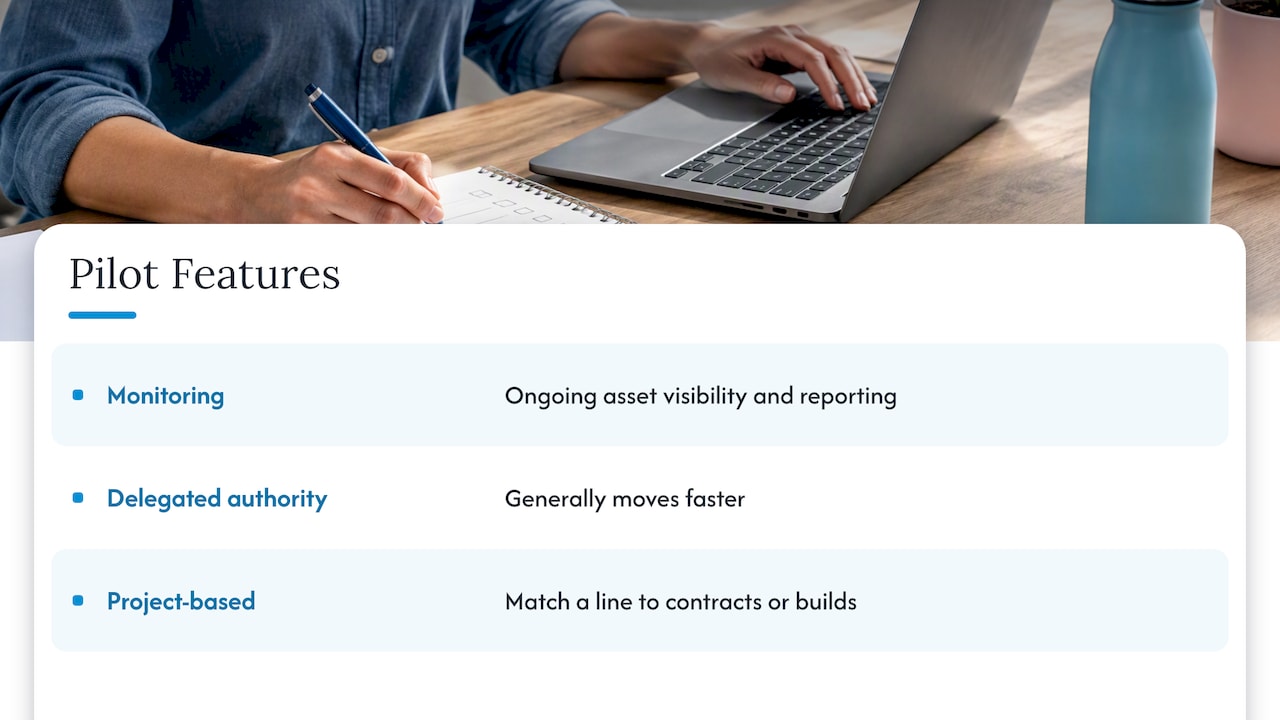
Three features separate the pilot from a plain bank line of credit. First, monitoring: revolving facilities need ongoing visibility into the assets behind them, so reporting is a built-in part of the arrangement. Second, delegated authority: lenders that can approve under their own SBA authority generally move faster. Third, project-based structure: you can match a line to a contract or build instead of forcing every dollar into one general-purpose facility.
For a U.S. small business, the practical takeaway is that CAPLines is no longer a legacy product to read about in old guides. The pilot is the current path, and understanding it keeps you from walking into a lender conversation with outdated assumptions.
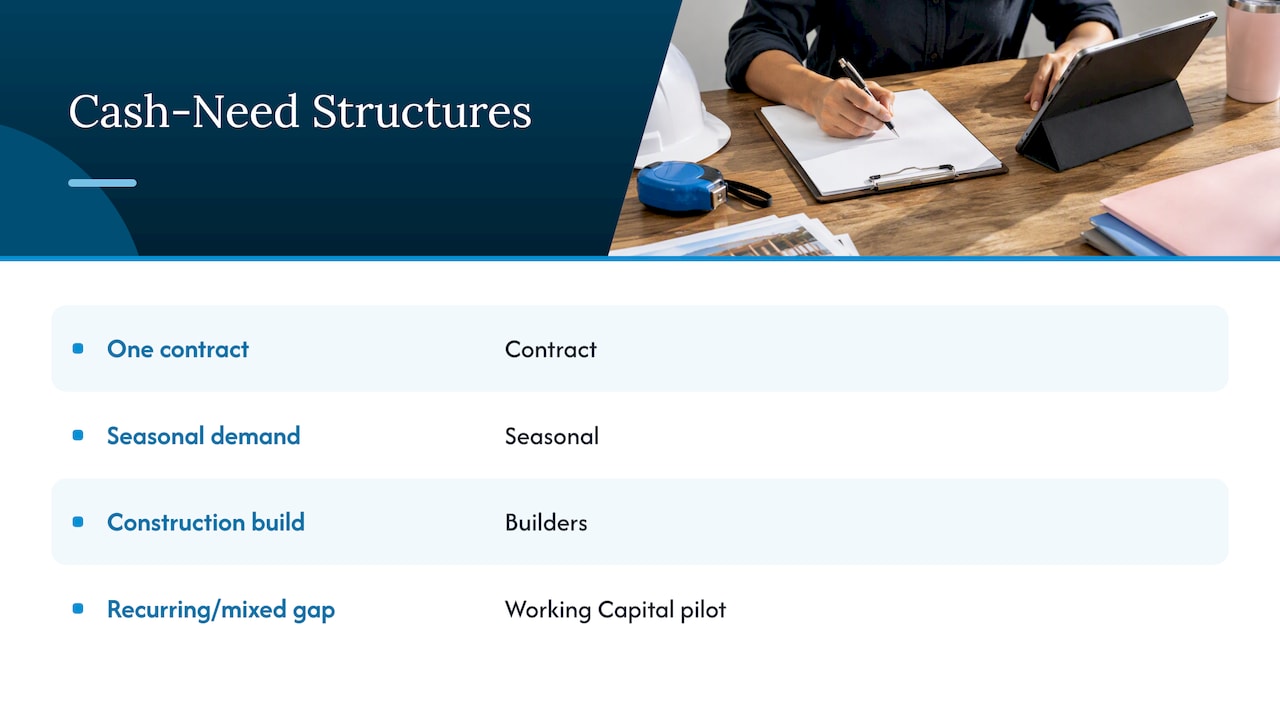
The traditional CAPLines family has several structures. Think of them as different answers to one question: when does your cash go out, and when does it come back? The right structure is the one whose timing matches yours.
Say you are a manufacturer who signs a purchase order for a large run of custom components. You have to buy materials and pay labor weeks before the customer pays you. A Contract CAPLine lines up the borrowing with that specific contract. The tie to performance is the point: the lender is lending against work that has a defined buyer and a defined payment, which is easier to underwrite than a vague promise of future sales.
This structure works well for businesses that live on contracts: subcontractors, suppliers to larger firms, service providers with milestone billing. If your revenue arrives in lumps tied to deliverables, it deserves a close look.
A garden center, a holiday gift retailer or a landscaping company knows when the rush comes. What it cannot always do is front the cash for inventory and seasonal staff months earlier. A Seasonal CAPLine is built for exactly that gap. You borrow ahead of the peak, then repay from the sales it generates.
The word that matters here is “predictable.” Lenders want to see a history showing the season repeats. If your busy months land in roughly the same window each year, your past financials make the case for you.
Construction and resale projects have a distinctive shape: costs stack up phase by phase, and the big payoff arrives at completion or sale. A Builders CAPLine finances construction or renovation costs and is designed around that shape. The statutory Builders program has its own provisions, so if you are a homebuilder or general contractor, confirm with your lender how those provisions apply to your project.
The SBA has also highlighted the pilot for this audience. Its March 2026 article for homebuilders notes that the pilot supports project-based lines up to $5 million and can be structured to finance direct project costs. That is a notable development for builders who previously fit awkwardly into other categories.
This is the catch-all with real teeth. If your need is recurring, like funding the gap between paying suppliers and collecting from customers, or project-based but not construction, the Working Capital structure fits. The pilot is the modern delivery route here, supporting revolving or non-revolving lines.
If you are still sorting out the basics of this kind of financing, our explainer on what a working capital loan is lays out how it differs from a term loan. And if a revolving line is what you are leaning toward, our post on small business line of credit uses shows how owners deploy that cash.
A quick way to choose: map your upcoming cash needs on a calendar. If one contract drives the gap, think Contract. If a season does, think Seasonal. If a build does, think Builders. If it is a steady rolling gap or a mix, think Working Capital under the pilot.
Vague ideas about “SBA terms” are not enough to plan around. These are the figures the SBA publishes for the 7(a) Working Capital Pilot, as stated on its program page and repeated in the legacy SBA program page.
| Term | Official figure |
|---|---|
| Maximum loan amount | $5 million |
| SBA guaranty, loans up to $150,000 | 85% |
| SBA guaranty, loans over $150,000 | 75% |
| Maximum maturity | Up to 60 months |
| Rate cap, $50,000 or less | Base rate plus 6.5% |
| Rate cap, $50,001 to $250,000 | Base rate plus 6.0% |
| Rate cap, $250,001 to $350,000 | Base rate plus 4.5% |
| Rate cap, $350,001 and greater | Base rate plus 3.0% |
The SBA’s pilot page sets the ceiling at $5 million, with a guaranty of 85% on loans up to $150,000 and 75% above that. That guarantee is what lets a lender say yes to a business it might otherwise decline: the SBA backs a large share of the loan if the borrower cannot repay.
The rate caps are the part owners most often misread. They are ceilings, not quotes. Your actual rate depends on the lender, your financials and the structure of the line.
Notice the direction of the tiers: the larger the loan, the lower the allowed spread. A small line costs more at the cap than a large one. If you are choosing between borrowing a smaller amount and a bigger one, that pattern is worth factoring into your math.
A maximum maturity of up to 60 months gives you a multi-year runway. It does not mean you must use the full term, and it does not mean the line sits untouched for five years. Revolving lines are drawn, repaid and drawn again, with the lender monitoring the assets behind them. Use the maturity as a planning boundary: the facility can support your operations for a period measured in years, not weeks.
For a rough sense of scale, we also publish our own pricing indications: our SBA Loan is listed at 8% per year, and our Line of Credit at 1-3% per month, both on our main page. Those are separate from the program caps above and depend on the lender and your profile.
Eligibility for CAPLines and the pilot follows the general shape of 7(a) eligibility. SBA guidance stresses that lenders and loan programs have their own requirements and that your lender will provide the final checklist for your specific loan, as the SBA’s loans overview puts it. Treat what follows as the common floor, not a guarantee.
For a longer walk through these thresholds, our guide on whether you meet SBA loan requirements covers the questions owners ask most.
Revolving lines are underwritten against your assets, so the paperwork leans heavier on receivables, payables and inventory than a simple term loan would.
Have these cleaned up before you apply. A receivables aging with unexplained gaps or a forecast that does not reconcile with last year’s numbers invites questions and slows everything down.
A term loan funds once and amortizes. A revolving line is different: the balance moves, the collateral moves, and the lender needs to see it. That is why revolving facilities come with continuing reporting. In practice, expect periodic submission of receivables and payables agings, possible inventory reviews, and checks that you are staying within the agreed terms.
This is not punishment. It is how the lender keeps the line safe enough to keep extending. Borrowers who treat reporting as a monthly habit, not a scramble, tend to have an easier time.
Pro Tip: Set a standing calendar date each month to export your receivables and payables agings and reconcile them with your books, so a lender request never catches you rebuilding reports from scratch.
Not every SBA lender handles these products the same way, and that difference shows up in your timeline. The key distinction is between lenders with delegated authority and those without.
A delegated lender can approve a loan under its own SBA authority, without sending every file to the SBA for review. A non-delegated lender has to route the file to the SBA, which adds a step and, usually, time. The Program Guide is the implementation document lenders work from, so how fluently a lender can talk about it is a good signal of how comfortable they are with the product.
Monitoring adds another layer. Handling a monitored revolving line takes operational controls: systems to collect borrowing-base reports, review them on schedule and flag problems. A lender that has those controls in place can underwrite and service the line with confidence. One that does not may hesitate, hedge or decline. Practitioners often observe that not all lenders have equal experience with these specialized revolving programs, which is why the right match matters as much as the right product.
The common thread is preparation. A lender with delegated authority and a borrower with clean documents is the fastest pairing.
Interest is the cost owners ask about first, but fees and administrative effort belong in the same budget.
On guarantee fees, the SBA’s program materials give a concrete example for builders: 0.25% for the first 12 months and 0.275% for each subsequent 12-month period, as noted on the legacy SBA program page and in the SBA’s homebuilder highlight. That is the example published for homebuilders, so confirm with your lender what applies to your own structure.
No official source in our research sets a fixed approval timeline, so treat any single number you see online with caution. What holds generally is the pattern: a delegated lender can decide under its own authority, while a non-delegated lender must wait on SBA review. Add a borrower whose documents are complete, and the process compresses. Add missing agings or an unclear forecast, and it stretches.
One more practical point sits outside the loan itself. Payroll and scheduling are often what a working-capital line is really funding, and tighter labor planning reduces how much you need to borrow. If you are weighing tools for that, this comparison of Connecteam and Homebase looks at workforce platforms for small businesses.
Abstract structures make more sense with a face on them. These sketches are illustrative, not predictions about any specific approval.
Ask three questions. Is your cash need tied to one contract, one season or one project? If so, the specific structure usually fits. Is the need recurring or mixed? Then the Working Capital route under the pilot is the natural home. Can you produce monthly reporting without strain? If not, solve that first, because every revolving CAPLine depends on it.
For more ideas on how owners put credit lines to work, see our write-up on stopping cash shortfalls with a business line of credit.
Our view is that an SBA monitored line is the right medium-term tool for businesses with a real, recurring working-capital gap and the discipline to report on it, and the wrong tool for a one-off, urgent need you cannot document. The pilot rewards organization. If your books are clean and your receivables, payables and inventory are tracked, the structure gives you scale (up to $5 million) and a multi-year maturity that few alternatives match.
Here is the checklist we would run before committing:
Where we come in is the matching step. Our one-page application and network of banks and lenders help point you toward potential funding sources, so you spend less time cold-calling institutions. We explain why that matters in what a small business lender network offers. The honest filter is simple: if the checklist above looks like you, pursue the line. If it does not yet, fix the gaps first.
— Rob
If a monitored working-capital line fits your business, the next step is getting in front of the right lender, and that is the part we handle. We built our process to help owners connect with potential lenders.
Here is what you can expect when you work with us:
We have funded over $120M for clients and hold an A+ BBB rating. You bring the business; we bring the lender network and the process.
Ready to begin? Visit our SBA Loan, Line of Credit and Working Capital page and complete the one-page application today. We will pair you with an advisor and start matching you with lenders right away.
This article is general information, not a substitute for advice from a qualified financial advisor. Consult a qualified financial professional about your own circumstances before acting on anything here.
You generally need to be a U.S.-based, for-profit business that meets SBA size standards, shows repayment ability and has about 12 months of operating history. Each lender sets its own final checklist, as the SBA’s loans page explains. Our guide on SBA loan requirements covers the details.
Lenders typically look for for-profit status, U.S. operations, SBA-size eligibility, creditworthiness, repayment ability and recent financial statements. For revolving lines, expect to add receivables and payables agings and inventory reports. The lender confirms the exact list for your loan.
Difficulty depends on the lender and your financial profile, not on a single rule. Clear documentation and a realistic request improve your odds. SBA Lender Match helps you find participating lenders, and an advisor can help you prepare.
Yes. SBA loans are repaid to the lender, and the SBA only guarantees a portion of the loan to the lender if you default. For CAPLines, the pilot’s guaranty is 85% on loans up to $150,000 and 75% above that, but the guarantee protects the lender, not you.
The 7(a) Working Capital Pilot supports loans up to $5 million, according to the SBA program page. The amount you qualify for depends on your finances and the lender’s underwriting.
At Fordham Capital, we've made the application process straightforward and reassuring. Dive in and explore your financial options with confidence, knowing there's no impact on your credit score and no obligations. We review your details and offer customized solutions based on what you're looking for.





.jpg)

