
A startup’s valuation directly alters which lenders will underwrite your loan, how much you can borrow, and the interest, fees, and covenants you’ll face. A VC-backed company valued at $50 million after a Series A can walk into venture debt conversations that a bootstrapped, revenue-stage company valued at $3 million simply cannot have. But valuation isn’t a single lever. Lenders run it through three underwriting channels: collateral and loan-to-value (LTV) math, investor quality and cap table signaling, and revenue or operating metrics. Each channel weighs valuation differently, and that’s why two founders with the same “valuation number” can get wildly different offers.
Here’s what actually decides your outcome:
Pro Tip: Before you apply anywhere, separate your “paper valuation” from your “collateral value” on paper. Lenders will do this math whether you do it first or not.
Valuation shapes loan size, lender type, and terms through three channels: collateral value, investor quality, and revenue metrics.
| Point | Details |
|---|---|
| Collateral beats paper valuation | Bank and SBA lenders size loans off appraised collateral, not your last funding round’s number. |
| Investor quality drives venture debt | Runway, margins, and cap table backing decide venture debt eligibility more than headline valuation. |
| Terms shift with confidence | Weak or inflated valuation signals raise interest premiums, tighten covenants, and demand more collateral. |
| Clean documents move fastest | A tidy cap table and reconciled financials fix more applications than a higher valuation would. |
| Fordham Capital matches by fit | A one-page application connects founders to whichever lender in Fordham Capital’s network fits their actual profile. |
Lenders rarely take your last funding round’s valuation at face value. Banks and SBA lenders care almost exclusively about collateral value, appraised independently, then discounted into a loan-to-value ratio. A $10 million paper valuation means nothing to a community bank if your hard assets appraise at $400,000. Venture debt shops work differently. They look past the balance sheet to who signed your term sheet and how much dry powder they have left, treating investor quality as a proxy for future equity infusions that will repay the loan if things go sideways.
Picture it as two separate funnels feeding into one decision. On one side: collateral appraisals flow into an LTV ratio, which caps how much a secured lender will extend. On the other: paper valuation and investor backing flow into a confidence score that shapes venture debt sizing and covenant structure. A company rarely maxes out both funnels at once.
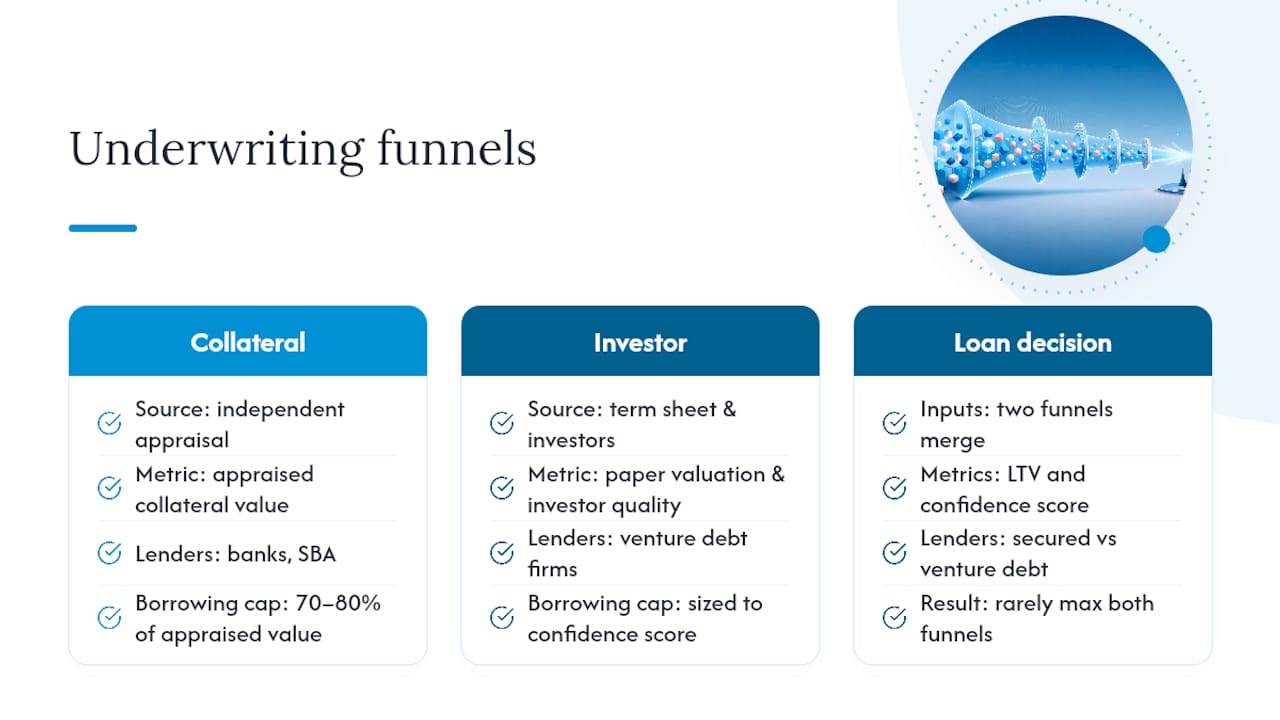
The gap between them can be stark. A logistics startup with $2 million in equipment might appraise at $2 million for collateral purposes and borrow up to 70% to 80% of that, regardless of its $30 million paper valuation. A software company with the same $30 million valuation but no hard assets might get zero from an asset-based lender and instead pursue venture debt sized off its last equity round.

Collateral quality moves pricing too. Pledging collateral reduces borrowing costs by roughly 23 basis points on average, and that discount is larger for smaller, private firms and longer-maturity loans, exactly the profile of most early-stage companies.
Pro Tip: Ask any lender upfront whether they’re underwriting to collateral value or to your cap table. The answer tells you which documents to prepare first.
Not every lender reads your valuation the same way. Matching your profile to the right product saves months of rejected applications.
Pro Tip: If you’re planning a debt raise, time it right after closing an equity round. Bargaining power and documentation are both strongest in the weeks after a raise closes, before runway starts shrinking.
Valuation rarely determines a flat yes or no. It moves the dial on every term attached to the loan.
Higher, well-supported valuations typically buy you: a larger maximum loan size, lower interest premiums, less frequent covenant checks, lighter collateral or guarantee requirements, and smaller warrant coverage. Weaker or unverified valuations push the other direction on all five.
Lenders also price in skepticism. Regulatory guidance under Basel 3.1 pushes appraisers toward conservative valuations that exclude speculative future price gains, and lenders often widen rates or tighten terms when a submitted valuation looks inflated relative to comparable deals.
Lenders have gotten sharper about inflated numbers. Higher uncertainty around an asset’s true value increases rejection rates and worsens both interest rate and LTV outcomes, so ambiguity costs you money even when it doesn’t cost you the loan outright.
You can’t manufacture a higher valuation overnight, but you can control what lenders see around it.
Lenders will typically request:
If your valuation signals are shaky in the short term, staged loans or bridge financing can buy you time to strengthen metrics before a bigger raise. Read more on how lenders assess startup repayment ability for the non-valuation side of this equation.
Pro Tip: If you can only fix one thing this week, fix the cap table. It’s the single document every lender type, from SBA to venture debt, asks for first.
Fordham Capital has funded over $120 million and holds an A+ BBB rating, built on matching founders to lenders who actually fit their profile instead of forcing every applicant through one bank’s checklist. The process runs on a one-page application, with lender matches and offers often returned within 24 hours.
Founders chase valuation as if it’s the whole game. It’s one input among three. I’ve seen companies with modest valuations get funded fast because their cap table was clean and their revenue was boring and predictable, which lenders love. If you can only do one thing today, pull your cap table and financials into one clean folder before you talk to anyone.
Fordham Capital exists for the exact gap this article just described: founders whose valuation story doesn’t fit neatly into one lender’s box. Instead of spending weeks pitching banks that only care about collateral or venture funds that only care about your cap table, you submit one application and let the matching happen across a wider network.
That means faster answers, less repeated paperwork, and a path to SBA loans, working capital, or lines of credit even if your valuation looks unconventional. There’s no credit-score hit for exploring your options, and no collateral requirement to get matched. If you’ve read this far because you’re not sure which loan type fits your numbers, that’s exactly the question a one-page application can answer. Apply now and expect a response fast.
At Fordham Capital, we've made the application process straightforward and reassuring. Dive in and explore your financial options with confidence, knowing there's no impact on your credit score and no obligations. We review your details and offer customized solutions based on what you're looking for.