
The fastest path to business funding in NYC is to register with NYC Funds Finder and schedule a free one-on-one session with a financing advisor. That single step connects you to vetted lenders, grants, and city-sponsored loan programs without a hard credit pull or upfront cost.
TL;DR:
NYC has more funding infrastructure than most cities in the country. The challenge is knowing which door to knock on first.
City level
NYC SBS Financing Assistance is the starting point for most small business owners. SBS advisors help you identify the right financial product, review your documents, calculate repayment terms, and connect you directly to banks, credit unions, nonprofit lenders, and the SBA. It costs nothing. Call 888-SBS-4NYC or create an account online and select “Financing Assistance” to book a session.
NYC Funds Finder is the city’s first free online capital marketplace, developed by SBS in partnership with Next Street. After a short intake form, the platform matches your business to vetted loans, grants, and one-on-one advisors in your borough. NYC Future Fund revenue-based loans ($25K–$500K) and contract financing loans up to $1M at 3% APR are both accessible through this portal.

State level
Empire State Development (ESD) manages the New York State Small Business Credit Initiative (SSBCI), a suite of programs with more than $500M in funding covering revolving loan funds, microloan pools, capital access insurance, and equity investments. The New York Forward Loan Fund 2 offers funding for eligible businesses and is available to pre-apply through the Financing Assistance portal.
Federal level
The U.S. Small Business Administration (SBA) runs grant and loan programs accessible through SBS advisors or directly at SBA.gov. SBA 7(a) loans are the most common route for larger working capital needs; SBA microloans (up to $50K) work well for newer businesses. SBA disaster loans have provided significant funding for NYC businesses affected by severe weather events.
Community lenders
Community Development Financial Institutions (CDFIs) fill the gap for businesses that traditional banks decline. NYC Funds Finder matches businesses with vetted CDFIs and grantmakers specifically serving underbanked owners, including minority-owned, immigrant-owned, and first-generation businesses.
Not every funding type fits every situation. Here is a plain-language breakdown of what each one does and when it makes sense.

| Funding Type | Typical Range | Best For | Key Caveat |
|---|---|---|---|
| Interest-free community loan (HFLS) | Up to $60K | Low-income entrepreneurs, all five boroughs | Requires 1–2 guarantors |
| Revenue-based loan (NYC Future Fund) | $25K–$500K | Retail, hospitality, seasonal businesses | 7.5% interest; 3% origination fee |
| Contract financing loan | Up to $1M | City agency contractors | Must have or be pursuing a city contract |
| New York Forward Loan Fund 2 | Varies by program | Recovery and growth | State program; pre-apply through ESD |
| SBA microloan | Up to $50K | Startups, newer businesses | Longer approval timeline |
| SBA 7(a) loan | Up to $5M | Established businesses, larger capital needs | Extensive documentation required |
| Business line of credit | Varies by lender | Working capital, cash flow gaps | Revolving; credit-dependent |
Interest-free community loans are the most overlooked option in NYC. The Hebrew Free Loan Society (HFLS) offers loans up to $60,000 at zero interest, with repayment terms of 12–36 months. Loans up to $30K require one guarantor; loans from $30K to $60K require two. For a business owner focused on long-term growth rather than paying down interest, this is hard to beat.
Revenue-based loans have grown in popularity because repayments flex with your monthly revenue. The NYC Future Fund structures principal payments so they can pause when revenue dips below defined thresholds. That makes it a natural fit for restaurants, boutiques, and any business with seasonal swings. The trade-off: a 7.5% annual interest rate and a 3% origination fee.
Grants are available but competitive. NYC Funds Finder connects businesses to grantmakers alongside loan options. Sector-specific grants often come through ESD’s SSBCI programs, targeting industries like manufacturing, tech, and food production.
For businesses that need fast funding options and cannot wait weeks for a community lender decision, private marketplace lenders and revenue-based products offer the quickest turnaround.
Most applications stall not because the business is ineligible, but because the documents are incomplete. Get these ready before you register anywhere.
Core documents to assemble:
| Document | Why It’s Needed |
|---|---|
| Articles of organization / business license | Confirms legal entity and operating status |
| Business tax returns (most recent year) | Primary income verification for most programs |
| Year-to-date profit and loss statement | Shows current financial health |
| 3–6 months of business bank statements | Verifies cash flow and revenue consistency |
| One-year monthly revenue projection | Required by NYC Future Fund and most marketplaces |
| Government-issued ID | Standard identity verification |
| Guarantor information (if applicable) | Required for HFLS loans above $30K |
Step-by-step application sequence:
Realistic timelines:
Pro Tip: Prepare your one-year monthly revenue projection before your first advisor session. Programs like the NYC Future Fund require it, and having it ready can shorten your lender matching timeline by days.
See the full small business funding checklist for a printable version you can bring to your advisor session.
Free advising is the most underused resource in NYC’s funding ecosystem. Most business owners skip it and submit incomplete applications. That is a costly shortcut.

SBS advisors do more than point you to a website. They review your documents, identify eligibility gaps, calculate repayment terms, and connect you to multiple lenders in a single session. The service is free, available in multiple languages, and accessible by phone or in person at Business Solutions Centers across all five boroughs.
NYC Funds Finder goes a step further by offering borough-specific one-on-one financing advisor sessions after you register. The platform matches you to advisors who specialize in the programs relevant to your business type and funding need. This is particularly valuable if you are considering multiple products at once, say, an interest-free HFLS loan alongside a revenue-based NYC Future Fund loan.
Small Business Development Centers (SBDCs) offer another layer of free advising, including business plan review, financial projections, and loan packaging. They operate through CUNY and other host institutions across the city.
When to escalate to a CDFI directly: if your business has been declined by traditional banks or has limited credit history, a CDFI advisor can structure an application specifically for community lending criteria. NYC Funds Finder connects you to these lenders as part of its matching process.
For owners who want a guided application without the wait, Fordhamcapital’s platform offers a one-page intake and connects you to a network of lenders, with no credit impact and decisions in as little as 24 hours.
Pro Tip: City Business Solutions Centers are underutilized. Advisors know the non-obvious eligibility rules for each program and can catch missing guarantor or documentation requirements before they delay your application. Book a session before you apply anywhere.
Marketplaces work by collecting your business information once and matching it to multiple lenders simultaneously. That is faster than applying to each lender individually, but speed comes with trade-offs worth understanding before you sign anything.
How marketplace matching works:
NYC Funds Finder matches businesses to vetted CDFIs, banks, and grantmakers based on your intake form. Private marketplaces like Fordhamcapital’s platform do the same with a broader lender network, including alternative lenders who move faster than community programs.
Timing expectations:
Due-diligence checklist before accepting any offer:
Pro Tip: For non-credit-reporting funding options, confirm in writing before you apply — not after you receive an offer. Some lenders report to personal bureaus even when the application does not trigger a hard pull.
Revenue-based loans are sensible for NYC retail, hospitality, and seasonal businesses because payments flex with cash flow. The risk is that a strong revenue month means a larger payment, which can feel counterintuitive when you are trying to reinvest. Model both scenarios before committing.
NYC small businesses have access to a layered funding system, and the fastest path through it starts with a free advisor session and a complete document package.
| Point | Details |
|---|---|
| Start with NYC Funds Finder | Register for free to match with vetted lenders and schedule a borough-based advisor session. |
| Know your loan ranges | Options run from interest-free HFLS loans up to $60,000 to NYC Future Fund revenue-based loans up to $500,000. |
| Prepare documents first | Missing year-to-date financials and guarantor details are the top causes of application delays. |
| Use free advising before applying | SBS and SBDC advisors catch eligibility gaps and document issues that would otherwise stall your application. |
| Fordhamcapital for fast access | One-page application, no credit impact, and lender matches with approvals in as little as 24 hours. |
Most owners treat funding as a last resort. They wait until cash is tight, then apply in a hurry with incomplete documents to the first program they find. That sequence almost guarantees a slow outcome or a rejection.
The better approach is to treat NYC’s funding infrastructure as a standing resource, not an emergency tool. NYC Funds Finder, SBS, and the HFLS program exist year-round. An advisor session when your business is stable gives you a clear picture of what you qualify for, what documents you need, and which programs to apply to before urgency forces your hand.
There is also a persistent misconception that grants are the best option because they do not require repayment. For most operating businesses, a well-structured interest-free loan from HFLS or a revenue-based loan from the NYC Future Fund is more accessible, faster to close, and just as affordable when the interest cost is zero or near-zero. Chasing grants while ignoring loan programs often means waiting months for a competitive award that may not come.
The other thing owners underestimate is the value of the free advising layer. An SBS advisor or NYC Funds Finder session is not just a referral service. Advisors know which programs have open capacity, which lenders are moving quickly, and which eligibility rules trip up applications most often. That intelligence is worth more than any checklist.
If you have gone through the city programs and need a faster decision, or if you want a guided application without navigating multiple portals, Fordhamcapital connects NYC small businesses to a network of banks and alternative lenders through a single one-page application. No hard credit pull, no collateral requirement, and approvals in as little as 24 hours.
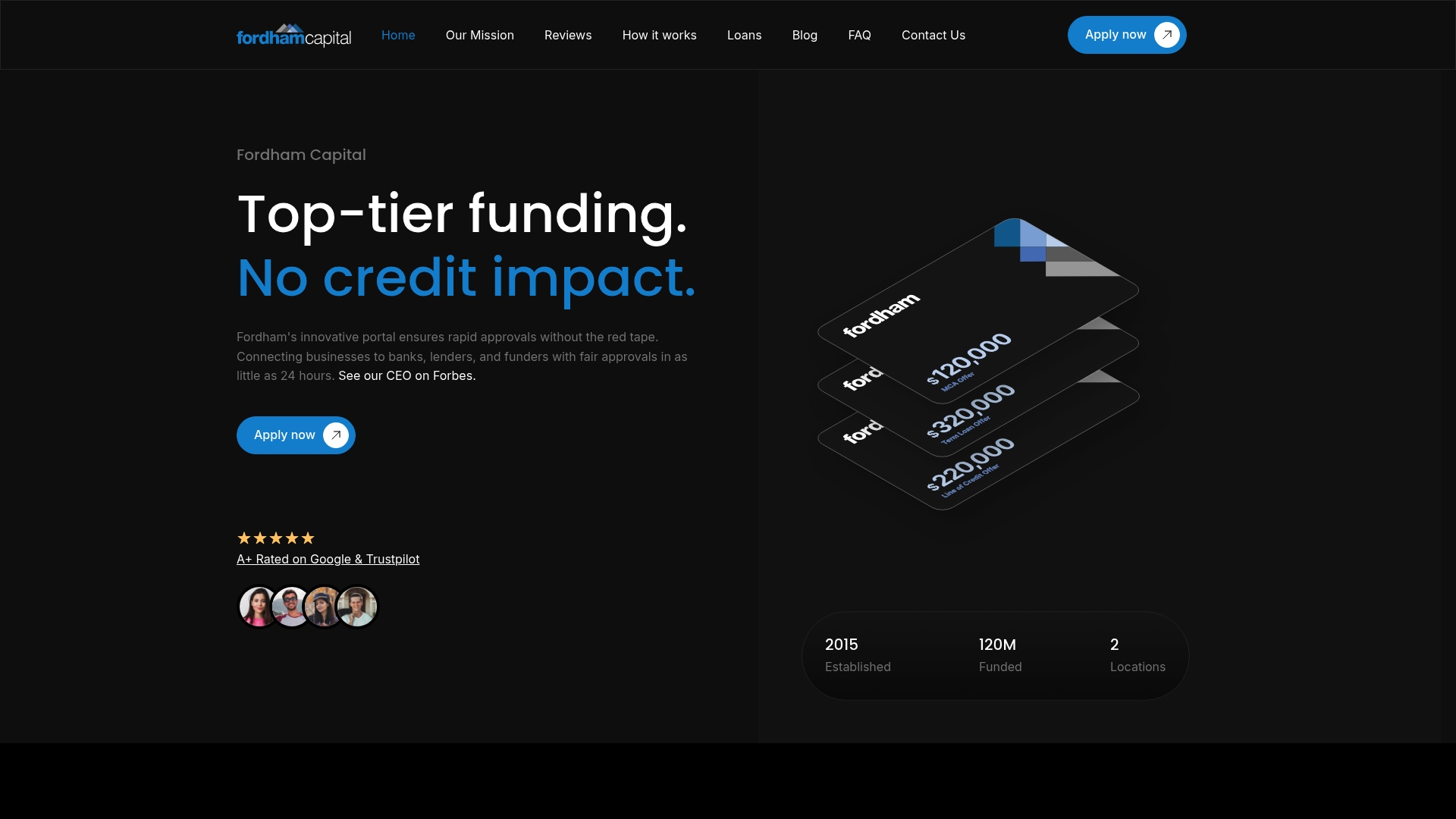
Fordhamcapital carries an A+ BBB rating and has funded over $120M for small and medium-sized businesses. The platform is built specifically for owners who need capital quickly and want a clear, transparent process without the back-and-forth of traditional bank applications. Apply now to see your options, or visit Fordhamcapital.com to learn more about how the platform works.
This article is general information, not financial or legal advice. Confirm current program eligibility and terms directly with each program or a qualified advisor before applying.
Use these links to apply, register, or get official program information directly from the source.
At Fordham Capital, we've made the application process straightforward and reassuring. Dive in and explore your financial options with confidence, knowing there's no impact on your credit score and no obligations. We review your details and offer customized solutions based on what you're looking for.