
If you have poor credit and need capital now, a lending marketplace is your fastest, most flexible path. These platforms match you to multiple lenders through a single application, using a soft credit pull that won’t touch your score. In this context, the term “business grants” refers to loan-based funding accessed through marketplace networks, not non-repayable government grants. Here’s where to start:
A lending marketplace is typically the fastest and most practical route to loan-based capital for U.S. entrepreneurs with bad credit, offering soft-pull matching and multiple lender options. Approvals can be as quick as 24 hours for qualified applicants, but funding timelines may vary by lender and completeness of your documentation.
| Point | Details |
|---|---|
| Start with a soft-pull marketplace | Pre-qualify without credit impact; compare multiple lender matches before committing. |
| Bank statements matter most | Consistent deposits over 3–6 months can offset a low FICO score with alternative lenders. |
| Speed costs more | MCAs and short-term loans fund fastest but carry the highest effective APRs — use them for specific, solvable cash-flow gaps. |
| CDFIs for lower cost | SBA microloans cap at $50,000 and carry lower rates, but approval takes weeks rather than days. |
| Fordhamcapital | One-page application, Approvals often occur within 24 hours, over $120 million in funding provided, and excellent BBB ratings. rating — built for bad-credit borrowers. |
This article is general information, not a substitute for advice from a qualified financial advisor. Consult a qualified financial professional about your own circumstances before acting on anything here.
Business lending marketplaces use a soft credit pull during initial matching, so browsing options costs you nothing on your credit report. You fill out one application, and the platform surfaces lender matches across term loans, lines of credit, merchant cash advances, invoice financing, and SBA-adjacent microloan programs. The hard pull only happens when you formally apply with a specific lender you’ve already chosen.
That structure matters more than most borrowers realize. A rejection from one lender in the network doesn’t close the door on the others. Marketplaces partner with lenders that cover different credit, revenue, and time-in-business profiles, so a sub-600 FICO score that disqualifies you at a bank may still match you to an online lender weighing cash flow more heavily.
The flow looks like this:
Funding options for entrepreneurs with bad credit narrow as scores drop, but several products remain accessible. The table below covers the primary categories.
| Product | Best for | Time to funding | Credit flexibility | Typical amount | Key tradeoff |
|---|---|---|---|---|---|
| Business line of credit | Recurring working capital needs | a few days | Moderate | a moderate amount | Higher APR than bank lines |
| Short-term online term loan | One-time cash need, fast | very quickly | High | a moderate amount | Short repayment window |
| Merchant cash advance | High-volume card sales businesses | very quickly | Very high | a moderate amount | Very high effective APR |
| Invoice factoring | B2B businesses with outstanding invoices | a few days | Very high | a large portion of invoice value | Factor fees reduce margin |
| Equipment financing | Buying specific equipment | 2–5 days | High (asset secures loan) | Up to equipment value | Collateral required |
| SBA microloan / CDFI | Lower-cost capital, can wait | multiple weeks | Moderate | a limited amount | Slower approval process |
SBA microloans and CDFIs cap at $50,000 and carry lower rates, but the approval timeline runs weeks rather than days. For borrowers who need capital quickly, online term loans and MCAs are the realistic options, with cost as the tradeoff.
Alternative online lenders evaluate bank-statement patterns and cash flow far more heavily than traditional banks. Consistent monthly deposits signal repayment capacity even when your FICO score is low. Think of it as a three-legged stool: time in business, revenue and cash flow, and credit score. Strength in two legs can offset weakness in the third.
Documents to prepare before you apply:
Having these ready before you start the marketplace application cuts days off your timeline. Lenders move faster when they don’t have to chase documents.
Pro Tip: Review your bank statements before submitting them. Overdrafts and irregular deposit patterns are the two signals that most often trigger declines or higher-cost offers. If your last 90 days show consistent deposits with no overdrafts, lead with those months. You can learn more about packaging your bank statement story to present the strongest possible picture.
Speed and cost move in opposite directions for bad-credit borrowers. The faster the product, the higher the effective cost tends to be.
The real cost of speed: A merchant cash advance that funds in 24 hours can carry an effective APR often above 30%, sometimes far higher. That’s not a reason to avoid it — it’s a reason to use it only for a specific, solvable cash-flow gap where the return on that capital exceeds the cost.
Watch for daily or weekly repayment schedules on MCAs and short-term loans. They hit cash flow harder than monthly payments, even when the total repayment amount looks manageable on paper.
Watch for these red flags: Any lender guaranteeing approval before reviewing your documents, upfront fees before funding, or vague fee disclosures that don’t state total repayment cost. Legitimate lenders disclose all costs before you sign. Protecting your credit during this process is worth understanding in detail — see how business funding impacts your personal credit score before you apply.
Fordhamcapital is built for exactly this situation. The platform connects small and medium-sized businesses to a network of banks and alternative lenders through a one-page application that uses no hard credit pull at the matching stage. Approvals for many applicants come within 24 hours, though the exact timeline can depend on the lender matched through the marketplace and how quickly you supply required documents.
The proof points are specific:
For entrepreneurs ready to move, the next step is straightforward: complete the one-page application and see your matched lender options without any credit impact. You can also review the bad credit business financing checklist to make sure your documents are ready before you start.
Eligibility for loan-based funding with poor credit typically centers on three factors: time in business (most online lenders want at least 6 months, some require a year), monthly revenue (minimums vary but $10,000–$15,000 per month is a common floor for online lenders), and cash flow consistency shown in bank statements. Personal credit score matters, but many alternative lenders work with scores in the 500s when revenue is strong.
For SBA microloans through CDFI intermediaries, eligibility often includes a business plan, demonstrated community impact, and participation in lender-sponsored technical assistance programs. The bar is different — less about raw revenue, more about mission and capacity to repay.
The practical categories for entrepreneurs with poor credit break into three tiers. Online marketplace lenders and direct alternative lenders move fastest and accept the widest range of credit profiles, covering term loans, lines of credit, MCAs, and invoice factoring. Nonprofit lenders and CDFIs offer lower-cost capital through microloan programs, often with credit counseling built in. Government-backed SBA programs, accessed through approved intermediaries, provide the most favorable terms but require the most documentation and time.
None of these are non-repayable grants. They are loan-based products where repayment is required. The distinction matters because applying for the wrong product type wastes time you may not have.
The most effective move is fixing what lenders actually see. Improving your business credit score takes time, but you can improve your application profile immediately by cleaning up your bank statement story, reducing overdrafts, and increasing deposit consistency in the 60–90 days before you apply.
Beyond that: separate your business and personal finances if you haven’t already, register your business formally, and open a dedicated business checking account. These steps signal operational maturity to lenders even when your credit score doesn’t.
If you have collateral — equipment, receivables, inventory — lead with it. Secured products carry lower rates and higher approval odds for bad-credit borrowers than unsecured alternatives.
The most expensive mistake is accepting the first offer without comparing alternatives. A marketplace exists precisely to give you multiple options; skipping the comparison step costs money.
Second: applying to multiple direct lenders simultaneously, each triggering a hard pull. That’s the problem a marketplace solves. Comparing offers through a marketplace limits hard inquiries to the one lender you actually choose.
Third: confusing factor rates with APR. A factor rate around 1.3 on a $50,000 MCA means you repay $67,500 total, but the effective APR depends entirely on the repayment term. A 6-month repayment schedule on that same advance carries a much higher effective APR than a 12-month one. Always convert to effective APR before comparing products.
Non-repayable grants exist for specific categories — minority-owned businesses, women entrepreneurs, rural businesses, specific industries — but they are competitive, slow, and rarely available for general working capital needs. The application process for most grants runs months, not days, and many require matching funds or detailed project proposals.
Loan-based funding through a marketplace is faster, more flexible, and available to a broader range of businesses. The tradeoff is repayment with interest or fees. For a business with a specific, near-term cash-flow need and a clear path to repayment, a marketplace loan is almost always the faster, more practical choice. Grants make sense as a parallel pursuit for businesses that qualify by category and can absorb the time investment.
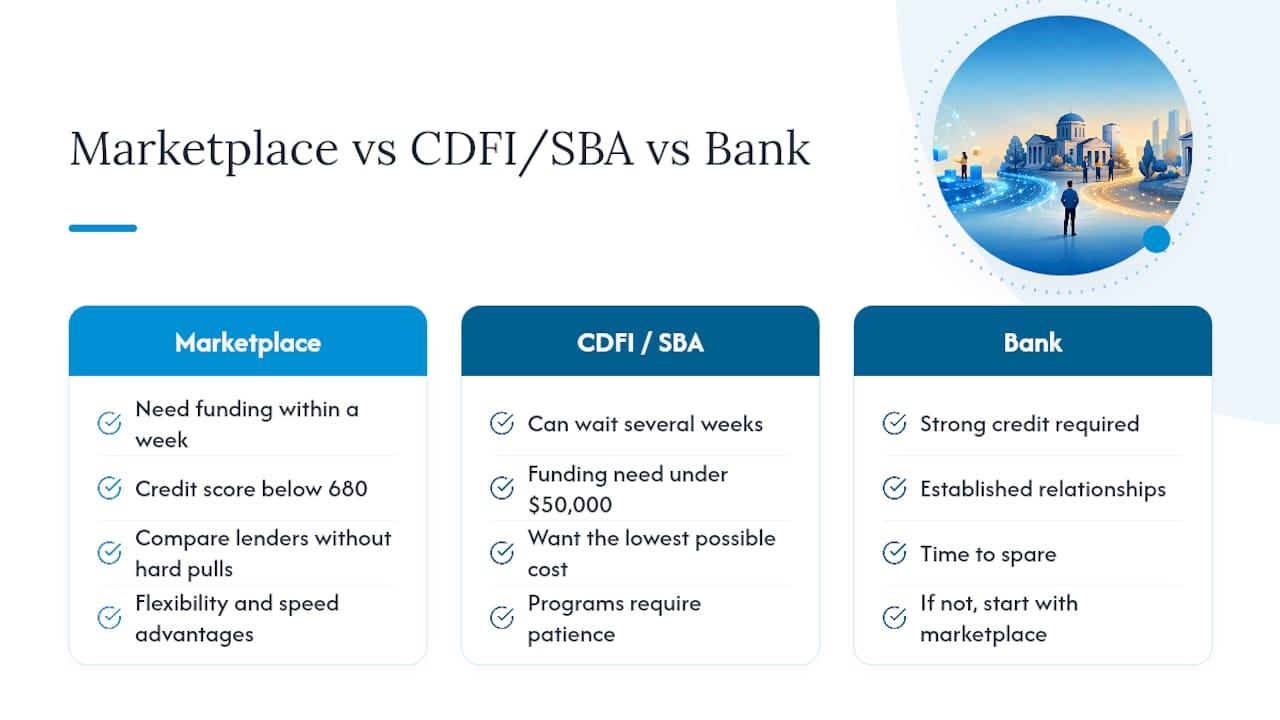
The answer comes down to three variables: how fast you need the money, what APR you can absorb, and how strong your revenue story is relative to your credit score.
Use a marketplace when you need funding within a week, your credit score is below 680, or you want to compare multiple lender types without multiple hard pulls. The flexibility and speed are real advantages that direct bank applications can’t match for most bad-credit borrowers.
Try a microloan product like those offered by CDFIs or SBA programs when you can wait several weeks, your funding need is under $50,000, and you want the lowest possible cost. These programs exist for exactly this borrower profile — they just require patience.
Banks are for borrowers with strong credit, established relationships, and time to spare. If that’s not your situation right now, a marketplace is the honest starting point. One risk note: higher-cost financing accepted in a cash-flow crunch can compound the problem if the underlying revenue doesn’t support the repayment schedule. Match the financing to a specific, solvable need — not to a general wish for more capital.
Bad credit doesn’t have to mean slow funding or no funding. Fordhamcapital connects you to a network of banks and alternative lenders through a one-page application, and many applicants receive approval within 24 hours, depending on lender requirements and document submission. The platform has funded over $120 million for small and medium-sized businesses and holds a strong BBB rating.
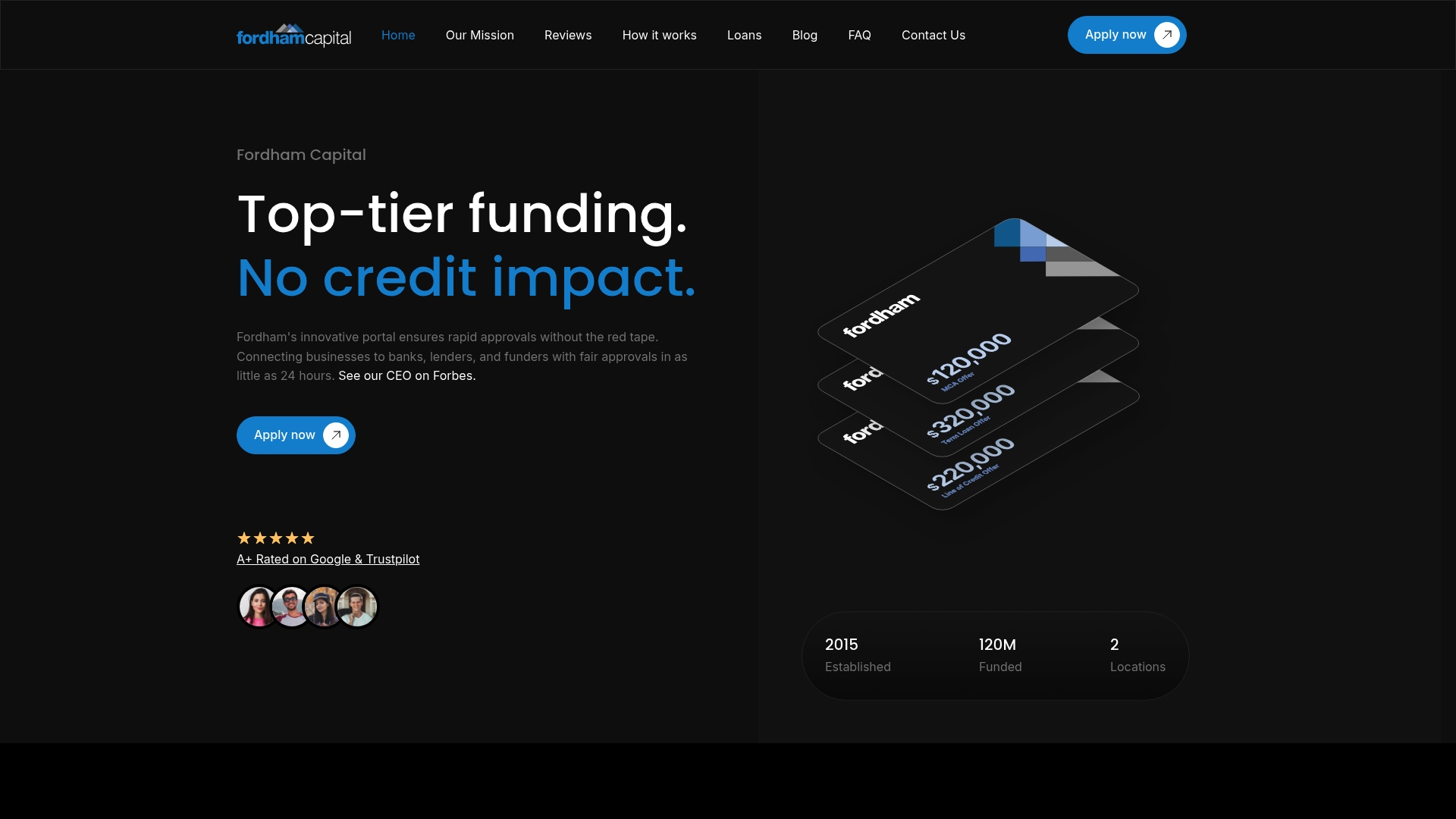
For entrepreneurs who need capital fast and want to compare real lender offers without damaging their credit score, Fordhamcapital is the direct path. Start your one-page application today and see matched offers within 24 hours.
At Fordham Capital, we've made the application process straightforward and reassuring. Dive in and explore your financial options with confidence, knowing there's no impact on your credit score and no obligations. We review your details and offer customized solutions based on what you're looking for.