The single most important difference between investor funding and a business loan comes down to this: equity investors buy a piece of your company, while lenders rent you money. One costs you ownership. The other costs you cash flow. That distinction shapes every financial decision you’ll make as a small business owner, and getting it wrong is expensive.
Here’s what that means in practice:
The typical fit: If your business generates steady, predictable revenue and you want to keep full ownership, a loan is usually the right tool. If you’re building something that needs large capital to scale fast and you’re willing to share the upside, equity is worth the dilution.
Investor funding and business loans are not the same thing. They represent fundamentally different financial structures with different costs, obligations, and long-term consequences for who owns and controls your business.
This article is general information, not professional financial or legal advice. Confirm current terms, rates, and eligibility with a qualified advisor or the relevant primary source before making a funding decision.
Equity funding means selling a percentage of your business to investors in exchange for capital. No repayment schedule, no interest rate. Instead, investors expect to profit when the company grows and eventually exits through a sale or IPO. That’s the deal: you get cash now, they get a share of what the company becomes.
The main investor types you’ll encounter as a small business owner:
Equity investors provide capital in exchange for an ownership stake and often seek governance influence through board seats or protective provisions. That governance piece surprises a lot of founders. An investor with a board seat has real input on hiring, strategy, and exit decisions. The non-financial value investors bring, including networks, recruiting connections, and credibility, can be as important as the capital itself for founders targeting rapid scaling.
Pros of equity funding: No fixed payments, shared risk, access to investor networks and expertise, and the ability to raise larger amounts than most lenders will approve.

Cons: You give up a portion of your company permanently. Governance changes can slow decisions. Investors expect growth and an exit event, which may not align with a founder who wants to run a lifestyle business indefinitely. The fundraising process itself is slow, often taking several months from first pitch to closed round.
Equity tends to fit high-growth, scalable models: SaaS companies, consumer tech, repeatable-service businesses with large addressable markets. A local restaurant or a steady-revenue professional services firm is rarely a good equity candidate, not because the business is bad, but because the return profile doesn’t match what investors need.
A business loan is debt: a lender gives you a lump sum or a credit line, and you repay it over time with interest and fees. The lender makes no claim on your ownership. Repayment terms range from a few months to 25 years for some SBA products, and loans can be secured (backed by collateral) or unsecured.
Common loan types small businesses actually use:
Lenders evaluate credit score, business cash flow, time in business, and collateral when underwriting. Better credit typically means lower rates. Many lenders look at both personal and business credit scores, especially for newer businesses without an established credit history.
Pros: You keep 100% ownership. Repayment schedules are predictable, which makes budgeting straightforward. Repaying loans responsibly builds business credit, improving your borrowing capacity for future needs. For creditworthy businesses, debt is often cheaper than equity over the long run.

Cons: Fixed payments hit your cash flow every month, whether revenue is up or down. Secured loans require collateral; many lenders also require a personal guarantee, which puts your personal assets on the line if the business defaults. A default can damage both your business and personal credit.
SBA loans offer some of the best terms available to small businesses because the SBA partially guarantees the loan to the lender, reducing lender risk and enabling lower rates. The tradeoff is documentation-heavy eligibility requirements and a closing process that can take several weeks to months.
Loans work best when you have steady, predictable revenue that comfortably covers the monthly payment; for a helpful overview of investment types relevant in the Netherlands, see soorten investeringsmogelijkheden. Asset purchases (equipment, real estate), working capital for a seasonal business, and expansion into a proven market are all situations where debt financing makes practical sense.
The table below maps the eight decision-critical dimensions across equity and debt financing. Read it as a quick diagnostic: the rows where your situation clearly favors one column are the ones that should drive your decision.

| Dimension | Equity investor | Term loan / line of credit |
|---|---|---|
| Ownership & control | You sell a percentage; investors may gain board seats or protective provisions | You retain 100% ownership; lender has no governance role |
| Repayment obligations | None; investors profit at exit (sale, IPO, or distributions) | Fixed monthly payments of principal plus interest |
| Cost | No interest, but you share future upside; investor ROI expectations are typically high | Interest rate plus fees; total cost depends on rate, term, and loan size |
| Speed & access | Weeks to months for due diligence and closing | Days to weeks for alternative lenders; 60–90 days for SBA |
| Qualification & documentation | Business traction, growth story, cap table, term sheet negotiation | Credit score, cash flow, time in business, collateral |
| Impact on cash flow | No immediate cash drain; frees capital for growth | Monthly payment reduces operating cash flow immediately |
| Tax treatment | Equity proceeds are not taxable income; dividends or distributions may be taxable | Interest payments are generally tax-deductible as a business expense (confirm with a tax advisor; IRS rules apply) |
| Long-term / exit implications | Investors expect an exit event; selling the company or going public becomes part of the plan | Loan is retired at payoff; no ongoing obligation to lender after repayment |
A few points worth unpacking:
For most small businesses, cash-flow capacity is the deciding factor: if monthly revenue comfortably covers loan service, debt is often cheaper in total cost. If it doesn’t, equity can fund growth without the immediate cash drain.
Work through these five steps before you sign anything.
For lenders:
For investors:
With investors: excessive control rights that let them veto operational decisions, vague or misaligned exit expectations, and liquidation preferences that stack heavily against founders in a moderate-outcome sale.
With lenders: balloon payments buried in the repayment schedule, personal guarantees disclosed late in the documentation process, and variable rates with no cap.
Pro Tip: The most negotiable item in a term sheet is usually the liquidation preference multiplier. In a loan, it’s the origination fee. Neither party expects you to accept the first draft. Push on both.
Term sheets and loan agreements differ structurally: term sheets trade dilution and liquidation preferences for capital and often include milestone-based governance, while loan documents include covenants and events of default that can trigger personal liability.
Assumptions are everything in this comparison. Here’s a straightforward scenario to make the tradeoffs concrete.
| Input | Loan scenario | Equity scenario |
|---|---|---|
| Capital raised | $100,000 | $100,000 |
| Terms | 5-year term loan | 10% equity stake |
| Monthly payment | ~$2,028/month | $0/month |
| Equity sold | None | 10% of company |
| Investor return (exit at $2M) | N/A | $200,000 (2x on $100,000) |
| Investor return (exit at $5M) | N/A | $500,000 (5x on $100,000) |
What the numbers tell you:
Sensitivity to growth outcomes:
Low growth (company stays at or below $1.5M value): debt almost always wins on total cost. High growth (company reaches $3M+): equity may have been the better enabler, even if it cost more in absolute dollars at exit.
Caveats worth noting:
Marketplace lenders and online alternative lenders occupy the space between a traditional bank loan and an investor round. They’re not equity investors, but they’re also not your local bank’s commercial loan officer. They’re technology-driven platforms that connect businesses to a network of banks and non-bank lenders, often with faster decisions and less documentation friction.
What this category typically includes:
Practical pros: Speed is the headline advantage. Some marketplace platforms approve applications within 24 hours. Documentation requirements are lighter than SBA loans. Businesses with limited credit history or no hard collateral can often still qualify.
Practical cons: Rates are typically higher than bank or SBA products. Terms are often shorter, which means higher monthly payments relative to the loan amount. Factor rates on merchant cash advances can translate to effective APRs that are significantly higher than they appear at first glance.
Marketplace funding can reduce application friction for small businesses that lack traditional credit profiles, but the tradeoff is typically higher fees and shorter terms compared with bank products. Evaluate total cost of capital carefully, not just the monthly payment.
Who typically fits this path: Pre-revenue or early-revenue businesses that need capital quickly, owners who can’t wait 60–90 days for an SBA close, and businesses that want to preserve their credit profile while exploring options.
When evaluating any marketplace lender, look for: a BBB rating (A or A+), transparent fee disclosure before you commit, clear total repayment figures, and a track record of funded volume that demonstrates operational credibility.
Fordhamcapital connects small and medium-sized businesses to a network of banks and alternative lenders through a one-page application process, with approvals available in as little as 24 hours and options that avoid hard credit pulls in many cases.
Pro Tip: Before accepting any marketplace offer, ask for the total repayment amount and the effective APR in writing. A $50,000 advance repaid as $68,000 over 12 months is a 36% APR, not the “small fee” it’s sometimes described as.
Investor equity funding and business loans are structurally different tools: equity trades ownership for capital with no repayment obligation, while debt preserves ownership but creates fixed monthly payments that directly affect cash flow.
| Point | Details |
|---|---|
| Ownership is the core tradeoff | Equity costs you a permanent share of the company; debt costs you interest but leaves ownership intact. |
| Cash flow drives the decision | If monthly revenue comfortably covers loan payments, debt is often cheaper in total cost over time. |
| Qualification requirements differ | Lenders assess credit and cash flow; investors assess growth potential and exit opportunity. |
| Tax treatment varies | Loan interest is generally tax-deductible; equity proceeds and exit gains are governed by separate IRS rules. |
| Fordhamcapital as a fast path | Fordhamcapital’s marketplace connects businesses to lenders with a one-page application, 24-hour approvals, and options that avoid hard credit pulls. |
Most of the founders I’ve seen struggle with this decision aren’t confused about the mechanics. They understand, at least abstractly, that equity dilutes ownership and loans require repayment. What they consistently underestimate is the behavioral cost of each option.
With a loan, the behavioral cost is the monthly payment staring at you from your bank statement. It’s concrete and immediate. Founders who take on debt they can technically afford often find that “technically afford” and “comfortably manage” are different things when a slow quarter hits. The payment doesn’t care about your revenue.
With equity, the behavioral cost is invisible until it isn’t. You don’t feel dilution the day you sign the term sheet. You feel it three years later when you’re in a board meeting and the investor who owns 25% of your company has a different opinion about whether to sell. Or when you realize that a $3 million exit, which would feel like a life-changing outcome to you, returns only 1.5x to a VC who needed a 10x to make their fund math work. Misaligned incentives are the hidden cost of equity that no term sheet spells out clearly.
The practical advice: match your financing choice to your actual exit intention, not your aspirational one. If you genuinely want to build and sell a high-growth company, equity investors are aligned partners. If you want to build a profitable business you run for 20 years, debt keeps you in the driver’s seat. Neither answer is wrong. But pretending you want one when you actually want the other creates problems that compound over time.
Getting the right capital shouldn’t mean waiting 90 days or giving up equity you’re not ready to part with. Fordhamcapital gives small and medium-sized businesses a faster, more direct path to funding: a single-page application, approvals in as little as 24 hours, and access to a wide network of banks and alternative lenders, all without a hard credit pull in many cases.
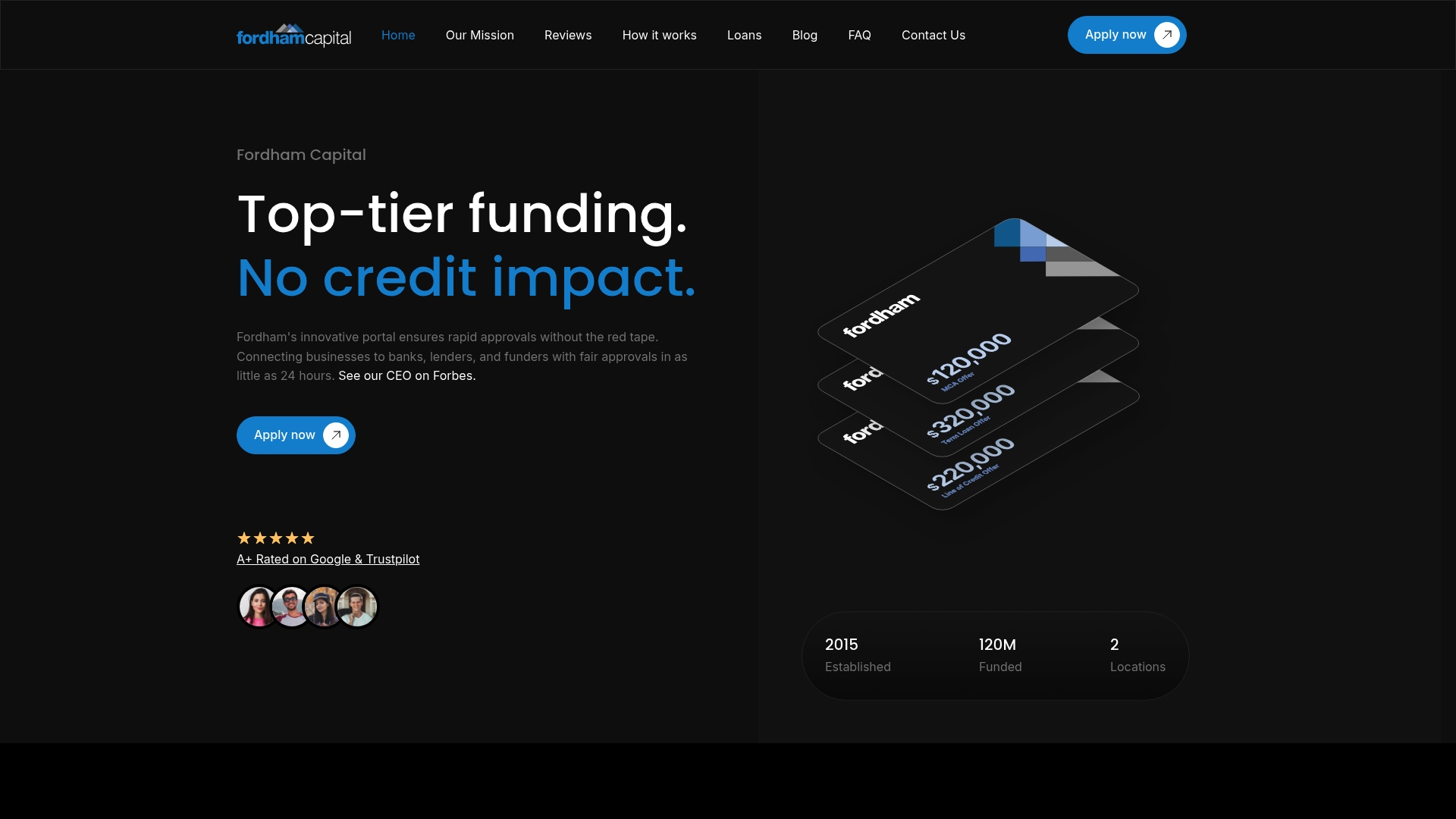
With an A+ BBB rating and over $120 million funded, Fordhamcapital has helped businesses across the country access the working capital they need to grow. The platform is built specifically for small and medium-sized businesses that traditional banks often overlook, offering SBA loans, business lines of credit, and working capital financing through one streamlined process. Clients who’ve come through the platform have collectively generated more than $500 million in revenue.
If you’ve worked through the decision framework in this article and you’re ready to explore your debt financing options without the friction of a traditional bank application, apply now and get a decision within 24 hours.
These sources back the claims in this article and are worth bookmarking for deeper research:
At Fordham Capital, we've made the application process straightforward and reassuring. Dive in and explore your financial options with confidence, knowing there's no impact on your credit score and no obligations. We review your details and offer customized solutions based on what you're looking for.