Traditional lenders deny entrepreneurs for three core reasons: conservative underwriting models built for stable, established businesses, documentation gaps that trigger automated rejections, and backward-looking credit scoring that penalizes growth. If you were just denied, the single best first step is to request your Adverse Action notice, which gives you the written explanation you are legally entitled to receive.
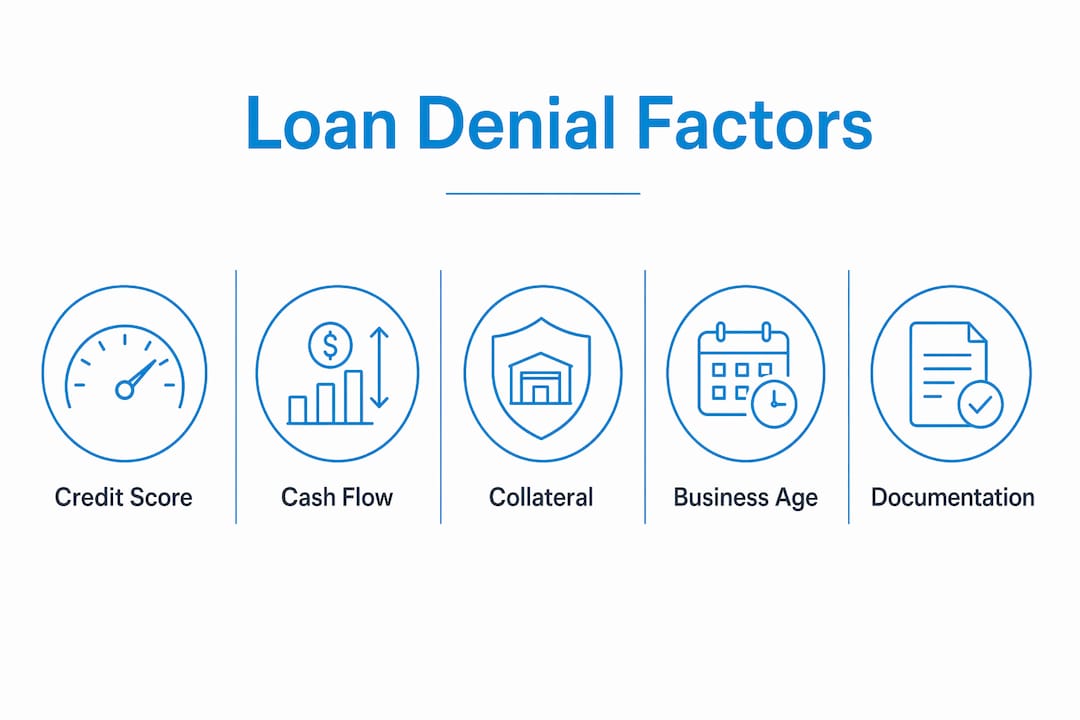
The top denial triggers, in order of frequency:
Banks are not built to fund entrepreneurs. Their underwriting models were designed for predictable, asset-heavy businesses with multi-year track records, and most small businesses simply do not fit that profile. Bank underwriting remains backward-looking, relying on tax returns and historical balance sheets rather than real-time cash flow or growth trajectory.
Most traditional banks use a hard credit score gate, often 680 or higher, before a human reviewer ever sees your file. A score below that threshold triggers an automated decline. Even a score in the low 700s can hurt you if there are recent derogatory marks, high utilization, or a thin credit file.
Cash flow is the single metric lenders care about most, because it tells them whether you can make payments. The problem for entrepreneurs is that tax returns, not bank statements, are the primary document most banks use. A fast-scaling business that reinvests heavily can appear unprofitable on paper even when real-time cash flow is strong.

Traditional lenders want security. If the loan amount exceeds the liquidation value of your assets, they face unacceptable risk. Many service businesses, software companies, and early-stage operators simply do not have enough hard assets to pledge.

Most banks require at least two years of operating history. Startups and businesses under two years old represent the highest-risk segment in a bank’s portfolio, so they are routinely declined regardless of revenue or growth rate.
Missing a single tax return, having bank statements that do not reconcile with your P&L, or listing an address that does not match your IRS records can trigger a rejection before underwriting even begins. These are fixable errors, but they are surprisingly common.
Restaurants, construction firms, cannabis-adjacent businesses, and highly seasonal operations face elevated scrutiny. Some banks have internal policies that restrict lending to certain SIC codes entirely, regardless of the individual business’s financial health.
Multiple short-term debt obligations, especially from merchant cash advances or online lenders, signal poor cash management to a bank. Lenders see loan stacking as a structural risk and often decline applications from businesses carrying several high-frequency payment obligations, even when those payments are current.
A loan request that says “general working capital” with no supporting projections raises red flags. Lenders want to see exactly how the money will be used, how it generates return, and how you plan to repay it. Weak or overly optimistic projections undermine the entire application.
Pro Tip: Before submitting any application, pull your own business credit report from Dun & Bradstreet, Equifax Business, or Experian Business. Errors on business credit files are more common than most owners realize, and they can kill an application at the automated screening stage.
Understanding the loan approval factors lenders use lets you audit your own application before submitting it. Here is what a typical bank underwriter reviews:
Documents you need to have ready:
Common underwriting thresholds:
| Factor | Typical Bank Threshold | How Rigid |
|---|---|---|
| Personal credit score | 680+ | Very rigid; hard gates common |
| Time in business | 2 years minimum | Rigid at most banks |
| DSCR | ~1.25x or higher | Moderate; varies by lender |
| Collateral coverage | — | Varies by loan type |
| Debt-to-income ratio | Below 43–50% | Moderate; context-dependent |
The SBA requires a Debt Service Coverage Ratio of approximately 1.25x, meaning your net operating income must be at least 25% higher than your total debt payments. SBA lenders also apply the “credit elsewhere” rule: they must document that you cannot obtain financing on reasonable terms from a conventional lender before approving an SBA-backed loan.
Pro Tip: Self-employed owners and sole proprietors should know that bank-statement underwriting, which some specialty lenders use instead of tax returns, can show a much stronger income picture. Bank-statement loan programs evaluate 12–24 months of deposits rather than adjusted taxable income, which is often far lower.
Fixing a denial is not always fast, but it is almost always possible. Here is a prioritized action plan with realistic timelines.
What you can fix in 7–30 days:
What takes 3–12 months:
Application packaging tips:
Pro Tip: If you need bridge capital while you repair your profile, startup bridge loans can cover short-term gaps without requiring the same underwriting depth as a term loan. Use them carefully — adding more debt while repairing your profile can worsen your DSCR.
Denial is not the end of the road. The first 30 days after a rejection are the most important.
Immediate action checklist:
Your legal rights after denial:
Under federal law, lenders must provide an Adverse Action notice when they decline a loan application. If you did not receive one automatically, you have 60 days to request a written explanation. That notice must state the specific reasons for the denial. This is not optional for lenders — it is a federal requirement, and it gives you a concrete starting point for fixing the problem.
Timing guidance for reapplying:
A key distinction that most entrepreneurs miss: being denied by one bank does not mean you are unfinanceable. It often means you applied to the wrong type of lender. Choosing the right lender for your specific situation is as important as fixing your financials.
Not every business belongs in a bank loan. Here is a plain-language map of the main alternatives and when each one makes sense.
SBA 7(a) and CDC/504 loans: Government-backed, lower rates, but slower (weeks to months) and still require solid documentation. Best for established businesses that nearly qualify for a conventional loan but need a guarantee to get approved.
CDFIs (Community Development Financial Institutions): Mission-driven lenders that serve underserved markets and accept more risk than banks. The Federal Reserve documents meaningful differences in approval behavior between CDFIs and traditional banks. Good fit for businesses in low-income areas or minority-owned businesses that face structural barriers.
Online nonbank term loans: Faster decisions (24–72 hours), but higher cost. These lenders use bank statements and revenue data rather than tax returns, which helps businesses with strong cash flow but weak tax-return income.
Invoice financing and factoring: If your denial was driven by low DSCR but you have solid receivables, invoice financing converts outstanding invoices into immediate cash. You are not borrowing against future revenue — you are accelerating cash you are already owed.
Merchant cash advances (MCAs): Fast, but expensive. MCAs use factor rates rather than APRs, which can obscure the true cost. A factor rate of 1.4 on a $50,000 advance means you repay $70,000, often in daily or weekly deductions. Use only for short-term gaps with a clear repayment path.
Business lines of credit: More flexible than term loans and useful for working capital gaps. Approval is still credit-dependent, but some nonbank lenders offer lines based on revenue rather than credit score.
HELOC or personal loans: Using home equity or personal credit to fund a business is a last resort, but it is an option when business credit is unavailable. The risk is personal: your home or personal credit is on the line.
Equity financing (angels and VC): Appropriate for high-growth businesses willing to give up ownership. Not a loan, so there is no repayment pressure, but you are selling a piece of your company.
Grants: Slow and competitive, but free money. Grants.gov lists federal grant programs; many states and municipalities also offer small business grants. Worth pursuing in parallel with other funding.
Pro Tip: When comparing nonbank options, always convert factor rates to an annualized APR equivalent before deciding. A factor rate that looks modest can translate to an effective APR of 40–150% depending on the repayment term. The Federal Reserve notes that nonbank financing disclosures differ from traditional APR disclosures, making direct comparisons harder.
When-to-use summary:
| Scenario | Best Alternative |
|---|---|
| Strong receivables, low DSCR | Invoice financing or factoring |
| Pre-revenue or early stage | Grants, angel equity, or CDFI |
| Short-term working capital gap | Line of credit or MCA (with caution) |
| Equipment purchase | SBA 504 or equipment financing |
| Scaling fast, reinvesting heavily | Online term loan or marketplace lender |
The scale of the problem is larger than most entrepreneurs realize. In 2024, only 41% of applicants received all the financing they sought; 36% received some; and 24% received none at all. For SBA loan or line of credit applicants specifically, the denial rate reached 45% in 2024 versus a 21% rate across all financing types.
The SBA’s “credit elsewhere” rule is a practical hurdle many entrepreneurs do not know about. Before an SBA lender can approve a guaranteed loan, they must document that the borrower cannot obtain financing on reasonable terms from a conventional source. This means SBA loans are not a shortcut around bank underwriting — they are a safety net for businesses that have already been turned down by conventional lenders.
Key federal protections to know:
The FDIC and CFPB both publish guidance on lender obligations around denial disclosures. Knowing these rights puts you in a stronger position when you reapply or escalate a dispute.
Most entrepreneurs assume that a business loan is evaluated purely on business performance. For established corporations with deep credit histories, that may be true. For small businesses and startups, personal credit is often the first filter a lender applies.
Banks typically require a personal guarantee from any owner holding 20% or more of the business. That guarantee is backed by your personal credit profile. A low personal score, recent late payments, a bankruptcy in the past 7 years, or high personal debt utilization can override strong business financials entirely.
The separation between personal and business credit matters most when your business has its own established credit profile, meaning years of trade lines, a DUNS number, and a Paydex score from Dun & Bradstreet. Until that profile is built, your personal FICO score is the primary underwriting signal. Funding without strong credit is possible, but it typically means accepting higher rates or nonbank terms.
Debt-to-income ratio (DTI) measures your total monthly debt obligations against your gross monthly income. For business loans, lenders often calculate a version of this using business revenue and existing debt service. A DTI above 43–50% is a common soft threshold where approvals become difficult.
The challenge for entrepreneurs is that DTI captures all debt, including personal obligations like a mortgage, car payments, or student loans. A business owner with a profitable company but a high personal mortgage can be denied because the combined debt load looks unsustainable to a lender.
DTI and DSCR are related but distinct. DSCR measures whether your business income covers its debt payments; DTI measures whether your total income (personal and business) covers all obligations. Both matter, and a weakness in either one can sink an otherwise strong application.
Bank lending is not static. When interest rates rise, banks tighten credit standards because the cost of a bad loan increases. When regulators increase capital requirements, banks become more selective about which loans they put on their books. Neither of these factors has anything to do with your business, but both directly affect whether you get approved.
Industry analysis shows that approval rates have tightened even for qualified applicants in recent years. Banks are not just being cautious about weak applications — they are being cautious across the board. This is why diversifying across lender types is a practical necessity, not just a fallback.
Smaller community banks and credit unions tend to have more flexibility than large national banks. They often use relationship-based underwriting, meaning a conversation with a loan officer can carry real weight. If you have been denied by a large bank, a community bank or CDFI may evaluate your application differently using the same underlying financials.
Business credit and personal credit are scored differently and reported by different agencies. Dun & Bradstreet’s Paydex score, Experian Business, and Equifax Business each maintain separate files. Most small businesses have thin or nonexistent business credit profiles, which pushes lenders back to personal credit as the primary signal.
Steps to build business credit from scratch:
Building a meaningful business credit profile takes 12–24 months of consistent activity. There are no shortcuts, but the payoff is significant: a strong business credit profile reduces your dependence on personal credit and opens access to better terms over time.
“A strong revenue number is enough.” Revenue without profitability or consistent cash flow does not satisfy a bank’s underwriting requirements. Lenders care about what is left after expenses, not the top line.
“SBA loans are easier to get.” SBA loans carry a government guarantee, but the underwriting is still rigorous. The denial rate for SBA applicants in 2024 was 45%, higher than the overall average.
“I can explain everything in the meeting.” Most loan decisions are made before you ever speak to a decision-maker. Your documents do the talking. A weak application package rarely gets rescued by a good conversation.
“Applying to multiple banks improves my odds.” Multiple hard credit inquiries in a short window can lower your credit score and signal desperation to lenders. Apply strategically, not broadly.
“My accountant’s projections will carry the application.” Projections matter, but they carry weight only when they are grounded in historical performance. A projection that shows 300% growth with no historical basis is a red flag, not a selling point.
“Denial means my business is not fundable.” It usually means you applied to the wrong lender type, had a documentation gap, or have a fixable metric. Most denials are not permanent verdicts.
Traditional loan denials are almost always diagnosable and often fixable once you know which specific factor triggered the rejection.
| Point | Details |
|---|---|
| Request your Adverse Action notice | Federal law gives you 60 days to request a written denial reason — use it before doing anything else. |
| DSCR and credit score are the top gates | Most banks require a DSCR of ~1.25x and a personal credit score of 680+; falling short of either triggers early rejection. |
| Documentation errors are fixable fast | Missing or inconsistent documents can be corrected and resubmitted within 30 days; structural issues take 3–12 months. |
| Alternatives exist for most denial scenarios | Invoice financing, CDFIs, online term loans, and SBA programs each fit different situations when bank loans are not the right match. |
| Fordhamcapital connects denied businesses to lenders | Fordhamcapital’s marketplace matches businesses that do not fit the bank box to a network of banks and alternative lenders with a one-page application and no credit impact. |
The honest truth about why entrepreneurs get denied traditional loans is that banks were never designed to fund them. The underwriting model that works for a 20-year-old manufacturing company with real estate collateral and stable annual revenue is a poor fit for a three-year-old service business growing at 40% a year. The bank sees volatility; the entrepreneur sees momentum. Those two perspectives rarely reconcile inside a traditional credit box.
What frustrates me most is how many good businesses get filtered out at the automated screening stage, before a human ever looks at the file. A mismatched address, a missing tax return, a credit score that is 15 points below a hard threshold — none of these things reflect the actual health of the business. They reflect the limitations of a system built for a different era.
The rise of marketplace lending is a direct response to this gap. When a single platform can submit your profile to dozens of lenders simultaneously, including CDFIs, nonbank term lenders, and SBA-preferred lenders, the odds of finding a match improve dramatically. That is not a workaround. For most small businesses, it is the most rational first step. The private credit market has also matured considerably; concerns about nonbank lending are often overstated, as private credit myths tend to reflect outdated assumptions rather than current market reality.
The businesses that get funded are not always the strongest ones. They are the ones that applied to the right lender with the right documentation at the right time.
If you have been denied by a traditional lender, or you want to avoid the credit hit of multiple bank applications, Fordhamcapital offers a direct alternative. The platform connects small and medium-sized businesses to a wide network of banks and alternative lenders through a single one-page application that does not affect your credit score.
Approvals come back within 24 hours in many cases. Fordhamcapital has funded over $120M and holds an A+ BBB rating, with clients generating more than $500M in revenue through capital accessed via the platform. There is no collateral requirement to apply, and the process is built specifically for businesses that traditional banks overlook.
Apply now and find out which lenders in the network match your profile. Have your last 3 months of bank statements and basic business information ready — that is typically all you need to get started.
The sources below are the primary references used in this article. Each one is worth bookmarking if you are navigating a denial or preparing to reapply.
This article is general information, not financial or legal advice. Loan eligibility, rates, and program rules change frequently — confirm current requirements with the relevant lender, the SBA, or a qualified financial professional before making decisions for your specific situation.
At Fordham Capital, we've made the application process straightforward and reassuring. Dive in and explore your financial options with confidence, knowing there's no impact on your credit score and no obligations. We review your details and offer customized solutions based on what you're looking for.