
If you’re a small business owner who’s been turned down by a bank, has limited time to shop lenders, or needs funding fast, a business loan broker is probably worth your time. The single next step: get a free broker consultation or submit a one-page application through a marketplace like Fordhamcapital before spending hours applying to lenders individually.
Two facts worth knowing upfront:
If you want help right now, apply through Fordhamcapital and get matched to lenders without affecting your credit score.
A business loan broker is worth using when speed, lender access, or application complexity outweighs the cost of their fee — but only if you verify their credentials and demand written fee disclosure upfront.
| Point | Details |
|---|---|
| Broker vs. direct | Use a broker for speed and lender access; apply direct when credit is strong and you have a bank relationship. |
| Fee transparency | Always get written fee disclosure and a sample term sheet before submitting any documents. |
| Verify credentials | Check broker licenses via NMLS Consumer Access and disciplinary records via FINRA BrokerCheck. |
| SBA programs | SBA 7(a), CDC/504, and Microloans offer the lowest long-term rates; use SBA Lender Match for free matching. |
| Fordhamcapital | Fordhamcapital offers a one-page application, approvals in as little as 24 hours, and has funded over $120M across its SMB network. |
A business loan broker, also called a commercial loan advisor or business funding agent, is an intermediary. They connect borrowers to lenders but do not lend money themselves. The distinction matters more than most borrowers realize.
What a broker does:
What a broker does NOT do:
Broker types range from marketplace platforms (which use technology to match borrowers to dozens of lenders simultaneously) to specialist brokers focused on SBA loans, equipment financing, invoice factoring, or merchant cash advances. Some brokers hold licenses under the NMLS Consumer Access system, particularly those handling mortgage-adjacent commercial products. Always verify credentials before sharing financial documents.
SBA Lender Match is a free government-run matching tool that functions similarly to a broker for SBA-specific programs. It’s not a broker, but it’s worth knowing about as a no-cost alternative.
The typical workflow runs in five stages, and the whole thing can take anywhere from 24 hours to several months depending on the loan type.
For a detailed walkthrough of what lenders look for at each stage, the business funding application guide covers the process step by step.
Documents to prepare before your first broker call:
Pro Tip: Organize these documents in a shared folder before your first broker call. Brokers who can submit a complete package move faster, and lenders prioritize complete files.
The right broker type depends almost entirely on what you need the money for and how quickly you need it.
NMLS licensing applies primarily to brokers handling commercial mortgage products. For business-purpose loans, licensing requirements vary by state, so check your state’s financial regulator and verify any broker’s credentials through NMLS Consumer Access before proceeding.
Most business loan brokers earn a placement fee or origination fee, paid either by the lender, the borrower, or both. The fee model directly affects your total loan cost, so ask about it before you share a single document.
| Fee model | Who pays | Typical range | When it applies |
|---|---|---|---|
| Lender-paid placement fee | Lender | 1%–3% of loan amount | Most marketplace and SBA brokers |
| Borrower-paid origination fee | Borrower | 1%–5% of loan amount | Specialty and MCA brokers |
| Success fee | Borrower | Flat or % at closing | Common in larger commercial deals |
| Retainer / upfront fee | Borrower | $500+ | Red flag unless scope is clearly defined |
Lender-paid fees are the norm for SBA and marketplace brokers. You don’t write a check, but the fee is often baked into the loan’s rate or origination costs. Borrower-paid fees are more common in niche products like MCAs and invoice factoring.
Written disclosures to demand before signing anything:
Fees are sometimes negotiable, particularly on larger loans or when you have strong financials. A broker who refuses to provide written fee disclosure before you submit an application is not worth your time. According to guidance on business loan brokers, transparency about compensation is one of the clearest signals of a trustworthy broker.
The clearest pro: access to more lenders than you’d find on your own, faster. The clearest con: an extra layer of cost and, in some cases, a broker whose incentives don’t fully align with yours.
Pros:
Cons:
When the pros outweigh the cons: You’re time-constrained, have been declined by your bank, need SBA guidance, or have credit challenges that require a broker who knows which alternative lenders to approach. For businesses with low credit scores, a broker or marketplace that includes alternative lenders can meaningfully expand your options, though those options often carry higher rates.
When to skip the broker: Your credit is strong, you have an existing bank relationship, and you’re not in a hurry. Applying direct to your bank or through SBA Lender Match costs nothing in broker fees.
On scams: Legitimate brokers never charge large upfront fees before doing any work, never guarantee approval, and never pressure you to sign quickly. If a “broker” asks for $1,000+ before submitting a single application, walk away.
The single most important criterion is transparency about compensation and lender relationships. A broker who won’t tell you how they’re paid before you apply is not a broker you want handling your financial documents.
Selection checklist:
Exact questions to ask on your first call:
Red flags to walk away from:
For a deeper look at evaluating lenders and brokers together, the lender selection guide covers the criteria worth weighing.
Direct channels and when they fit:
Applying direct saves the broker fee and keeps you in direct communication with the lender. The tradeoff is time and effort: you’re doing the research, comparison, and follow-up yourself.
The fastest channel is a marketplace or online lender; the slowest is an SBA CDC/504 loan. Here’s a realistic breakdown:
| Loan type | Approval timeline | Funding after approval |
|---|---|---|
| Merchant cash advance | very fast approval and funding times | |
| Online term loan | generally fast approval and funding times | |
| Equipment loan | relatively quick approval and funding times | |
| SBA 7(a) standard | longer approval and funding times due to underwriting complexity | |
| SBA CDC/504 | extended approval and funding times due to thorough processing | |
| SBA Microloan | comparatively longer approval and funding times |
Tips to shorten your timeline:
Using a broker can speed up the matching phase but adds a coordination layer during underwriting. The loan approval speed guide covers additional tactics for cutting days off the process.
These are illustrative calculations only. Actual payments depend on the lender’s terms, your credit profile, and any fees included.
| Scenario | Rate | Term | Est. monthly payment | Notes |
|---|---|---|---|---|
| Short-term online loan | 24% APR | 24 months | ~$2,650 | Higher rate, faster funding |
| Mid-term bank/SBA preferred | 10% APR | 60 months | ~$1,062 | Moderate rate, standard docs |
| SBA 7(a) long-term | 7% APR | 120 months | ~$581 | Lowest rate, longest process |
Broker fees, when borrower-paid, effectively increase your APR. Always ask the broker to show you the all-in cost, including their fee, before comparing offers.
These figures are illustrative only. Confirm exact payments and total costs with your lender before signing.
Use a broker if you’re short on time, have been declined before, or need help navigating SBA paperwork. Apply direct if you have strong credit, an existing bank relationship, and a clear loan type in mind.
By borrower profile:
Most articles about business loan brokers spend their energy explaining what brokers do. The more useful conversation is about what brokers don’t tell you.
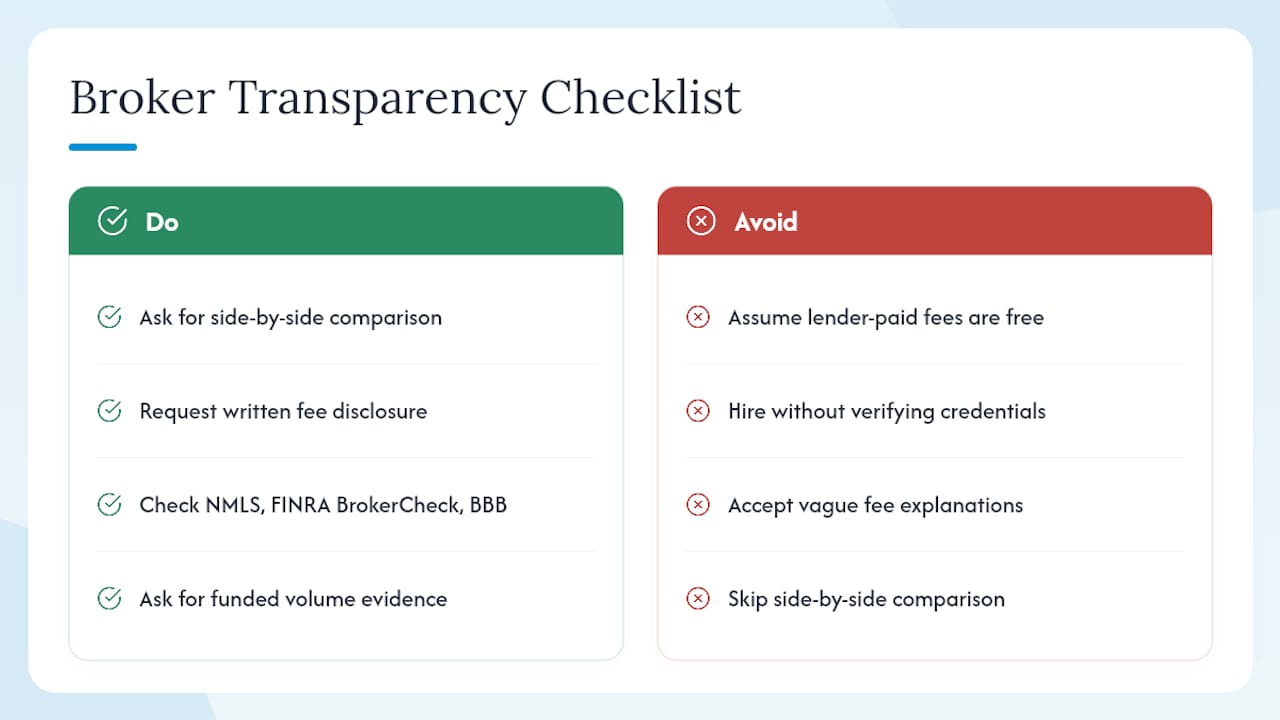
The fee model is the clearest example. Lender-paid fees sound free to the borrower, but they’re not. When a lender pays a broker 2–3% of your loan amount, that cost is recovered somewhere in your rate or origination charges. You’re paying it; it’s just not labeled as a broker fee on your term sheet. The only way to know the true all-in cost is to ask for a side-by-side comparison of the same loan product from the same lender, with and without the broker’s involvement. Most brokers won’t offer that comparison unprompted.
The second thing worth naming: broker quality varies more than almost any other financial services category. There’s no universal federal licensing standard for business loan brokers the way there is for mortgage brokers. That means the person calling themselves a “commercial loan advisor” might have deep SBA expertise and a decade of funded deals, or they might have set up a website last month. The verification steps in this article (NMLS, FINRA BrokerCheck, BBB, written fee disclosure, funded volume) aren’t optional extras. They’re the minimum.
That said, a good broker is genuinely valuable. For a business owner who’s been declined by two banks, doesn’t know which SBA program fits, and can’t spend 20 hours researching lenders, a broker who knows the market and presents three real competing offers is worth the fee. The key is knowing exactly what you’re paying and why.
For small business owners who want competing loan offers without spending days researching lenders, Fordhamcapital is a faster path. The platform connects SMBs to a network of banks and alternative lenders through a single one-page application, with approvals in as little as 24 hours and no impact to your credit score.
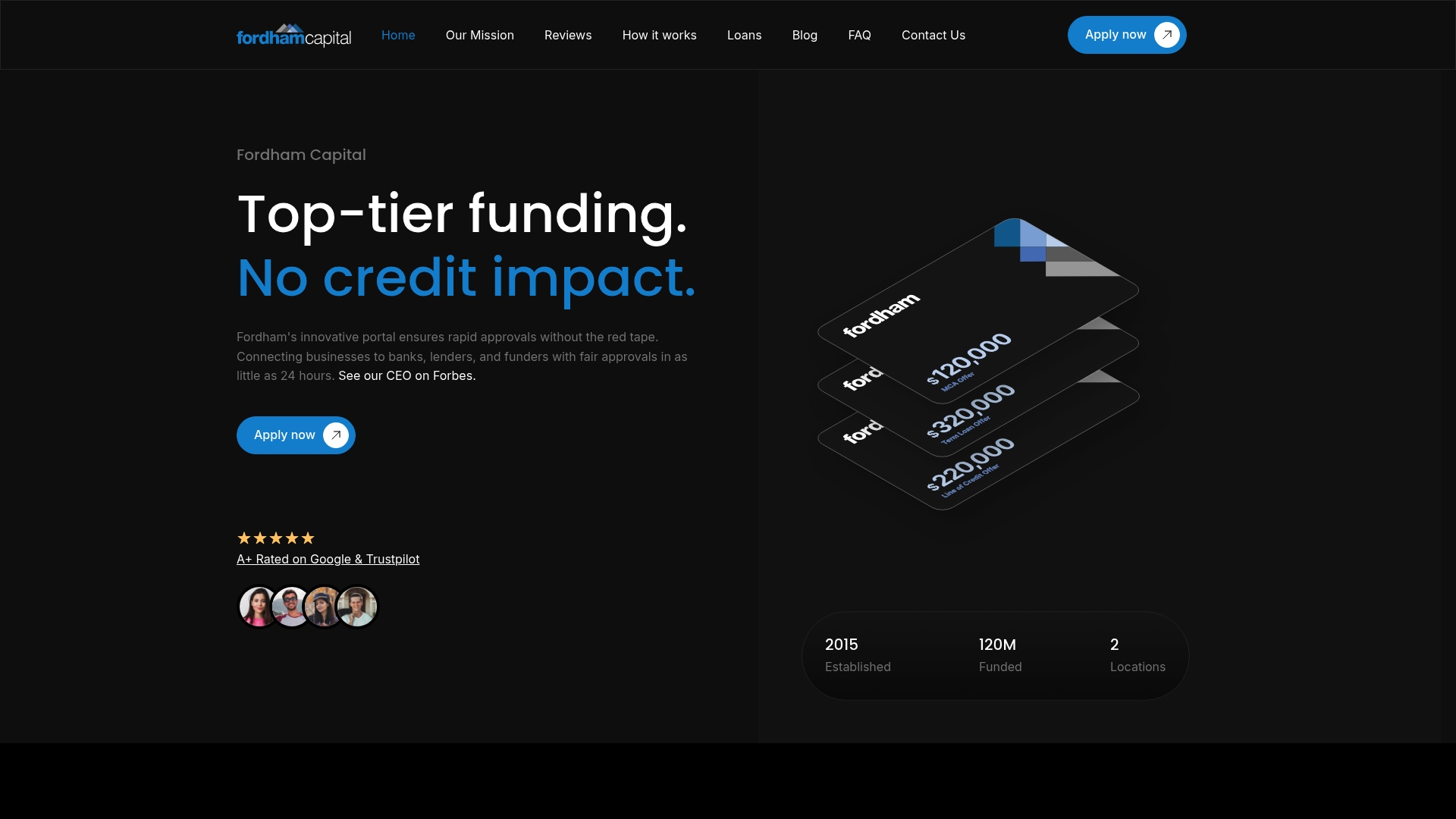
Fordhamcapital holds an A+ BBB rating, has funded over $120 million, and has helped clients generate more than $500 million in revenue. The model is straightforward: you apply once, the platform matches you to lenders that fit your profile, and you compare real offers before committing to anything. No collateral required to apply.
Start your application at Fordhamcapital and get matched to lenders today.
This article is general information, not financial or legal advice. Confirm current program terms and eligibility with the SBA, your lender, or a qualified financial professional before applying.
Before working with any broker, request written fee disclosure and a sample term sheet. If they won’t provide both before you submit documents, find a different broker.
At Fordham Capital, we've made the application process straightforward and reassuring. Dive in and explore your financial options with confidence, knowing there's no impact on your credit score and no obligations. We review your details and offer customized solutions based on what you're looking for.